
You have the sleuth (a retired librarian with a nosy cat), the village, the victim and the bakery where everyone gossips. Now you need an outline, and the outline needs a number: how long is one chapter? I counted every chapter in all ten Agatha Christie novels now in the US public domain, including Miss Marple’s first case, and turned the result into a chapter planner you can run.
Type “how many chapters in a cozy mystery” into Google and the suggestions include “how many words per chapter in a cozy mystery”, next to “how many chapters should a cozy mystery have” and “how many words in a cozy mystery chapter” (suggestions I pulled on October 18, 2026).
Here is the short answer: about 2,200 words per chapter, and anything from roughly 1,300 to 3,600 is normal. That gives a 60,000 to 70,000-word cozy about 28 to 32 chapters. The longer answer: the chapters should not all be the same length, and the data shows where they get shorter.
TL;DR
- I counted all 283 chapters in the 10 Agatha Christie novels now in the US public domain (1920-1930): median 2,208 words, 80% between 1,288 and 3,639.
- The Murder at the Vicarage, Miss Marple’s first case (public domain since January 1, 2026): 32 chapters, 70,257 words, median 2,176.
- The body turns up in chapter 5: 14% into the Vicarage, 18% into Roger Ackroyd. In 8 of 10 books the last quarter has shorter chapters.
- Cozy publishers set book length, not chapter length: Tule caps cozies at 60k, Gemma Halliday wants 60-80k.
- Plan it: 60,000 words / 2,200 per chapter = 28 chapters, about 8.5 minutes each at 260 wpm.
What cozy publishers ask for (total length)
No publisher I checked sets a chapter length. They set a book length, and the chapter count follows from that:
- Tule Publishing‘s mystery imprint caps cozies at “No more than 60k words” (its general mystery line allows 70k). Note that Tule says it is currently closed to non-agented submissions, with its schedule “full into 2028.”
- Gemma Halliday Publishing, which publishes “in the cozy mystery and humorous romantic mystery genres only,” asks for 60,000-80,000 words.
- Crooked Lane Books, which lists “Cozy” among its genres, wants 60,000 to 100,000 words.
- Joffe Books asks for a full manuscript with a “minimum 60,000 word count” and names “cosy crime” among its favourite genres.
So the realistic target is 60,000 to 80,000 words. For chapter length you need a different source, so I went to the author who set the template for the village mystery.
Why Christie, and why now
On January 1, 2026, works from 1930 entered the US public domain. Duke’s Center for the Study of the Public Domain lists among the highlights “Agatha Christie, The Murder at the Vicarage (the first novel featuring Miss Marple).” Project Gutenberg released it on March 16, 2026, marked “Public domain in the USA.”
That puts all ten Christie novels from 1920 to 1930 on Project Gutenberg, from The Mysterious Affair at Styles to the Vicarage. Not all ten are cozies. The Secret Adversary and The Seven Dials Mystery are closer to thrillers. But the two village murders, Roger Ackroyd and the Vicarage, are the blueprint the modern cozy still follows: a closed community, an amateur or a polite outsider asking questions, and no gore on the page.
The script finds each chapter heading in the Gutenberg text (the formats differ from book to book, so each book gets its own pattern), skips the table of contents, and counts the words between headings. Prologues are left out of the chapter counts.
# christie.py - how many words per chapter in a cozy mystery? (checked October 18, 2026)
import re, statistics as st

def words(text):
    text = text.replace("\u2014", " ").replace("--", " ").replace("_", "")
    return sum(1 for t in text.split() if re.search(r"[A-Za-z0-9]", t))

def chapters(gid, rx):
    lines = open(f"src/pg{gid}.txt", encoding="utf-8-sig").read().splitlines()
    start = next(i for i, l in enumerate(lines) if l.startswith("*** START"))
    end = next(i for i in range(start + 1, len(lines)) if END_RE.match(lines[i]))
    hits = {}
    for i in range(start, end):
        m = re.match(rx, lines[i])
        if m:
            g = m.group(1); n = int(g) if g.isdigit() else roman(g)
            hits[n] = i                    # last occurrence = body heading (TOC comes first)
    idx = [hits[k] for k in range(1, max(hits) + 1)]
    assert idx == sorted(idx)
    bounds = idx + [end]
    return [words("\n".join(lines[a + 1:b])) for a, b in zip(bounds, bounds[1:])]
ALL: 283 chapters | median 2,208 | mean 2,395 | p10 1,288 | p90 3,639 | total 677,714
in 2,000-3,000: 107 of 283 | under 1,000: 11 | over 4,000: 17
| Year | Novel | Sleuth | Chapters | Words | Median words/chapter | Shortest-longest |
|---|---|---|---|---|---|---|
| 1920 | The Mysterious Affair at Styles | Poirot | 13 | 56,875 | 4,036 | 2,189-8,017 |
| 1922 | The Secret Adversary | Tommy & Tuppence | 28 | 74,974 | 2,492 | 1,062-5,214 |
| 1923 | The Murder on the Links | Poirot | 28 | 64,798 | 2,240 | 1,185-3,371 |
| 1924 | The Man in the Brown Suit | Anne Beddingfeld | 36 | 73,934 | 1,889 | 983-3,740 |
| 1925 | The Secret of Chimneys | Superintendent Battle | 31 | 74,839 | 2,408 | 571-3,708 |
| 1926 | The Murder of Roger Ackroyd | Poirot | 27 | 70,148 | 2,555 | 875-4,572 |
| 1927 | The Big Four | Poirot | 18 | 55,829 | 2,885 | 1,463-4,632 |
| 1928 | The Mystery of the Blue Train | Poirot | 36 | 70,247 | 1,826 | 542-3,460 |
| 1929 | The Seven Dials Mystery | Bundle & Battle | 34 | 65,813 | 1,916 | 436-3,465 |
| 1930 | The Murder at the Vicarage | Miss Marple | 32 | 70,257 | 2,176 | 549-4,038 |
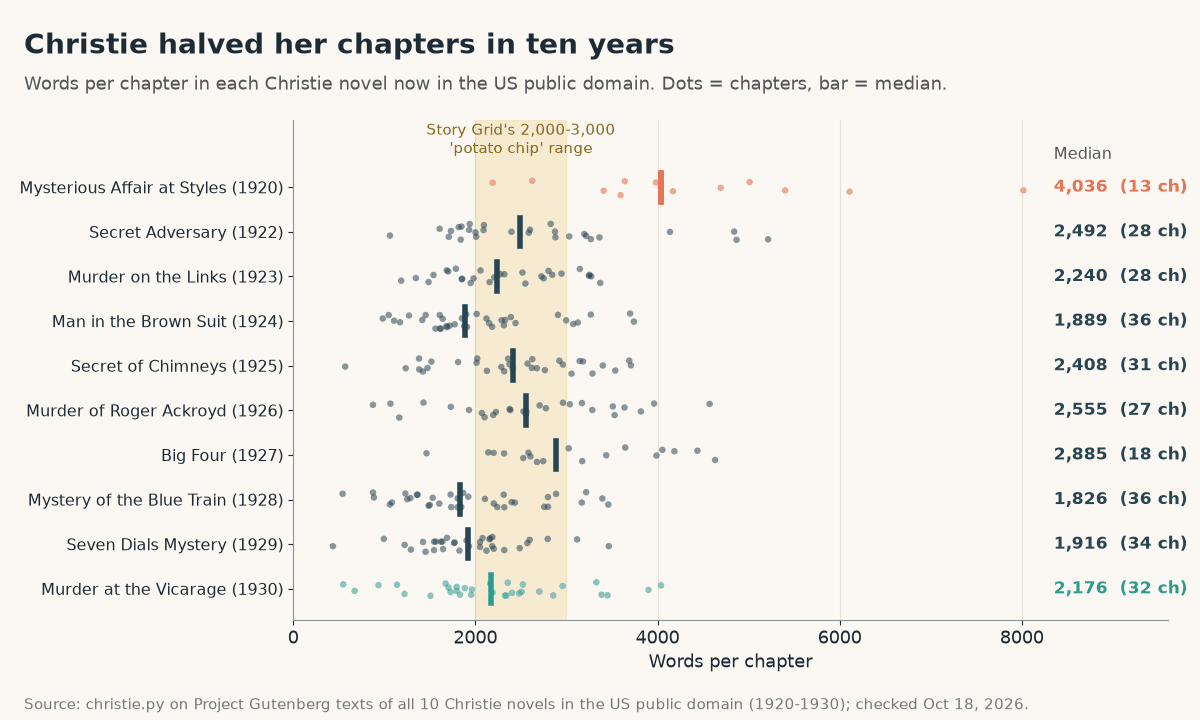
Three things stand out:
- The median chapter is 2,208 words, and 80% of all 283 chapters fall between 1,288 and 3,639.
- Christie got shorter fast. Her debut, Styles, has 13 chapters with a median of 4,036 words. Ten years later the Vicarage has 32 chapters with a median of 2,176. A longer book (70,257 words against 56,875) with more than twice as many chapter breaks.
- Variety is the norm. Only 107 of 283 chapters (38%) land in the 2,000-3,000 band that Story Grid calls “potato chip length”. Eleven are under 1,000 words; seventeen run past 4,000.
Inside Miss Marple’s first case
Averages hide the shape. Here is the Vicarage, one bar per chapter:
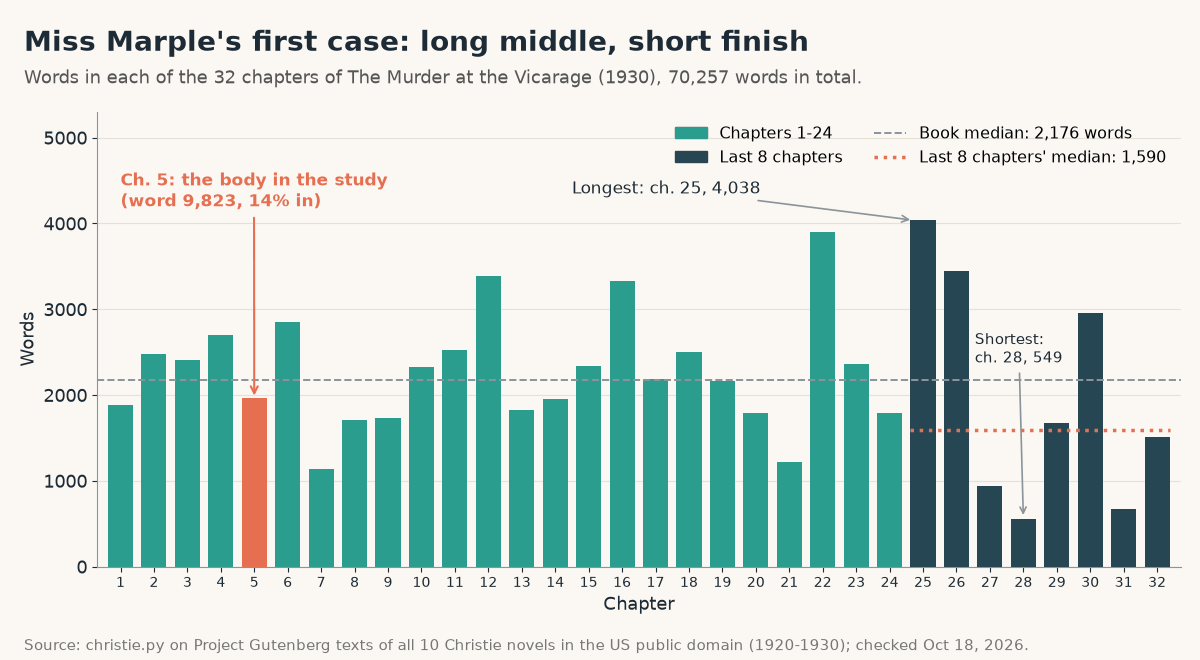
Two patterns are worth copying.
The body arrives early. The vicar finds Colonel Protheroe “lying sprawled across my writing table” in chapter 5 of 32, at word 9,823: 14% into the book. In The Murder of Roger Ackroyd, the door to Ackroyd’s study is broken down in chapter 5 of 27, 18% in. In both books, four full chapters of set-up come first, then the corpse.
The finish gets choppy. The last eight chapters of the Vicarage have a median of just 1,590 words, against 2,176 for the book. They are not uniformly short: chapter 25 is the longest in the book (4,038 words), and chapter 28 is the shortest (549). Long chapter, short chapter, long chapter: the pace jumps around. Across all ten novels, the last quarter of chapters has a lower median than the book as a whole in 8 of 10.
How Christie compares with other novels
Story Grid published average words per chapter for eight well-known novels. Here are seven of them next to Christie (I left out its own outlier, The Perks of Being a Wallflower, at 13,800). These are averages, so I use Christie’s averages too: 2,196 for the Vicarage and 2,395 across all 283 chapters.
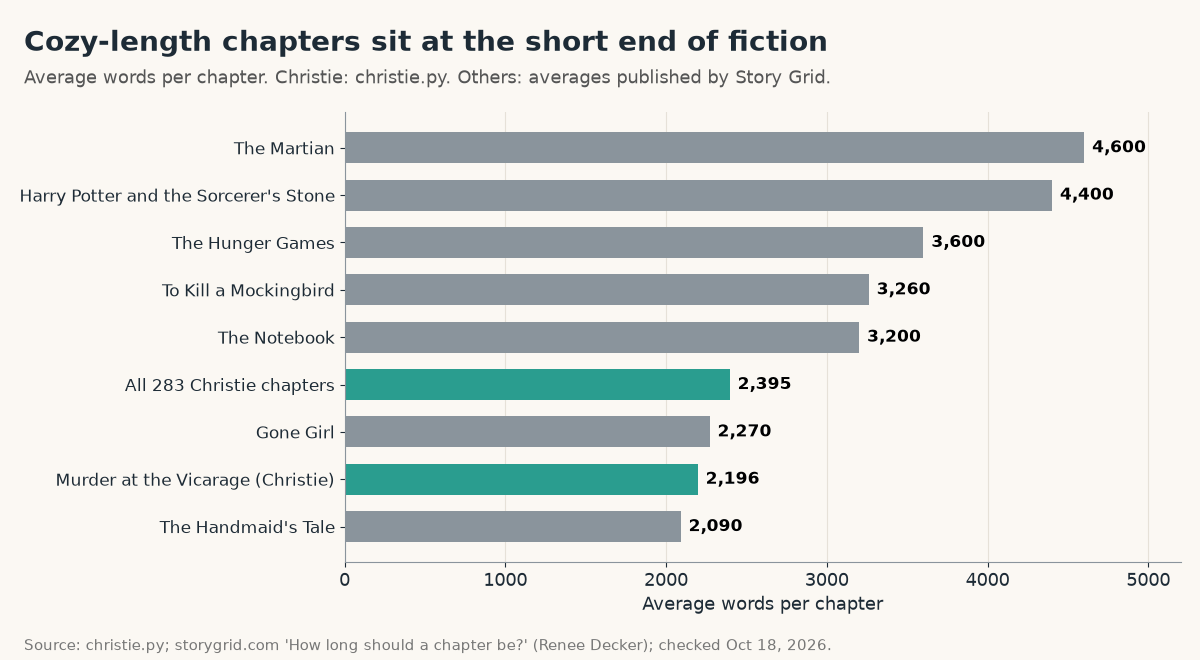
Christie sits with Gone Girl (2,270) and The Handmaid’s Tale (2,090) at the short end. The Martian and Harry Potter run about twice as long per chapter. Story Grid’s own note, “Thriller and crime novels tend to have smaller chapter word counts,” fits Christie’s numbers.
Short chapters fit how cozies are read: in a cup of tea, before bed. Marc Brysbaert’s 2019 review of reading rates puts adult silent reading of fiction at 260 words per minute. At that rate, a 2,208-word chapter takes 8.5 minutes, and the whole 70,257-word Vicarage about four and a half hours.
Plan your own chapter count
Turn the target book length and the chapter length into a chapter count with one function:
import math
FICTION_WPM = 260      # Brysbaert (2019), fiction

def plan(target_words, words_per_chapter):
    """Chapters needed and minutes per chapter for a cozy draft."""
    n = math.ceil(target_words / words_per_chapter)
    return dict(chapters=n, minutes=round(words_per_chapter / FICTION_WPM, 1))

for target in (60000, 70000, 80000):
    print(target, {w: plan(target, w) for w in (1800, 2200, 2500)})
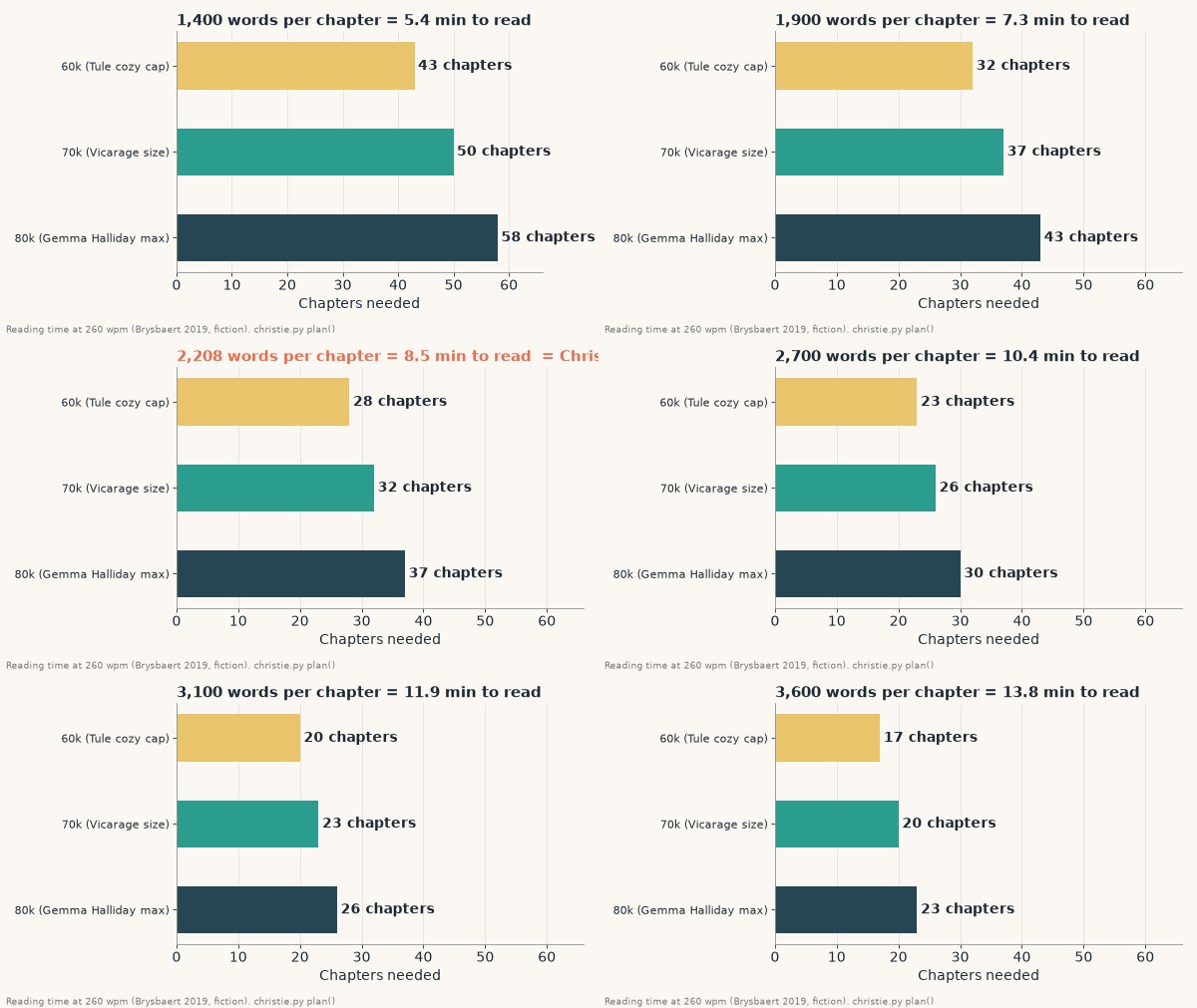
At Christie’s median, a 60,000-word cozy (Tule’s cap) needs 28 chapters. A 70,000-word cozy needs 32, which is exactly the Vicarage. An 80,000-word book (Gemma Halliday’s maximum) needs 37.
| Target words | Benchmark | At 1,800/chapter (6.9 min) | At 2,200/chapter (8.5 min) | At 2,500/chapter (9.6 min) |
|---|---|---|---|---|
| 55,000 | Short self-published cozy | 31 chapters | 25 chapters | 22 chapters |
| 60,000 | Tule Mystery cozy cap | 34 chapters | 28 chapters | 24 chapters |
| 70,000 | Vicarage size | 39 chapters | 32 chapters | 28 chapters |
| 80,000 | Gemma Halliday maximum | 45 chapters | 37 chapters | 32 chapters |
My take: pick 2,200 words as your outline’s planning unit, not as a rule. Let the opening chapters run a bit longer while you build the village, put the body in by about 15% of the way through, and let the last quarter speed up with shorter chapters.
Drafting chapter by chapter (and the AI rules)
A chapter-sized unit is also the right size for a writing session or a drafting prompt. Some tools that help:
- A spreadsheet outline, one row per chapter: suspect, clue, red herring, target words. Add a column for actual words and you can see your shape against the Vicarage.
- Reedsy Studio, a free writing app that organizes chapters and tracks writing goals.
- Sudowrite, an AI writing assistant for fiction, useful for drafting and rewriting single scenes.
- ImagineYourBook, an AI book-writing tool that turns a prompt or your notes into a ~10,000-word draft with Word and EPUB export: about four and a half Christie-length chapters, enough to test a premise and a sleuth’s voice before you commit to the full book.
If you go the API route for a full draft instead, I worked out that a 50,000-word novel draft costs $0.04 to $17 in tokens. And if you self-publish the series, the KDP royalty calculator shows why one cent past $12.99 matters.
One rule before you use any AI tool: under KDP’s content guidelines, text created by an AI tool counts as “AI-generated” and must be disclosed, “even if you applied substantial edits afterwards.” Using AI only to edit or error-check your own writing is “AI-assisted,” which you don’t have to disclose. (The Medium story Can Amazon Tell If Your Book Was Written by AI? covers the detection side.) For a mystery, the clue trail is the part to plan yourself: a draft that invents a clue in chapter 30 that was never planted in chapter 8 breaks the fair-play promise readers buy a cozy for.
What the numbers leave out
- Christie is one author, 1920 to 1930. Modern cozies are not public domain, so I couldn’t count them. Treat 2,208 as a well-tested benchmark, not a survey of today’s market.
- Gutenberg editions vary. Chapter titles inside a chapter’s text count as words; prologues (in The Secret Adversary and The Man in the Brown Suit) are excluded. Either effect is small next to a 2,000-word chapter.
- The Story Grid figures are its published averages, not my counts.
- Four publishers aren’t the market. They are four published limits, checked October 18, 2026, the same way I treated magazine limits in yesterday’s devotional word count.
Try it
- Download the Christie texts from Project Gutenberg and run
christie.pyto reproduce the 2,208. - Pick your target length from the publisher you want (or 60-75k for a self-published series).
- Run
plan(target, 2200), write the chapter list, and mark the chapter where the body turns up.
How many words per chapter in a cozy mystery? About 2,200. Christie’s 283 chapters have a median of 2,208, and 80% fall between 1,288 and 3,639. For a 60,000-70,000-word cozy, outline 28 to 32 chapters, find the body by about 15% in, and let the last quarter run shorter.