
You have a folder of poems that feel like they belong together. Maybe a sequence about your father’s workshop, maybe forty poems about one winter. You want to send them out as a chapbook, and the first practical question is the one Google finishes for you: how many poems should be in a chapbook?
Short answer: 20 to 30 poems, because what contests actually limit is pages, and 25 to 30 pages of poems passes the page rule of 11 of the 13 chapbook contests and open reading periods I checked. If your poems average a page each, that is 25 to 30 poems. If many run long, it is closer to 20.
I didn’t want to guess, so I pulled the current guidelines of 13 chapbook calls, typed every page window into a small Python script, and asked it one question for every length from 10 to 46 pages: how many doors does this manuscript open?
TL;DR
- No contest sets a poem count; all 13 set a page window, and the median stated window is 20 to 34 pages.
- 25 to 30 pages of poems passes the page rule of 11 of 13 contests; exactly 24 pages passes only 9.
- At one page per poem that’s 25-30 poems; at 1.25 pages 20-24; at 1.5 pages 16-20.
- Keep 5-7 pages you can cut: a 21-23 page version fits the PSA (open until December 15) and Burnside.
- 5 of 13 calls reject AI-written work, and self-publishing the collection can make it ineligible.
Contests count pages, not poems
Not one of the 13 guideline pages sets a poem count. They all set a page window, and they don’t even agree on which pages count:
- Rattle takes “15 – 30 pages of poetry,” not counting the table of contents or acknowledgments.
- The Poetry Society of America wants 20 to 25 pages, and that count includes the title page and table of contents.
- The Headlight Review wants 24 to 36 pages “including cover page, table of contents and any acknowledgements.”
- Burnside Review asks for 18 to 24 pages of poetry “including a list of acknowledgments.”
So the first step is to normalize. My script subtracts one page each for the title page, contents page and acknowledgments page wherever a contest counts them, which turns every rule into the same unit: pages of poems.
The page rule is also why poem count is a derived number. New Michigan Press / DIAGRAM says “no more than one poem per page if you’re sending poems unless they are very, very short,” and The Comstock Review reminds you that “single poems may be more than 1 page long.” One poem per page is your ceiling; longer poems pull the count down.
To count pages at all, you need the manuscript in one file instead of a folder of loose poems and notes. If you are still at the notes stage, ImagineYourBook, an AI book-writing tool that turns a prompt or your notes into a roughly 10,000-word draft you can export to Word or EPUB, is a quick way to get a first working draft of the manuscript into one document, which you then sort, sequence and rewrite into your own poems. The poems you send out have to be yours (more on contest AI rules below); the point is to have one file you can paginate and count.
The 13 page windows
Here are the calls, with their own numbers, fees and dates as published:
| Call | Stated pages | What the count covers | Pages of poems | Fee | Dates |
|---|---|---|---|---|---|
| Rattle Chapbook Prize | 15-30 | poems only | 15-30 | $30 | deadline Jan 15, 2027 |
| Finishing Line New Women’s Voices | 16-34 | poems only | 16-34 | $20 | closed Oct 15, 2026 |
| Black Lawrence Black River | 16-36 | poems only | 16-36 | $20 | Sep 1 – Oct 31, 2026 |
| Burnside Review | 18-24 | includes acknowledgments | 17-23 | $15 | May 1 – Jun 30, 2026 |
| Poetry Society of America | 20-25 | includes title page + contents | 18-23 | $14 | Oct 1 – Dec 15, 2026 |
| Bull City Press open reading | 18-30 | poems only | 18-30 | pay what you want | May 15 – Jun 15 |
| New Michigan Press / DIAGRAM | 18-44 | poems only | 18-44 | $30 | deadline Apr 23, 2027 |
| Jacar Press | 20-32 | poems only | 20-32 | $10 | Jan 1 – Apr 30, 2026 |
| Tupelo Snowbound | 20-36 | poems only | 20-36 | $30 | Dec 1 – Feb 28 |
| Nine Syllables Press | 20-40 | poems only | 20-40 | $10 | Jun 1 – Aug 31, 2026 |
| The Headlight Review | 24-36 | includes cover, contents, acknowledgments | 21-33 | $18 | Jan 1 – Mar 31, 2026 |
| The Comstock Review | 25-34 | poems only | 25-34 | $30 | Aug 1 – Oct 31, 2026 |
| Omnidawn (suggested) | 25-45 | poems only | 25-45 | not stated | see site |
The median stated window runs from 20 to 34 pages. That sounds like plenty of room. It isn’t, once you line the windows up.
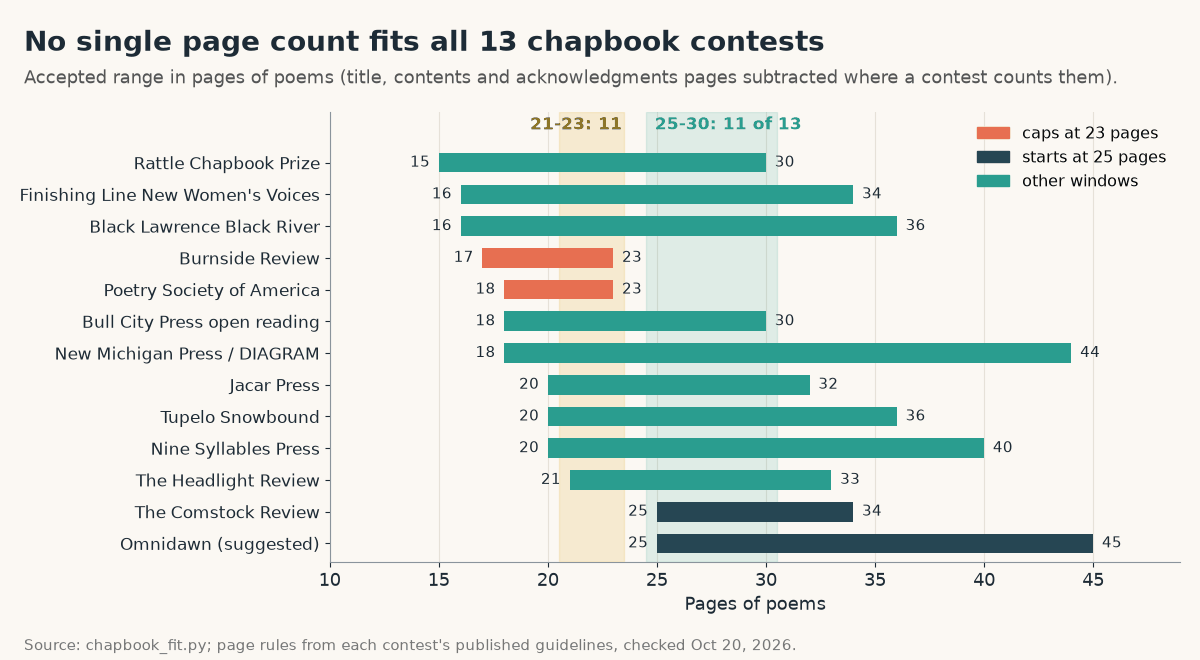
Two contests stop early: Burnside and the PSA both top out at 23 pages of poems once their front matter is taken off. Two start late: Comstock and Omnidawn both begin at 25. The highest floor is above the lowest ceiling, so no manuscript length fits all 13.
The script
Here is the core of chapbook_fit.py. The full table of 13 contests is in the dictionary; I’ve shortened it here.
from statistics import median

CONTESTS = {  # name: (min, max, pages the contest counts besides poems, fee, dates)
    "Rattle Chapbook Prize":     (15, 30, (),                      30, "deadline Jan 15, 2027"),
    "Poetry Society of America": (20, 25, ("title", "toc"),        14, "Oct 1 - Dec 15, 2026"),
    "The Headlight Review":      (24, 36, ("title", "toc", "ack"), 18, "Jan 1 - Mar 31, 2026"),
    "The Comstock Review":       (25, 34, (),                      30, "Aug 1 - Oct 31, 2026"),
    # ... 9 more, see the table above
}

def poem_window(name):
    lo, hi, counts, *_ = CONTESTS[name]
    return lo - len(counts), hi - len(counts)

def accepting(poem_pages):
    return [n for n in CONTESTS if poem_window(n)[0] <= poem_pages <= poem_window(n)[1]]

def coverage(rng=range(10, 47)):
    return {p: len(accepting(p)) for p in rng}

def fit(poem_lengths):
    total = sum(poem_lengths)
    return {"poems": len(poem_lengths), "poem_pages": total,
            "fits": len(accepting(total)), "of": len(CONTESTS),
            "too_long_for": [n for n in CONTESTS if total > poem_window(n)[1]],
            "too_short_for": [n for n in CONTESTS if total < poem_window(n)[0]]}
And the real output for all 13 contests:
contests: 13 | median stated window: 20 - 34 pages
best coverage: 11 of 13 at poem pages [21, 22, 23, 25, 26, 27, 28, 29, 30]
highest floor (poem pages): 25 | lowest ceiling: 23
 1.0 pages/poem -> 25-30 pages = 25-30 poems
1.25 pages/poem -> 25-30 pages = 20-24 poems
 1.5 pages/poem -> 25-30 pages = 16-20 poems
example draft: {'poems': 23, 'poem_pages': 30, 'fits': 11, 'of': 13, 'too_long_for': ['Burnside Review', 'Poetry Society of America'], 'too_short_for': []}
trimmed for PSA/Burnside: {'poems': 18, 'poem_pages': 23, 'fits': 11, 'of': 13, 'too_long_for': [], 'too_short_for': ['The Comstock Review', 'Omnidawn (suggested)']}
The example draft is made up for illustration: 23 poems, 17 of them one page long, five two-pagers and one three-page sequence. That’s 30 pages, which fits 11 calls. Cut four one-page poems and the sequence, and the 18 poems that remain (23 pages) fit a different set of 11.
25 to 30 pages is the sweet spot
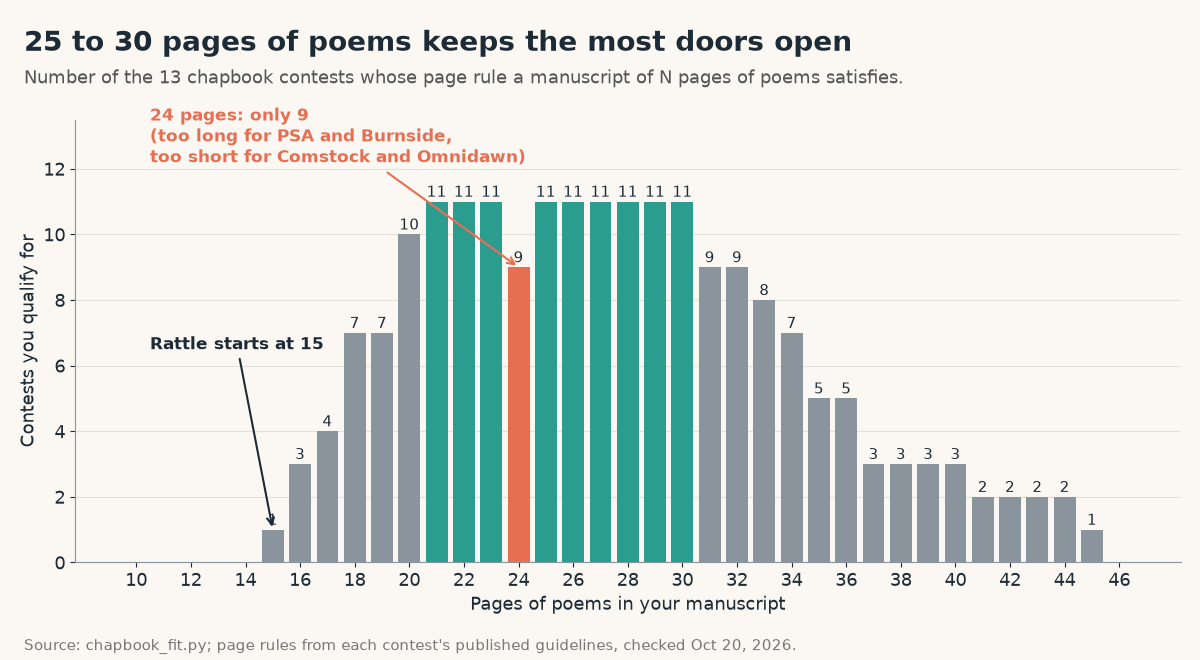
Coverage climbs fast from Rattle’s floor at 15 pages, reaches 11 of 13 at 21 to 23 pages, drops to 9 at exactly 24 (too long for PSA and Burnside, too short for Comstock and Omnidawn), then holds at 11 from 25 through 30. After 30, Rattle and Bull City Press drop out and it slides from there.
So the band you want is 25 to 30 pages of poems: six page counts wide, every one of them good for 11 contests. The 21-23 band is just as good on paper, but it’s only three pages wide, so one extra poem knocks you out of it.
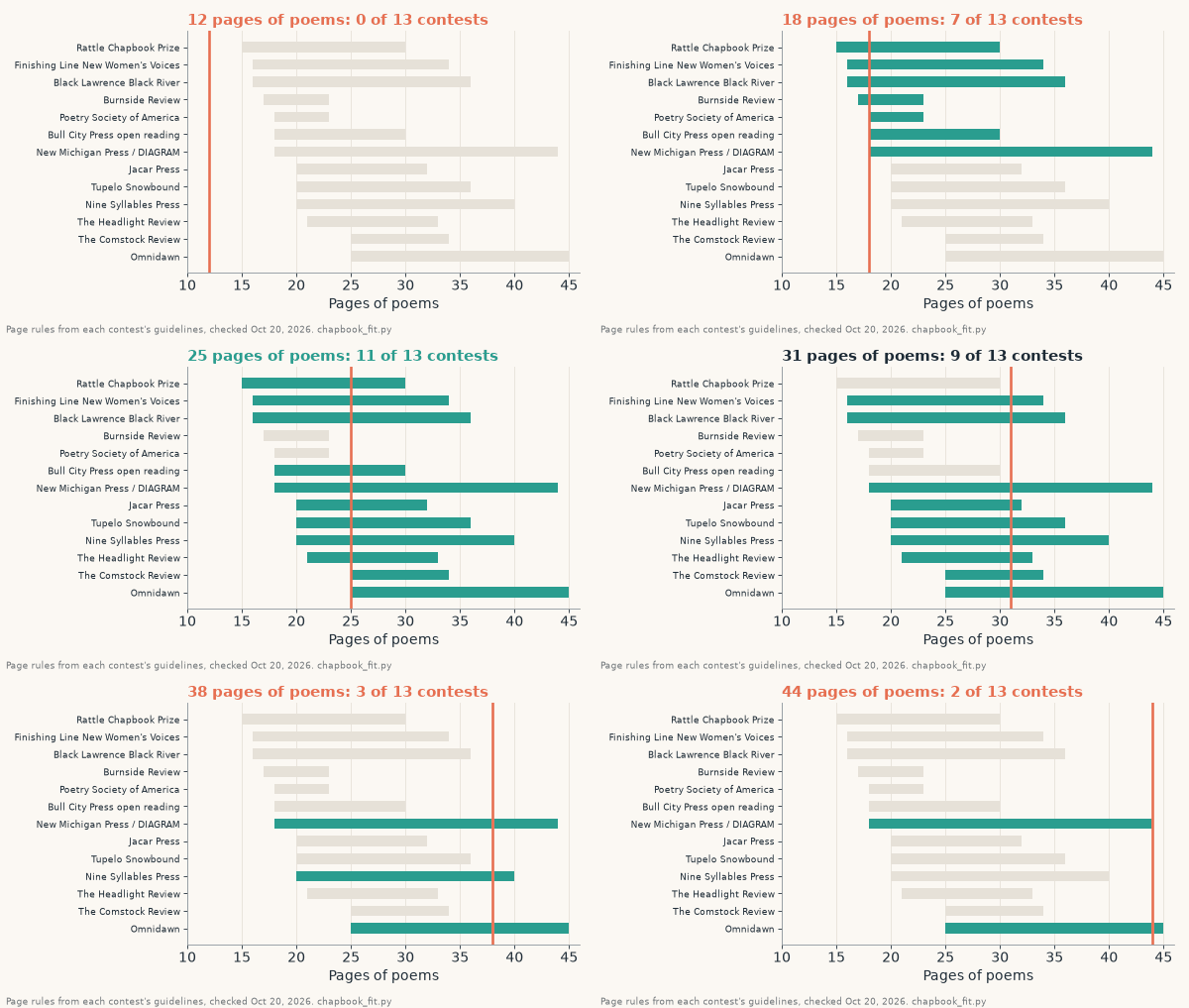
Watch the sweep: the red line is your manuscript, and a bar turns teal when that contest’s page rule accepts it.
From pages to poems
Now the conversion. Pages are fixed by the contests; poems depend on how long yours run. Divide, round down:
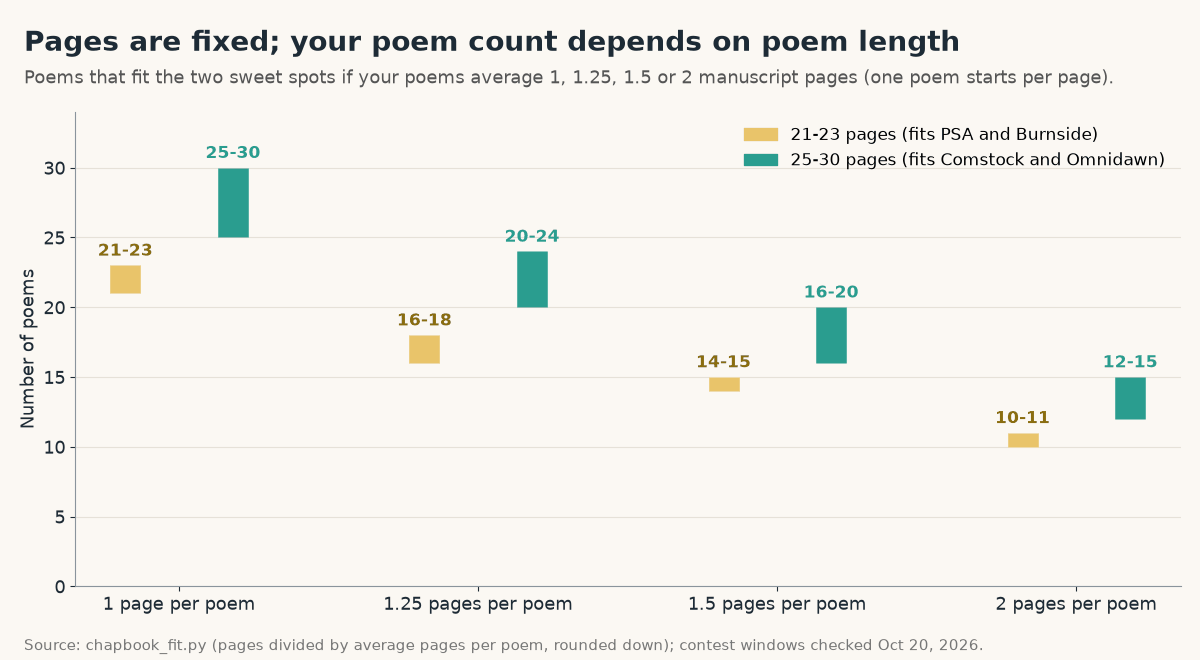
- Poems average 1 page: 25-30 poems (or 21-23 for the short band).
- Average 1.25 pages: 20-24 poems.
- Average 1.5 pages: 16-20 poems.
- Average 2 pages: 12-15 poems.
That’s where the “20 to 30” answer comes from. For most lyric poets, whose poems sit on one page with an occasional spill-over, it means writing toward about 25 poems and expecting to cut a few.
To get your own average, format the manuscript the way contests ask for it: Nine Syllables wants “a standard typeface such as Times New Roman or Garamond, size 12,” and Comstock says to “consider the smaller chapbook page when calculating line lengths,” with lines of “generally about 70 characters” at most. Start every poem on a new page, then count. This is the same counting exercise I did for cozy mystery chapters and daily devotionals: measure the real thing before you trust a rule of thumb.
Build one accordion manuscript
Because no single length fits everything, don’t build one fixed chapbook. Build a 28-page core (the middle of the sweet spot) and mark 5 to 7 pages of removable poems. That gives you two versions from one folder:
- Long version, 25-30 pages for Rattle, Black Lawrence, Finishing Line, DIAGRAM, Jacar, Nine Syllables, Tupelo, Headlight, Comstock, Omnidawn and Bull City.
- Short version, 21-23 pages for the PSA and Burnside (which also passes everyone else except Comstock and Omnidawn).
Run fit() on both before every submission. Two edge rules worth knowing: the Tupelo Snowbound page says there is “no mandatory page count” and won’t reject a manuscript “simply because it’s a little bit” over or under, and Nine Syllables says “a few pages more or less will not disqualify you.” Most others give a hard range; treat those as hard.
Going smaller? A micro-chapbook is a different format. Ghost City Press caps its micro-chaps at “no longer than 10 pages (of writing/art),” so at one page per poem that is 10 poems at most.
Which ones are open right now
As of October 20, 2026, according to their own pages:
- Black Lawrence Press, Black River: fall period September 1 to October 31, $20, 16-36 pages.
- The Comstock Review: August 1 to October 31, $30, 25-34 pages.
- Poetry Society of America: October 1 to December 15, 2026, $14, 20-25 pages counting title page and contents, for poets who haven’t published a full-length collection.
- Rattle: deadline January 15, 2027, $30 (it doubles as a subscription), 15-30 pages; three winners get $5,000 and 500 copies.
- Tupelo Snowbound opens December 1; DIAGRAM’s next deadline is April 23, 2027.
Two of those closing this month have different windows (16-36 vs 25-34), which is exactly why the accordion helps.
AI rules, and the tools that are fine
Five of the 13 guideline pages say no to AI-written work: Comstock (“Do NOT include AI-generated poetry”), Nine Syllables, Tupelo (“we generally do not accept writing … generated with AI software”), Bull City Press (“Use your own brain”) and DIAGRAM, which won’t consider AI-authored work but is open to disclosed assistive use. The other eight pages don’t mention AI. Write the poems yourself.
The tools that help here are boring ones. A word processor’s page count is all fit() needs, whether that is Word, Google Docs or a typesetting app such as Reedsy Studio, which is free for writing and formatting and exports PDF and EPUB if you want a clean contest PDF.
Self-publishing it instead?
You can print a chapbook on Amazon KDP, but there are two catches.
First, the floor. KDP’s print options start at 24 pages for a black-ink paperback, so a 10-page micro-chap won’t make it without padding. A 25-30 page chapbook plus front matter clears it. Black-ink paperbacks with 24-110 pages only incur the fixed printing cost: $2.30 per copy on Amazon.com at a regular trim size. (For the royalty side, see my KDP royalty calculator in Python, and the full cost of self-publishing is broken down here.)
Second, and more important: self-publishing can disqualify you. Black Lawrence Press says a chapbook previously published as a collection, “including publication with a press, self-publication, online/digital publication, and publication in a small, limited-edition print run,” is not eligible. Rattle requires the manuscript be “unpublished as a collection.” Individual poems in journals are fine almost everywhere; the collection as a whole is not. Enter the contests first, self-publish later.
The numbers in one table
| Question | Data | Number | What to do |
|---|---|---|---|
| How many poems? | No call sets a poem count | 20-30 poems | Count pages, not poems |
| Best length | 25-30 pages of poems | 11 of 13 calls | Build a 28-page core |
| Short version | 21-23 pages of poems | 11 of 13 calls (incl. PSA, Burnside) | Mark 5-7 removable pages |
| Length to avoid | Exactly 24 pages of poems | 9 of 13 calls | Add or cut one page |
| Micro-chapbook | Ghost City Press | 10 pages max | A different format |
| AI | Explicit bans | 5 of 13 calls | Write the poems yourself |
| Self-publishing | KDP black-ink paperback | 24-page minimum, $2.30 print cost | Contests first, KDP later |
Limits of this analysis
Thirteen calls is a sample, not the whole market; I picked current, well-known calls with clear page rules. Page windows change between years (the PSA cut its window from 20-30 pages for 2026 to 20-25 for 2027), so re-check each page before you pay a fee. My one-page-per-front-matter-item assumption is a simplification. Omnidawn’s 25-45 is explicitly a suggestion. And a contest that accepts your length is not a contest that will pick your manuscript: the page rule only gets you read.
Takeaway
How many poems should be in a chapbook? Aim for 25 to 30 pages of poems, which for most poets means 20 to 30 poems. That length passes 11 of the 13 page rules I checked. Keep 5 to 7 pages you can pull to make a 21-23 page version for the PSA and Burnside, avoid exactly 24, and don’t self-publish the collection until you’re done with contests.
Your next step is the same one I started with: get everything into one document and count the pages. If your material is still scattered across notebooks, ImagineYourBook can turn those notes into a first draft you export to Word, which you then rework into poems in your own voice, trim to 25-30 pages, and run through fit() before you pay a single entry fee.