
A KDP AI book cover sounds like a shortcut for corner-cutters. For a portfolio publisher, it’s mostly a budgeting question.
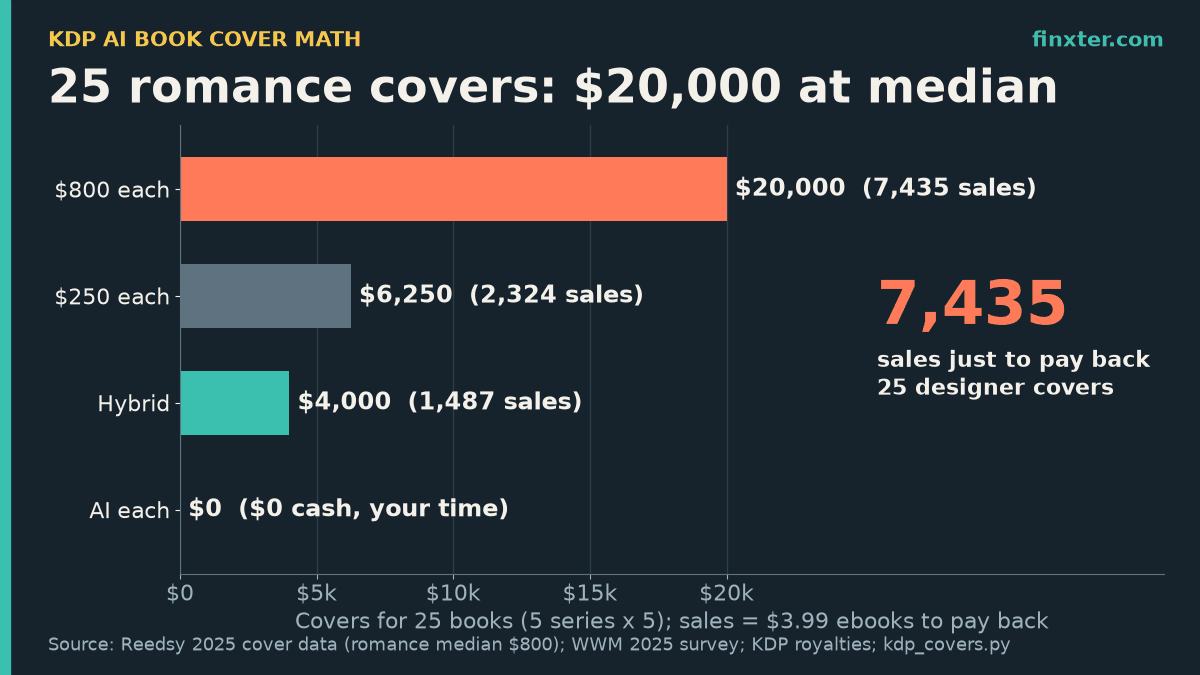
Here is the number that changes the conversation. Reedsy analyzed more than 9,600 cover projects on its marketplace in 2025. The median professional romance cover cost $800. Put that on every book of a 25-book catalog (five series of five) and you’ve spent $20,000 on covers. At a $3.99 ebook price, that’s 7,435 sales before the covers pay for themselves.
Nobody serious skips covers, though. In Written Word Media’s 2025 survey of 1,346 indie authors, cover design came out as the #1 factor in selling a book, across experience levels and income tiers.
So the real question isn’t “AI or designer?” It’s which books earn a paid cover, which ones an AI cover can carry, and what KDP requires when you use one. This post runs the napkin math in Python and ends with a stack you can actually afford at 25 books.
If you’re drafting with AI anyway, the cleanest place to get an AI cover is the tool that writes the book. My top pick is ImagineYourBook, an AI book-writing tool that turns a prompt or your notes into a complete draft (from a 10,000-word book to a full novel) with an original cover and Word/EPUB export. Its Series Continuation carries Book One’s canon into Book Two, and paid plans add monthly bonus cover recreations, so you can test a few cover directions without spending book credits.
TL;DR
- KDP allows AI covers but requires you to disclose AI-generated images, including covers, even after heavy edits.
- KDP recommends 1,600 × 2,560 px (1.6:1); under 500 px on the longest side, the cover isn’t displayed.
- Reedsy’s 2025 romance median is $800 a cover: 25 books = $20,000, or 7,435 sales at $3.99 to pay back.
- Hybrid: $800 only on each series’ Book 1, AI covers on Books 2–5 = $4,000 (1,487 sales).
- A purely prompted image may not be copyrightable (U.S. Copyright Office, 2025): add your own typography and layout.
What KDP requires for an AI book cover
Two rule sets apply: the AI disclosure rule and the file specs.
1. You must disclose AI-generated covers. KDP’s content guidelines say: “We require you to inform us of AI-generated content (text, images, or translations) when you publish a new book or make edits to and republish an existing book.” And they spell out that “AI-generated images include cover and interior images and artwork.”
The line KDP draws is about who created the content:
- AI-generated: an AI tool created the image, “even if you applied substantial edits afterwards.” Disclose it.
- AI-assisted: you created the cover yourself and used AI to “edit, refine, error-check, or otherwise improve” it. No disclosure needed.
Either way, KDP says you’re responsible for making sure the content follows its guidelines and respects intellectual property rights.
2. The file has to pass KDP’s ebook cover specs. From KDP’s eBook cover guidelines:
- JPEG, PNG, non-animated GIF or TIFF (JPEG preferred; no SVG).
- At least 500 px on the longest side, or the cover isn’t displayed. At most 10,000 px per side and 50 MB.
- Recommended: 2,560 px tall × 1,600 px wide (a 1.6:1 ratio), 300 DPI, RGB.
3. Copyright is thinner than you think. The U.S. Copyright Office’s Part 2 report (January 29, 2025) concludes that AI outputs “can be protected by copyright only where a human author has determined sufficient expressive elements,” and “not the mere provision of prompts.” In practice, a purely prompted cover image may be something you can’t stop others from reusing. Your own typography, layout and edits are where human authorship comes back in. (Not legal advice. If a cover matters a lot, ask a lawyer.)
The napkin math: what covers cost a 25-book portfolio
The assumptions, clearly labeled:
- Portfolio (assumption): 25 ebooks, as five series of five, one book a month. Why 25? In our how many KDP books to make money breakdown, 25+ books is where Written Word Media’s median income reaches about $3,000 a month.
- Price (assumption): $3.99 ebook with a 1 MB file. With KDP’s 70% royalty and $0.15/MB delivery, that’s $2.69 per sale. The function comes from our KDP royalty calculator in Python.
- Cover prices (sourced): $800 = Reedsy’s 2025 romance median. $250 = the low end of the “$250–$500 sweet spot” WWM sees among high earners. $100 = the low end of the $100–$499 mid-range earners typically pay.
- AI cover (assumption): $0 extra cash when the cover comes with the tool you already pay for. It still costs your time.
Here’s the script. It also checks a cover file against KDP’s specs with Pillow.
"""kdp_covers.py - what do covers cost a 25-book KDP portfolio, and how many sales pay them back?
Sources (checked 2026-10-24):
  Reedsy, "Book Cover Design Costs" (9,600+ Reedsy projects in 2025): romance median $800, average $1,290
  Written Word Media 2025 Indie Author Survey: mid earners $100-$499 per cover, $250-$500 = high-earner "sweet spot"
  KDP eBook cover guidelines: 500 px min longest side, 10,000 px max, 50 MB max, 2,560 x 1,600 recommended
  KDP royalties: 70% band $2.99-$12.99, delivery $0.15/MB (kdp_royalty.py, from the Finxter royalty calculator)
Everything marked ASSUMPTION is mine, not a source.
"""
import math
from kdp_royalty import ebook_royalty

BOOKS, SERIES = 25, 5                  # ASSUMPTION: 5 series x 5 books, 1 book a month
PRICE, MB = 3.99, 1                     # ASSUMPTION: $3.99 ebook, 1 MB file
COST = {"reedsy_romance_median": 800,  # Reedsy 2025 romance median
        "wwm_sweet_spot": 250,          # WWM 2025: low end of the $250-$500 high-earner sweet spot
        "wwm_mid_low": 100}             # WWM 2025: low end of mid earners' $100-$499

def per_book_cost(strategy, book):      # book = 0..24, series = book // 5, position = book % 5
    if strategy == "designer": return COST["reedsy_romance_median"]
    if strategy == "sweet_spot": return COST["wwm_sweet_spot"]
    if strategy == "hybrid":            # $800 on each Book 1 (the one you advertise), AI covers for Books 2-5
        return COST["reedsy_romance_median"] if book % 5 == 0 else 0
    if strategy == "ai": return 0       # ASSUMPTION: $0 marginal cash, cover included with the drafting tool
    raise ValueError(strategy)

STRATEGIES = ["designer", "sweet_spot", "hybrid", "ai"]
def running_total(strategy, books=BOOKS):
    out, t = [], 0
    for b in range(books): t += per_book_cost(strategy, b); out.append(t)
    return out

def payback_sales(cost, price=PRICE, mb=MB):
    """Ebook sales needed to earn back `cost` at one list price (US store, best royalty option)."""
    return math.ceil(cost / ebook_royalty(price, mb)) if cost else 0

def check_cover(path):
    """Check an ebook cover file against KDP's published requirements."""
    from PIL import Image
    import os
    im = Image.open(path); w, h = im.size; mb = os.path.getsize(path) / 1e6
    problems = []
    if max(w, h) < 500: problems.append("longest side under 500 px: not displayed")
    if max(w, h) > 10_000: problems.append("a side over 10,000 px")
    if mb > 50: problems.append("file over 50 MB")
    if im.format not in ("JPEG", "PNG", "TIFF", "GIF"): problems.append(f"format {im.format} not accepted")
    if (w, h) != (1600, 2560): problems.append(f"{w}x{h}: KDP recommends 1600x2560 (ratio 1.6)")
    if im.mode not in ("RGB",): problems.append(f"mode {im.mode}: RGB recommended")
    return problems or ["OK"]

if __name__ == "__main__":
    r = ebook_royalty(PRICE, MB)
    print(f"Royalty per ${PRICE} sale: ${r:.2f}")
    for name in STRATEGIES:
        total = running_total(name)[-1]
        print(f"{name:>11}: 25 covers = ${total:>6,}  -> {payback_sales(total):>5,} sales to pay back")
    print("One cover, sales to pay back:")
    for c in (800, 250, 100):
        print(f"  ${c:>3}: {payback_sales(c):>4} at $3.99 | {payback_sales(c, 4.99):>4} at $4.99 | {payback_sales(c, 0.99):>4} at $0.99")
    from PIL import Image                                   # demo: a square-ish AI export vs. a resized file
    Image.new("RGB", (1024, 1536), "white").save("/tmp/ai_export.png")
    Image.new("RGB", (1024, 1536), "white").resize((1600, 2560)).save("/tmp/kdp_ready.jpg", quality=92)
    for f in ("/tmp/ai_export.png", "/tmp/kdp_ready.jpg"): print(f.split("/")[-1], "->", "; ".join(check_cover(f)))
Output:
Royalty per $3.99 sale: $2.69
   designer: 25 covers = $20,000  -> 7,435 sales to pay back
 sweet_spot: 25 covers = $ 6,250  -> 2,324 sales to pay back
     hybrid: 25 covers = $ 4,000  -> 1,487 sales to pay back
         ai: 25 covers = $     0  ->     0 sales to pay back
One cover, sales to pay back:
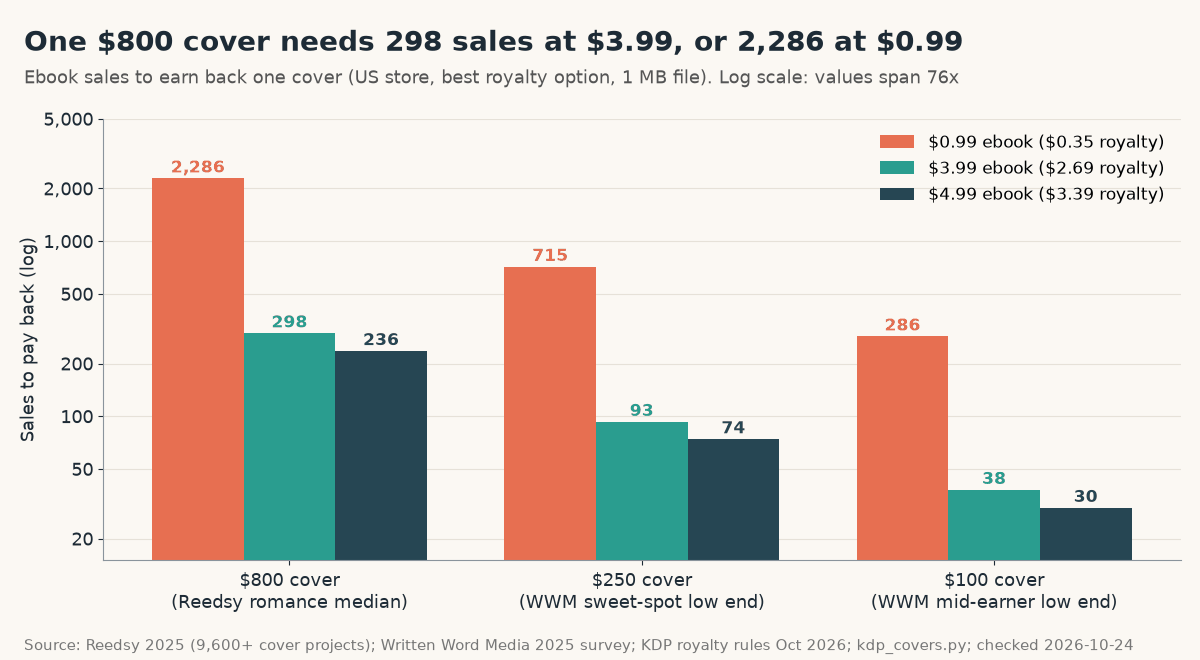
  $800:  298 at $3.99 |  236 at $4.99 | 2286 at $0.99
  $250:   93 at $3.99 |   74 at $4.99 |  715 at $0.99
  $100:   38 at $3.99 |   30 at $4.99 |  286 at $0.99
ai_export.png -> 1024x1536: KDP recommends 1600x2560 (ratio 1.6)
kdp_ready.jpg -> OK
Read the top block as four cover strategies for the same 25 books:
| Strategy | Cover spend | $3.99 sales to pay back |
|---|---|---|
| $800 designer cover on every book | $20,000 | 7,435 |
| $250 designer cover on every book | $6,250 | 2,324 |
| Hybrid: $800 on each Book 1, AI covers on Books 2–5 | $4,000 | 1,487 |
| AI cover on every book | $0 cash | 0 |
The demo at the bottom matters too. A 1024×1536 export fails KDP’s recommended 1600×2560. Resizing it passes the check, but upscaling doesn’t add detail. Generate at the larger size, or upscale with a proper tool, before you upload.
One cover’s payback depends on your price more than the designer
The per-cover view is where pricing strategy bites. At $3.99, an $800 cover needs 298 sales to pay back. At $4.99, it needs 236.
Now put that cover on a $0.99 Book 1. Below $2.99 you’re on the 35% royalty: $0.35 a sale. The same $800 cover needs 2,286 sales.
That isn’t an argument against a $0.99 first-in-series. In our KDP ebook pricing post, a $0.99 Book 1 earned about 2.1× as much across a five-book series for promo readers. It’s a reminder that a Book 1 cover gets paid back by read-through into Books 2–5, not by its own sales. So that’s the cover worth paying a designer for.
The compounding part: cover spend grows with every book
Covers are a per-book cost, so they scale with your catalog exactly like your output does. Watch the four strategies over 25 months:
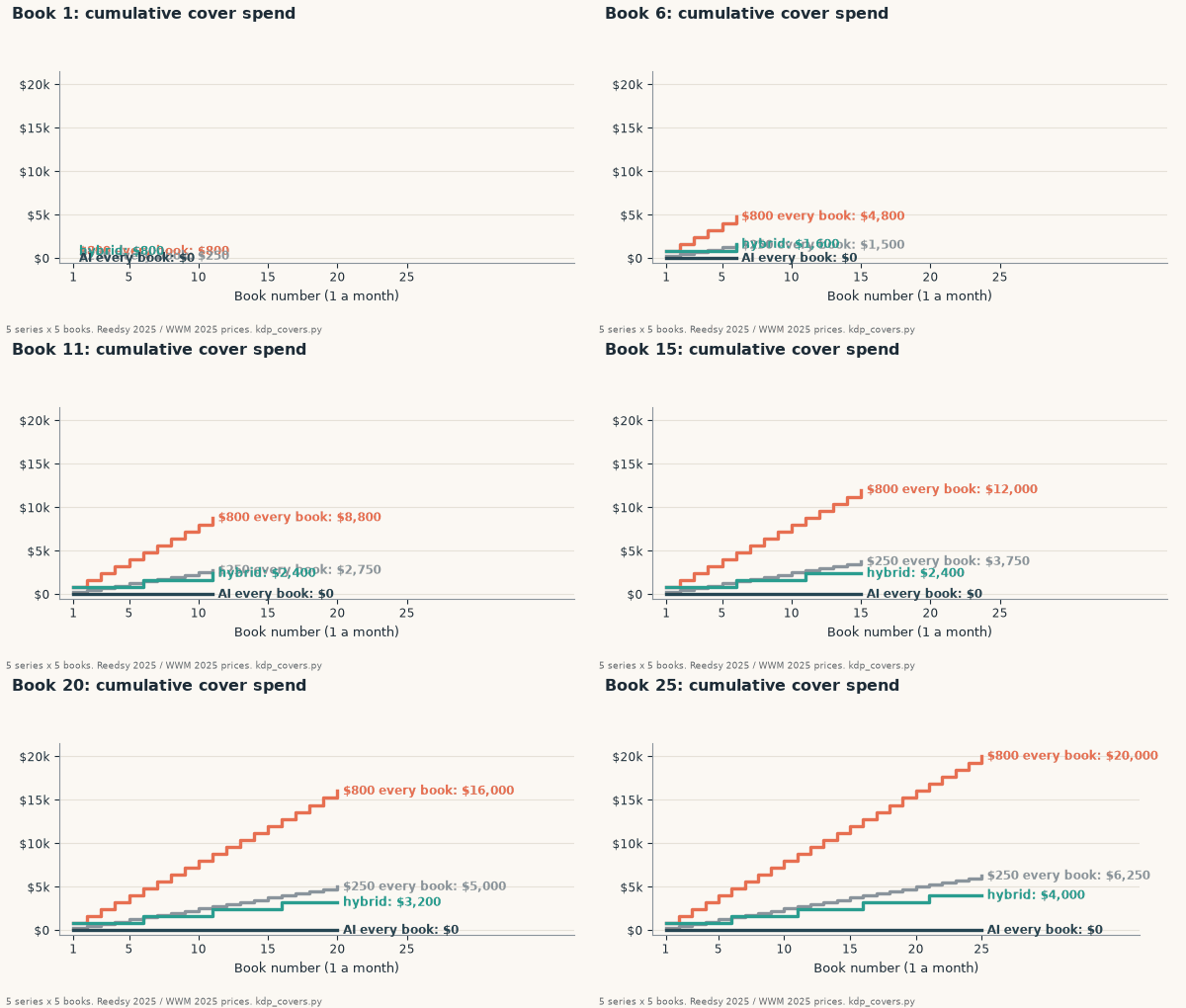
The $800 line climbs $800 every month. The hybrid line only moves when a new series starts: books 1, 6, 11, 16 and 21. By book 25 the gap is $16,000, which is real money in a business where the median author with 25+ books earns about $3,000 a month.
Why does the hybrid work? Because of how readers shop a series:
- Book 1 carries the ads and the first impression. It’s the cover readers see in category lists and ads. WWM’s advice: your cover’s job is to “signal genre, not summarize plot”, and it should “fit” when dropped into the Top 10 of your category.
- Books 2–5 are mostly read by people who already liked Book 1. They need consistency (same fonts, same layout, same series branding), which you can template.
- You can upgrade later. WWM’s guidance is to move into the $250–$500 range “as revenue grows” and to be “ruthless (kindly!)” about replacing a cover that isn’t working. KDP lets you upload an updated cover to a published book; it goes through review again.
How to make a KDP AI book cover that doesn’t look like one
The same workflow works whether your image comes from a drafting tool or a separate image generator.
- Screenshot the Top 10 in your exact category. Note the color palette, the font style, whether it’s a figure, an object or an illustrated couple. That’s your brief. Genre signal beats originality.
- Generate several image directions, not one. Pick the one that reads at thumbnail size. With ImagineYourBook, the paid plans’ bonus recreations (4 a month on Author, 12 on Publisher, 48 on Mogul, per its pricing FAQ) don’t spend book credits, which makes this testing step cheap.
- Do the typography yourself. Title and author name in a genre-appropriate font, in a free tool like Canva or KDP’s own Cover Creator. This is the part readers judge hardest, and per the Copyright Office it’s where your human authorship lives.
- Build a series template. Same title position, same font, same series line on every book. Books 2–5 then take minutes.
- Run
check_cover()before uploading: 1600×2560, RGB, under 50 MB. - Tick the AI disclosure box in KDP if the image is AI-generated. Hiding it isn’t worth the risk to your account.
- Get objective feedback. WWM’s alternative to spending money is to “spend nothing but make sure that you get objective feedback”. Ask readers in your genre, not friends.
| Decision | Cheap default | When to pay a designer |
|---|---|---|
| Book 1 of a series | AI cover while you test the concept | Once it gets ads or promos: Reedsy romance median $800 |
| Books 2–5 | AI image + your series template | Rarely: readers already bought into Book 1 |
| Typography | Do it yourself (Canva, KDP Cover Creator) | If titles look off-genre next to the Top 10 |
| Upgrades | Keep what sells | WWM: move to $250–$500 as revenue grows |
| KDP disclosure | Required for AI-generated images | Not needed if you made it and AI only assisted |
| File specs | 1600×2560, RGB, JPEG, under 50 MB | Same for every cover |
Where this can be wrong
- Cover prices vary a lot. Reedsy’s 2025 romance average was $1,290 against an $800 median, and its older self-publishing cost guide lists romantasy covers at an average of $3,950. Premade covers can cost far less than $100. Put your own quotes into
COST. - Assumptions: 25 books, five per series, $3.99, 1 MB files and $0 for AI covers are napkin inputs. Kindle Unlimited page reads also pay covers back, so real payback can be faster.
- WWM figures are self-reported and describe patterns, not causes. Their own note: there’s “no clear correlation between spending $2k+ and higher income.”
- An AI cover can lose sales if it looks off-genre or has visible artifacts. The $0 line only holds if the cover is good enough to sell.
The takeaway
A KDP AI book cover is allowed: disclose it, hit 1600×2560, and add your own typography. The money question is where to put a designer. Paying the $800 romance median on all 25 books costs $20,000 and 7,435 sales to recover. Paying it only on the five Book 1s costs $4,000, and AI covers in a consistent series template handle the rest until the numbers justify upgrades.
If you want the draft and the cover from one place, try ImagineYourBook on your next series: the 7-day trial is $0 and includes one complete 10,000-word book with its own cover. It needs a card, and the $29.99 Author plan starts after 7 days unless you cancel before day 8. Sales are never guaranteed: the editing, positioning and the final cover call are still yours.
Related reading on Finxter: Best AI for writing a book series, Top 10 AI dark romance book writers, and for the Python side, 5 best ways to convert Python bytes to PIL images.
Sources (checked October 24, 2026): KDP: Content Guidelines (AI content) · KDP: eBook cover image guidelines · KDP: Update Your Cover · KDP: Cover Creator · KDP: eBook list price requirements · KDP: eBook royalties · Reedsy: Book Cover Design Costs (2025 marketplace data) · Reedsy: How Much Does It Cost to Publish a Book · Written Word Media: 2025 Indie Author Survey Results · U.S. Copyright Office: Part 2 of the AI Report (copyrightability) · ImagineYourBook pricing and FAQ. Script: kdp_covers.py (shown above), using kdp_royalty.py from our royalty calculator post. ImagineYourBook is listed in the community-curated awesome-ai-tools list on GitHub.