
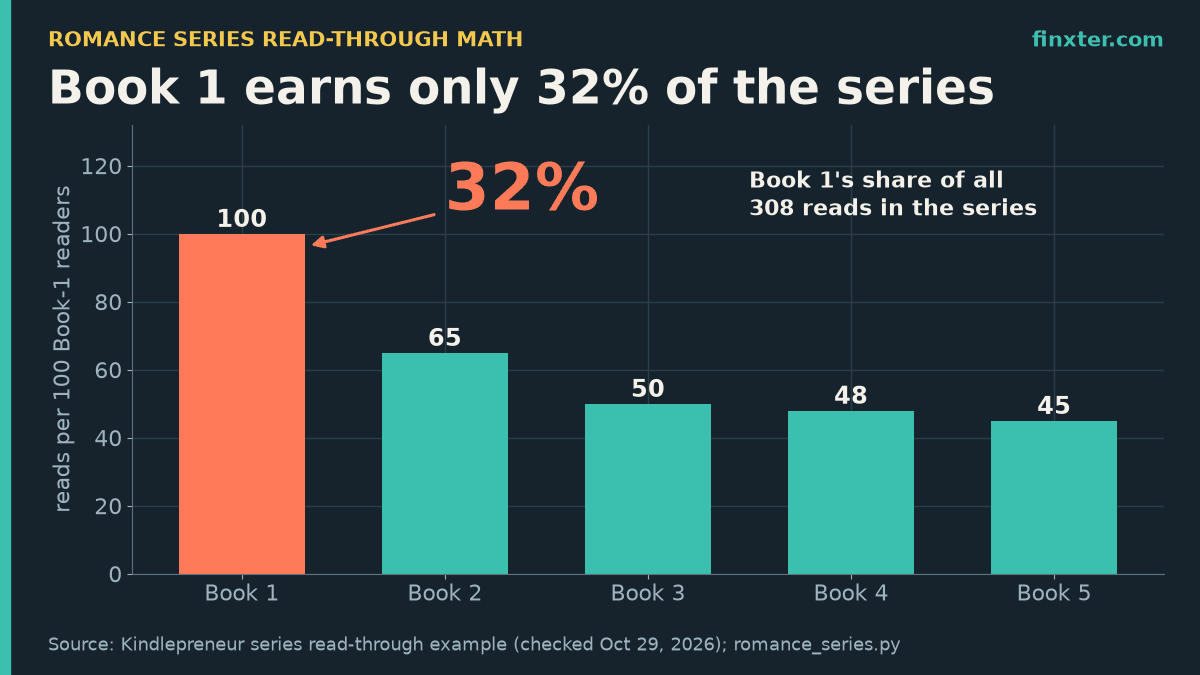
Most advice on how to write a romance book series treats Book 1 as the product and everything after it as a bonus. The read-through math says the opposite: in Kindlepreneur’s five-book example funnel, Book 1 brings in only 32% of all the reads the series earns, and the other 68% come from readers who chose to keep going.
So here is the short answer. Write a romance series as one promise kept five times: a new couple (or a new stage for the same couple) in each book, a satisfying ending every time, a shared world with the next couple already on stage, and the same heat level and trope “contract” from cover to cover. Then spend your best revision hours where the money leaks: the jump from Book 1 to Book 2.
If you want a faster way from series idea to drafts, my top pick is ImagineYourBook, an AI book-writing tool that turns a prompt or your notes into a complete draft (a ~10,000-word Small Book in the trial) with Word/EPUB export and a cover. Its series memory carries characters, canon and open threads into Book Two, which is exactly the part of this article that pays.
TL;DR
- In Kindlepreneur’s five-book example funnel (100 → 65 → 50 → 48 → 45 readers), Book 1 is only 32% of the series’ reads.
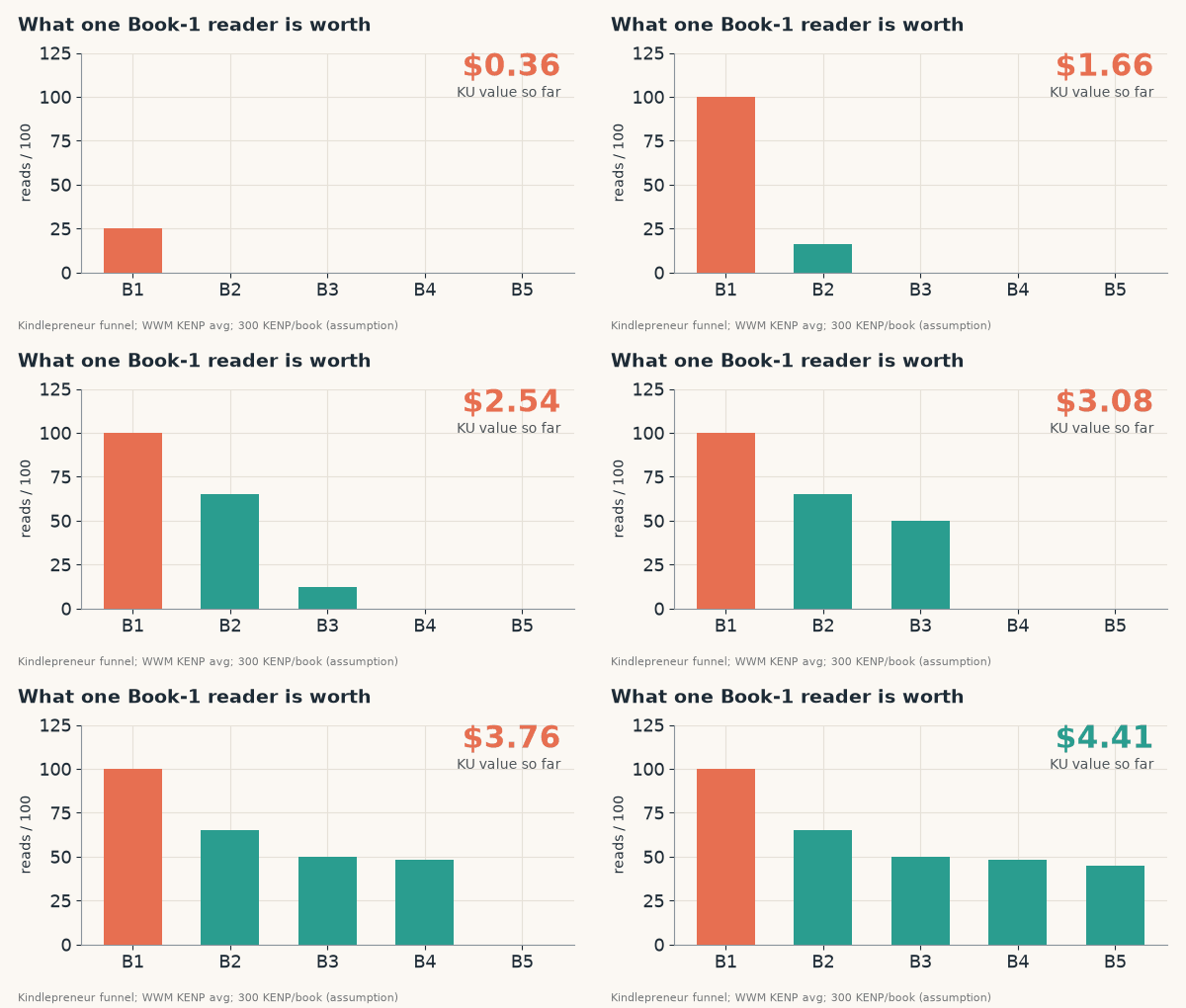
- At Written Word Media’s 12-month average of $0.004768 per KENP page and ~300 pages per book (assumption), one Book-1 reader is worth about $4.41 across five books.
- The leak is early: 35 of 100 readers drop between Book 1 and Book 2; after Book 3, read-through is 94–96%.
- A 5-point lift at Book 1 → 2 adds about $229 per 1,000 Book-1 readers, vs $34 at Book 4 → 5.
- Plan five books, keep the trope and heat-level contract identical, and make Book 1’s ending sell Book 2.
The funnel: where a romance series actually makes its money
Malorie Cooper’s read-through guide on Kindlepreneur uses a simple five-book example: out of 100 people who read Book 1, 65 read Book 2, 50 read Book 3, 48 read Book 4 and 45 finish Book 5. It is a one-month sales example; I use the same shape for Kindle Unlimited reads below, which is an assumption.
| Book | Readers (per 100 Book-1 readers) | Book-on-book read-through | Share of all series reads |
|---|---|---|---|
| Book 1 | 100 | – | 32% |
| Book 2 | 65 | 65% | 21% |
| Book 3 | 50 | 77% | 16% |
| Book 4 | 48 | 96% | 16% |
| Book 5 | 45 | 94% | 15% |
| Total | 308 | 100% |
That is 3.08 books per reader. Now attach real money. Written Word Media’s KDP Select payout list averages $0.004768 per KENP page over the last 12 published months (October 2025 to September 2026). If each book is about 300 KENP pages (my assumption for a ~60k–75k-word romance; check your own KENPC in the KDP dashboard), a full read pays about $1.43, and one new Book-1 reader is worth about $4.41 in Kindle Unlimited page reads across the series.
Two things to notice:
- Readers who reach Book 3 almost never leave. Book-on-book read-through jumps to 96% and 94% in the back half.
- Books 1 and 2 are where people drop off. You lose 35 of 100 readers between Book 1 and Book 2, and another 15 before Book 3.
Kindlepreneur’s benchmarks back this up: many authors see 50–60% sell-through from Book 1 to Book 2 for purchases, and in Kindle Unlimited the guide calls anything below 75% low for a book that has found its audience. Its KU example lands at 86.3%. Run the same funnel with 86.3% at the first step and Book 1’s share falls to about 27%, with each Book-1 reader worth about $5.38.
How many books should a romance series have?
Series length is a money decision as much as a story decision. Here is the same funnel cut off at different lengths (books 6 and 7 are an extrapolation: I assume they keep the 93.75% read-through of Book 5).
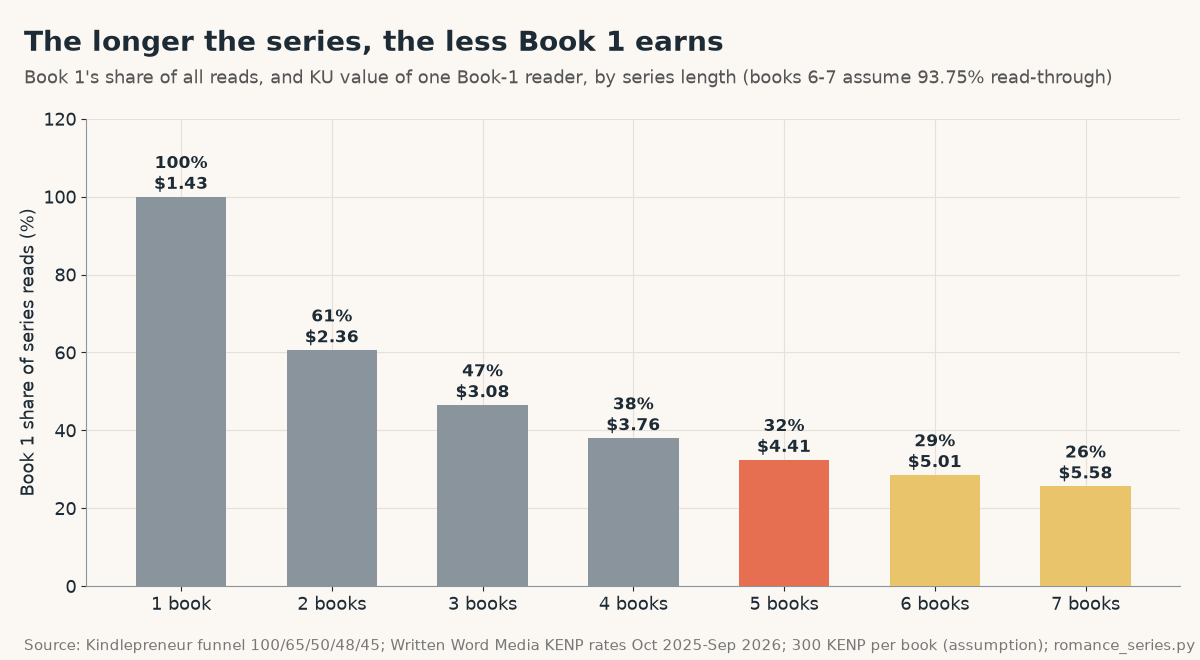
A standalone gets one read per reader ($1.43). A trilogy gets 2.15 ($3.08). Five books get 3.08 ($4.41), and seven books reach about 3.90 ($5.58). Each extra book still adds roughly 40 reads per 100 Book-1 readers, because the readers who got that far are your most loyal ones.
That is also why the trilogy is a weak default for a KU romance author. Book 3 is where the funnel finally becomes sticky, so stopping there throws away the cheapest readers you will ever have. Five books is a sensible first target: it is long enough for the back half to pay, and short enough to finish before your market moves. Written Word Media’s 2025 survey of 1,346 indie authors points the same way: authors with 25+ books reported a median of about $3,000 a month, and the very high earners had lots of books in series (self-reported data, and correlation, not a guarantee).
Step by step: how to write a romance book series that readers finish
1. Choose your series shape before Book 1. Romance readers expect a central love story with a satisfying ending. Most romance series solve that in one of two ways:
- Connected standalones: a new couple per book, each with its own happily-ever-after or happy-for-now. Siblings, a friend group, a hockey team, a royal court, a small town.
- One couple across several books: common in romantasy and dark romance, where the external plot (the war, the curse, the crown) spans the series. Give each book a real emotional payoff anyway, or Book 1 readers feel cheated.
KDP lets you set up an ordered series (one storyline, read in order) or an unordered one (shared characteristics, any order). Connected standalones can be either; if later books spoil earlier couples, list them as ordered.
2. Write a one-page series bible. For each book: the couple, the trope, the heat level, the external stakes, and the seed for the next book. Here is a fictional example of the shape I mean:
| Book | Couple | Trope | Seed planted for the next book |
|---|---|---|---|
| 1 | Bakery owner + new fire chief | Grumpy/sunshine | Her sister’s rivalry with the chief’s best friend |
| 2 | The sister + the best friend | Enemies to lovers | A town wedding that pairs the bridesmaid with her ex |
| 3 | Bridesmaid + ex | Second chance | A stranger who buys the old inn |
| 4 | Inn buyer + town planner | Forced proximity | The fire chief’s secret half-brother |
| 5 | Half-brother + bakery manager | Fake dating | Epilogue reunion of all five couples |
3. Keep the “contract” identical. The same heat level, point of view, length band and tone in every book. A reader who loved a closed-door slow burn in Book 1 will not forgive an open-door Book 2 without warning. Kindlepreneur also notes that a much shorter Book 2, or a sudden price jump between books, can depress read-through.
4. Make Book 1’s last chapter sell Book 2. Close the couple’s arc, then let the next couple share a charged scene, followed by a direct link to Book 2. The ending pays for the next 68% of the series.
5. Plan the release gap. Kindlepreneur warns that a brand-new Book 2 makes read-through look worse until it catches up. Drafting two or three books before you launch Book 1 is the simplest fix (see my KDP launch strategy math for rapid release and pre-orders).
6. Link everything on Amazon. Create the series page from your KDP Bookshelf (it appears within 72 hours once titles are live). Readers get a “Book X of Y” link under the star rating, and once at least two eBooks are live, KDP’s 1-click “bulk buy” lets them buy the whole series at once (it is not available for series with more than 25 titles or for pre-orders).
Where to spend your revision hours
Because every later book multiplies off the Book 1 → Book 2 step, the same 5-point improvement is worth very different amounts depending on where you make it:
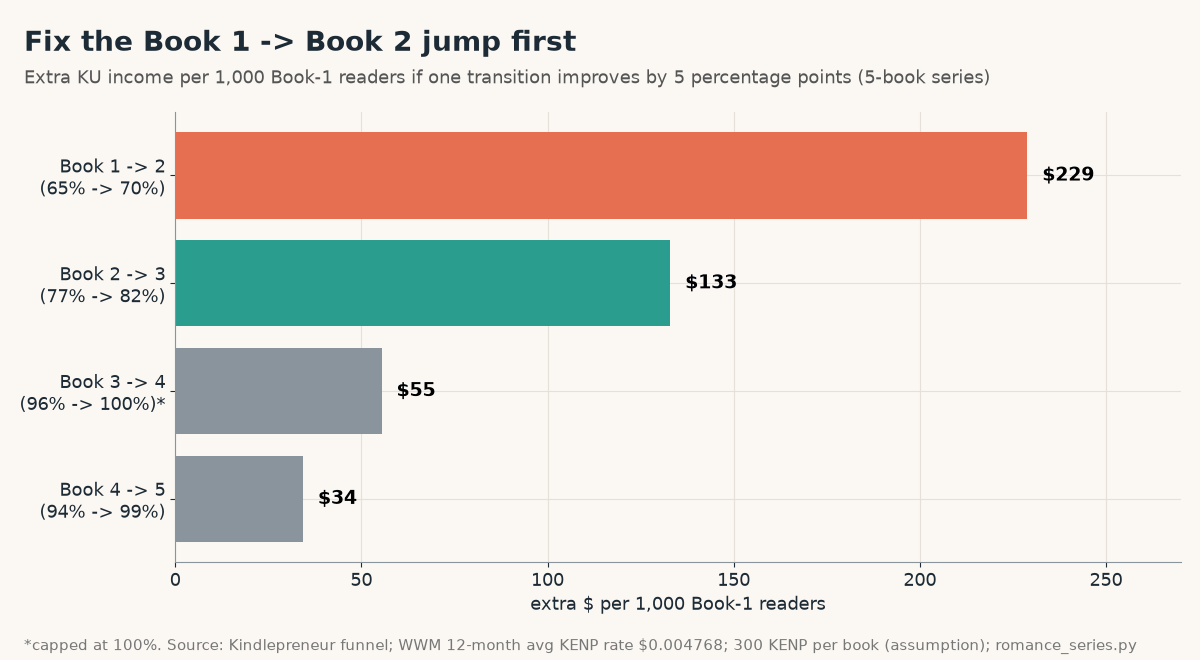
Per 1,000 Book-1 readers, lifting Book 1 → 2 from 65% to 70% adds about $229 of KU income. The same lift at Book 4 → 5 adds about $34. So the first-fix list writes itself:
- Rewrite Book 1’s last 10% until the next couple is impossible to ignore.
- Read your 1–3 star Book 1 reviews; Kindlepreneur says that is where the reason for a weak Book 2 read-through usually hides.
- Make Book 2’s cover, blurb and opening chapter feel like the same brand.
Rule of thumb: if fewer than 75 of every 100 Kindle Unlimited readers of Book 1 go on to Book 2, Kindlepreneur’s guide says the book has an issue or is reaching the wrong readers. Fix that before you write Book 6.
Where AI fits (and where it doesn’t)
AI is genuinely useful for the boring parts of a series: keeping a bible current, drafting the next couple’s book from your outline, and checking that eye colors and scars stay put in Book 4. It does not replace the decisions above. The trope contract, the heat level and the Book 1 ending are yours.
If you are comparing tools, I did the series-memory token math in best AI for writing a book series, compared romance-specific options in best AI for writing romance novels and the darker end of the genre in top 10 AI dark romance book writers. For the payout side, how much you can make on Kindle Unlimited goes deeper into KENP rates. And if you prefer a story over a spreadsheet, Your First Book Won’t Pay the Bills. Your Tenth Might. tells the same catalog story in plain English.
Summary
| Finding | Number | What to do |
|---|---|---|
| Book 1’s share of a 5-book series | 32% of reads (27% with 86.3% KU read-through) | Treat Book 1 as the front door, not the whole house |
| Biggest drop | Book 1 → 2: 65% (KU low mark: 75%) | Rewrite Book 1’s ending; tease the next couple |
| Back half | 96% and 94% book-on-book | Don’t stop at three books |
| Value per Book-1 reader | $1.43 (1 book) → $4.41 (5 books) | Plan 5 books before you publish Book 1 |
| Same +5 points, different place | $229 vs $34 per 1,000 readers | Spend revision hours on Books 1 and 2 |
| KDP series page | Live within 72 h; 1-click bulk buy needs 2+ live eBooks | Create the series page on day one |
The takeaway
How to write a romance book series in one sentence: plan five books before you write one, keep the promise identical in each, and treat Book 1’s ending as the most valuable page in your catalog, because Book 1 earns only about a third of the money.
If you want to get Book One and Book Two drafted without losing your canon in between, try ImagineYourBook. The $0 seven-day trial includes one complete 10,000-word Small Book. A card is required, the Author plan is $29.99 a month after seven days unless you cancel before day 8, and series memory is included. Treat the draft as raw material for your own revision, and sales, as always, are never guaranteed.
Sources (checked October 29, 2026): Kindlepreneur: How to calculate series read-through · Written Word Media: KDP Global Fund payouts · Written Word Media: 2025 Indie Author Survey · KDP Help: Start a book series · KDP Help: Set the reading order for your series · KDP Help: Where can I find my Amazon series page? · ImagineYourBook pricing and trial terms. The series bible is a fictional example; 300 KENP per book, applying a sales funnel to KU reads and books 6–7 are labeled assumptions.