
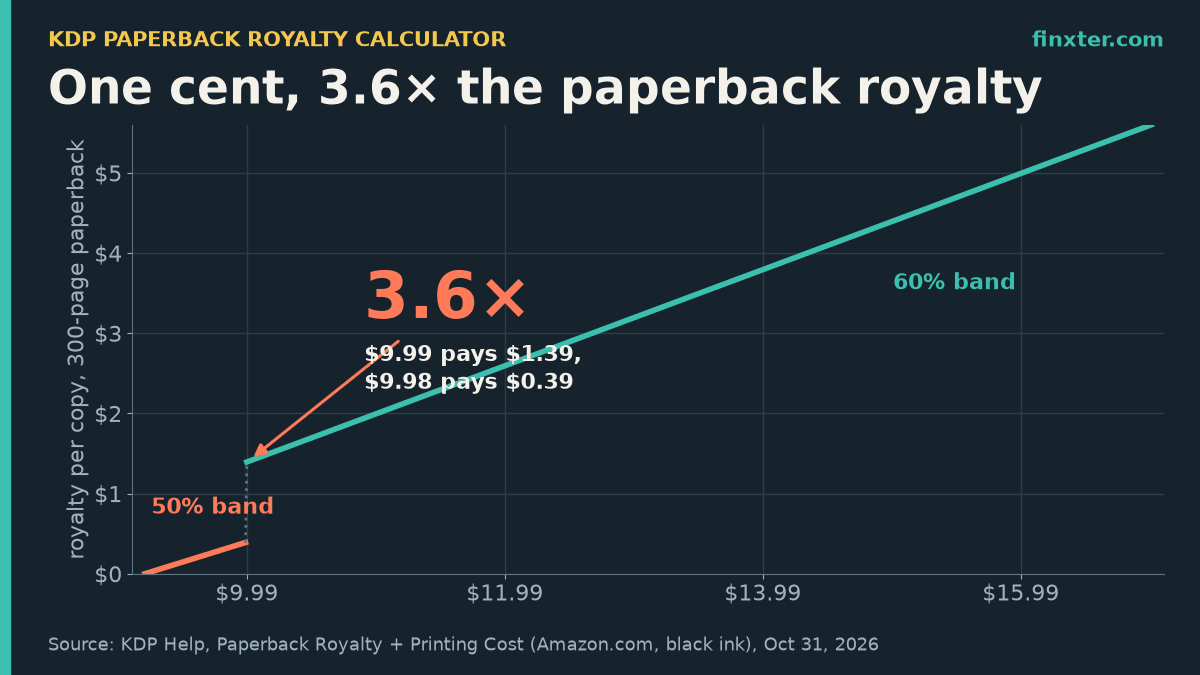
Price a 300-page paperback at $9.98 and KDP pays you $0.39 a copy. Price it at $9.99 and you get $1.39. One cent, 3.6× the royalty, because KDP now pays 50% on Amazon.com paperbacks listed at $9.98 or less and 60% at $9.99 or more.
That’s the first thing a KDP paperback royalty calculator should show you, and most authors never see it because they type one price into the calculator and move on. This post gives you the whole formula, a price-by-page-count grid, and the three paperback decisions that matter for a romance or romantasy series: list price, page count and Expanded Distribution. Every number comes from KDP’s own help pages, checked today.
If you’re building that series with AI, the drafting step is the cheap part now. My top pick is ImagineYourBook, an AI book-writing tool that turns a prompt or your notes into a complete draft with Word/EPUB export and a cover. Its Series Builder carries characters and world rules into Book Two, and paid plans add paperback full-wrap covers sized to your final page count, trim size and paper. The paperback math below decides what each of those books actually earns you in print.
TL;DR
- KDP paperback royalty on Amazon.com = 60% of list (at $9.99+) or 50% (at $9.98 or less), minus printing cost.
- A 300-page book pays $0.39 at $9.98 and $1.39 at $9.99: one cent, 3.6× the royalty.
- Printing is $1.00 + $0.012 per page above 110 pages, so every 100 pages costs $1.20 a copy; add $2.00 of list price per 100 pages to stand still.
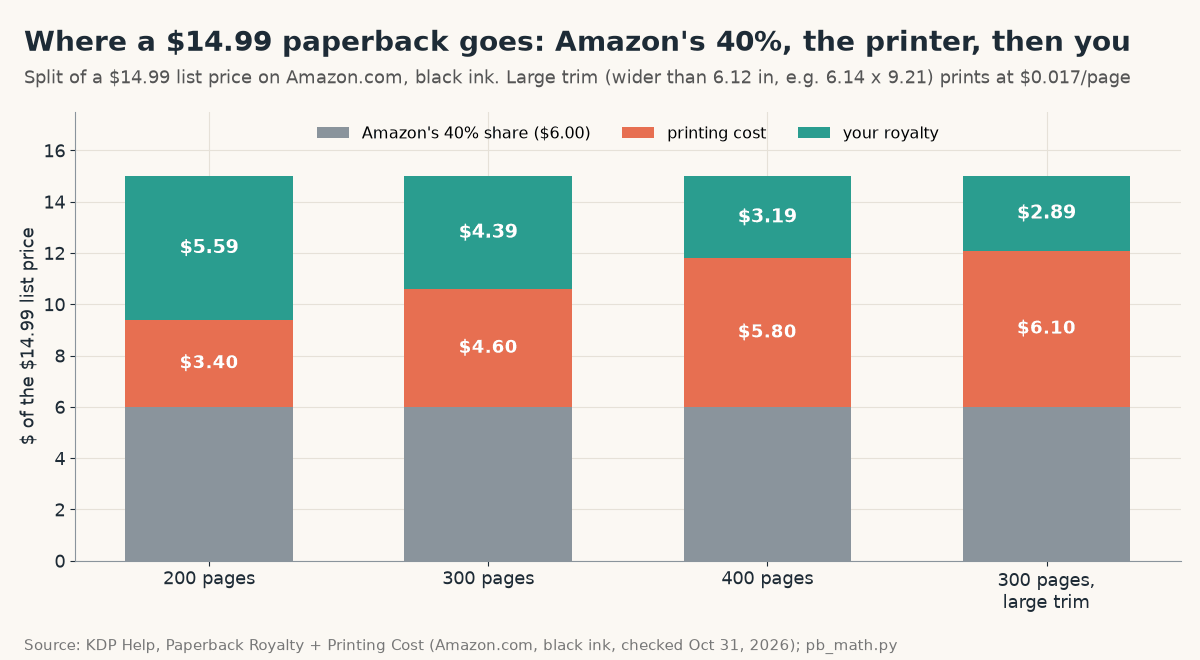
- At $14.99: 200 pages pays $5.59, 300 pages $4.39, 400 pages $3.19; a 300-page large trim pays $2.89 (−34%).
- Expanded Distribution (40%) pays $2.60 at 200 pages and about $0 at 416 pages at $14.99.
The KDP paperback royalty formula
KDP’s Paperback Royalty page gives it in one line:
(royalty rate × list price) − printing cost = royalty
On Amazon.com the rate is 50% at list prices of $9.98 or less and 60% at $9.99 or more. Through Expanded Distribution (bookstores, libraries and other retailers) it’s 40% of list, minus the same printing cost.
The Printing Cost page gives the other half. For a black-ink paperback on cream or white paper sold on Amazon.com:
- 24–110 pages: a flat $2.30 per copy (regular trim).
- 110–828 pages: $1.00 fixed + $0.012 per page (regular trim).
- Large trim (wider than 6.12 inches or taller than 9 inches): $1.00 + $0.017 per page.
KDP’s own example: a 300-page regular-trim book costs $1.00 + 300 × $0.012 = $4.60 to print. At $14.99, you keep 0.60 × $14.99 − $4.60 = $4.39.
That’s the whole calculator. Everything below is what falls out of it.
Decision 1: never list a paperback at $9.98 or below
The 50% band hurts more than “10 points” sounds, because the printing cost comes off after the rate is applied. At $9.98 a 300-page book keeps 0.50 × $9.98 − $4.60 = $0.39. At $9.99 it keeps 0.60 × $9.99 − $4.60 = $1.39.
For a 200-page book (about a 60,000-word romance at roughly 300 words per 6×9 page, which is my assumption; your interior file decides the real count) the step is $1.59 to $2.59, or +63%.
So if your paperback sits anywhere from about $8 to $9.98, the cheapest fix in your whole catalog is to raise it to $9.99. And at 400 pages you have no choice: the printing cost is $5.80, which puts KDP’s minimum list price above the 50% band, so the floor is effectively $9.99.
Decision 2: page count is a price you pay on every copy
Above 110 pages, each page costs you $0.012 on every copy you sell. That’s $1.20 per 100 pages, at any list price. To keep the same royalty, you have to raise the list price by $1.20 ÷ 0.60 = $2.00 for every extra 100 pages.
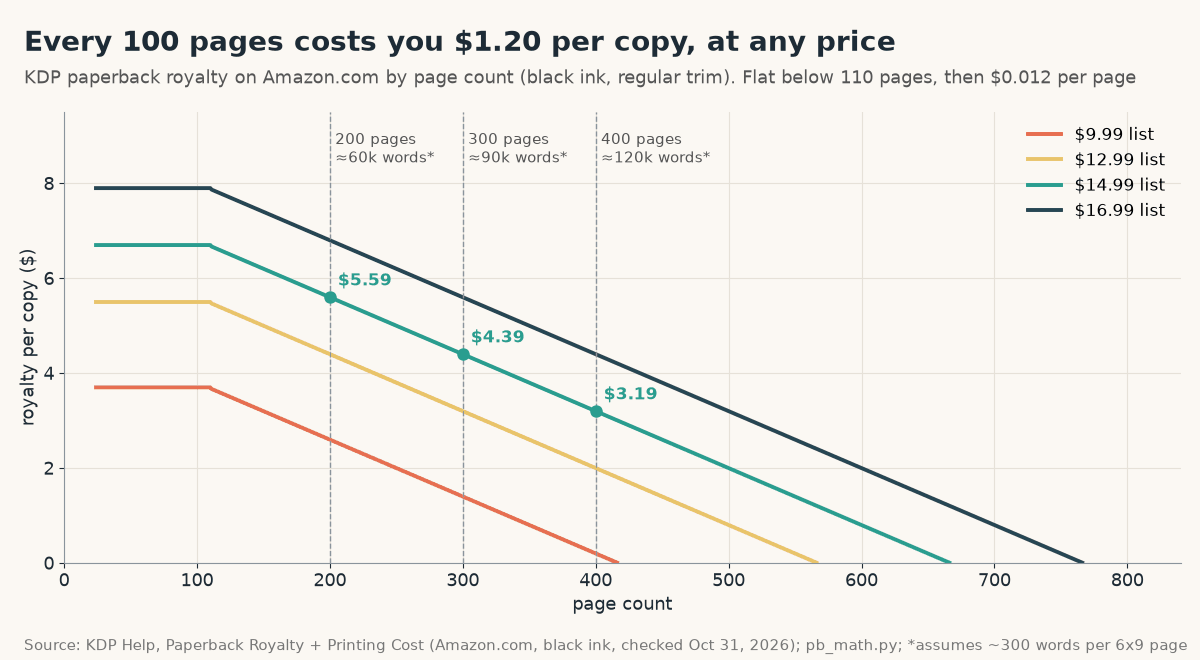
This matters more for AI-assisted series than for anyone else. When drafting is cheap, books drift long, and romantasy readers like long books. But the printer doesn’t care how the words were made. A 120,000-word romantasy (about 400 pages) at $14.99 pays $3.19. The 90,000-word version at the same price pays $4.39. To get the long book back to $4.39 you’d list it at $16.99, exactly the $2 per 100 pages rule.
Trim size is the other hidden page cost. A 6.14 × 9.21 paperback looks almost like a 6 × 9, but it’s a large trim, so every page costs $0.017 instead of $0.012. At 300 pages and $14.99 that’s a $6.10 print bill and a $2.89 royalty instead of $4.39, which is 34% less per copy. (One KDP help page says trim size doesn’t affect printing cost; the detailed cost table lists separate large-trim rates. Run your exact trim through KDP’s calculator before you commit.) I worked through that trim trap in more detail in this @iyb7 story on the 6.14 × 9.21 paperback.
The paperback royalty grid
Here is the calculator run for the prices and lengths series authors actually use. All rows are Amazon.com, black ink, regular trim.
| Pages (≈ words*) | Print cost | Min. list price | $9.98 | $9.99 | $12.99 | $14.99 | $16.99 | $19.99 |
|---|---|---|---|---|---|---|---|---|
| 200 (≈60k) | $3.40 | $6.80 | $1.59 | $2.59 | $4.39 | $5.59 | $6.79 | $8.59 |
| 300 (≈90k) | $4.60 | $9.20 | $0.39 | $1.39 | $3.19 | $4.39 | $5.59 | $7.39 |
| 400 (≈120k) | $5.80 | $9.99 | below min. price | $0.19 | $1.99 | $3.19 | $4.39 | $6.19 |
| 600 (≈180k) | $8.20 | $13.67 | below min. price | below min. price | below min. price | $0.79 | $1.99 | $3.79 |
| 300, large trim | $6.10 | $10.17 | below min. price | below min. price | $1.69 | $2.89 | $4.09 | $5.89 |
Read it two ways. Across a row, every $2 of list price adds $1.20 of royalty. Down a column, every 100 pages takes $1.20 away. A 600-page omnibus needs $13.67 just to clear KDP’s minimum list price.
Decision 3: Expanded Distribution only pays on short books at full price
Expanded Distribution pays 40% of list minus the same printing cost, so the printer eats a much bigger share. At $14.99:
- 200 pages: 0.40 × $14.99 − $3.40 = $2.60
- 300 pages: $6.00 − $4.60 = $1.40
- 416 pages: about $0.00. That’s the break-even page count at $14.99.
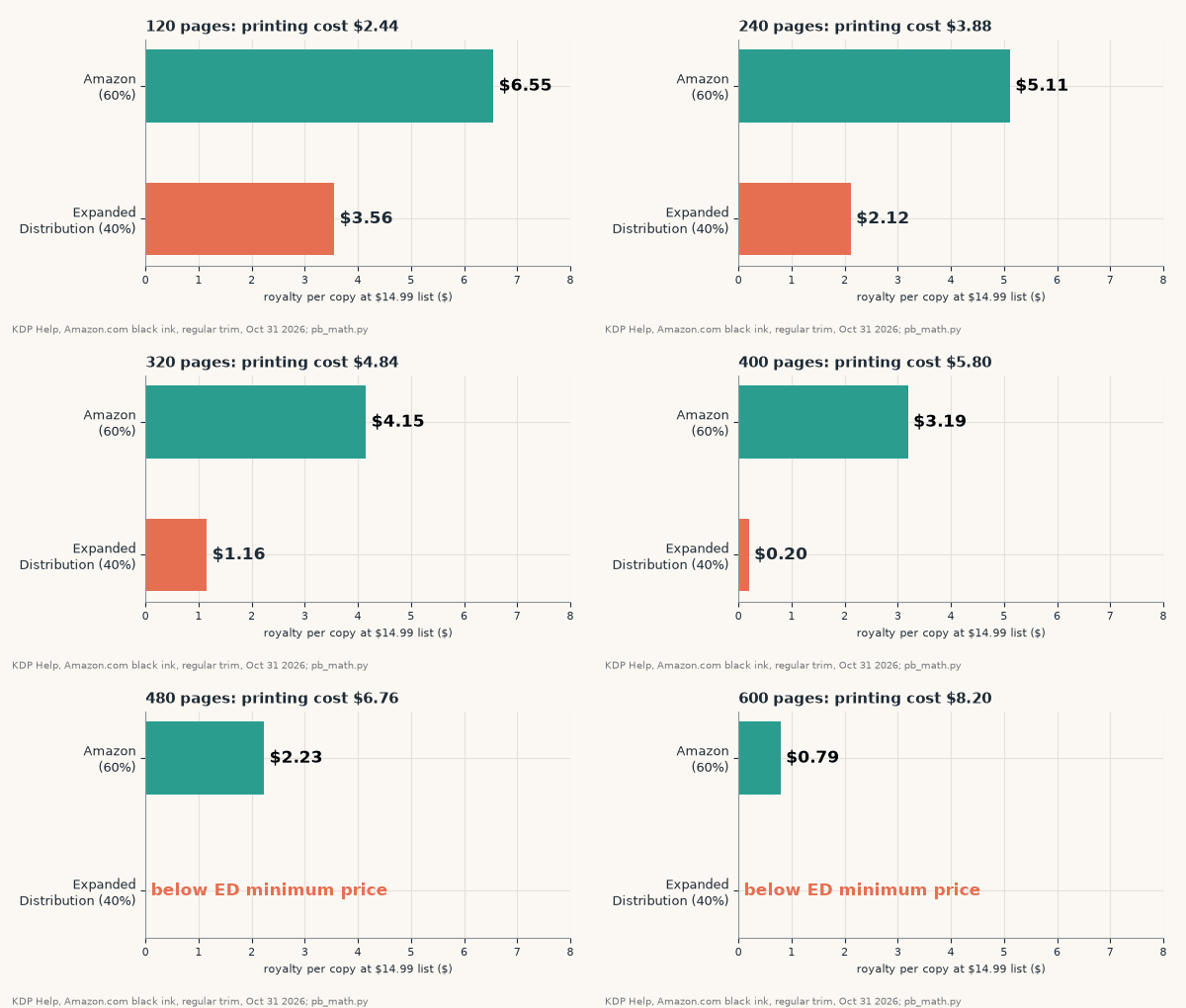
To get any positive Expanded Distribution royalty, the list price has to beat printing cost ÷ 0.40: $8.50 for 200 pages, $11.50 for 300, $14.50 for 400. For a long romantasy, Expanded Distribution either forces a high list price on Amazon too, or it pays you nearly nothing. A bookstore order is nice for visibility, but it’s rarely income.
Check before you hit Publish: list price at $9.99 or higher, page count known (every 100 pages = $1.20 per copy), regular trim unless you priced in the large-trim rate, and Expanded Distribution only if the list price is above printing cost ÷ 0.40.
What it means for a series portfolio
Paperbacks rarely carry a KU-first romance catalog. But they’re the format where pricing mistakes are permanent per copy. Three portfolio rules fall out of the grid:
1. Paperback royalty per copy beats the ebook, so price the paperback to earn. A $3.99 ebook on the 70% plan with a 1 MB file earns 0.70 × ($3.99 − $0.15) = $2.69 (KDP’s delivery cost is $0.15/MB on Amazon.com). A 200-page paperback at $14.99 earns $5.59, about 2.1 ebook sales per copy. If you’re working through the ebook side, my KDP ebook royalty calculator and the post on how to price KDP ebook series cover the 70% band.
2. A $2 price step pays for itself unless it costs you more than 27% of buyers. For a 300-page book, $12.99 pays $3.19 and $14.99 pays $4.39. You’d need to lose more than 27.3% of paperback buyers before $14.99 earns less. Napkin math (assumption: 12 paperbacks in the catalog, 15 copies each a month, same demand at both prices): $575 a month at $12.99 vs $791 at $14.99.
3. Omnibus paperbacks are a reader product, not a royalty product. Three 200-page books bundled into a 600-page paperback at $24.99 pays $6.79. Three separate $14.99 singles pay $16.78. A bundle still makes sense for ebooks (see the KDP box set math), but in print you’re giving away about $10 per reader to save them shelf space. If you’re planning series length and read-through, start with how to write a romance book series.
Summary: the paperback royalty decisions
| Decision | Number | Rule |
|---|---|---|
| List price | $0.39 at $9.98 vs $1.39 at $9.99 (300 pages) | Never list at $9.98 or below |
| Page count | $1.20 less royalty per 100 pages | Add $2.00 list price per 100 pages |
| Trim size | $2.89 vs $4.39 (300 pages, $14.99) | Stay at or under 6.12 x 9 in unless you price it in |
| Expanded Distribution | $2.60 / $1.40 / ~$0 at 200 / 300 / 416 pages | Only above print cost ÷ 0.40 |
| $12.99 → $14.99 | $3.19 → $4.39 (300 pages) | Worth it unless you lose >27.3% of buyers |
| Omnibus paperback | $6.79 vs $16.78 for three singles | Bundle ebooks, not paperbacks |
Limits of this calculator
- All numbers are Amazon.com, black ink, cream or white paper. Other marketplaces use their own fixed and per-page costs, and EU and UK list prices are entered before VAT.
- Page counts from word counts are my assumption (about 300 words per 6×9 page). Font, trim, margins and chapter breaks move that a lot.
- Demand isn’t modeled. A higher price can lose buyers; the 27% break-even tells you how many you can afford to lose.
- KDP’s calculator in your bookshelf is the final word for your file. Rates and costs change, so recheck before repricing.
The takeaway
A paperback’s royalty is set by two numbers you control: the list price (stay at $9.99 or above, and add $2.00 for every 100 pages) and the page count (every 100 pages costs $1.20 a copy, forever). Get those two right once per series, and every print copy pays what it should.
The writing is the part that no longer has to be slow. ImagineYourBook drafts the book from your prompt or notes, keeps the series consistent from Book One to Book Two, and on paid plans designs the paperback full-wrap cover for your final page count, trim and paper. The trial is $0 today with a card, includes one 10,000-word book, and the first $29.99 payment starts after 7 days unless you cancel before day 8. Then run the finished page count through the grid above before you set the price.
Sources (checked October 31, 2026): KDP: Paperback Royalty · KDP: Printing Cost · KDP: Digital Book Pricing (delivery costs) · KDP: eBook List Price Requirements · ImagineYourBook pricing and trial terms. Napkin assumptions: ~300 words per 6×9 page, 1 MB ebook file, 12 paperbacks × 15 copies a month with equal demand at both prices. Rates and costs change; re-check KDP’s calculator before you price.