
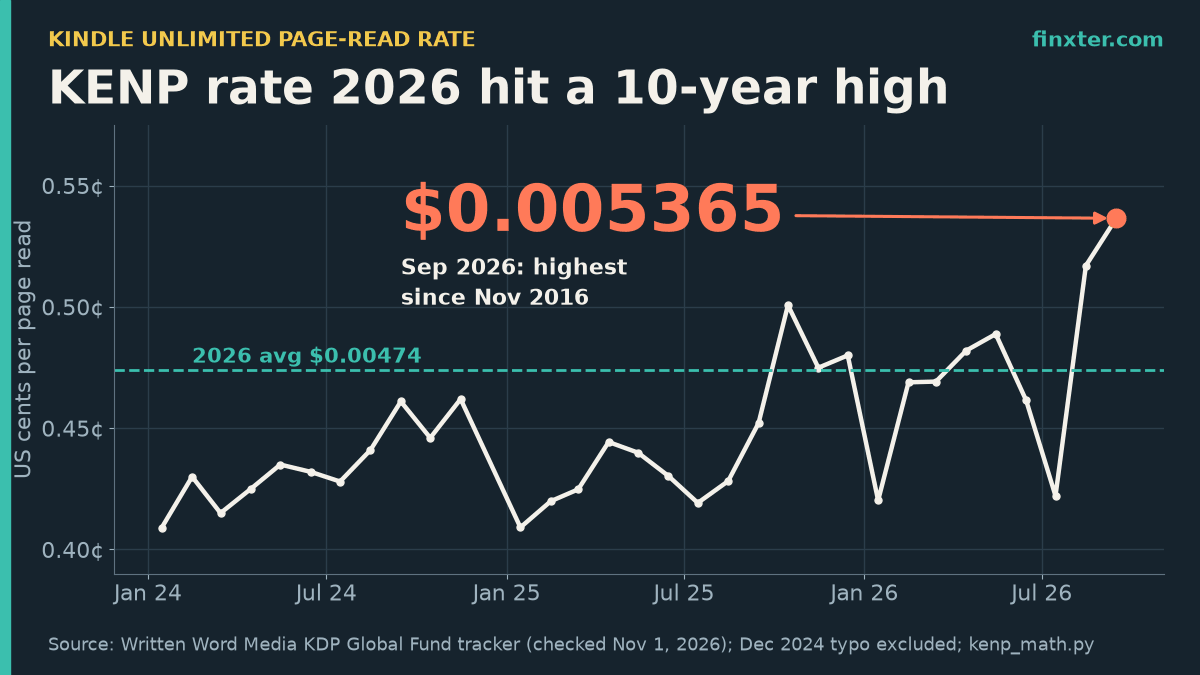
The KENP rate in 2026 has ranged from $0.004202 (January) to $0.005365 (September) per page read in the US, and it has averaged $0.00474 over the nine months Amazon has announced so far. September’s rate is the highest since November 2016, according to Written Word Media’s KDP Global Fund tracker, which logs Amazon’s monthly announcements.
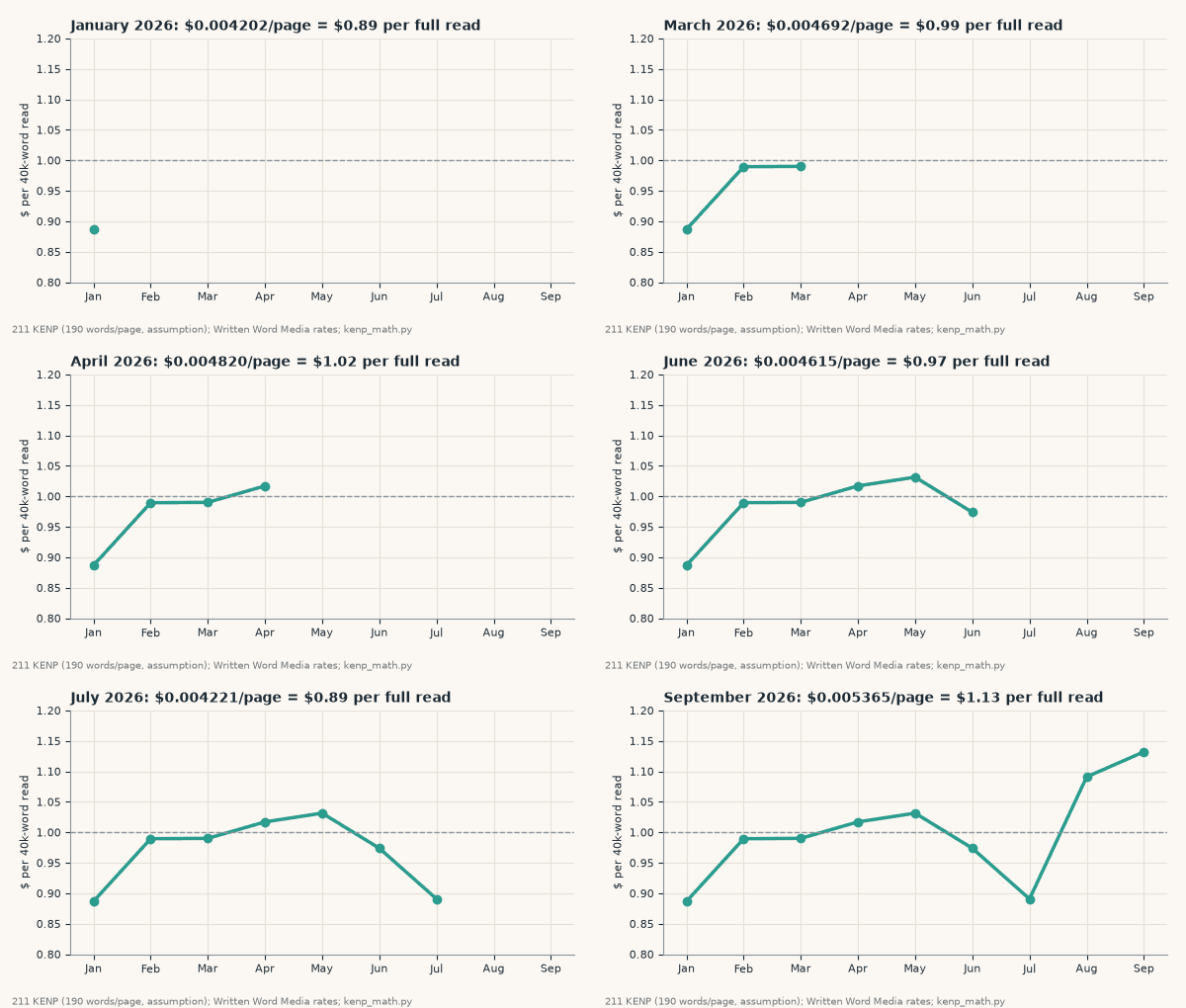
That’s the quick answer. The more useful one: the same full read of a 40,000-word novel paid $0.89 in January and $1.13 in September. Nothing about the book changed. Only the rate did. Below are every 2026 month in one table, the ten-year pattern behind it, the month that drops almost every year, and the napkin math for what this means for a KU catalog.
If you write series for Kindle Unlimited, the rate is the one number you can’t move. Pages are the number you can. That’s why the tool I’d start with is ImagineYourBook, an AI book-writing tool that turns a prompt or your notes into a full draft (a 10,000-word Small Book or a 40,000-word novel) with a cover, Word and EPUB export, and a Series Builder that carries characters and open threads into the next book.
TL;DR
- KENP rate 2026 (US): $0.004202 in January up to $0.005365 in September; Jan–Sep average $0.00474 per page.
- September’s rate is the highest since November 2016.
- One full read of a 40,000-word novel paid $0.89 in January and $1.13 in September (211 KENP, assumption).
- Since 2016 the Global Fund grew 4.4x, but the rate stayed between $0.0040 and $0.0054.
- January fell in 9 of 9 measurable years, by 8.0% on average.
What is the KENP rate?
KENP stands for Kindle Edition Normalized Pages. When a Kindle Unlimited reader borrows and reads your book, Amazon counts the pages read in KENP, a standardized page size so a font change doesn’t inflate the count. According to KDP’s KENP help page, you can earn for up to 3,000 KENP per title per customer, and pages count whether the book is “read or listened to.”
Every month Amazon sets a pot, the KDP Select Global Fund, and divides it by all pages read. That gives the per-page rate. Written Word Media’s tracker notes the program is now branded Kindle+ (formerly Kindle Unlimited); the mechanics are the same. Amazon doesn’t publish a rate formula in advance, so authors only learn last month’s rate after the fact.
KENP rate 2026, month by month
| Month | US KENP rate | Change vs prior month | KDP Global Fund | One full read, 40k-word novel* |
|---|---|---|---|---|
| January 2026 | $0.004202 | -12.5% vs Dec 2025 | $62.2M | $0.89 |
| February 2026 | $0.004689 | +11.6% | $61.7M | $0.99 |
| March 2026 | $0.004692 | +0.1% | $65.9M | $0.99 |
| April 2026 | $0.004820 | +2.7% | $64.3M | $1.02 |
| May 2026 | $0.004888 | +1.4% | $66.9M | $1.03 |
| June 2026 | $0.004615 | -5.6% | $63.6M | $0.97 |
| July 2026 | $0.004221 | -8.5% | $67.6M | $0.89 |
| August 2026 | $0.005170 | +22.5% | $66.0M | $1.09 |
| September 2026 | $0.005365 | +3.8% | $65.9M | $1.13 |
| Jan–Sep average | $0.00474 | $64.9M | $1.00 |
Three things stand out:
- January was the low at $0.004202, and July nearly matched it at $0.004221.
- August and September jumped to $0.005170 and $0.005365. September is 27.7% above January.
- The fund didn’t explain the swings. July had the biggest pot of the year, $67.6 million, and the second-worst rate. A bigger fund just means more pages were read.
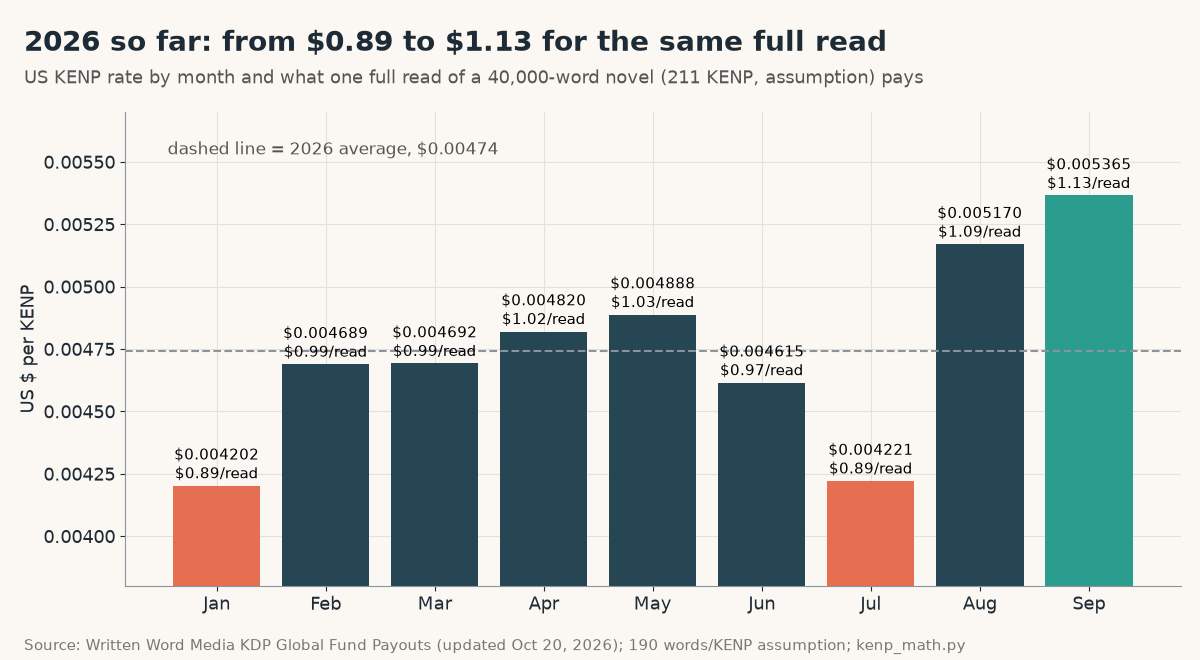
The bars carry the per-read payout because that’s the number you feel. I used 211 KENP for a 40,000-word novel, which assumes about 190 words per KENP (an assumption: authors report roughly 170 to 200, as in koobe.ai’s KENP calculator). Your own KENPC is listed on your book’s Promote and Advertise page in KDP.
Is September’s rate really a 10-year high?
Yes, with one asterisk. Going back through the tracker, the last month with a higher US rate was November 2016 ($0.0054). Before that you have to go to 2015, when the program was a year old and rates of $0.0058 showed up.
The asterisk is December 2024. The tracker lists it as $0.03228, roughly seven times every month around it. Commenters on the page flag it as a typo, and I’ve excluded it from every number here.
Zoom out and the bigger story is how little the rate moves. Since January 2016 the US rate has stayed between $0.003989 and $0.0054 per page. Meanwhile the Global Fund grew from $15 million to $65.9 million, or 4.4x.
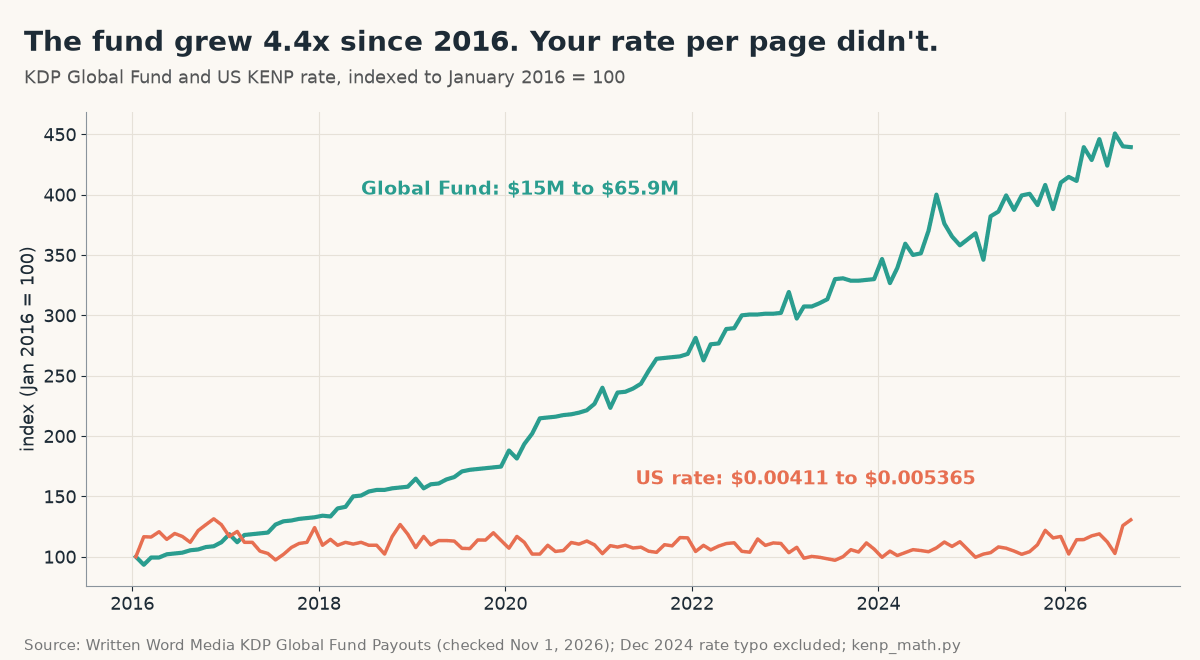
Here’s the napkin version of why (rough, because the fund is global and the rate is the US one): divide the fund by the rate and you get an implied page count of about 3.6 billion pages in January 2016 and 12.3 billion in September 2026. Readers grew, and so did the books competing for them. The pot grows; your slice per page doesn’t.
January drops almost every year
If you budget on KU income, this is the pattern worth taping to the wall. I computed the month-over-month change in the US rate for every month from 2017 to 2025 and averaged by calendar month.
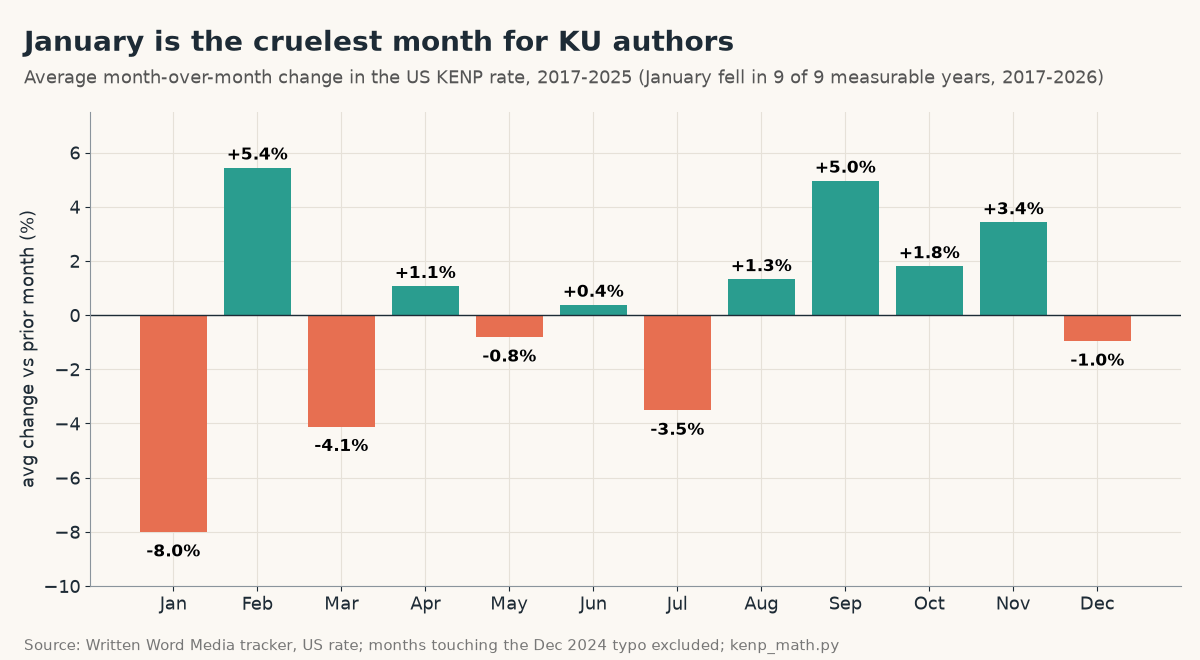
January is the standout: an average -8.0% versus December, and the rate fell in January in 9 of the 9 years I could measure from 2017 to 2026 (2025 is skipped because its December comparison is the typo). February bounces back (+5.4% on average), and September has been strong too (+5.0%).
My read, which is a hunch rather than something Amazon confirms: holiday device gifts and free-time reading flood January with pages, so the same pot gets split thinner. Whatever the cause, the takeaway is practical. Don’t plan a big KU-only launch expecting January’s rate to look like December’s.
What the rate means in dollars
Rates in fractions of a cent are hard to feel. Here’s the same data as money, with my assumptions labeled.
| Scenario | January 2026 rate | 2026 average | September 2026 rate |
|---|---|---|---|
| One full read, 40k-word novel (211 KENP) | $0.89 | $1.00 | $1.13 |
| Full read as share of a $3.99 sale ($2.79 at 70%) | 32% | 36% | 41% |
| Example catalog: 500,000 KENP in a month | $2,101 | $2,370 | $2,683 |
| Same catalog over 12 months | $25,212 | $28,441 | $32,190 |
Two comparisons from that table:
- A borrow vs a sale. At the 2026 average, a full KU read of a 40,000-word novel pays about $1.00. A $3.99 sale at the 70% royalty band pays about $2.79 before delivery fees, so one full read is worth about 36% of a sale. That’s fine for a reader who would never have paid, and it’s why read-through across a series matters so much. More on that in our post on how much you can make on Kindle Unlimited.
- The swing on a catalog. Assume (example number) a catalog reading 500,000 KENP a month. January’s rate pays $2,101 and September’s pays $2,683. That’s a $582 difference in one month for identical reading. At the 2026 average, the same catalog earns about $28,441 a year from pages.
You can’t control the first number in “pages x rate”. So a sensible KU business plans on the average, treats the swings as noise, and pushes the other number.
Five ways to earn more when the rate won’t budge
- Plan on the average, not the last month. Use the 2026 average ($0.00474) or 2025’s ($0.004436) in your projections. One great month like September will make an annual forecast look about 13% better than the year’s average.
- Write series, not standalones. Each book adds pages for readers who already like you. Our romance series guide shows how read-through compounds.
- Get more page reads per borrow. Book length, hooks at chapter ends and back matter all change how many KENP a borrow turns into. See how to get more Kindle Unlimited page reads.
- Decide Select vs wide per book. KU’s rate is only one side of the trade. We ran the numbers in KDP Select vs wide.
- Check your per-sale royalty too. Price changes move sales royalties more than the KENP rate ever will. Our KDP royalty calculator does the math.
Watch the December 2024 number: the tracker lists $0.03228, about seven times normal. If you pull rates into a spreadsheet, drop or fix that row or your averages will be badly inflated.
When does the next KENP rate come out?
Amazon announces each month’s fund and rate after the month ends, and the tracker updates when it does. Written Word Media posted September’s figures on October 20, 2026, so October’s numbers will come after that pattern, most likely in November. History says the October change has been mild: an average of +1.8% versus September from 2017 to 2025. That’s an average, not a forecast.
| Question | Answer | What to do |
|---|---|---|
| KENP rate 2026 average (Jan–Sep)? | $0.00474 per page (US) | Use this, not last month, in projections |
| 2026 high and low? | High $0.005365 (Sep), low $0.004202 (Jan) | Expect ±10–15% months as normal noise |
| Is September a record? | Highest since Nov 2016 ($0.0054) | Enjoy it; don’t extrapolate it |
| Does a bigger fund mean a better rate? | No: July had the 2026 high fund ($67.6M), second-lowest rate | Ignore fund headlines |
| Weakest month historically? | January, -8.0% on average; fell 9 of 9 years | Avoid KU-only launches that depend on January’s rate |
| Biggest lever you control? | Pages read: more books, series read-through | Publish the next book in the series |
The takeaway
The KENP rate in 2026 so far is $0.00474 on average, with a low of $0.004202 in January and a near-ten-year high of $0.005365 in September. Over ten years it has stayed in a narrow band while the fund quadrupled. So the rate is weather, and pages are the climate you build.
For KU authors, that means more books in a series, finished faster, with consistent characters. If drafting is your bottleneck, try ImagineYourBook. The trial costs $0 today with a card, includes one complete 10,000-word book, and the first $29.99 payment starts after 7 days unless you cancel before day 8. At the 2026 average rate, a $29.99 month of the Author plan (about one 40,000-word novel) pays for itself after about 30 full KU reads of that novel, before any sales. You still do the editing, positioning and marketing; no tool guarantees income.
Sources (checked November 1, 2026): Written Word Media: KDP Global Fund Payouts (updated Oct 20, 2026) · KDP Help: Kindle Edition Normalized Page (KENP) · koobe.ai: KENP calculator (words per KENP band) · ImagineYourBook pricing and trial terms. All averages, changes and implied page counts are my calculations from the tracker’s monthly figures, with the December 2024 rate excluded as a likely typo. Napkin assumptions: 190 words per KENP, $3.99 at 70% royalty, and a 500,000-KENP example catalog. Related: what an LLM costs to draft a novel, in LLM API cost of a 50,000-word novel, and KU audio reads in KDP audiobook royalty.