
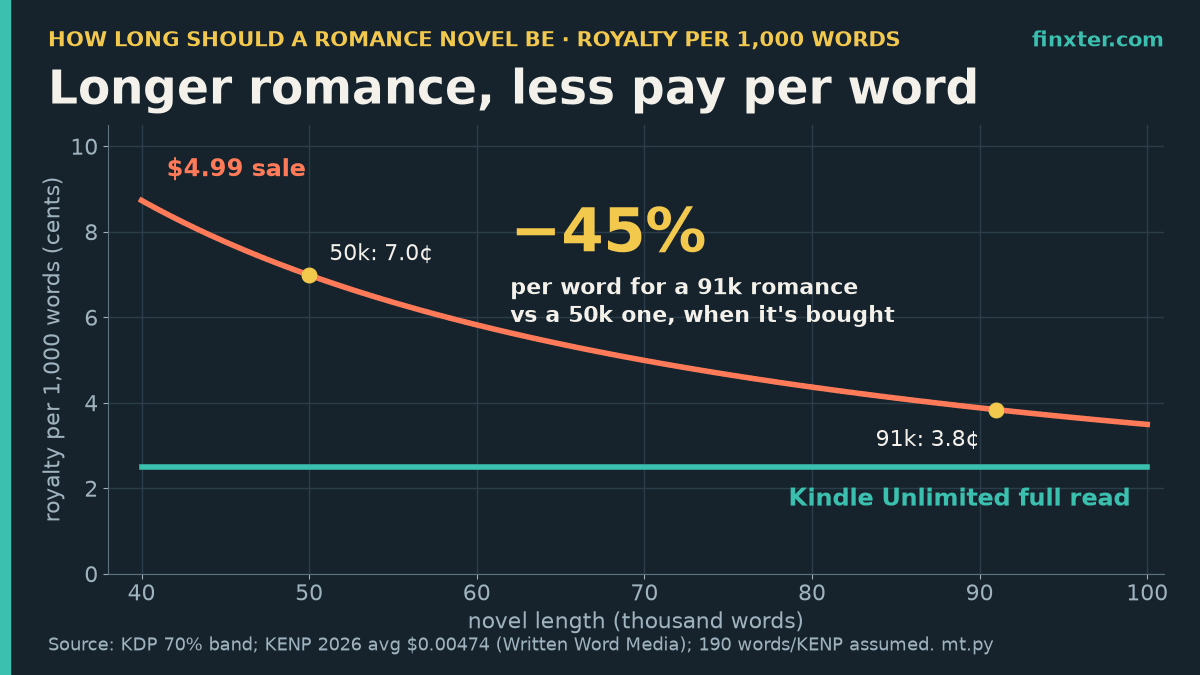
A 91,000-word romance doesn’t earn a cent more per word than a 50,000-word one in Kindle Unlimited. And when a reader buys it at $4.99, it earns 45% less per word you wrote.
So how long should a romance novel be? Most land between 50,000 and 100,000 words. Harlequin’s open romance lines ask for 50,000 to 85,000 words (median 55,000), while the top 100 romances on Amazon average 91,000, according to Kindlepreneur’s word-count research. If you’re building a KDP series, the money math below says: go as short as your subgenre’s readers accept, and spend the saved words on the next book.
If you’re writing a series on a schedule, the tool I’d start with is ImagineYourBook. It’s an AI book-writing tool that turns a prompt or your notes into a complete draft with a cover. You pick the finished length (anywhere from 1,000 to 200,000 words), export to Word or EPUB, and its Series Builder carries a story bible, characters and open threads into Book Two.
TL;DR
- Most romance novels run 50,000–100,000 words; Harlequin’s eleven open lines have a median of 55,000.
- Amazon’s Top 100 romances average 91,000 words (range 19,000–194,000), per Kindlepreneur.
- Kindle Unlimited pays the same per word at any length: about 2.5 cents per 1,000 words at the 2026 KENP average.
- At $4.99, a 50,000-word book earns 82% more per word than a 91,000-word one.
- For a series business: as short as your subgenre allows, and more books per year.
What publishers actually ask for
The cleanest public data on romance length comes from the people who buy romance manuscripts for a living. Harlequin lists a target word count for every line on its Submittable guidelines page. I pulled all eleven open lines on November 11, 2026 (Harlequin Historical is closed to submissions and ends in September 2027, so it’s out).
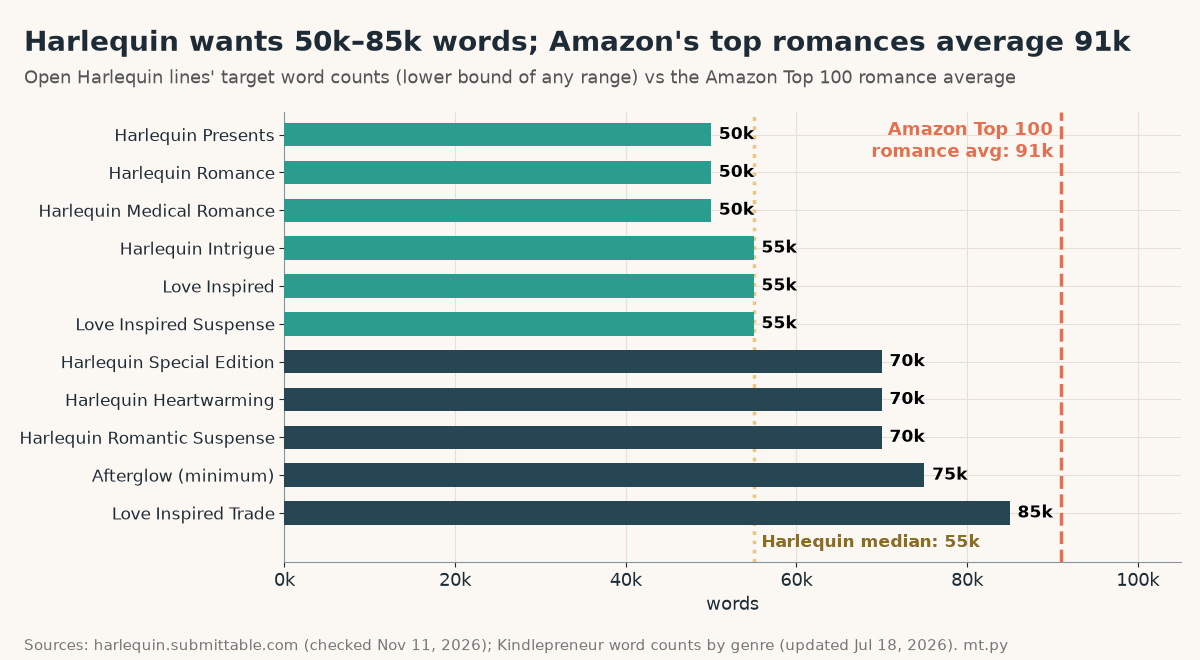
Three things stand out:
- Short category romance is a real, paid format. Presents, Romance and Medical Romance all target 50,000 words. Intrigue, Love Inspired and Love Inspired Suspense sit at 55,000.
- Longer means more subplot, not more romance. Harlequin says the 70,000-word Romantic Suspense length means “a wider breadth of story and potential for subplots.” Special Edition and Heartwarming are also 70,000.
- The top of the range is about 100,000. Afterglow by Harlequin wants “over 75,000 words,” and Love Inspired Trade runs 85,000 to 100,000.
Amazon’s bestseller lists skew longer. Kindlepreneur averaged the Amazon Top 100 in each Kindle category, removing box sets and omnibuses, and found romance at 91,000 words on average, with a range of 19,000 to 194,000. Erotica averaged 58,000 and fantasy 109,000, which is worth remembering if you write romantasy.
So there’s no single right answer. There’s a band, and where you sit in it should depend on your subgenre and on how you get paid.
Kindle Unlimited pays per word, so length is neutral there
Kindle Unlimited pays by KENP (Kindle Edition Normalized Pages) read. The 2026 US rate has averaged $0.00474 per page from January to September, per Written Word Media’s KDP Global Fund tracker, which we broke down in our KENP rate 2026 analysis.
Now the napkin math. I assume 190 words per KENP (an assumption: authors report roughly 170 to 200, and your exact count is listed in KDP).
- A 50,000-word romance is about 263 KENP, so one full read pays about $1.25.
- A 91,000-word romance is about 479 KENP, so one full read pays about $2.27.
- Per 1,000 words, both pay the same: 2.5 cents.
That’s the key point. In KU, a longer book pays more per reader but exactly the same per word you wrote. Length doesn’t change your hourly rate; only finished reads do. If readers drop off in a saggy middle, a longer book pays less per word, not more. Our guide on how to get more Kindle Unlimited page reads covers that side.
Sales pay per book, so shorter wins per word
Sales flip the math. KDP’s 70% royalty band now covers list prices from $2.99 to $12.99 on Amazon.com (effective July 7, 2026, per KDP’s eBook list price page). At an assumed $4.99, a sale pays about $3.49 before the small delivery fee, no matter how long the book is.
| Length (words) | KENP (est.) | KU pay per full read | KU per 1,000 words | $4.99 sale per 1,000 words | Books per 600k words |
|---|---|---|---|---|---|
| 40,000 | 211 | $1.00 | 2.5¢ | 8.7¢ | 15.0 |
| 50,000 | 263 | $1.25 | 2.5¢ | 7.0¢ | 12.0 |
| 55,000 | 289 | $1.37 | 2.5¢ | 6.4¢ | 10.9 |
| 70,000 | 368 | $1.75 | 2.5¢ | 5.0¢ | 8.6 |
| 75,000 | 395 | $1.87 | 2.5¢ | 4.7¢ | 8.0 |
| 91,000 | 479 | $2.27 | 2.5¢ | 3.8¢ | 6.6 |
| 100,000 | 526 | $2.49 | 2.5¢ | 3.5¢ | 6.0 |
At $4.99, the 50,000-word book earns 7.0 cents per 1,000 words and the 91,000-word book earns 3.8 cents. That’s 45% less, or put the other way, the shorter book pays 82% more per word. To match the 50,000-word book’s per-word royalty, the 91,000-word book would need a list price of about $9.08.
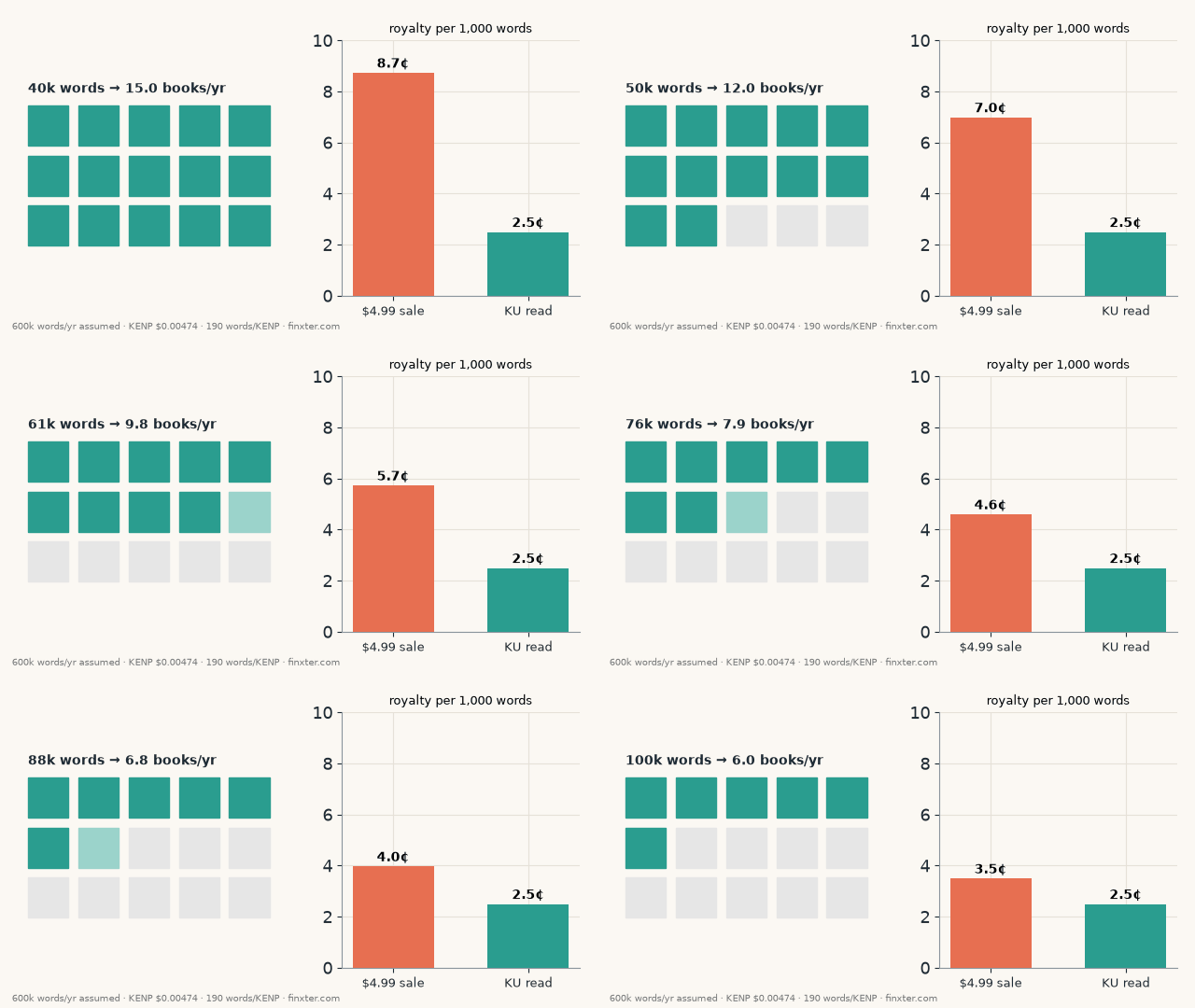
What it means for a year of writing
Here’s where it compounds. Assume you can publish 600,000 finished words a year and that 100 loyal readers buy or read every book you release (both are assumptions, picked to make the comparison easy to scale).
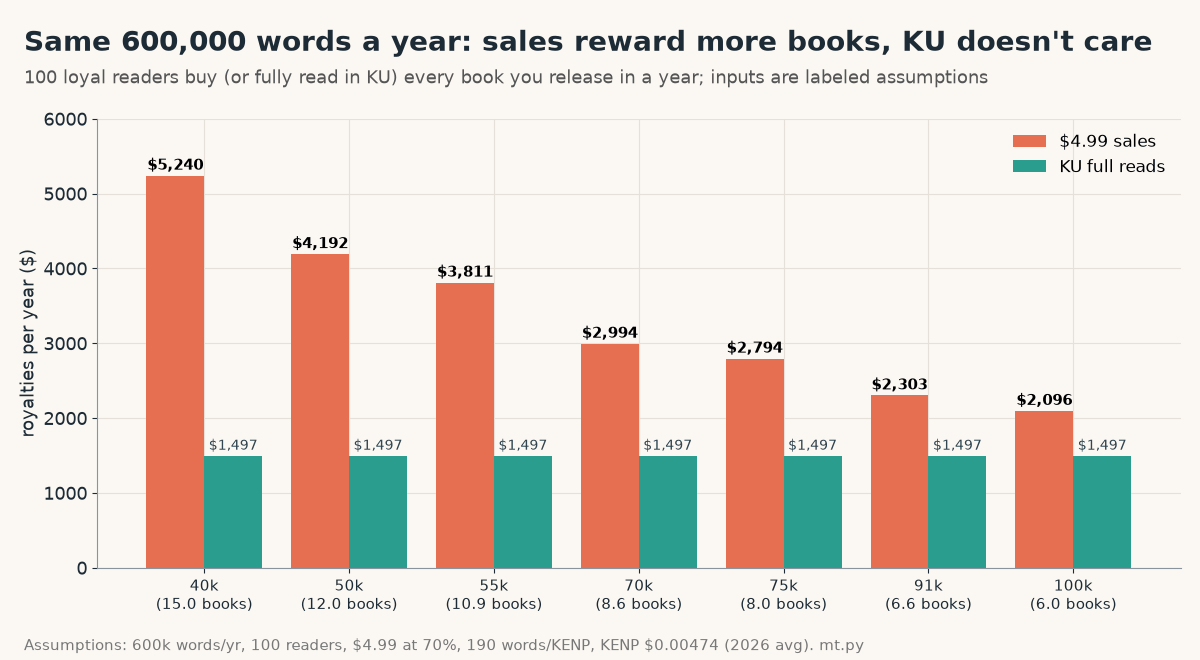
- In KU, every length pays the same: about $1,497 a year from those 100 readers, because they read the same 600,000 words either way.
- In sales, twelve 50,000-word books earn about $4,192, while 6.6 books at 91,000 words earn about $2,303. Same words, same readers, 82% more money.
More books also means more release days, more “also bought” slots and more entry points into a series. Our romance series guide shows how read-through multiplies that effect.
The guardrail: readers of some subgenres expect length. Romantic suspense, slow-burn and romantasy readers often want subplots and worldbuilding, and a 50,000-word book can feel thin there. The math rewards short books only when they still deliver a complete, satisfying arc.
Don’t pad and don’t gut. KU only pays for pages that get read, and sales only pay once. A padded 91,000-word book can earn less per word than a tight 70,000-word one if readers quit halfway.
A practical way to pick your length
- Find your subgenre’s band. If your book looks like a Harlequin line, start from its count. If it’s indie contemporary or dark romance, compare against 10 bestsellers in your exact Amazon category.
- Decide how you’ll be paid. KU-heavy: length is neutral, so write the length that keeps readers turning pages. Sales-heavy or wide: lean shorter and release more often.
- Price to the length. If you write long, price toward the top of the 70% band to recover per-word value.
- Plan the series, not the book. A 55,000-word book that leads into Book 2 usually beats a 91,000-word standalone. See self-publishing romance novels on Amazon for the full launch picture.
- Draft fast, edit hard. An AI first draft gets you to the editing stage sooner. Our roundup of the best AI for writing romance novels compares the options.
| Your situation | Length to aim for |
|---|---|
| Category-style romance (sweet, medical, billionaire) | 50,000–55,000, like Harlequin Presents, Romance and Intrigue |
| Contemporary with subplots, romantic suspense | 70,000, like Special Edition and Romantic Suspense |
| Competing with Amazon’s top 100 head-on | Around 91,000, the Top 100 romance average |
| Romantasy or epic worldbuilding | Closer to fantasy norms (Top 100 fantasy average 109,000) |
| Mostly Kindle Unlimited | Length is neutral per word; optimize for finished reads |
| Mostly sales or wide | Lean shorter and release more often, or price long books higher |
FAQ
How many words should a romance novel be?
Most romance novels are 50,000 to 100,000 words. Harlequin's open lines ask for 50,000 to 85,000 (median 55,000), and Amazon's Top 100 romances average 91,000 words, according to Kindlepreneur.
Is 50,000 words long enough for a romance novel?
Yes for category romance. Harlequin Presents, Harlequin Romance and Medical Romance all target 50,000 words. For romantic suspense or romantasy, readers usually expect more subplot and length.
Do longer books earn more on Kindle Unlimited?
Per reader, yes; per word, no. At the 2026 average of $0.00474 per KENP and an assumed 190 words per page, every length pays about 2.5 cents per 1,000 words read.
How many pages is a 70,000-word romance?
In Kindle Unlimited terms, roughly 368 KENP, assuming 190 words per normalized page. KDP shows your book's exact KENPC on its Promote and Advertise page.
Should I price a longer romance novel higher?
If you sell rather than rely on KU, probably. At $4.99 a 91,000-word book earns 45% less per word than a 50,000-word one; matching it would take about $9.08, still inside KDP's 70% band.
The takeaway
How long should a romance novel be? Between 50,000 and 100,000 words, with category romance near 50,000 to 55,000 and Amazon’s bestsellers averaging 91,000. In Kindle Unlimited, length is neutral per word. In sales, a 50,000-word book pays 82% more per word than a 91,000-word one at the same price. For a series business, that usually means shorter books, released more often.
If you want to test that with a real draft, ImagineYourBook lets you set the exact length and carry your characters into the next book. The 7-day trial is $0 (card required) and includes one complete 10,000-word book; after that, the Author plan is $24.99 a month for 40,000 words.
Sources (checked November 11, 2026): Harlequin writing guidelines (Submittable) · Kindlepreneur: How long should a novel be? Word counts by genre · Written Word Media: KDP Global Fund payouts · KDP Help: eBook list price requirements · KDP Help: eBook royalties · koobe.ai KENP calculator (words per page) · ImagineYourBook pricing. Assumptions: 190 words per KENP; $4.99 list price at the 70% royalty (delivery fee ignored); 600,000 published words a year; 100 readers who buy or fully read every book.