
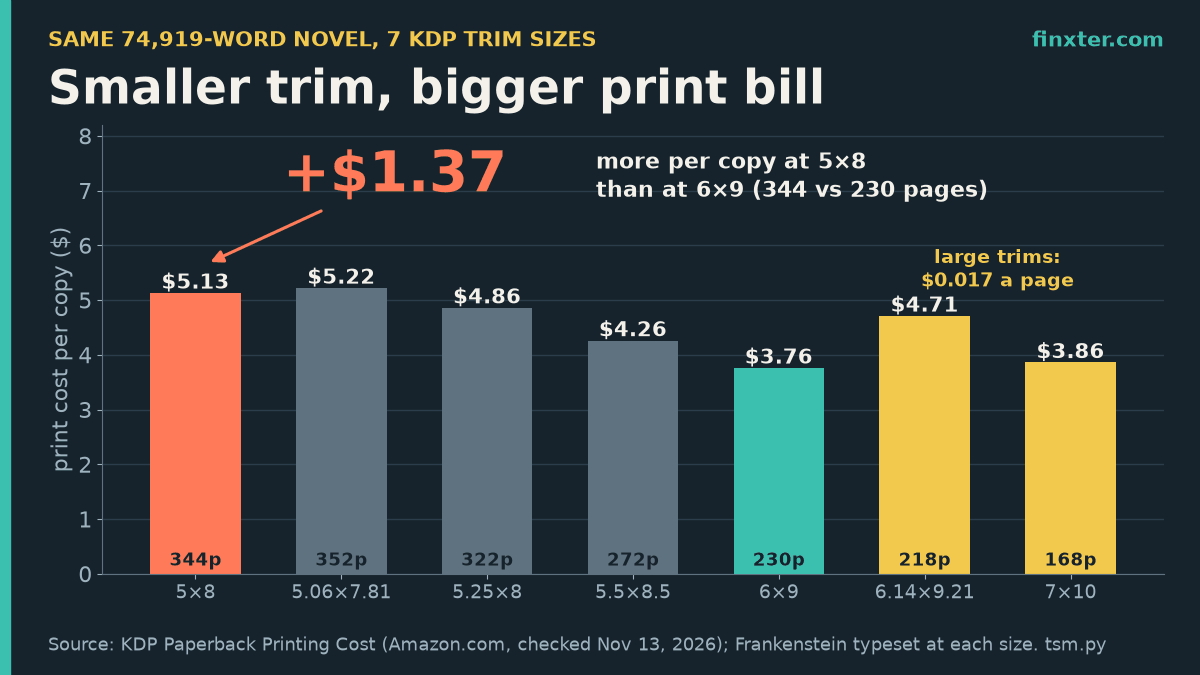
A smaller trim size doesn’t give you a cheaper paperback on KDP. It gives you a more expensive one. I typeset the same novel, Frankenstein (74,919 words), at seven KDP trim sizes with the same font and margins. At 5 x 8 it printed on 344 pages and cost $5.13 per copy. At 6 x 9 it needed 230 pages and cost $3.76.
That’s $1.37 more on every copy for the smaller book, because KDP charges by the page, not by the paper area. At a $14.99 list price, the 6 x 9 edition pays you $5.23 a copy and the 5 x 8 edition pays $3.86. Most trim size guides stop at dimensions or one words-per-page guess. This KDP trim size calculator runs on page counts I actually measured, then turns them into the numbers you care about: print cost, royalty, minimum price, spine width, and Expanded Distribution eligibility. KDP rates were checked on November 13, 2026.
TL;DR
- Same 74,919-word novel: 344 pages at 5 x 8 vs 230 pages at 6 x 9. KDP charges per page, so 5 x 8 costs $1.37 more per copy.
- At $14.99 on Amazon.com, 6 x 9 pays $5.23 a copy and 5 x 8 pays $3.86. 6 x 9 paid the most for all 3 books I tested.
- Large trims (wider than 6.12 in or taller than 9 in) cost $0.017 a page, not $0.012: 6.14 x 9.21 saves 12 pages but costs $0.95 more.
- 11 pt instead of 12 pt cut pages by about 14%; changing the trim moved the cost 3.6 times as much.
- On cream paper, 5.06 x 7.81, 6.14 x 9.21 and 7 x 10 are not eligible for Expanded Distribution.
One step before the layout: trim size only matters once you have a finished book, and a catalog of them is what makes paperback royalties add up. My top pick for drafting that catalog is ImagineYourBook. It’s an AI book-writing tool that turns your idea or notes into a complete text draft with a cover, exports Word, EPUB and Markdown files, and keeps characters and plot threads consistent across a series. Paid plans add paperback full-wrap covers. You revise the draft in your own voice, then pick the trim with the numbers below.
How I measured it
Words-per-page rules of thumb disagree, so I set real books instead. I took three public-domain novels from Project Gutenberg that cover the usual genre lengths:
- The Great Gatsby: 48,143 words (novella to short-novel length)
- Frankenstein: 74,919 words (a typical genre novel)
- Pride and Prejudice: 121,606 words (long fantasy or saga territory)
Each book was typeset at seven KDP paperback trim sizes with identical settings: 12 pt EB Garamond, 1.4 line spacing, justified text with hyphenation, 0.8 in top and bottom margins, 0.7 in outside margin, and every chapter on a new page. The inside margin was KDP’s minimum gutter for the resulting page count plus 0.2 in. Where a book crossed a page band, I re-ran it with the larger gutter KDP requires. I then rounded each count up to an even number and applied KDP’s Amazon.com printing cost and royalty rules. The page counts are body text only, so add your front and back matter.
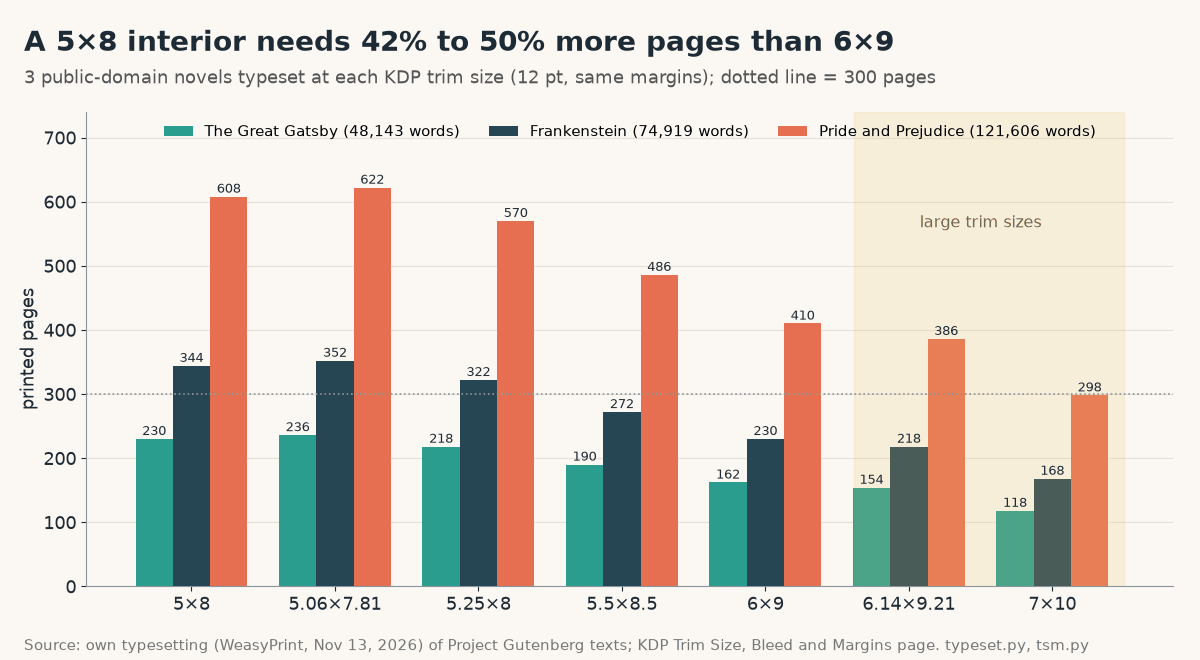
The pattern holds for all three books. A 5 x 8 interior needs 42% to 50% more pages than 6 x 9. The 5.06 x 7.81 size is even worse than 5 x 8 because it’s shorter. The two large sizes, 6.14 x 9.21 and 7 x 10, need the fewest pages.
The trim size table for a 75,000-word novel
Here is every number for Frankenstein, the 74,919-word book. It’s the closest of the three to a typical romance, mystery, or thriller length.
| Trim (in) | Words per page | Pages | Print cost | Royalty at $14.99 | Minimum list price | Spine (cream) | Expanded Distribution on cream |
|---|---|---|---|---|---|---|---|
| 5 x 8 | 218 | 344 | $5.13 | $3.86 | $9.99 | 0.860 in | Yes |
| 5.06 x 7.81 | 213 | 352 | $5.22 | $3.77 | $9.99 | 0.880 in | No |
| 5.25 x 8 | 233 | 322 | $4.86 | $4.13 | $9.72 | 0.805 in | Yes |
| 5.5 x 8.5 | 276 | 272 | $4.26 | $4.73 | $8.52 | 0.680 in | Yes |
| 6 x 9 | 326 | 230 | $3.76 | $5.23 | $7.52 | 0.575 in | Yes |
| 6.14 x 9.21 (large) | 344 | 218 | $4.71 | $4.28 | $9.42 | 0.545 in | No |
| 7 x 10 (large) | 449 | 168 | $3.86 | $5.13 | $7.72 | 0.420 in | No |
Three things stand out.
Small trims cost more and raise your price floor. At 5 x 8 the print cost is $5.13, so KDP won’t let you list below $9.99. At 6 x 9 the minimum is $7.52.
The gutter rule adds pages on top. At 5 x 8, Frankenstein first came out at 332 pages with a 0.5 in gutter. Over 300 pages KDP requires a 0.625 in gutter, and the narrower text block pushed the book to 343 pages, 11 more. Small trims cross those page bands sooner, so they get hit more often.
Large trims cost more per page. KDP calls anything wider than 6.12 in or taller than 9 in a large trim and charges $0.017 per page instead of $0.012. The 6.14 x 9.21 size looks almost like 6 x 9 and saves 12 pages, but each copy costs $0.95 more. I wrote about that look-alike trap in this @iyb7 story on the 6.14 x 9.21 paperback. One catch: KDP’s Paperback Royalty page says trim size doesn’t affect printing cost, but its Printing Cost page lists separate large-trim rates. I used the detailed table. Check your exact book in KDP’s own calculator before you commit.
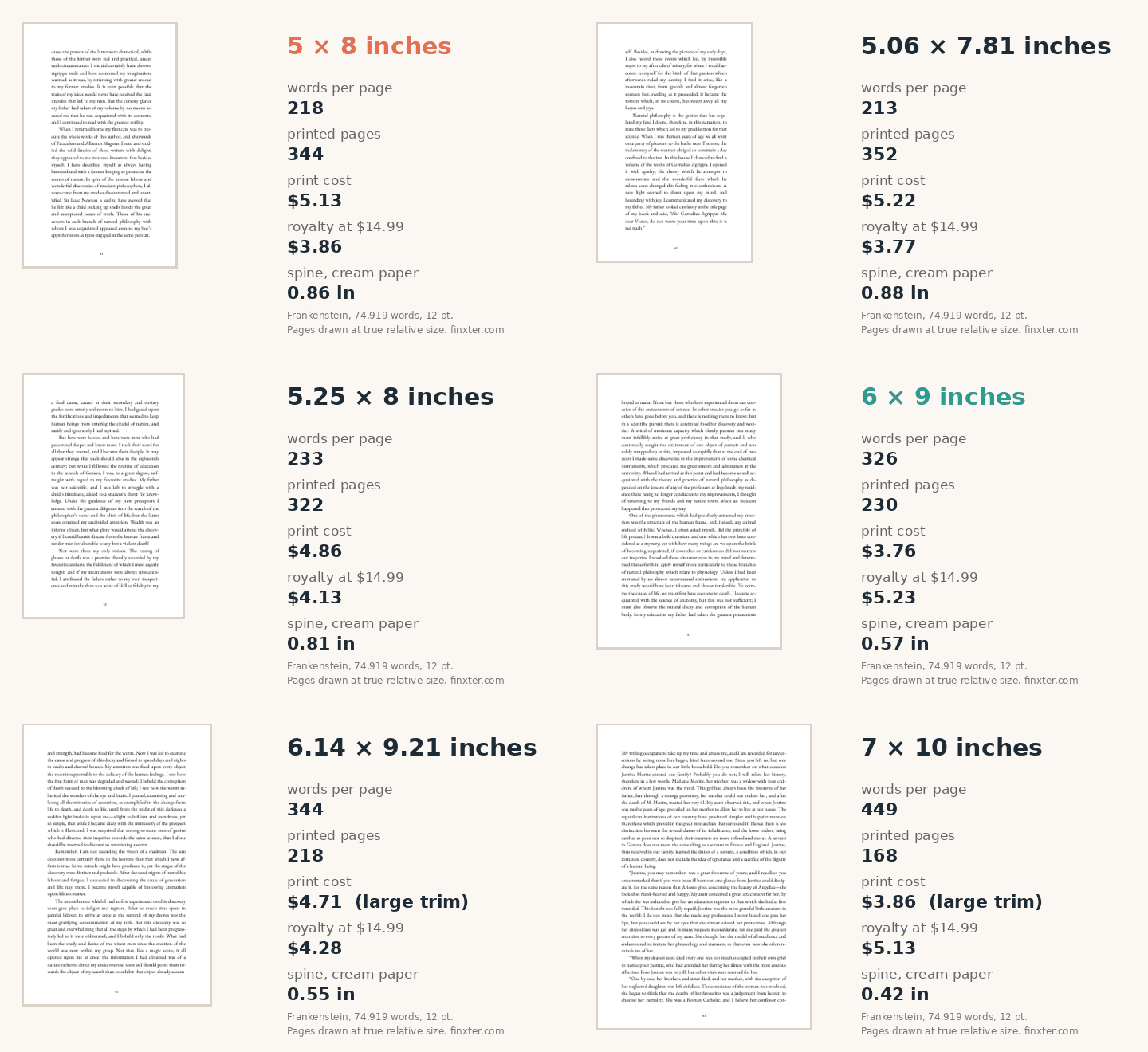
Try it: KDP trim size calculator
Enter your word count and price. The calculator uses the words per page I measured for each trim (12 pt, averaged over the three books) and shows every trim side by side.
KDP trim size calculator (Amazon.com, black ink)
Why rules of thumb understate the gap
Other page-count tools do publish words-per-page figures. They imply a much smaller jump from 6 x 9 to 5 x 8 than I measured:
| Source | Words per page, 5 x 8 | Words per page, 6 x 9 | Extra pages at 5 x 8 |
|---|---|---|---|
| BookSpace trim size guide (11 pt) | about 260 | about 325 | 25% |
| Kernsetzer words-per-page data (12 pt fiction) | 273 | 354 | 30% |
| BookWriter page count table | about 280 | about 300 | 7% |
| This test, 12 pt (3 full novels, chapter openings included) | 200 to 218 | 297 to 326 | 42% to 50% |
| This test, 11 pt | 231 to 260 | 343 to 378 | 45% to 48% |
The difference is the margins. Margins are fixed in inches, so they take a bigger share of a small page. With my margins and a 0.5 in gutter, the 5 x 8 text block is 3.6 x 6.4 in and the 6 x 9 block is 4.6 x 7.4 in. The 6 x 9 page is 35% bigger, but its text area is 48% bigger. If you use tighter margins on a small trim, your gap will be smaller than mine. If you use generous ones, expect a gap closer to mine.
Font size moves less money than trim size
Dropping the body text from 12 pt to 11 pt cut page counts by about 14% across the nine runs I did at 5 x 8, 5.5 x 8.5 and 6 x 9. For Frankenstein at 6 x 9, that’s 230 pages down to 198, which saves $0.38 a copy. Switching the same book from 5 x 8 to 6 x 9 cut 114 pages and saved $1.37. If you’re squeezing pages, change the trim before you shrink the type. Readers notice small type, and they rarely notice an extra inch of page.
Long books: where trim size decides whether you earn anything
Trim choice matters more the longer the book. Here are all three books at $14.99:
| Trim (in) | Gatsby, 48,143 words | Frankenstein, 74,919 words | Pride and Prejudice, 121,606 words |
|---|---|---|---|
| 5 x 8 | 230 / $5.23 | 344 / $3.86 | 608 / $0.69 |
| 5.06 x 7.81 | 236 / $5.16 | 352 / $3.77 | 622 / $0.53 |
| 5.25 x 8 | 218 / $5.37 | 322 / $4.13 | 570 / $1.15 |
| 5.5 x 8.5 | 190 / $5.71 | 272 / $4.73 | 486 / $2.16 |
| 6 x 9 | 162 / $6.05 | 230 / $5.23 | 410 / $3.07 |
| 6.14 x 9.21 | 154 / $5.37 | 218 / $4.28 | 386 / $1.43 |
| 7 x 10 | 118 / $5.98 | 168 / $5.13 | 298 / $2.92 |
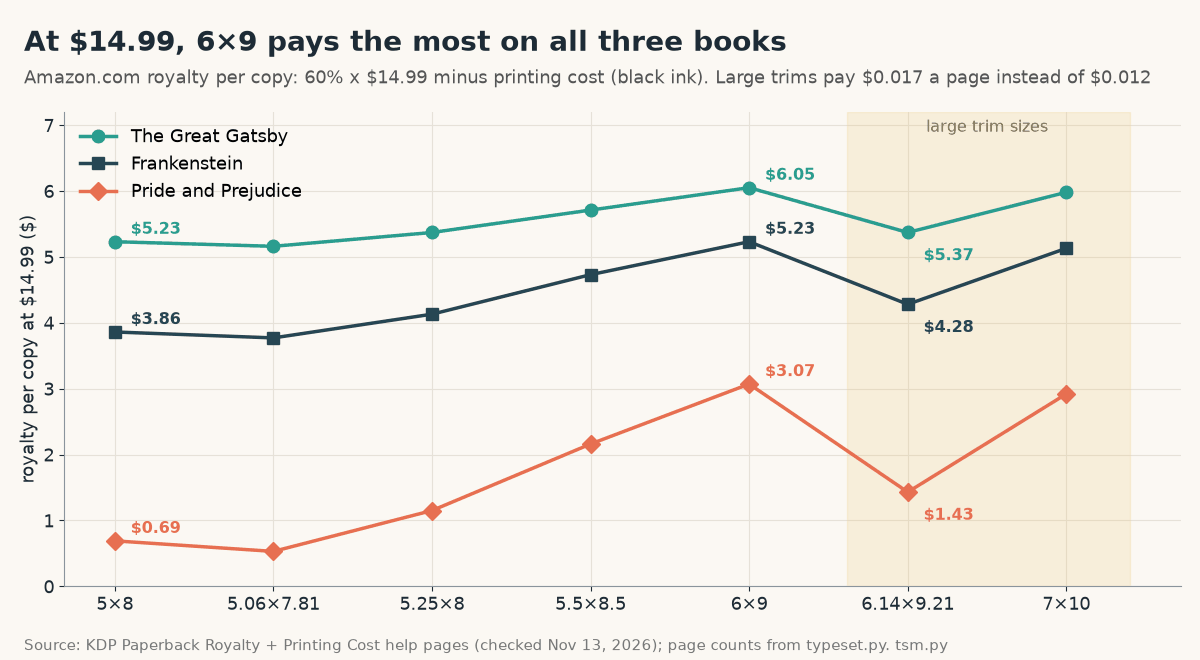
Pride and Prejudice at 5 x 8 runs to 608 pages and earns $0.69 a copy at $14.99. At 6 x 9 it earns $3.07. If you write long fantasy or put a series into one omnibus volume, use 6 x 9 or raise the price. Our KDP paperback royalty calculator shows how each extra 100 pages eats into the royalty, and how long a romance novel should be gives the word counts readers expect by subgenre.
Expanded Distribution: two trims fail on cream paper
Most novelists print on cream paper. KDP’s Expanded Distribution chart lists every trim in the table above as eligible on white paper. On cream paper, though, 5.06 x 7.81, 6.14 x 9.21 and 7 x 10 are not eligible. If you want bookstores and libraries, 5 x 8, 5.25 x 8, 5.5 x 8.5 and 6 x 9 all work on cream. Whether Expanded Distribution is worth it at all is a separate question; our Expanded Distribution breakdown runs the 40% math.
What it adds up to across a catalog
Napkin math with a clearly labeled assumption: 10 paperbacks of about 75,000 words, each selling 30 copies a month on Amazon.com. Printing them at 5 x 8 instead of 6 x 9 costs 300 x $1.37 = $411 a month, or $4,932 a year, for the same books at the same price. That money comes out of your royalty, not the reader’s pocket.
Why does anyone choose 5 x 8 then? It feels like a mass-market or genre paperback, and it makes a short book look thicker on the shelf. Those are real reasons. Just price the smaller trim knowing what it costs, and for a hardcover edition run the separate numbers in our KDP hardcover calculator.
Pick the trim before the cover. Spine width is 0.0025 in per cream page, so Frankenstein’s spine is 0.860 in at 5 x 8 and 0.575 in at 6 x 9. Changing trim after the cover is done means a new cover file.
How to pick your KDP trim size
- Start at 6 x 9 for any novel over about 60,000 words. In my tests it paid the highest royalty for all three books.
- Consider 5.5 x 8.5 if you want a smaller, trade-fiction feel. It costs $0.50 more per copy than 6 x 9 for a 75,000-word book.
- Use 5 x 8 or 5.25 x 8 for novellas or a genre look, and raise the price to cover the extra pages.
- Avoid 6.14 x 9.21 unless you need it. It’s a large trim with a higher per-page cost and no cream-paper Expanded Distribution.
- Set the trim before you design the cover. Spine width depends on page count, and page count depends on trim.
| Question | Answer from the test | What to do |
|---|---|---|
| Cheapest regular trim to print | 6 x 9: $3.76 for 75k words | Default for novels over ~60k words |
| Cost of choosing 5 x 8 | +114 pages, +$1.37 a copy | Raise the price or accept less |
| Large-trim penalty | $0.017 vs $0.012 a page | Avoid 6.14 x 9.21 for fiction |
| Font size 12 pt to 11 pt | About 14% fewer pages | Change trim first, font second |
| Gutter step above 300 pages | +11 pages at 5 x 8 | Recheck margins after layout |
| Expanded Distribution on cream | Not 5.06 x 7.81, 6.14 x 9.21, 7 x 10 | Use 5 x 8 to 6 x 9 for bookstores |
Limits of this test
These are three classic novels set in one font with one set of margins. Your own interior, dialogue density and chapter count will change the page numbers, so treat the calculator as a planning estimate and confirm the final count from your interior PDF. Costs are Amazon.com, black ink, before any VAT. The ratios between trims are the part I’d trust most.
FAQ
What is the best trim size for a novel on KDP?
For most novels, 6 x 9. In my test of three novels it printed the fewest pages of any regular trim and paid the highest royalty at $14.99. 5.5 x 8.5 is the common smaller alternative.
Is 5 x 8 cheaper to print than 6 x 9 on KDP?
No. KDP charges per page, and a 5 x 8 interior needed 42% to 50% more pages in my test. For a 75,000-word novel that's $5.13 versus $3.76 per copy.
How many words fit on a 6 x 9 page?
About 300 to 330 words at 12 pt and 340 to 380 at 11 pt in my test, including chapter openings. Font, margins and dialogue move this a lot.
Which KDP trim sizes count as large trim?
Any size wider than 6.12 inches or taller than 9 inches, such as 6.14 x 9.21 or 7 x 10. On Amazon.com, black-ink large trims cost $0.017 per page instead of $0.012.
Does trim size affect Expanded Distribution?
Yes. On cream paper, 5.06 x 7.81, 6.14 x 9.21 and 7 x 10 are not eligible. 5 x 8, 5.25 x 8, 5.5 x 8.5 and 6 x 9 are eligible on both cream and white paper.
The takeaway
On KDP, a smaller trim makes a thicker book, and a thicker book costs more to print. For a 75,000-word novel the gap between 5 x 8 and 6 x 9 is $1.37 a copy, about 26% of what you keep at $14.99. Pick the trim for the reader you want, but do it with the numbers in front of you. If writing the books is the slow part of building that catalog, ImagineYourBook turns your outline into a full text draft with a cover that you then revise in your own voice. The trial is $0 today with a card required and includes one complete 10,000-word book; the first $24.99 charge happens after 7 days unless you cancel before day 8.
Sources (checked November 13, 2026): KDP Help: Paperback Printing Cost · KDP Help: Paperback Royalty · KDP Help: Set Trim Size, Bleed, and Margins · KDP Help: Create a Paperback Cover (spine width) · KDP Help: Expanded Distribution · Project Gutenberg: Frankenstein · The Great Gatsby · Pride and Prejudice · ImagineYourBook pricing. Method: books typeset with WeasyPrint in 12 pt and 11 pt EB Garamond, 1.4 line spacing, 0.8 in top/bottom, 0.7 in outside, KDP minimum gutter + 0.2 in, chapters on new pages; body text only. Assumption in the napkin math: 10 paperbacks x 30 copies a month. Prices before VAT.