
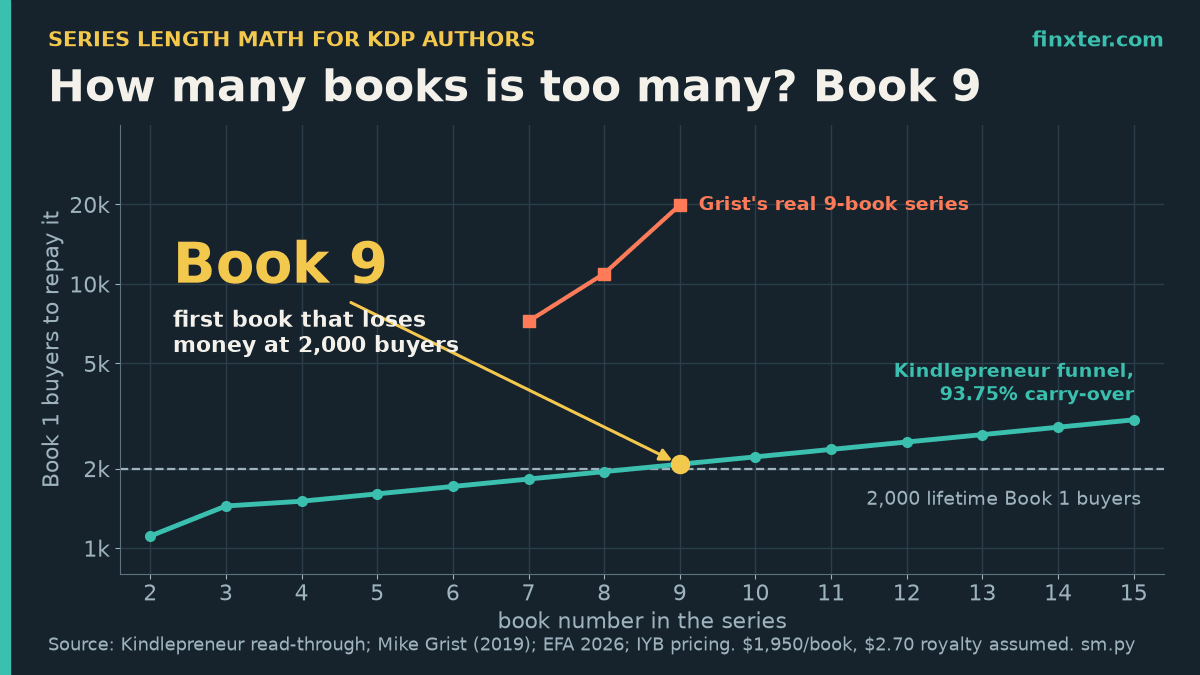
Short answer: there is no fixed number. A book is one too many when the readers who reach it can’t pay for it. Readers drop off at every book, so each new volume sells to a smaller slice of your Book 1 audience.
I ran the numbers on a $1,950 book (AI draft plus a human copyedit and proofread). With Kindlepreneur’s benchmark read-through funnel, Book 2 needs 1,111 lifetime Book 1 buyers to pay back. Book 9 needs 2,078. So if your Book 1 will sell about 2,000 copies over its life, Book 9 is the first book that loses money. With the steeper drop-off one indie author actually measured on his 9-book series, Book 9 needs 19,896.
The lever that decides your series length isn’t the book count. It’s how many readers you keep from one later book to the next. If you plan to keep a series going, a series-aware drafting tool like ImagineYourBook cuts the drafting part of that $1,950 to about $30. Its series memory carries characters, world rules and open threads from Book One into the next volume.
TL;DR
- The series Google suggests for this question run 2 to 13 books (median 7), and 4 of 6 are unfinished.
- At $1,950 per book and Kindlepreneur’s funnel, Book 2 needs 1,111 lifetime Book 1 buyers to pay back; Book 9 needs 2,078.
- In Mike Grist’s real 9-book series, Book 9 needs 19,896, almost 10x more.
- At 2,000 Book 1 buyers, the last book that pays is Book 5 at 80% later-book carry-over and Book 10 at 96%.
What the series Google suggests actually look like
When you type “how many books in a series” into Google, autocomplete finishes the question with real series. I looked up every one with a Wikipedia page on November 14, 2026:
| Series (from Google autocomplete) | Books out (Nov 14, 2026) | Status | Copies sold (Wikipedia) |
|---|---|---|---|
| A Series of Unfortunate Events | 13 | Complete | 60 million+ |
| Throne of Glass | 8 | Complete (2018) | n/a |
| Dungeon Crawler Carl | 8 | Ongoing; 10 planned | 14 million+ (first 8) |
| A Court of Thorns and Roses | 6 | Ongoing; 8 planned | 13 million+ |
| Empyrean (Fourth Wing) | 4 | Ongoing | Fourth Wing: 2 million+ in 6 months |
| Shield of Sparrows | 2 | Sequel out Apr 7, 2026 | n/a |
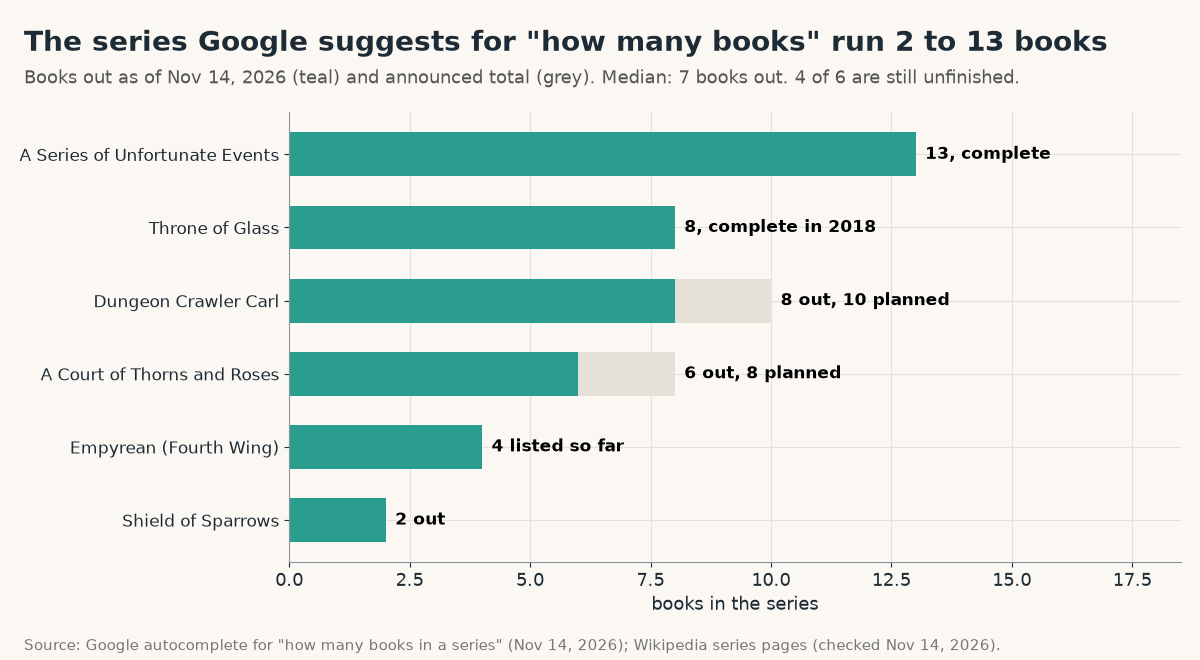
Readers ask this about long series: the median is 7 books out, the range 2 to 13, and 4 of 6 are unfinished. They want to know how much is left, not whether it’s too long.
These are blockbusters, so they prove reader appetite, not your economics. For a KDP author the real question is: will the next book earn back what it costs?
The funnel: each book sells to fewer readers
Kindlepreneur’s read-through guide uses a 5-book example month: 100 Book 1 sales, then 65, 50, 48 and 45. Book 1 to 2 keeps 65%. After that, readers who bought two books mostly stay. Book 3 to 4 keeps 96% and Book 4 to 5 keeps 93.75%.
Kindlepreneur says 50 to 60% from Book 1 to 2 is common in paid sales; in Kindle Unlimited, around 86% is normal and 75% is low.
A real long series can look much worse. Mike Grist tracked his 9-book Last Mayor series in 2019, with Book 1 often at 99 cents and two box sets in the mix. Only 35% of readers went from Books 1 to 3 on to Books 4 to 6. Only 30% of those went on to Book 7. Then 66% to Book 8 and 55% to Book 9. Per 100 readers at the start, that’s 10 at Book 7 and about 3.6 at Book 9.
His reviews show the same funnel: 235 on Book 1, 18 on Book 9.
Napkin math: the break-even for each book
Assumptions (label them as yours to change):
- Each book is a 60,000-word novel. Drafting on ImagineYourBook’s Publisher plan costs $0.50 per 1,000 words, so $30.
- Human editing at the low end of the EFA 2026 fiction medians: copyediting 2.0 cents a word plus proofreading 1.2 cents, so $1,920. Total $1,950 per book. Covers, ads and your own time are not included.
- Every book is a $3.99 ebook, which pays about $2.70 in royalties (Kindlepreneur’s figure).
- Books 1 to 5 follow Kindlepreneur’s funnel. Every later book keeps 93.75% of the previous one, the same as Book 4 to 5.
Break-even for Book N = $1,950 ÷ (Book N’s share of Book 1 buyers × $2.70): the lifetime Book 1 buyers you need for Book N to repay its cost.
| Book | Share of Book 1 buyers who reach it | Royalty per Book 1 buyer | Lifetime Book 1 buyers to repay $1,950 |
|---|---|---|---|
| Book 2 | 65.0% | $1.76 | 1,111 |
| Book 3 | 50.0% | $1.35 | 1,444 |
| Book 4 | 48.0% | $1.30 | 1,505 |
| Book 5 | 45.0% | $1.22 | 1,605 |
| Book 6 | 42.2% | $1.14 | 1,712 |
| Book 8 | 37.1% | $1.00 | 1,948 |
| Book 9 | 34.8% | $0.94 | 2,078 |
| Book 10 | 32.6% | $0.88 | 2,216 |
| Book 13 | 26.9% | $0.73 | 2,690 |
| Book 15 | 23.6% | $0.64 | 3,060 |
| Grist Book 7 | 10.0% | $0.27 | 7,222 |
| Grist Book 8 | 6.6% | $0.18 | 10,943 |
| Grist Book 9 | 3.6% | $0.10 | 19,896 |
The Kindlepreneur funnel is gentle after Book 3, so the bar rises slowly: 1,605 at Book 5, 2,078 at Book 9, 2,690 at Book 13. Grist’s funnel is brutal: Book 7 needs 7,222 Book 1 buyers and Book 9 needs 19,896, almost 10 times more than the same book in the gentle funnel.
Why “too many” depends on one rate
Book 1 to 2 decides how big the audience is. The carry-over between later books decides how long you can keep writing for it. Here’s the sweep from 80% to 96% later-book carry-over, at 2,000 lifetime Book 1 buyers:
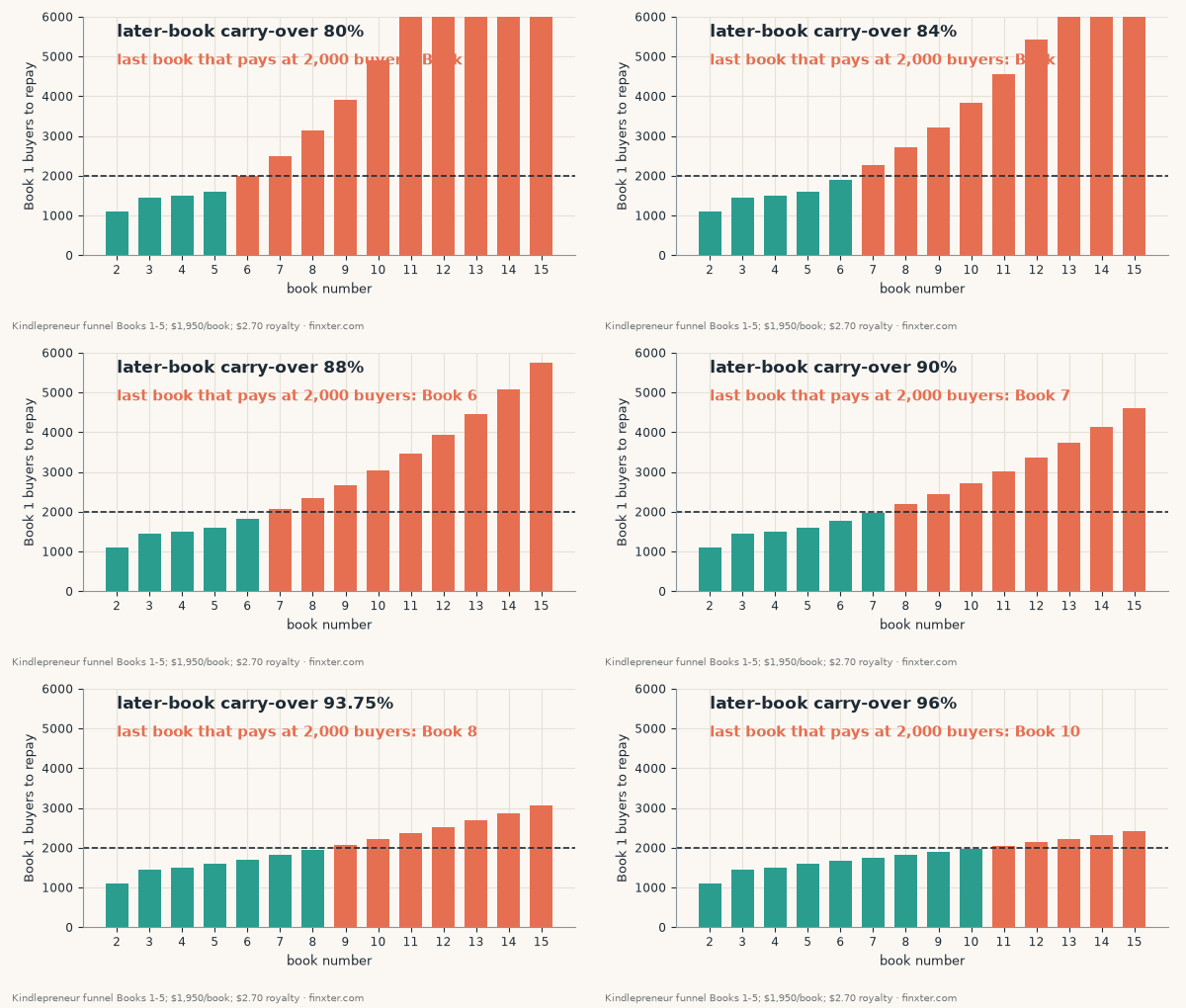
- At 80% carry-over, the last book that pays is Book 5.
- At 90%, it’s Book 7.
- At 93.75% (Kindlepreneur’s Book 4 to 5 rate), it’s Book 8.
- At 96%, it’s Book 10.
With 5,000 lifetime Book 1 buyers, the same rates give you 10, 15, 22 and 32 books. With 1,000 buyers, even Book 2 doesn’t repay $1,950 in this model, because it needs 1,111. That’s a strong argument for cheaper drafts or a smaller editing budget on a small series, not for stopping at Book 1.
Longer series still raise what a reader is worth
The other side of the math is good news. Each book adds less, but it still adds:
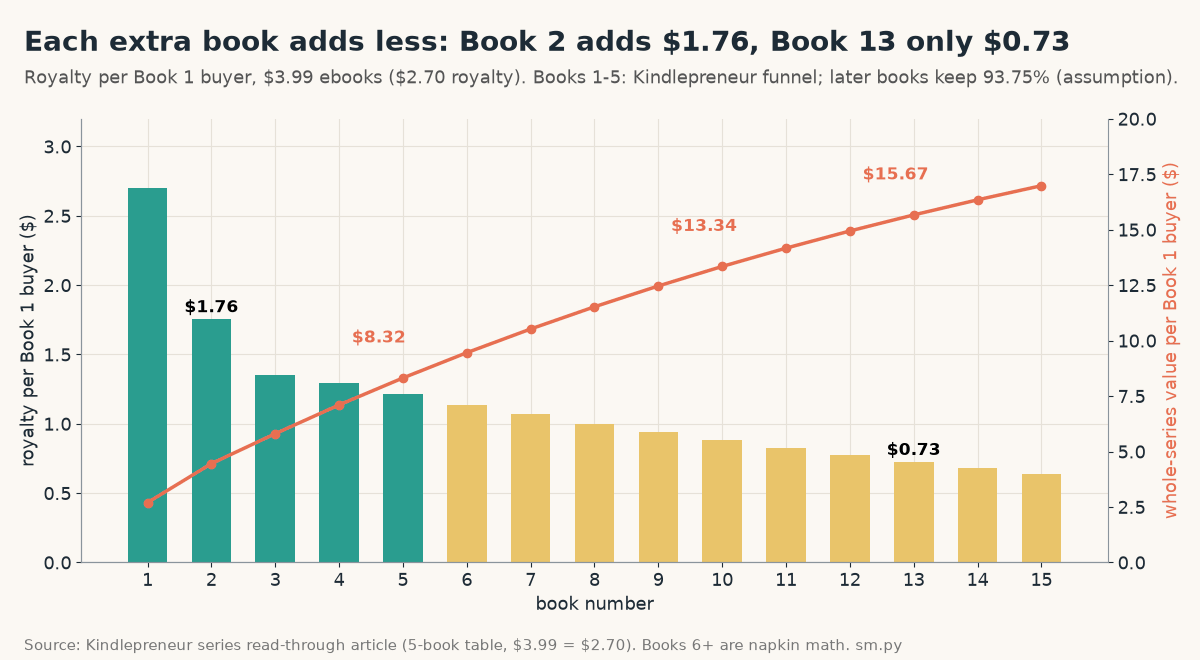
A Book 1 buyer is worth $8.32 across 5 books, $13.34 across 10 and $15.67 across 13 in this model. Book 2 adds $1.76 per Book 1 buyer. Book 13 adds only $0.73.
That matters for ads. Kindlepreneur’s improved ad example converts 1 sale per 20 clicks. At that rate, your break-even cost per click is the series value divided by 20: $0.42 for 5 books, $0.67 for 10 and $0.78 for 13. A longer series can afford ads a shorter one can’t, as long as carry-over stays high. More on that in Are KDP Ads Worth It?.
The same logic works in Kindle Unlimited. A full read of Kindlepreneur’s 402-page example book pays about $2.16 at the September 2026 KENP rate of $0.005365, close to the $2.70 sale. Since KU read-through runs higher (86% is normal), KU-heavy series usually clear the bar sooner.
The number that ends series is carry-over, not length. In Grist’s series, two thirds of readers who had already bought twice stopped before Book 7. If your later-book carry-over drops below about 80%, the next book needs far more Book 1 buyers than most indie series ever get.
When to stop a series (a practical rule)
- Measure carry-over between your later books, not just Book 1 to 2 (my read-through rate guide shows how).
- Estimate lifetime Book 1 buyers honestly, not from your launch week.
- Look up the break-even for the next book in the table above, or recompute it with your own cost and royalty.
- If the next book won’t pay, change one variable first: a cheaper draft, a lighter edit, a box set of the earlier books (see KDP box sets), or better back matter that pulls more readers into Book 2.
- If carry-over is collapsing like Grist’s, end the arc and start a new series in the same world. A new Book 1 can earn new readers. Book 9 can only sell to those who survived Books 1 to 8.
For how the money spreads across a series at launch, see why Book 1 is only a third of the money.
| Question | Answer (this article’s math) |
|---|---|
| How many books do Google’s suggested series have? | 2 to 13 out, median 7; 4 of 6 unfinished |
| Book 1 buyers to repay Book 2 ($1,950 book) | 1,111 |
| Book 1 buyers to repay Book 9 | 2,078 (Kindlepreneur funnel) vs 19,896 (Grist) |
| Last book that pays at 2,000 buyers | Book 5 (80% carry-over) to Book 10 (96%) |
Limits of this math
Kindlepreneur’s funnel is a worked example, not a survey. Grist’s numbers are one author’s 2019 data, with 99-cent pricing and box sets merged in. Holding 93.75% after Book 5 is my assumption. Plug in your own KDP reports.
FAQ
How many books in a series is too many?
There's no fixed number. A book is too many when the readers who reach it can't repay its cost. With a $1,950 book and 2,000 lifetime Book 1 buyers, Book 9 is the first that loses money at Kindlepreneur's benchmark read-through.
What is a good read-through rate for a book series?
Kindlepreneur says 50 to 60% from Book 1 to 2 is typical for paid sales and about 86% in Kindle Unlimited. Later books usually keep 77 to 96% of readers who got that far.
Do readers prefer long series?
The series Google suggests for this question have 2 to 13 books out, median 7, and 4 of 6 are still unfinished. Readers ask how many books are left, not whether a series is too long.
How do I know when to end my series?
Measure carry-over between your later books, estimate lifetime Book 1 buyers, and check whether the next book's share of them repays its cost. If carry-over collapses, start a new series in the same world.
Can AI help me write more books in a series?
Yes, for drafts. ImagineYourBook's Publisher plan drafts about 60,000 words for $30 and carries characters and canon into the next book. Edit every draft yourself before publishing.
The takeaway
Write the next book when the readers who’ll reach it can pay for it. With a $1,950 book and 2,000 lifetime Book 1 buyers, that’s up to Book 8 at a typical carry-over and only Book 5 at 80%. Protect carry-over first, and keep costs low.
If you want first drafts of the next volumes that keep the same characters, canon and voice, ImagineYourBook writes complete text-based book drafts with a cover, and its Publisher plan covers 120,000 words a month for $59.99. The 7-day trial is $0 today with one 10,000-word book, but a card is required and the first $24.99 charge happens after 7 days unless you cancel before day 8. Edit every draft into your own book before it carries your name.
Sources (checked November 14, 2026): Kindlepreneur: How to calculate series read-through · Mike Grist: Readthrough on the Last Mayor series (2019) · Written Word Media: KDP Global Fund payouts (Sep 2026) · EFA 2026 Rate Chart · ImagineYourBook pricing · Google autocomplete · Wikipedia series pages. Assumptions: 60,000 words per book; $1,950 per book (AI draft at $0.50 per 1,000 words + EFA fiction copyedit 2.0c and proofread 1.2c, low end); $3.99 ebooks paying $2.70; Kindlepreneur funnel for Books 1 to 5 and 93.75% carry-over after that; 1 sale per 20 ad clicks. US dollars before tax; covers, ads and your time not counted.