
Most romantasy tropes lists are written from memory. This one counts what is selling. On November 25, 2026, I collected the product page of every book visible on three Amazon.com charts (Kindle Romantasy best sellers, Kindle Romantic Fantasy best sellers and Kindle Romantasy new releases): 180 chart slots, 126 unique books. Then I counted which tropes each title and blurb names.
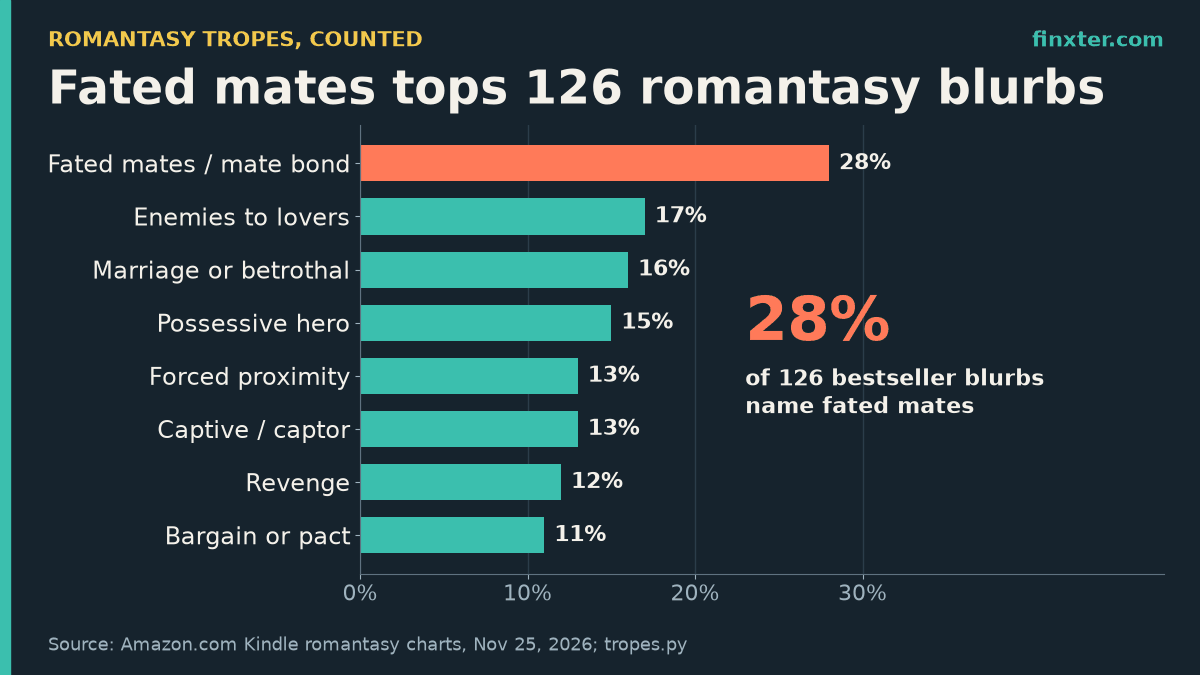
The short answer: fated mates (or a mate bond) is the most named romantasy trope on the charts today, in 28% of blurbs, ahead of enemies to lovers at 17%. The twist is who uses it. Self-published bestsellers name fated mates in 40% of blurbs; publisher-backed bestsellers in 8%. And found family, the number two trope in reader talk, shows up in only 7% of bestseller blurbs and in none of the 48 publisher blurbs.
If you plan a romantasy series for KDP, my top tool pick for the drafting step is ImagineYourBook, an AI book-writing tool that turns a prompt or your notes into a complete 10,000-word draft with a cover and Word/EPUB export, and carries characters and world rules into Book Two with its series memory. The data below tells you which tropes to put in that prompt.
TL;DR
- Fated mates is the most named romantasy trope on Amazon’s charts: 28% of 126 bestseller blurbs. Enemies to lovers: 17%.
- Self-published blurbs name fated mates 40% of the time, publishers 8%. 97% of the self-published books are in Kindle+.
- Fated mates fills 43% of new release slots vs 12% to 22% on the best seller lists: the most crowded lane.
- Found family is #2 in reader talk but appears in only 7% of blurbs (0 of 48 publisher blurbs).
- Length follows the trope: a full Kindle+ read pays about $1.85 at fated mates length vs $2.89 for enemies to lovers.
The romantasy tropes list, ranked by what bestsellers name
Every trope I tracked, ranked by the share of the 126 books whose title or blurb names it (once per book).
| Trope | Share of 126 blurbs | Self-published (78) | Publisher-backed (48) | Books |
|---|---|---|---|---|
| Fated mates / mate bond | 28% | 40% | 8% | 35 |
| Enemies to lovers | 17% | 17% | 19% | 22 |
| Marriage or betrothal | 16% | 19% | 10% | 20 |
| Possessive or obsessive hero | 15% | 22% | 4% | 19 |
| Forced proximity | 13% | 17% | 8% | 17 |
| Captive / captor | 13% | 13% | 15% | 17 |
| Revenge | 12% | 13% | 10% | 15 |
| Bargain, deal or vow | 11% | 14% | 6% | 14 |
| Slow burn | 10% | 10% | 10% | 13 |
| Why choose / reverse harem | 9% | 13% | 2% | 11 |
| Forbidden love | 8% | 8% | 8% | 10 |
| Found family | 7% | 12% | 0% | 9 |
| Villain love interest | 6% | 5% | 8% | 8 |
| Morally grey hero | 6% | 5% | 6% | 7 |
| Second chance | 6% | 6% | 4% | 7 |
| Chosen one / prophecy | 5% | 6% | 2% | 6 |
| Grumpy sunshine | 3% | 5% | 0% | 4 |
| Rivals to lovers | 2% | 1% | 2% | 2 |
| Only one bed | 2% | 1% | 2% | 2 |
| Secret identity or hidden heir | 1% | 1% | 0% | 1 |
Three things stand out. First, the median blurb names just 2 tropes, and 30% name none at all. Among publisher blurbs, 42% name none: many big publisher books sell on the author’s name and the world, not on a trope list. Second, the explicit “trope” words that fill reader lists are rarer than you would think: grumpy sunshine, only one bed and rivals to lovers each appear in 3% of blurbs or fewer. Third, fated mates rides on a specific subgenre: 23 of the 35 fated mates blurbs also name shifters, wolves or alphas, and 11 are why-choose books.
How I classified. I matched each title and blurb against fixed phrase rules (for example “fated mate”, “mate bond” or “my mate” for fated mates; “forced proximity” only as that phrase). Praise lines from other authors and reviewers are removed first, so a quote such as “my next obsession” does not count as a possessive hero. I spot-checked every match. These shares are a floor: a book can contain a trope its blurb never names.
Self-published vs publisher romantasy: two different shelves
Of the 126 books, 78 list no publisher on Amazon (I count those as self-published) and 48 list one. Bloomsbury (13 books, all Sarah J. Maas) and Entangled’s Red Tower Books (9, led by Rebecca Yarros with 4) lead the publisher side.
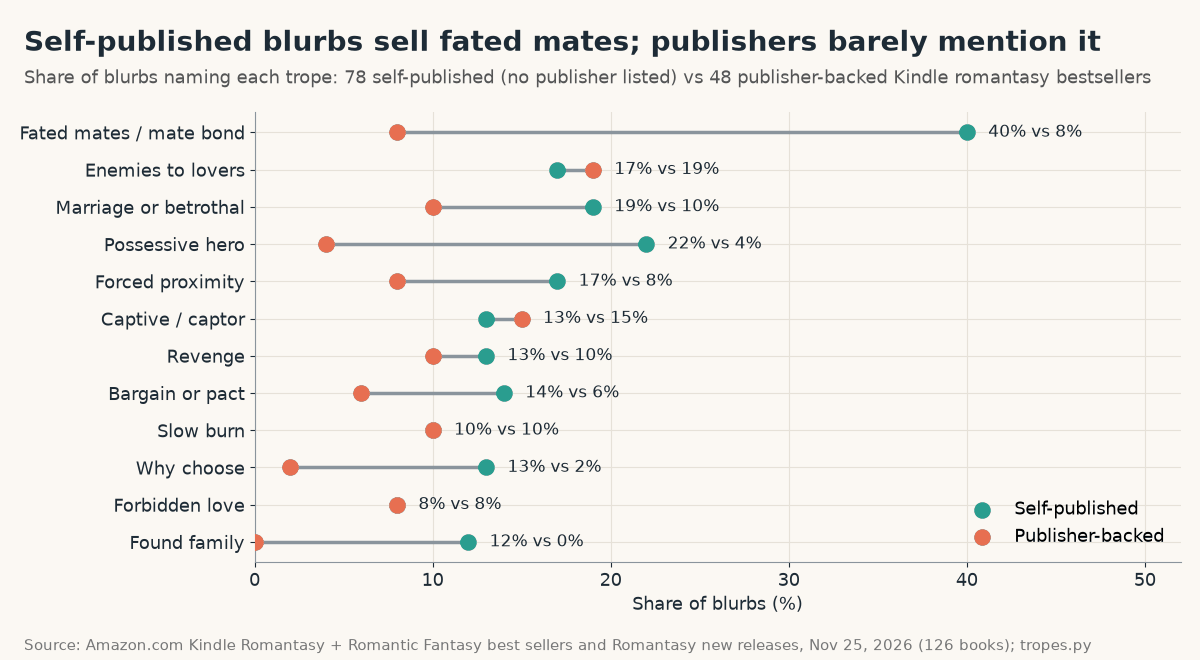
The two sides sell differently:
- Fated mates: 40% of self-published blurbs vs 8% of publisher blurbs.
- Possessive hero: 22% vs 4%. Why choose: 13% vs 2%. Found family: 12% vs 0%.
- Enemies to lovers is the one big trope publishers use as often as indies: 19% vs 17%.
- Shifters, wolves and alphas appear in 44% of self-published blurbs and 6% of publisher blurbs. Trials and tournaments run the other way: 9% vs 31%.
- Self-published blurbs name more tropes: a median of 2 vs 1, and 36% name three or more (publishers: 19%). 32% of self-published titles put a trope in the title or subtitle itself, against 10% of publisher titles.
The money side explains the style. 97% of the self-published books are free to read in Kindle Unlimited (now called Kindle+), against 54% of the publisher books. A Kindle+ reader browses by trope and borrows at no extra cost, so naming the trope is the sales pitch. If you are still deciding on exclusivity, I worked through the trade-off in KDP Select vs wide.
Bestsellers vs new releases: fated mates is crowding
The two best seller lists show what sells now, including old books (ACOTAR is from 2015). The new releases list shows what was just published. Watch the fated mates bar as the animation cycles.
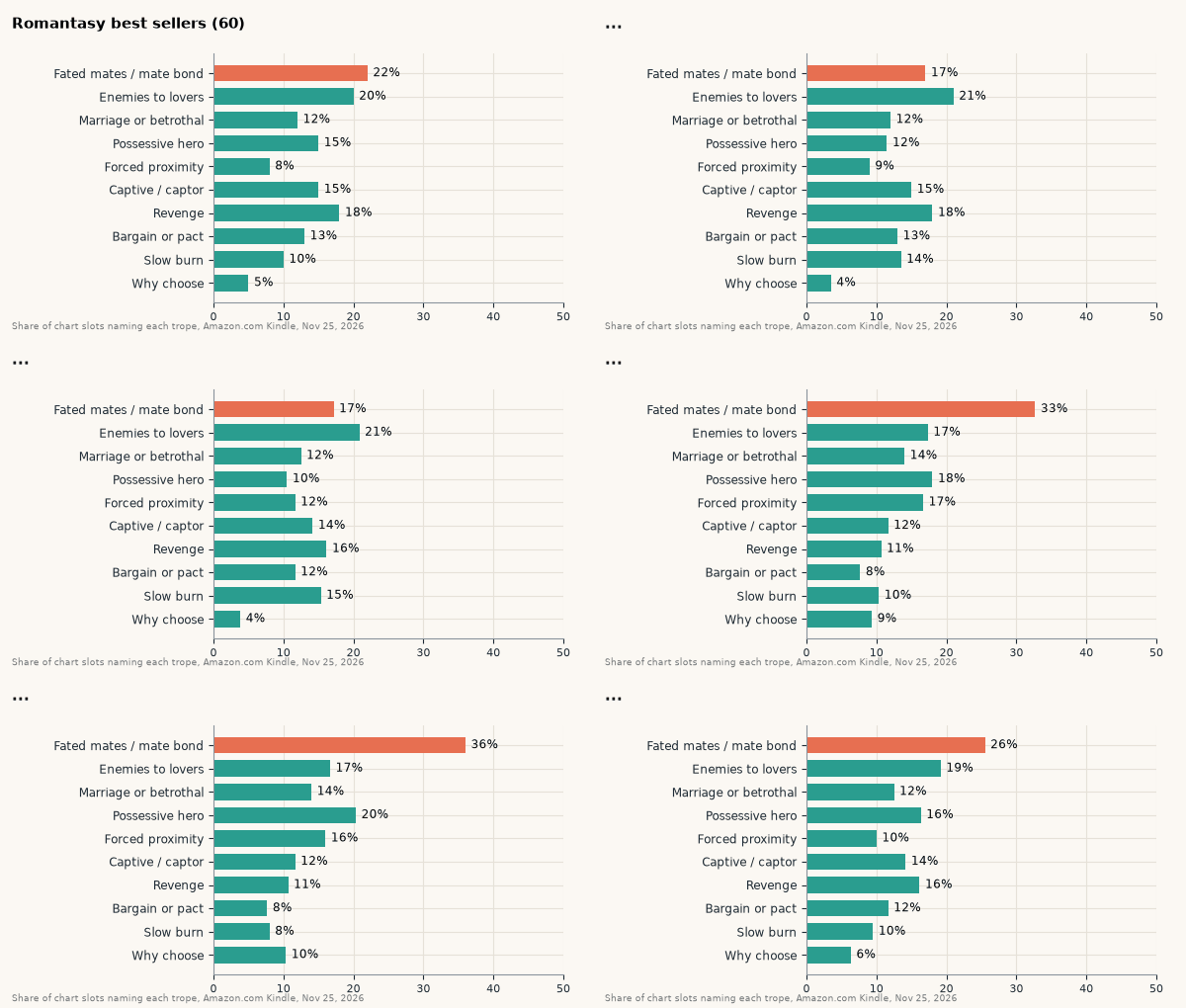
Fated mates takes 22% of slots on the Romantasy best sellers list and 12% on Romantic Fantasy, but 43% of new release slots. Why choose jumps from 5% and 2% to 13%; possessive hero from 15% and 8% to 23%. Meanwhile revenge (18% on both best seller lists, 7% of new releases) and bargains (13% vs 5%) are more common among books that have lasted.
That is supply, not demand. 79% of the 42 books that appear only on the new release list are self-published, and a large share of them launched with the same trope stack: fated mates plus possessive or why choose. A fated mates launch this winter enters the most crowded lane on the chart, so the hook has to be more than the trope.
The twist: readers talk about found family, blurbs don’t
TropeSmith counts “demand signals” (a trope a reader asked for or praised) in Goodreads reviews, BookTok comments and Reddit posts. In its latest settled month for romantasy (September 2026), the top three were slow burn (4.7% of tags), found family (4.4%) and fated mates (4.1%), with enemies to lovers at 1.7%.
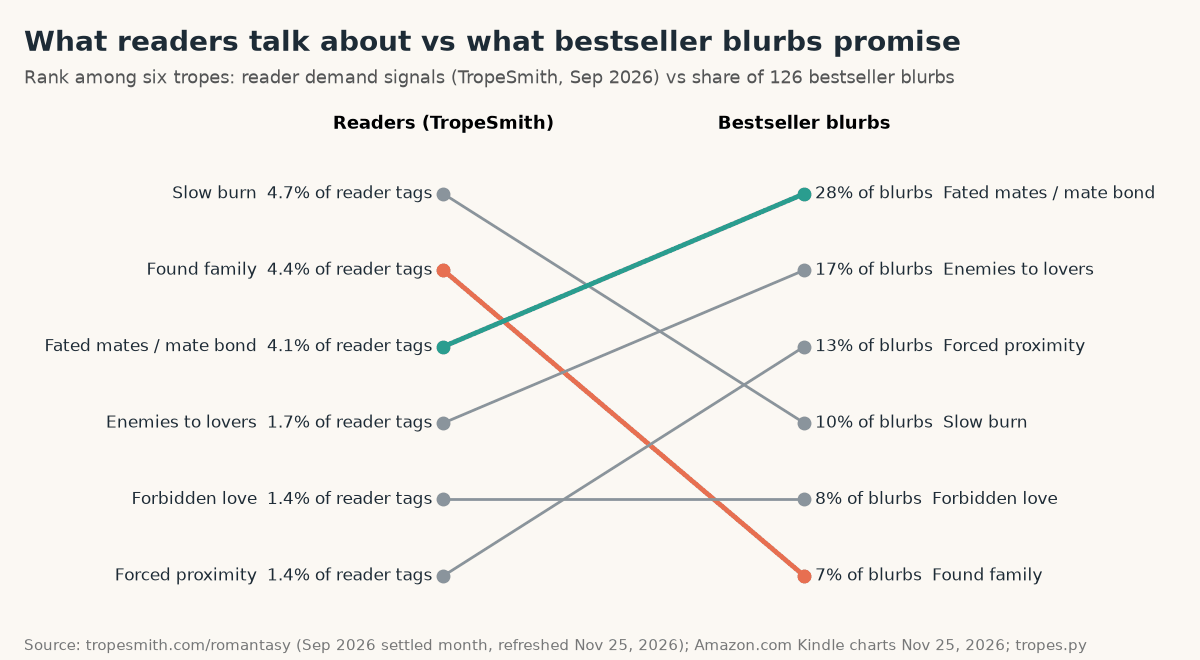
Put the two lists side by side and found family falls from second place to last. Readers praise it almost as often as fated mates, but only 9 of 126 bestseller blurbs name it, and all 9 are self-published. Slow burn tells the same story: first in reader talk, fourth in blurbs (10%).
The two sources measure different things (reader praise vs seller promises), so this is not proof that found family books would sell more. It is a positioning gap. Readers value it, sellers rarely lead with it, and it fits a series naturally, because the found family is the cast that carries Book 2 to Book 5. If your story has a crew, a court or an academy cohort, say so in the blurb. For phrasing, see the 141-blurb analysis in book blurb examples.
Romantasy tropes and Kindle Unlimited money: length follows the trope
Trope choice also predicts book length, and in Kindle+ length is money. Books naming fated mates have a median print length of 333 pages. Enemies to lovers books run 519, slow burn 544.
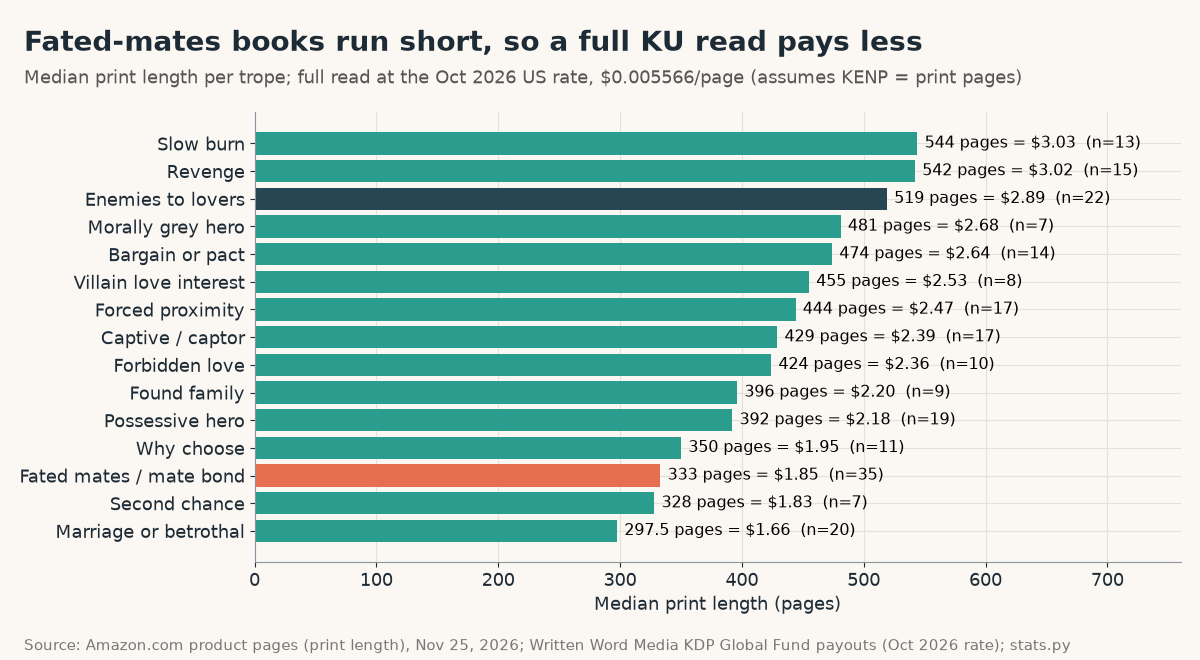
Napkin math. Amazon paid $0.005566 per page read in the US for October 2026 (Written Word Media’s KDP Global Fund tracker). Assume one KENP page is about one print page (an assumption; KENP is counted differently, so treat these as rough):
- A full read of a median fated mates book pays about $1.85. A median enemies to lovers book pays about $2.89, 56% more per reader.
- A reader who finishes a five-book series pays about $9.27 at fated mates length vs $14.44 at enemies to lovers length.
- Per page, the rate is the same. The longer epic simply takes longer to write, edit and format, while the shorter book lets you release faster. Faster releases matter for a series: self-published series on these charts run a median of 4 books, publisher series 3.
So the real decision is not “which trope is best” but “which lane”: short, high-heat, fast-release (fated mates, why choose, marriage plots, around 300 to 350 pages) or long, slow-burn epic (enemies to lovers, revenge, slow burn, around 520 to 545 pages). For the series side of that decision, see how to write a romance book series.
Premise elements that sit under the tropes
Tropes describe the relationship; readers also buy the world.
| Premise element | All 126 | Self-published | Publisher-backed |
|---|---|---|---|
| Royalty, crowns and courts | 60% | 56% | 65% |
| Shifters, wolves, alphas | 29% | 44% | 6% |
| Monsters and beasts | 29% | 33% | 23% |
| Fae | 25% | 24% | 25% |
| War | 23% | 18% | 31% |
| Academy or school | 22% | 26% | 17% |
| Gods and the divine | 20% | 17% | 25% |
| Death and reapers | 20% | 18% | 23% |
| Curse | 19% | 22% | 15% |
| Dragons | 19% | 22% | 15% |
| Trials, tournaments, games | 17% | 9% | 31% |
| Vampires | 8% | 9% | 6% |
| Witches | 5% | 6% | 2% |
| Demons | 5% | 5% | 4% |
| Assassins | 5% | 3% | 8% |
Royalty, crowns and courts are close to universal (60%). Fae appear in 25%, dragons in 19%, academies in 22%. To turn these into Amazon search terms, the seven filled keyword boxes in KDP keywords examples are built for exactly this kind of romantasy series.
How to use this when you plan a romantasy series
- Pick your lane first: short and fast (fated mates, why choose, marriage plots) or long and epic (enemies to lovers, revenge, slow burn).
- Name two or three tropes, not seven, inside a sentence rather than a hashtag list.
- Add one under-named trope. Found family and slow burn are high in reader talk and low in blurbs.
- Beat the crowd. If you write fated mates, open with a premise twist (the world, the bond, the cost).
- Plan the series before Book 1. With a median of 4 books per self-published series, cast and world rules must hold for the whole run.
| Finding | Number | What to do |
|---|---|---|
| Most named trope | Fated mates, 28% of blurbs (enemies to lovers 17%) | Expect the most competition in fated mates |
| Self-published vs publisher | Fated mates 40% vs 8%; possessive hero 22% vs 4% | Indie readers shop by trope; name yours |
| Crowded lane | Fated mates holds 43% of new release slots | Lead with a premise twist, not the trope alone |
| Under-named trope | Found family: #2 in reader talk, 7% of blurbs, 0 of 48 publisher blurbs | Add it if your story has a crew or court |
| Tropes per blurb | Median 2 (self-published), 1 (publisher) | Name two or three inside a sentence |
| Length by trope | Fated mates 333 pages ($1.85 a full read) vs enemies to lovers 519 ($2.89) | Choose short and fast or long and epic, on purpose |
| Kindle+ share | 97% of self-published vs 54% of publisher books | For indie romantasy, Kindle+ is the default |
Limits of this count
One day of three charts that move hourly; the static pages show ranks 1 to 30 and 51 to 80, so 60 slots per chart. Self-published means no publisher listed, so indie authors with their own imprint count as publishers. Median pages are shown only for tropes with at least 7 books.
FAQ
What are the most popular romantasy tropes right now?
On Amazon.com's Kindle romantasy charts on November 25, 2026, the most named tropes were fated mates or a mate bond (28% of 126 blurbs), enemies to lovers (17%), marriage or betrothal (16%) and a possessive hero (15%).
Is fated mates overdone in romantasy?
It is the most crowded lane. Fated mates appears in 43% of Kindle Romantasy new release slots, against 22% on the Romantasy best seller list and 12% on Romantic Fantasy. If you write it, lead with a premise twist, not the trope alone.
Do self-published romantasy books use different tropes?
Yes. Self-published bestseller blurbs name fated mates 40% of the time vs 8% for publisher books, possessive heroes 22% vs 4%, and shifters 44% vs 6%. Enemies to lovers is similar on both sides (17% vs 19%).
Which romantasy tropes are underused?
Found family. It is the second most common trope in reader demand signals tracked by TropeSmith (4.4% of tags, September 2026), but only 9 of 126 bestseller blurbs name it, all self-published.
How long is a typical romantasy book?
The median print length of the 126 books was 447 pages: 407.5 for self-published and 506 for publisher books. Fated mates books ran shortest (median 333 pages); slow burn books longest (544).
Which romantasy trope earns the most on Kindle Unlimited?
Per page, all pay the same ($0.005566 in October 2026). Per full read, longer lanes earn more: about $3.03 for a median slow burn book vs $1.85 for fated mates, assuming one KENP page equals one print page.
Takeaway
The romantasy tropes that sell on Amazon today are fated mates, enemies to lovers, marriage plots and possessive heroes, but the gap worth exploiting is found family: readers praise it, and bestseller blurbs almost never promise it. Choose your lane by length, stack two or three tropes, and plan the series before you write Book 1. Once you know your trope stack, ImagineYourBook can turn that premise into a first 10,000-word draft (the $0 seven-day trial includes one; a card is required and the first $24.99 monthly charge comes after day seven unless you cancel) and keep your series consistent from Book 1 to Book 5. For more on drafting long fantasy with AI, see best AI for writing fantasy novels, and for why series pay, the IYB story What Can Series Authors Borrow From Romance?
Sources (checked November 25, 2026): Amazon.com Best Sellers: Kindle Romantasy · Amazon.com Best Sellers: Kindle Romantic Fantasy · Amazon.com Hot New Releases: Kindle Romantasy · TropeSmith: romantasy tropes by demand signals (September 2026 month, refreshed November 25, 2026) · Written Word Media: KDP Global Fund payouts (US per-page rate, October 2026) · ImagineYourBook pricing and trial terms. Data: titles, descriptions, publisher, print length, series and Kindle+ availability of 126 books (180 chart slots, ranks 1 to 30 and 51 to 80 on each chart) from Amazon.com product pages, collected November 25, 2026. Trope rules: tropes.py. Kindle+ payout math assumes one KENP page equals one print page.