
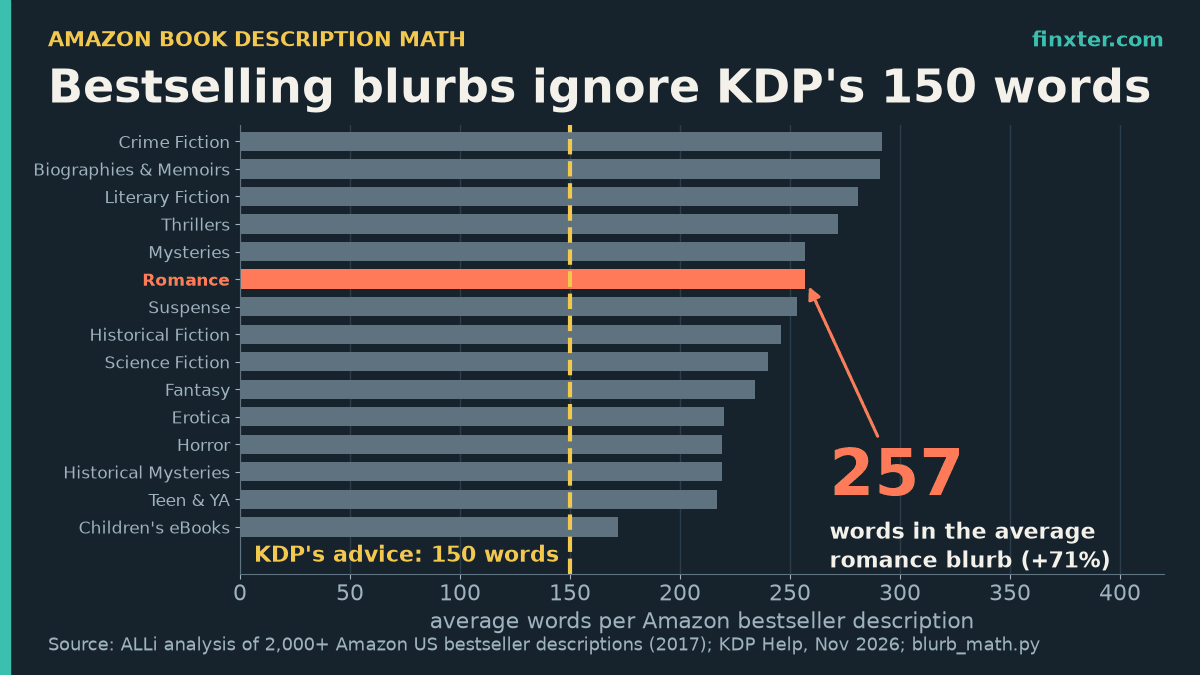
Amazon’s own KDP help page tells you to “aim for a 150-word paragraph” for your book description. The bestsellers don’t listen. When ALLi’s Self-Publishing Advice Center analysed more than 2,000 descriptions from Amazon’s US paid bestseller charts, romance blurbs averaged about 257 words, 71% longer than KDP’s advice. Every adult fiction genre it measured averaged between 219 and 292 words.
There’s a second surprise. 87% of 2025’s top 100 Kindle romance bestsellers are written in first person, but 63% of their blurbs are in third person (Romancing the Data). So an Amazon book description generator that copies your manuscript’s voice and squeezes it into KDP’s 150 words gets two things wrong before it writes a single hook.
The best Amazon book description generator, then, is one that drafts the blurb from your actual book, not from a one-line pitch. My top pick for romance and romantasy series authors is ImagineYourBook. It’s an AI book-writing tool that turns a prompt or your notes into a complete draft with a designed cover: one 10,000-word book in the free trial, exported as Word or EPUB. Its KDP author pack includes a book description drafted from that book, plus keyword and category suggestions. Its Series Builder carries characters, world rules and open threads into Book Two.
Below: the length and POV data, the napkin math on what a better blurb is worth in ad dollars, and a seven-step way to use any generator without sounding like everyone else.
TL;DR
- KDP says 150 words; bestselling romance descriptions average about 257 (ALLi, 2,000+ Amazon bestseller blurbs). Use 150 for the hook, ~250 in total.
- 87% of 2025’s top 100 romances are first person, but 63% of their blurbs are third person (Romancing the Data).
- The 4,000-character limit includes HTML tags; a 257-word blurb uses about 39% of it.
- Napkin math: on $0.80 clicks, moving conversion from 5% to 10% is worth $639 per 1,000 clicks for a 5-book series; break-even is 6.3%.
- Best generator: one that drafts from your actual book (top pick: ImagineYourBook’s KDP author pack), then you edit.
KDP’s 150 words vs. what actually sells
KDP’s guidance is sensible on its own terms. Make it “simple, compelling, and professional”, describe “the main plot, theme, or idea only”, and remember that the shopper is “only taking a second or two to decide”. The field holds up to 4,000 characters, and that count includes your HTML tags.
But the bestseller charts show a different habit. In ALLi’s analysis, the shortest genre averages were for children’s eBooks (172 words) and Teen & YA (217). Adult genres clustered around 250: romance 257, mysteries 257, suspense 253, historical fiction 246, fantasy 234. Crime fiction (292) and memoirs (291) ran longest.
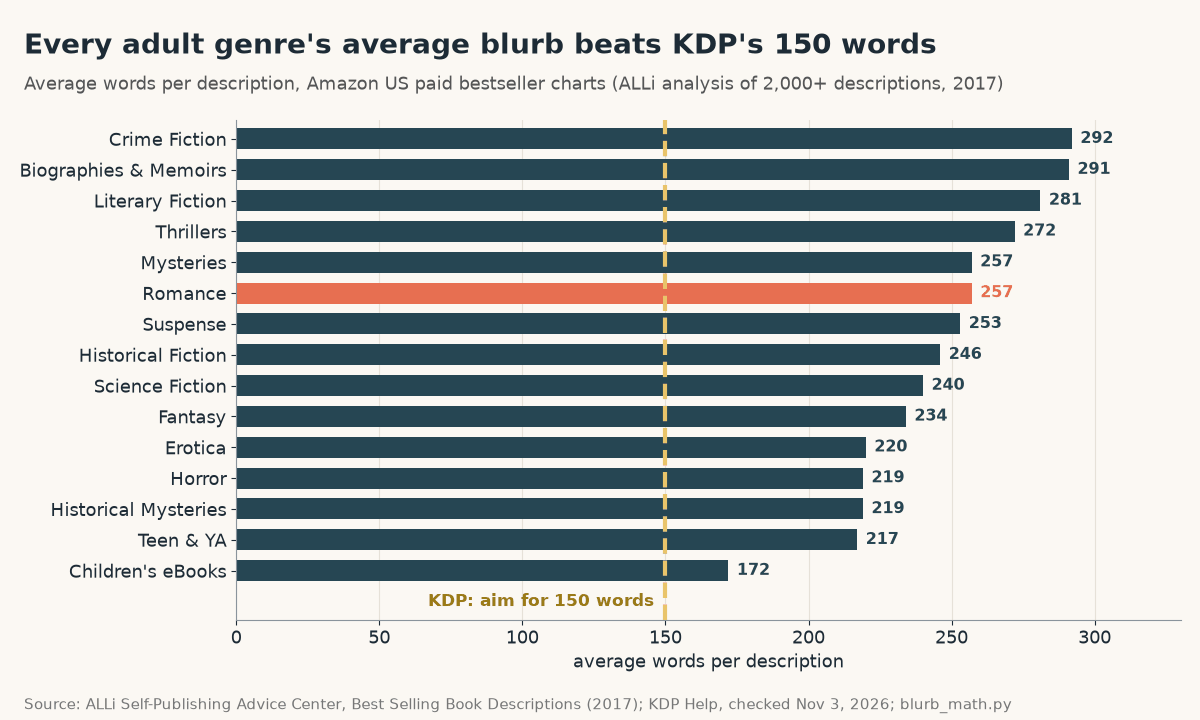
How do both things hold up? Look at what KDP is actually optimising. Its 150 words is the hook: the part a skimmer reads in “a second or two”. Bestselling blurbs keep that hook up front, then add roughly 100 more words for the readers who are still deciding: tropes, stakes, series promise and heat level. Romance readers buy on those signals. In ALLi’s word counts, the magic adjective for romance was HOT, with SEXY tied for second, and HEART appeared nearly three times as often as in other genres.
Napkin math (assumption: about 6 characters per word, including spaces and punctuation): a 257-word romance blurb is about 1,542 characters, or 39% of KDP’s 4,000-character box. You’re not short of room. The limit only bites if you pile on formatting tags. KDP’s own example: the word test counts as 4 characters, but bolded as <b>test</b> it counts as 11.
Your book is first person. Your blurb probably shouldn’t be
Romancing the Data compiled 52 weekly Top 100 lists from 2025: 5,200 entries, boiled down to the 100 best-selling romances of the year. The point-of-view split:
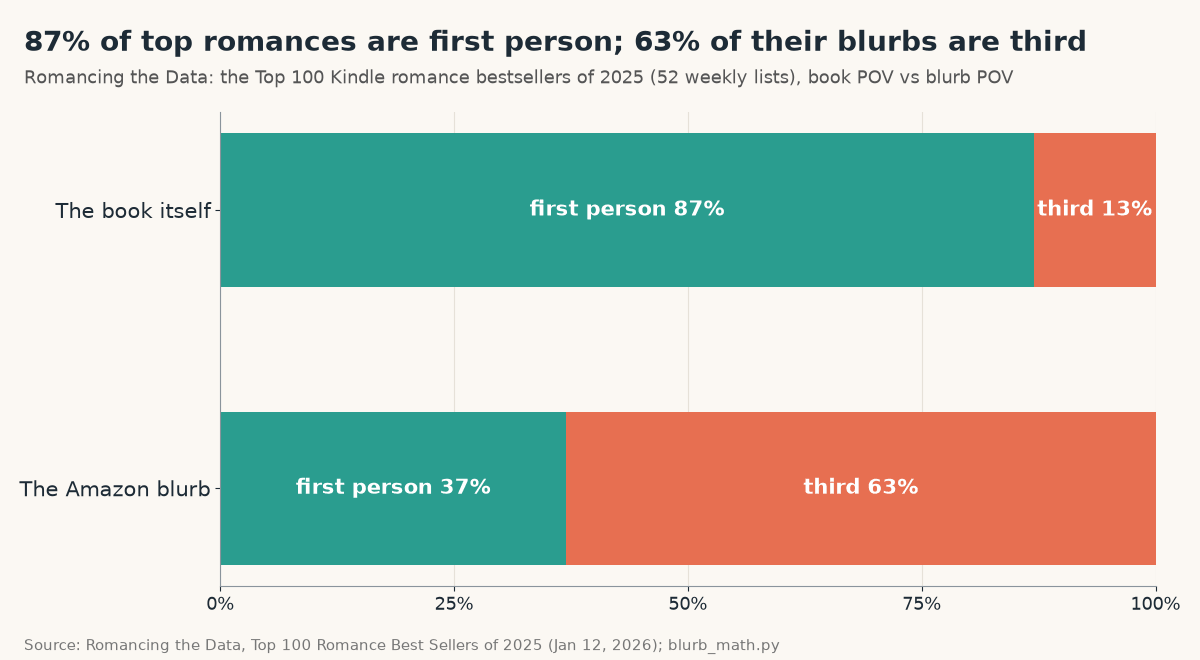
The book and the blurb do different jobs. The book puts a reader inside one head. The blurb has to sell both love interests, the conflict between them and the promise of the trope. That’s easier from outside. Third person lets you name both leads in the first two lines, which is where the hook lives.
First-person blurbs still work (37% of the top 100 use them), usually as a short in-voice teaser followed by a third-person pitch. The point is this: a generator that just mirrors your manuscript’s voice will hand you the minority choice by default. Tell it which POV you want.
What a better blurb is worth, in dollars
Weekend Publisher, which has managed over $225,000 of author ad spend, gives a simple decision flow for Amazon ads. If a target has 15 clicks and sales but converts below 5%, the instruction is: “check the blurb and look-inside”. Their benchmarks: fiction clicks cost 70 to 90 cents, a 5% conversion rate is good and 10% is “the golden ratio” that few books reach.
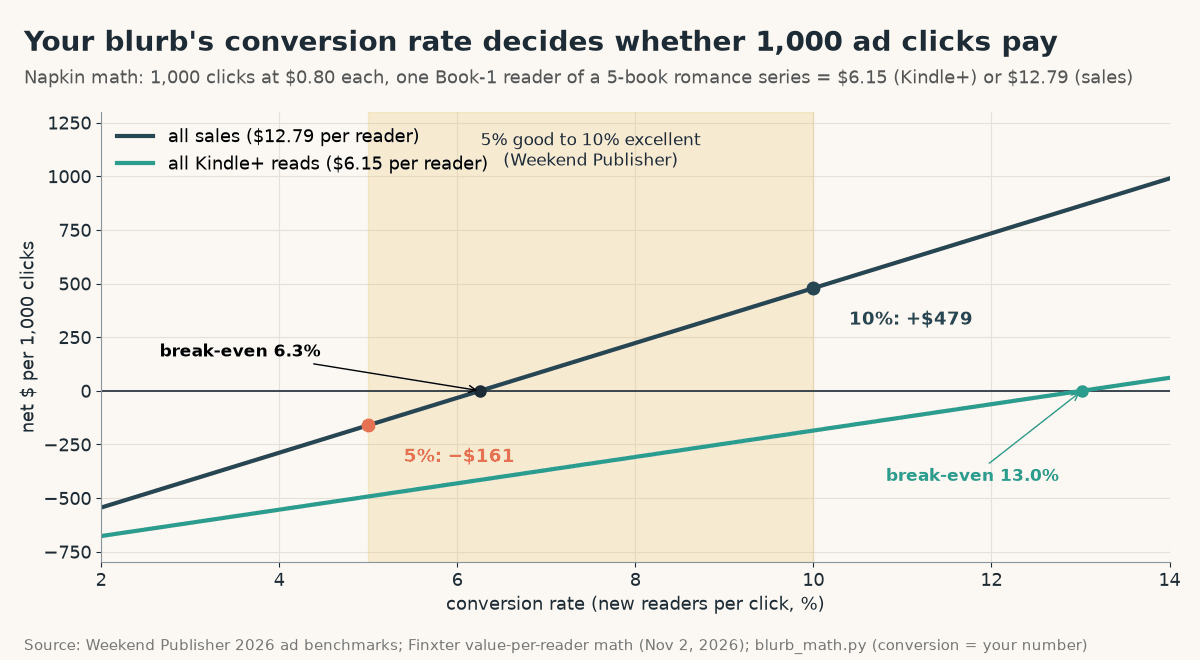
So let’s price the blurb’s job. Assumptions (labeled): 1,000 ad clicks at $0.80 (the midpoint), so $800 spent. Each new Book-1 reader of a 5-book romance series is worth $12.79 if every book is bought at $5.99, or $6.15 if every book is read in Kindle+. Both values come from the read-through math in self publishing romance novels on Amazon. Conversion counts a new reader per click.
| Conversion | New readers | Net, all sales | Net, all Kindle+ |
|---|---|---|---|
| 3% | 30 | −$416 | −$616 |
| 5% (“good”) | 50 | −$161 | −$493 |
| 7.5% | 75 | +$159 | −$339 |
| 10% (“excellent”) | 100 | +$479 | −$185 |
Three things jump out:
- “Good” isn’t break-even. On 80-cent clicks, an all-sales 5-book series needs 6.3% conversion just to pay for its ads. A “good” 5% blurb still loses $161 per 1,000 clicks.
- The swing is large. Going from 5% to 10% conversion moves the result by $639 per 1,000 clicks. No bid tweak does that.
- Kindle+-heavy series need more than ads. At $6.15 per reader, break-even is 13.0% conversion, above Weekend Publisher’s “excellent”. Ads only pay there with cheaper clicks or a longer series. The full grid is in are KDP ads worth it.
Here’s the all-sales case animated, from 2% to 12% conversion:
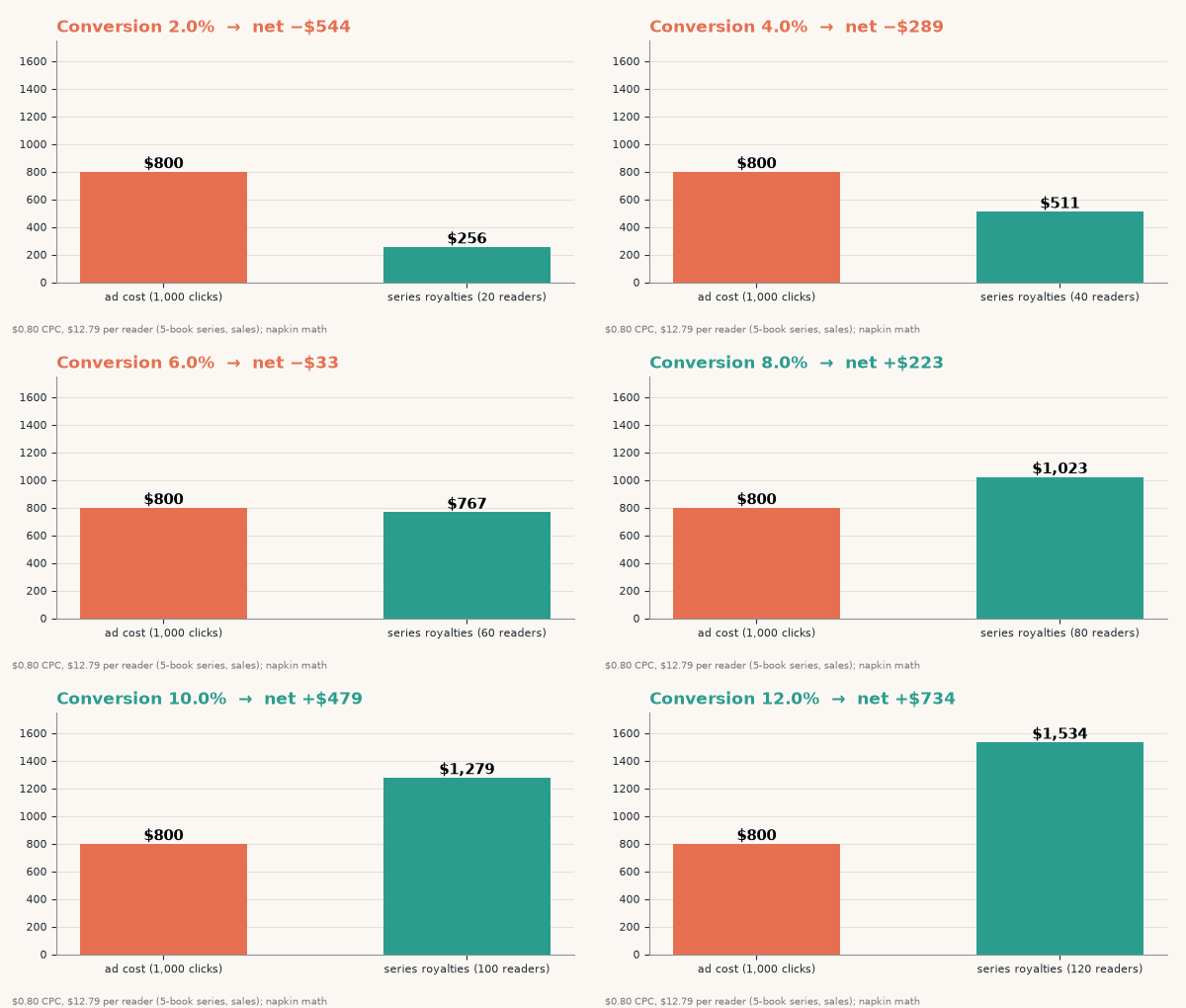
A blurb isn’t the only thing behind conversion: cover, price, reviews and the look-inside sample all count. Weekend Publisher’s flow points at the cover first when click-through is low, and at the blurb when the clicks come but the sales don’t. That second case is exactly where a better description pays.
How to use an Amazon book description generator (7 steps)
| Step | What to do | Number to know |
|---|---|---|
| 1. Generate from the book | Give the generator your manuscript or full outline, not a logline | Specific stakes beat generic trope copy |
| 2. Write the hook first | First sentence = the conflict; name both leads early | KDP: shoppers decide in “a second or two” |
| 3. Pick the POV on purpose | Default to third person for romance; add an in-voice teaser if you like | 63% of 2025’s top-100 romance blurbs are third person |
| 4. Set the length | ~150 words of hook and conflict, then tropes, series promise, heat level | Romance bestsellers average ~257 words |
| 5. Format lightly | Bold the hook, add line breaks; h4–h6 only | 4,000 characters incl. tags; <b>test</b> = 11 characters |
| 6. Remove banned content | No reviews, quotes, URLs, prices, dates, emojis or keyword lists | KDP rejects descriptions that include them |
| 7. Test with ads | 15 clicks per target, then judge; fix the blurb if conversion < 5% | Break-even ~6.3% at $0.80 clicks (5-book series, sales) |
Five notes on the parts that trip people up:
- Feed it the book, not a logline. A generator that only sees “enemies-to-lovers fae romance” writes the same blurb as everyone else’s. One that drafts from your manuscript can name your stakes. That’s why a description drafted from the finished book beats a one-line prompt.
- The first sentence is the ad. KDP says the first sentence “may be a reader’s first impression”. Keep KDP’s ~150 words for the hook and the core conflict, then use the rest of a ~250-word blurb for tropes, series and heat level.
- Run A/B by ad target, not by gut. Weekend Publisher gives each target 15 clicks before judging it. Swap the blurb only after you have conversion data, and change one thing at a time.
- Format sparingly. KDP supports
<b>,<i>,<em>,<u>, lists, line breaks and<h4>–<h6>headings (not<h1>–<h3>). Every tag counts toward the 4,000 characters. - Strip what KDP bans. Before you paste a generated draft in, check it for emojis, review quotes and “now only $0.99” lines. KDP’s restriction list rejects all three (see the box below).
Your keywords should use the same language as the blurb. The seven keyword boxes are covered in KDP keywords examples, and if you’re still choosing a drafting tool, see the best AI for writing romance novels. There’s also a short Medium piece on 7 KDP settings that quietly cost you money.
KDP will reject these in a description: reviews, quotes or testimonials; requests for reviews; phone numbers, emails or website URLs; price, availability or time-sensitive information (such as tour dates); spoilers; Unicode emojis; and “any keywords or book tags phrases”. Check every generated blurb against this list before you paste it in.
Summary
| Question | Number | What to do |
|---|---|---|
| How long should an Amazon book description be? | KDP: 150 words; romance bestsellers: ~257 | Hook in the first ~150, total ~250 |
| What’s the hard limit? | 4,000 characters, HTML tags included | You’ll rarely need more than ~40% of it |
| First or third person? | Books 87% first; blurbs 63% third | Third person by default for romance |
| When is the blurb the problem? | Clicks but under 5% conversion | Rewrite the blurb before raising bids |
| What’s a better blurb worth? | 5% → 10% = +$639 per 1,000 clicks | Only true for a series; standalones need more |
| Which generator? | One that drafts from your book | Then edit: POV, hook, banned content |
Limitations
ALLi’s word counts are from 2017, and the article doesn’t say exactly how it counted. It also gives thrillers as 272 words in one place and 277 in another; I use 272. Treat the genre averages as a direction, not a target. The POV split is current (2025) but covers only the top 100 romances. The dollar grid assumes 80-cent clicks, a sample 5-book read-through funnel and an all-sales or all-Kindle+ catalog. Your own conversion rate from the ad console beats every number here.
The takeaway
KDP’s 150 words is the right length for your hook, not your whole blurb. Bestselling romance runs about 257 words and is usually pitched in third person, even when the book is in first. And because the blurb is what turns clicks into readers, the gap between a 5% and a 10% conversion rate is worth about $639 per 1,000 ad clicks on a 5-book series.
If you want the blurb drafted from the book itself, alongside the manuscript, cover and keyword ideas, try ImagineYourBook. The $0 7-day trial includes one complete 10,000-word book. A card is required, and it becomes $29.99/month unless you cancel before day 8. Then edit the draft blurb yourself: third person, hook first, about 250 words.
Sources (checked November 3, 2026): KDP Help: Write a Book Description (150 words, 4,000 characters, HTML, restrictions) · ALLi Self-Publishing Advice Center: Best Selling Book Descriptions, A Visual Analysis (2017) · Romancing the Data: Top 100 Romance Best Sellers of 2025 (Jan 12, 2026) · Weekend Publisher: Amazon ads for books (2026 benchmarks) · Finxter: value per series reader (Nov 2, 2026) · ImagineYourBook pricing and trial terms. Napkin assumptions: $0.80 per click (midpoint of 70–90 cents), about 6 characters per word, a 5-book series valued at $12.79 (all sales at $5.99) or $6.15 (all Kindle+ reads) per Book-1 reader.