
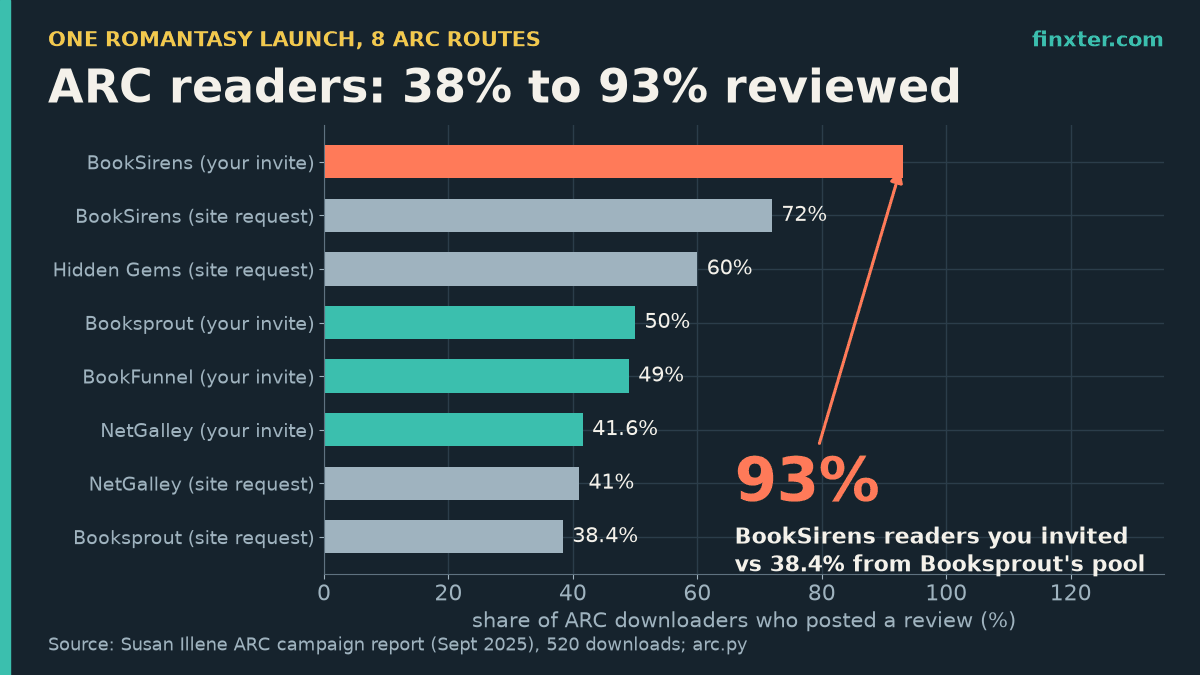
ARC readers are people who get a free advance copy of your book before launch and may post an honest review. Every ARC platform advertises a review rate around 75% to 80%. The only multi-platform field report I could find tells a different story: one romantasy launch ran the same book through five ARC services at once, and the share of readers who actually reviewed ranged from 38.4% to 93% depending on the platform and on who invited the reader.
That spread matters more than the sticker price. Below, I combine that real campaign (622 requests, 520 downloads, 263 reviews by day 12) with every platform’s live price on November 18, 2026 to answer the two questions a series author actually has: how many ARC readers do I need, and what does each review really cost?
TL;DR
- In one real 5-platform campaign, 50.6% of ARC downloaders reviewed within 12 days (263 of 520).
- Review rates ran from 38.4% (Booksprout site requests) to 93% (BookSirens readers the author invited).
- At 50 readers, cost per review ranges from $0.99 (Booksprout Pro) to $4.67 (Hidden Gems) at measured rates.
- For 25 launch reviews you need about 27 invited readers or 66 strangers from a browse platform.
- 263 reviews came with only 154 ebook sales: ARCs buy proof, not buyers.
An ARC campaign only works if the next book is already moving. If you write series, the bottleneck is usually drafting book 2 while book 1’s ARCs are out. My top pick for that is ImagineYourBook, an AI book-writing tool that turns a prompt or your notes into a complete draft with a cover and Word, EPUB and Markdown downloads. The EPUB matters here: it is the file BookSirens, Booksprout and BookFunnel hand to ARC readers.
What ARC readers are (and what Amazon allows)
An ARC (advance reader copy) is a finished or near-final ebook you give away before launch. ARC readers are not paid, and a review must never be required. As Storiad’s guide summarizes Amazon’s Community Guidelines, readers may review a free advance copy as long as you don’t require a review, ask for five stars, pay, swap reviews, or recruit close friends and family. Every platform below repeats the same line: you pay for distribution to readers, not for reviews.
Most guides stop there and tell you to “aim for 20 to 50 readers.” That number is useless without the review rate, so let’s get the rate.
The data: one launch, five ARC platforms, 520 downloads
In September 2025, romantasy author Susan Illene published the full results of her ARC campaign for Oaths & Vengeance, book 1 of a new series. She ran it for about six weeks through NetGalley, BookSirens, Booksprout, Hidden Gems and BookFunnel, plus a sign-up list fed by about $6 a day in Instagram and Facebook ads. About two thirds of the ARCs went to readers from her own sign-up list, who then picked the platform they wanted to receive the book through.
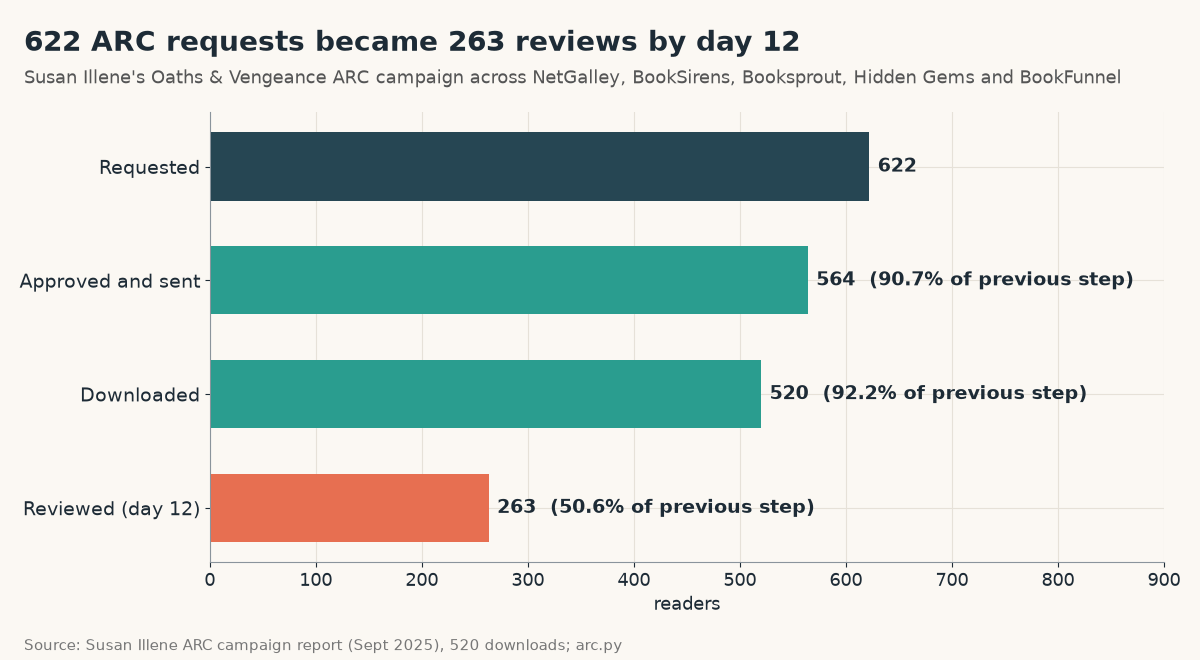
The funnel: 622 requests, 564 approved and sent, 520 downloaded, 263 reviews twelve days after release. So 50.6% of downloaders reviewed, or 42.3% of everyone who asked. A later update on the post puts the total at 311 reviews, with stragglers still arriving, mostly from NetGalley.
Here is the part no ARC platform page shows you, the rate split by platform and by route:
| Platform | Reviewed: site requests | Reviewed: readers you invited | Vendor’s claimed rate |
|---|---|---|---|
| BookSirens | 72% | 93% | 75% |
| Hidden Gems | 60% | n/a | 80% |
| NetGalley | 41% | 41.6% | not published |
| Booksprout | 38.4% | 50% | 80% |
| BookFunnel | n/a | 49% | not published |
Two patterns jump out:
- Readers you invite beat readers who browse. On BookSirens, invited readers reviewed at 93% vs 72% for site requests. On Booksprout it was 50% vs 38.4%.
- Vendor claims are a ceiling. Booksprout says to expect about 8 reviews per 10 participants. The measured site-request rate was less than half of that. BookSirens came closest to its own claim (75% site-wide vs 72% measured).
One campaign is one book, one genre and one six-week window, so treat these as a realistic floor to plan with, not a law. It is still the best apples-to-apples comparison published, because the same book went to every platform at the same time.
What each ARC platform costs in November 2026
I pulled every price from the live pricing pages on November 18, 2026:
| Platform | Price (Nov 18, 2026) | Pricing model | Cost for 50 readers |
|---|---|---|---|
| Booksprout | $9 / $19 / $29 / $59 a month | Flat monthly plan; Growing 25 copies, Pro 50 copies, Bestselling unlimited | $19 (Pro) |
| BookFunnel | $30 a year (First-Time Author) | Flat annual plan, delivers to readers you invite | $30 a year |
| BookSirens | $10 per ARC + $2 per downloading reader, or $100 a year (Author) | Pay per download | $110 |
| NetGalley (Victory Editing co-op) | $75 a month ebook slot | Flat slot rental | $75 |
| Hidden Gems | $20 deposit covers 1 to 10 readers, then $3 each, MAX $400 | Pay per reader, billed in steps of 5 | $140 |
The pricing models are completely different, which is why you can’t compare them by headline price. Booksprout charges a flat monthly fee no matter how many readers claim the book. BookSirens and Hidden Gems charge per reader. NetGalley is a flat slot you rent, usually through a co-op for indie authors.
Cost per review: the real ranking
Cost per review = campaign price / (readers x review rate). For a campaign that puts the book in front of 50 downloading readers:
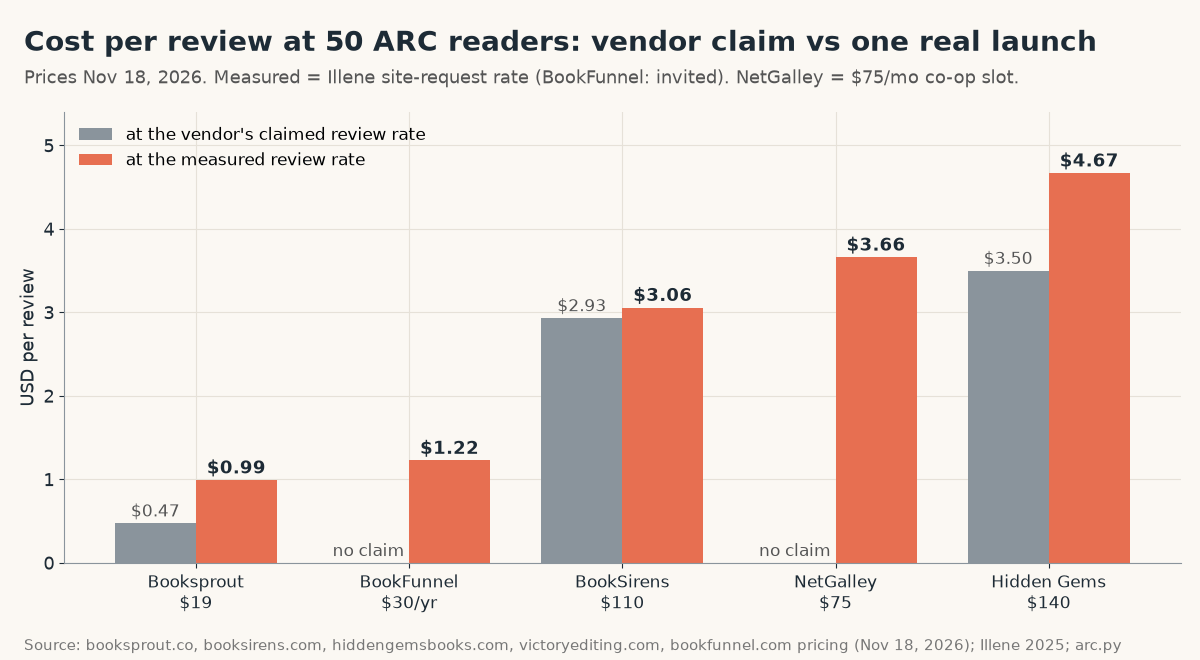
- Booksprout Pro ($19): at its own 80% claim, $0.47 a review. At the measured 38.4%, $0.99. Still the cheapest.
- BookFunnel First-Time Author ($30 a year): only for readers you bring yourself. At the measured 49%, $1.22, and the plan covers every launch that year.
- BookSirens ($10 + $2 x 50 = $110): $3.06 at the measured 72%. You pay only for readers who download, so it never charges for an empty campaign.
- NetGalley via a $75/month co-op slot: $3.66 at 41%. The flat slot gets cheaper per review only if many readers request the book, and its measured completion rate was among the lowest.
- Hidden Gems ($20 + $3 x 40 = $140): $4.67 at the measured 60%. Its MAX option caps the bill at $400.
For scale, a single paid editorial review costs $299 at Reedsy Discovery and $450 for a standard Kirkus Indie review (Reedsy’s comparison). That is one review vs dozens of reader reviews.
The ranking flips when you scale. Flat fees get cheaper per review as more readers claim, per-reader pricing doesn’t:
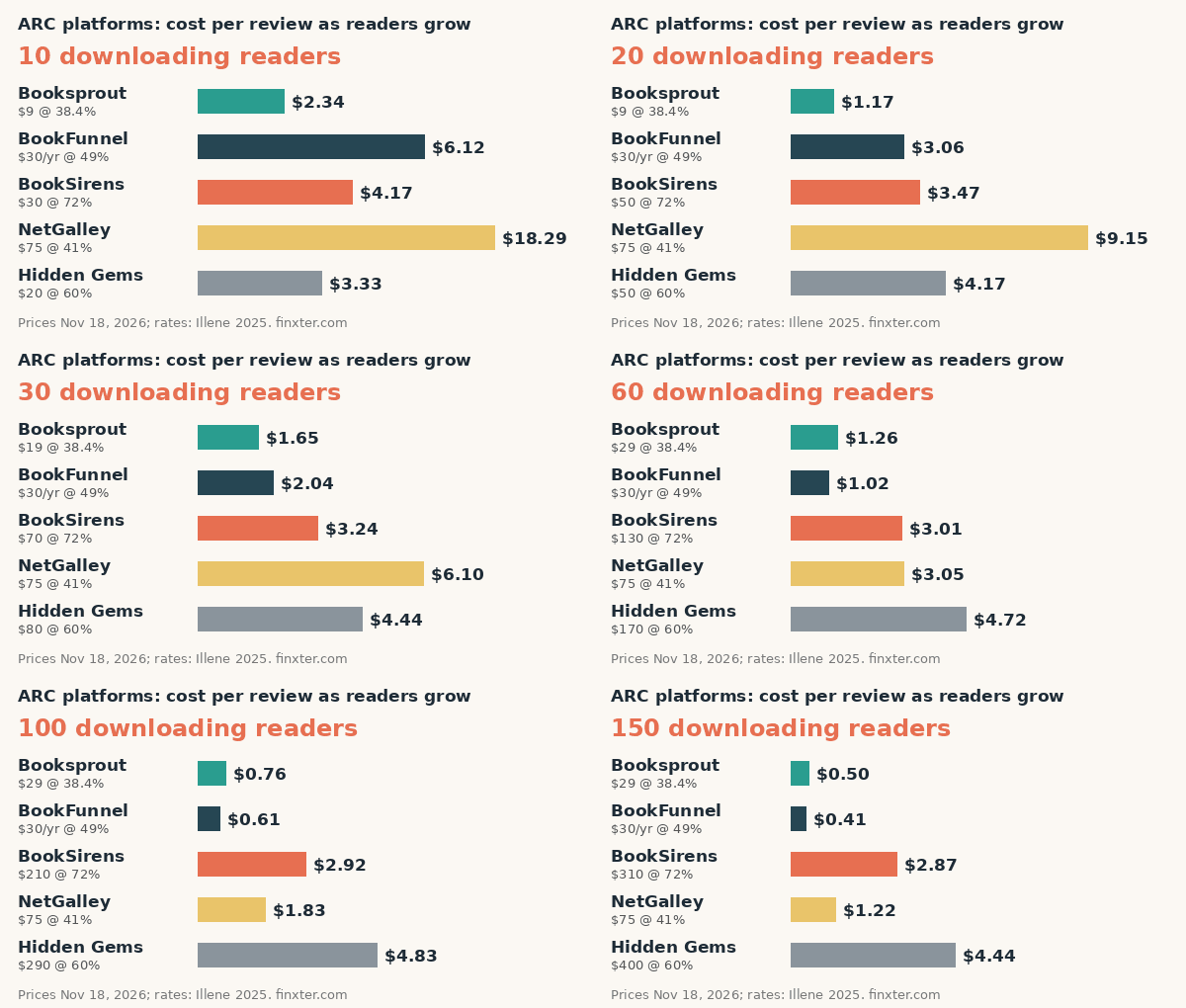
At 150 readers, Booksprout’s $29 Bestselling plan works out to $0.50 a review at the measured rate, while BookSirens stays near $2.87 and Hidden Gems hits its $400 cap at about $4.44.
How many ARC readers do you need?
Readers needed = reviews you want / review rate, rounded up. For 25 launch-week reviews:
| Route | Review rate | Readers for 25 reviews | Readers for 10 reviews |
|---|---|---|---|
| BookSirens, invited | 93.0% | 27 | 11 |
| BookSirens, site requests | 72.0% | 35 | 14 |
| Hidden Gems | 60.0% | 42 | 17 |
| Illene’s whole campaign | 50.6% | 50 | 20 |
| BookFunnel, invited | 49.0% | 52 | 21 |
| NetGalley, site requests | 41.0% | 61 | 25 |
| Booksprout, site requests | 38.4% | 66 | 27 |
| Rule of thumb (one third) | 33.3% | 75 | 30 |
The common rule of thumb of “about a third will review” (Storiad) gives 75 readers, which is too pessimistic for invited readers and about right for a NetGalley-heavy campaign. Plan with your own mix: if most readers come from your list through BookSirens, 27 to 35 is enough. If you rely on strangers browsing Booksprout or NetGalley, budget 61 to 66.
The twist: reviews are not sales
Illene’s campaign was a review success and, in her own words, a weak launch. Twelve days after release she had 263 ARC reviews but 154 ebook sales across all stores, 14 print copies, 34,971 Kindle Unlimited pages read and $688.67 in total earnings. That is about 1.7 reviews per ebook sold. Amazon US showed 86 ratings and reviews, because many ARC readers posted only on Goodreads or Instagram.
Don’t judge an ARC campaign by review count. In the only multi-platform report I found, the launch earned $688.67 in its first stretch despite 263 reviews. Reviews convert traffic you already have; plan the traffic (ads, newsletter, the next book) separately.
The money math makes the same point. At a $4.99 ebook, KDP pays $3.39 per sale on Amazon.com (70% of the price after a $0.15 delivery fee for a 1 MB file, per KDP’s eBook royalty rules). So:
- Booksprout Pro at $19 pays for itself after 6 sales.
- A 50-reader BookSirens campaign at $110 needs 33 sales.
- A Hidden Gems MAX campaign at $400 needs 118 sales.
ARC reviews buy social proof for the readers your ads and newsletter send, they do not create those readers. That is why ARCs pay off best on book 1 of a series, where every review keeps working for the books behind it. My KDP launch strategy breakdown shows why a launch is judged by the series, not by one book.
The series math: five launches, one ARC budget
For a five-book rapid-release romance series with 50 ARC readers per book:
- Booksprout Pro: 5 x $19 = $95
- BookSirens: 5 x $110 = $550
- Hidden Gems: 5 x $140 = $700
- BookFunnel First-Time Author to your own list: $30 for the year
Here is the practical system I’d copy from the data: run book 1 wide on paid platforms to find readers, ask every ARC reader to join your list, then deliver books 2 to 5 to that list through BookFunnel or BookSirens’ invite route, where the measured review rates were 49% to 93%. Building that list is its own math problem, covered in my reader magnet cost breakdown. Time the ARCs against your preorder window so reviews land in launch week.
| Question | Answer from the numbers |
|---|---|
| Realistic review rate | 38% to 50% from browsing strangers, 72% to 93% from readers you invited |
| Cheapest per review | Booksprout Pro, $0.99 at 50 readers (measured) |
| Cheapest for your own list | BookFunnel First-Time Author, $30 a year |
| Pay only for downloads | BookSirens, $10 + $2 per reader |
| Readers for 25 reviews | 27 invited to 66 strangers |
| Sales to cover the campaign | 6 (Booksprout Pro) to 118 (Hidden Gems MAX) at $3.39 each |
| 5-book series, 50 readers each | $95 Booksprout, $550 BookSirens, $700 Hidden Gems |
FAQ
What are ARC readers?
ARC readers get a free advance reader copy of a book before launch and may post an honest review. They are not paid, and authors may not require a review or ask for a positive one.
How many ARC readers do I need?
Divide the reviews you want by your expected review rate. For 25 reviews that is about 27 readers you invited yourself at 93%, or 66 strangers from a browse platform at 38.4%.
What percentage of ARC readers leave a review?
Platforms claim 75% to 80%. In one real five-platform campaign, 50.6% of 520 downloaders reviewed within 12 days of release, ranging from 38.4% to 93% by platform and route.
Is Booksprout or BookSirens better for ARC readers?
Booksprout is cheaper per review ($0.99 vs $3.06 at 50 readers, measured). BookSirens had the higher review rate (72% vs 38.4%) and charges only for readers who download.
Can ARC readers review on Amazon?
Yes, if the author doesn't require a review, ask for a rating, pay, or trade reviews, and the reader isn't a close friend or family member, per Amazon's Community Guidelines.
The takeaway
Plan ARC campaigns with measured review rates, not vendor promises: 38% to 50% for strangers on browse-style platforms, 72% to 93% for readers you recruited yourself. That makes Booksprout the cheapest way to meet new readers (about $1 a review) and your own list the cheapest way to keep them. And remember the twist: 263 reviews did not make 263 sales, so the real asset is the next book in the series.
If drafting that next book is your bottleneck, ImagineYourBook gives you a 7-day free trial with one complete 10,000-word book (card required), then a first $24.99 charge for the Author plan’s 40,000 words a month, with EPUB files ready for your ARC platform. For more ways to turn AI into income, see Finxter’s guide on making money with AI.
Sources (checked November 18, 2026): Susan Illene: Brutally honest ARC campaign results (Sept 2025) · Booksprout pricing · Booksprout for authors · BookSirens pricing · Hidden Gems ARC FAQ · Victory Editing NetGalley co-op · BookFunnel pricing · Storiad: ARC readers and Amazon’s rules · Reedsy: editorial review prices · Kirkus Indie · KDP eBook royalties · KDP delivery costs · ImagineYourBook pricing. Method: review rates are the share of downloaders who reviewed, as reported by Susan Illene for one campaign; cost per review = campaign price / (50 readers x review rate), one month for monthly plans; break-even sales = cost / $3.39 (70% of a $4.99 list price less $0.15 delivery for a 1 MB file, Amazon.com). Not affiliated with any ARC platform named.