
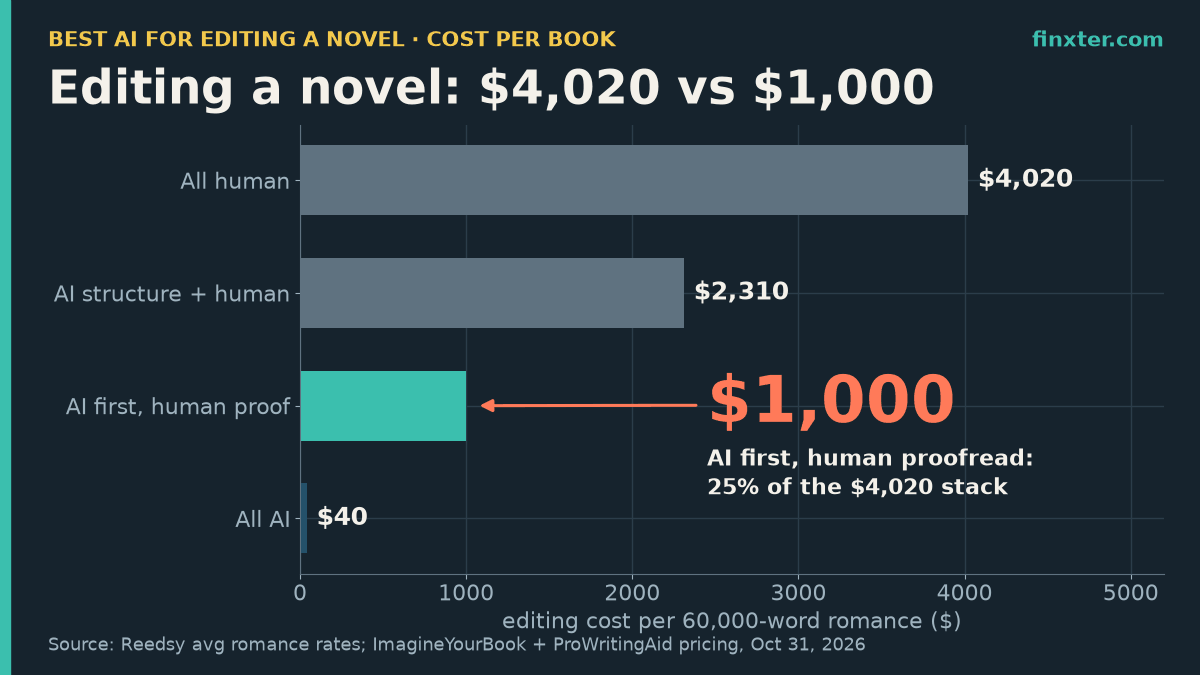
The best AI for editing a novel is one that revises the whole manuscript at once, because the pass it can take over is the expensive one. At Reedsy’s average romance rates, a developmental edit of a 60,000-word book costs $1,740. A full-book AI revision pass costs about $30. Add a line checker, keep one human proofread, and your editing bill drops from $4,020 to about $1,000 a book.
For that whole-book pass, my top pick is ImagineYourBook. It’s an AI book-writing tool that turns a prompt or notes into a complete draft (the free trial gives you one 10,000-word book) with Word and EPUB exports. The part that matters for editing is Manuscript Rewrite: you upload a Word, Markdown, text or HTML manuscript of up to 200,000 words, describe what should change in plain language, and get a revised edition back while your source file stays untouched. Small fixes you can make in its in-browser editor. If you write in series, its Series Builder keeps a story bible of characters, world rules and open threads, so Book Three still knows what happened in Book One.
The rest of this post is the money math behind that answer, which passes AI handles well, which one I would never skip, and how KDP’s AI disclosure rule treats editing.
TL;DR
- A human edit of a 60,000-word romance costs about $4,020 at Reedsy’s average rates: dev $1,740, copy $1,320, proofread $960.
- A whole-book AI revision costs about $30 (12 ImagineYourBook credits on Publisher), so AI can take the $1,740 structural pass, if you write the editorial notes.
- AI structure + AI line check + human proofread = $1,000 a book, 364 sales to break even instead of 1,462.
- Series rule: full human edit for Book One, AI-first for Books 2–5: $8,020 vs $20,100 for five books.
- KDP: AI that edits or error-checks your own writing is AI-assisted (no disclosure); AI-written passages are AI-generated (disclose).
What a human edit of a novel costs
Reedsy publishes average freelance rates per word by genre. For romance they are:
- Developmental edit (structure, pacing, character arcs): $0.029 per word, so $1,740 for 60,000 words
- Copy edit (sentence-level clarity, consistency, grammar): $0.022 per word, so $1,320
- Proofread (the last typo sweep): $0.016 per word, so $960
That is $4,020 per book before you buy a cover. The developmental edit alone is 43% of it. The proofread, the pass readers notice most when it’s missing, is only 24%.
Assumptions, clearly labeled: a 60,000-word romance, Reedsy average rates (your editor may charge more or less), and a $3.99 ebook earning $2.75 per sale at the 70% royalty (assuming $0.06 delivery cost). For Kindle Unlimited readers I use the 12-month average payout of $0.004768 per page (October 2025 to September 2026, from Written Word Media), so one full read of a 300-page book pays about $1.43. I worked through that read value in how much you can make on Kindle Unlimited.
At $2.75 a sale, a fully human edit needs 1,462 sales (or about 2,810 full KU reads) just to pay for itself.
The editing ladder: which pass AI can take over
Here are four ways to edit the same book. Each rung swaps one human pass for an AI one:
| Rung | Structure | Line / copy | Proofread | Cost per book | Break-even sales | Full KU reads |
|---|---|---|---|---|---|---|
| 1. All human | Dev editor $1,740 | Copy editor $1,320 | Human $960 | $4,020 | 1,462 | 2,810 |
| 2. AI structure | AI whole-book revision $30 | Copy editor $1,320 | Human $960 | $2,310 | 840 | 1,615 |
| 3. AI first, human proof | AI whole-book revision $30 | AI line checker $10 | Human $960 | $1,000 | 364 | 699 |
| 4. All AI | AI whole-book revision $30 | AI line checker $10 | none | $40 | 15 | 28 |
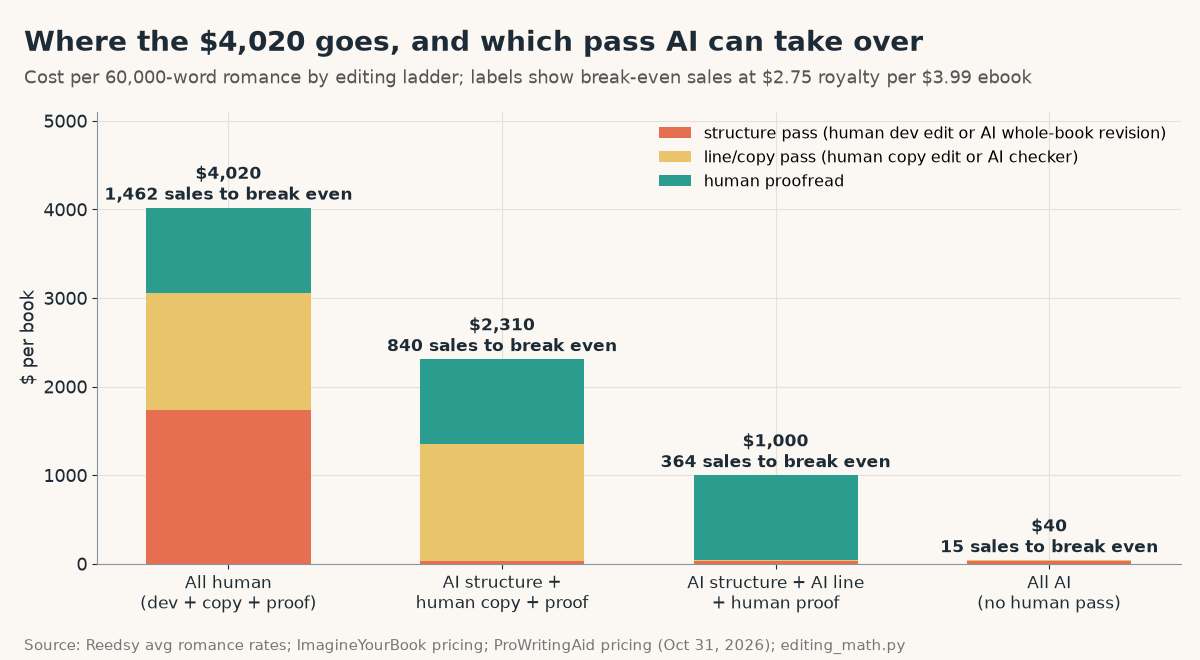
The pattern is lopsided. AI is cheapest exactly where humans are most expensive. A whole-book AI revision costs 12 credits with ImagineYourBook’s Manuscript Rewrite (1 credit per 5,000 output words). On the Publisher plan ($59.99 for 24 credits) that’s $30; on the Author plan ($29.99 for 8 credits) it’s about $45. For line-level problems (repeated words, sticky sentences, filler adverbs, grammar), a dedicated checker costs a monthly subscription: ProWritingAid Premium is listed at $10 a month billed yearly or $30 billed monthly, AutoCrit Pro at $15 a month billed annually or $30 monthly, and Grammarly Pro at $12 on its plans page. I use $10 a month in the math, which assumes one book a month on annual billing.
Rung three, AI for structure and lines and a human for the final proofread, costs $1,000 a book. That’s 25% of the full human stack, and it needs 364 sales to break even instead of 1,462.
Why I keep the human proofread
The bottom rung costs $40 and needs just 15 sales. It’s tempting, and I wouldn’t publish that way, for three reasons:
- An AI can’t check its own blind spots. The same model that introduced a wrong name in chapter 14 is not the right judge of whether it’s wrong. A second set of human eyes catches the class of errors a pattern-matcher repeats.
- The proofread is the cheapest human pass. At $960 it’s the smallest line in the stack, and it protects the thing that sells Book Two: reviews of Book One that don’t say “full of typos”.
- You are now the developmental editor. The AI pass only fixes what you tell it to fix. Read the draft yourself, write the editorial notes a dev editor would write (“the middle sags between chapters 9 and 14”, “his motivation flips in chapter 20”), then feed those notes into the rewrite.
Rule of thumb: let AI do the expensive pass, let a human do the last pass. Never publish an AI-only edit of a book you haven’t read yourself, cover to cover.
That third point is the honest catch in this whole post. The $1,740 doesn’t vanish into a $30 button. It turns into a few hours of your own reading and note-taking. For a portfolio publisher that’s a good trade, because those hours also teach you what your readers want. But plan for them.
How to pick the best AI for editing a novel
Judge any editing AI on four things, in this order:
- Whole-book context. Structure problems live across chapters. A tool that only sees the chapter you pasted will fix sentences and miss the arc. Chat windows hit their limits fast on a long series; I did the token math in best AI for writing a book series.
- Your source stays safe. You want a new edition next to the original, not a silent overwrite, so you can compare and keep the better chapter.
- Instructions in plain language. “Tighten chapters 3 to 6, give the heroine a clearer reason to stay, keep the banter” is how authors think. The tool should accept that.
- Price per pass, not per month. Compare the cost of one full revision of your word count. At 12 credits for 60,000 words, the gap between tools is a rounding error next to a single human pass.
The series math: give Book One the full edit
Series change the arithmetic. Book One carries the series: if it fails, readers never reach Book Two. In how to write a romance book series I showed that Book One earns only about a third of a series’ reads, but every later book depends on it.
So here is the rule I’d use: the full human stack for Book One, then the AI-first ladder for Books 2 to 5.
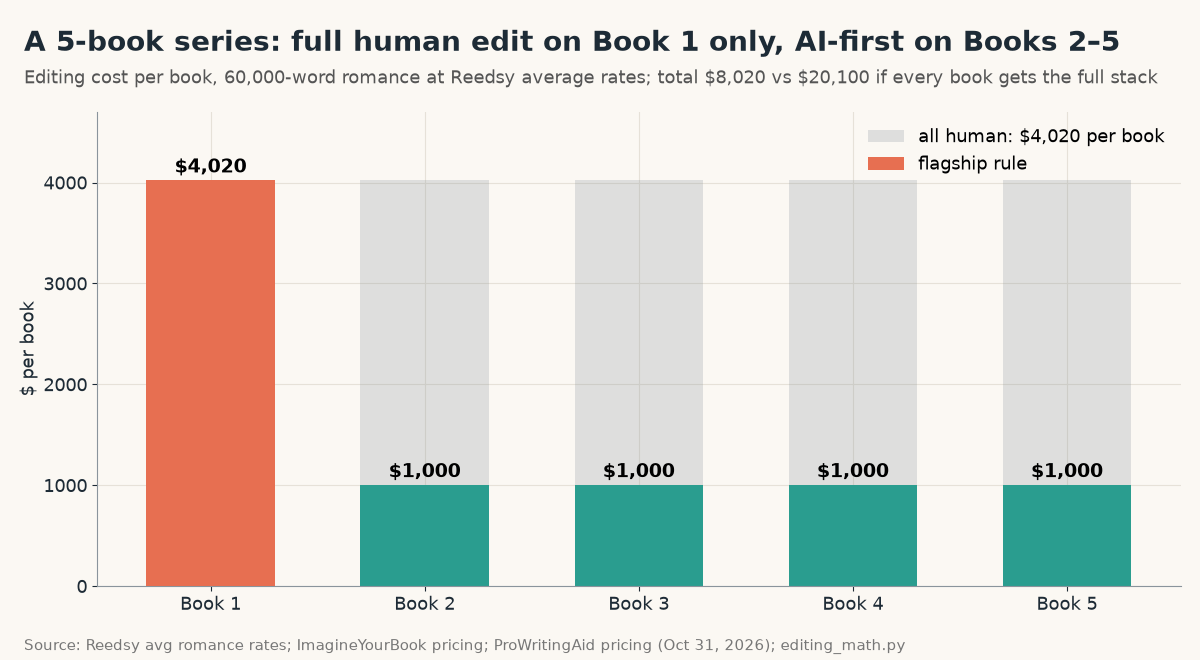
That’s $8,020 for the five-book series instead of $20,100, and 2,916 sales to break even instead of 7,309. By Book Two you also have something an editor gave you for free: their notes on Book One. Recurring issues (a tic in your dialogue tags, a character who keeps explaining her feelings) become standing instructions for every AI pass that follows.
The compounding part: 36 books in three years
Run that at one book a month and the gap compounds into real money:
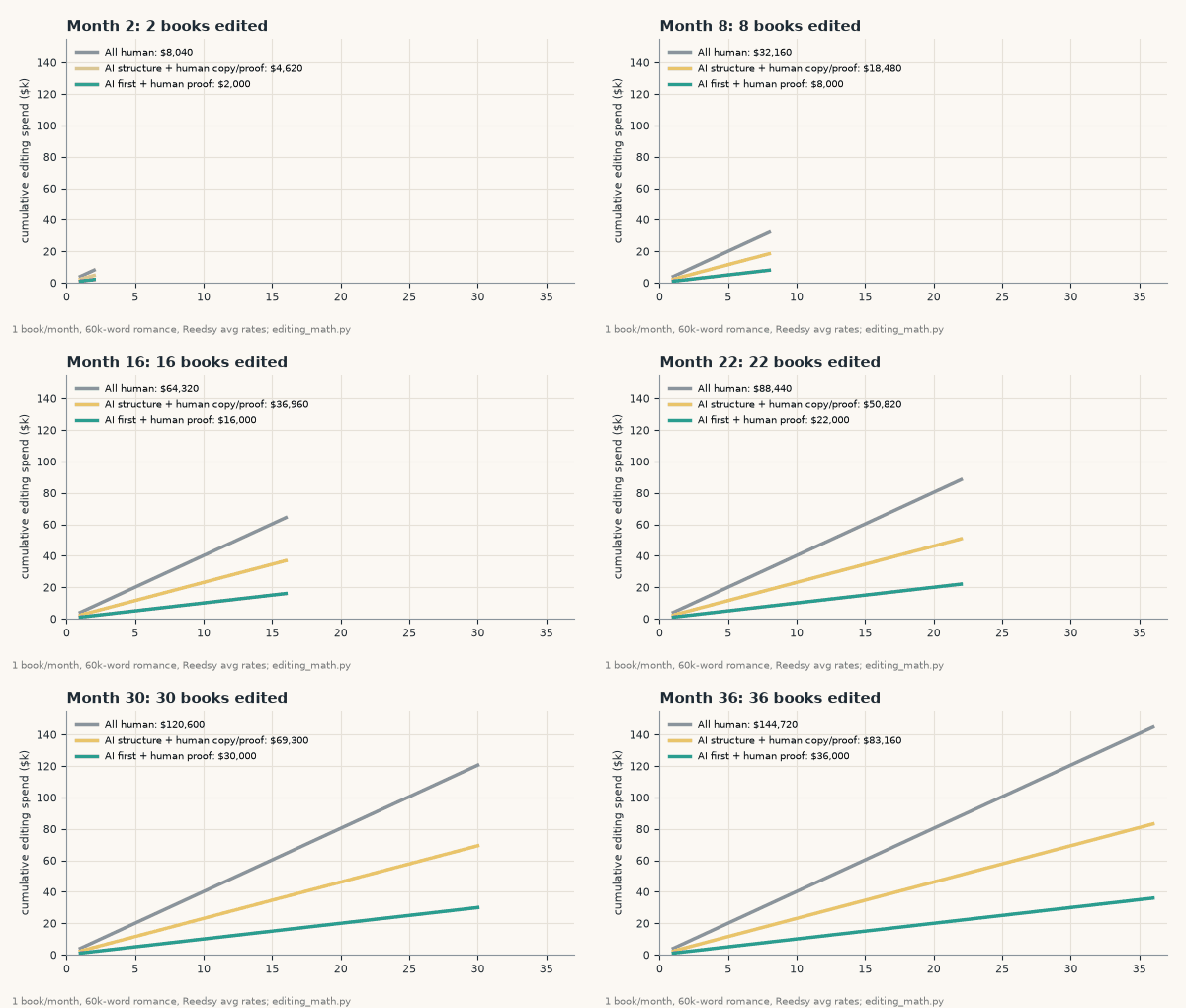
After 36 books, the fully human route has cost $144,720. The AI-structure route costs $83,160. The AI-first route with a human proofread costs $36,000. That’s $108,720 you can put into covers, ads or simply into staying in business long enough for the backlist to work. If you want the full production budget beyond editing, I priced a book line by line in best AI for KDP, and the raw API cost of a 50,000-word draft in what an LLM costs to write a novel.
KDP’s AI rule: editing your own draft doesn’t need disclosure
KDP asks you to disclose AI-generated text, images and translations when you publish or republish a book. It does not require disclosure of AI-assisted content. Its own definitions decide which side of the line your editing falls on:
| What the AI did | KDP category | Disclose? |
|---|---|---|
| Spelling, grammar or style check on a draft you wrote | AI-assisted (“error-check”) | No |
| Rephrased or tightened your own sentences and scenes | AI-assisted (“edit, refine… improve”) | No |
| Brainstormed ideas, but you wrote the text | AI-assisted | No |
| Wrote new chapters or passages during a rewrite | AI-generated (the AI created the content) | Yes |
| Drafted the book, then you edited it heavily | AI-generated (“even if you applied substantial edits”) | Yes |
| Translated the book | AI-generated (translations are named explicitly) | Yes |
The practical reading: if you wrote the book, an AI that edits, refines or error-checks it keeps the book AI-assisted. If the AI wrote new passages or chapters during a “rewrite”, treat those as AI-generated. And if the AI drafted the book in the first place, KDP counts the text as AI-generated “even if you applied substantial edits afterwards”. When in doubt, tick the box. It’s a KDP requirement, not a judgment call.
Summary
| Question | Number | What to do |
|---|---|---|
| Most expensive human pass? | Dev edit $1,740 (43%) | Hand it to a whole-book AI revision plus your own notes |
| Cheapest human pass? | Proofread $960 (24%) | Keep it; it protects Book One’s reviews |
| AI-first cost per book? | $1,000 vs $4,020 | AI structure + AI line check + human proofread |
| Series? | $8,020 vs $20,100 (5 books) | Full human edit on Book One only |
| 36 books at 1/month? | $36,000 vs $144,720 | Reinvest the $108,720 in covers and ads |
| Disclosure? | Editing your own text = AI-assisted | Disclose AI-written passages and AI drafts |
Limitations
These are averages. Reedsy’s rates are marketplace means, and real quotes vary with experience and genre: fantasy runs slightly higher than romance ($0.031 vs $0.029 a word for a developmental edit). The AI line-check cost assumes one book a month on annual billing. Break-even counts ignore covers, ads and taxes. And no figure here measures quality: whether an AI pass plus your own notes gets your book to the standard your readers expect is something only your reviews and read-through will tell you.
The takeaway
The best AI for editing a novel doesn’t compete with your proofreader. It competes with the $1,740 structural pass, and it wins on price by about 58 times if you bring the editorial judgment yourself. Use AI for the whole-book revision and the line check, keep a human for the final proofread, and give Book One of every series the full treatment.
If you want to try that workflow, ImagineYourBook offers a $0 seven-day trial that includes one complete 10,000-word book. It requires a card, the first $29.99 payment starts after 7 days, and you can cancel any time before day 8. Manuscript Rewrite itself runs on plan credits (1 credit per 5,000 words), so budget it on a paid plan rather than the trial book. Related read on Medium: AI Can Draft 10,000 Words in Minutes. The Next 60,000 Are the Job.
Sources (checked October 31, 2026): Reedsy: average freelance editing rates by genre · Reedsy: how much does editing cost · Written Word Media: KDP Global Fund payouts (Sept 2026) · KDP Content Guidelines (AI content) · ImagineYourBook pricing, credits and trial terms · ProWritingAid pricing · AutoCrit pricing · Grammarly plans. Napkin assumptions: 60,000-word romance, $3.99 ebook with $0.06 delivery cost, 300-page KU read, one book a month, line checker on annual billing. Prices change; re-check before you budget.