
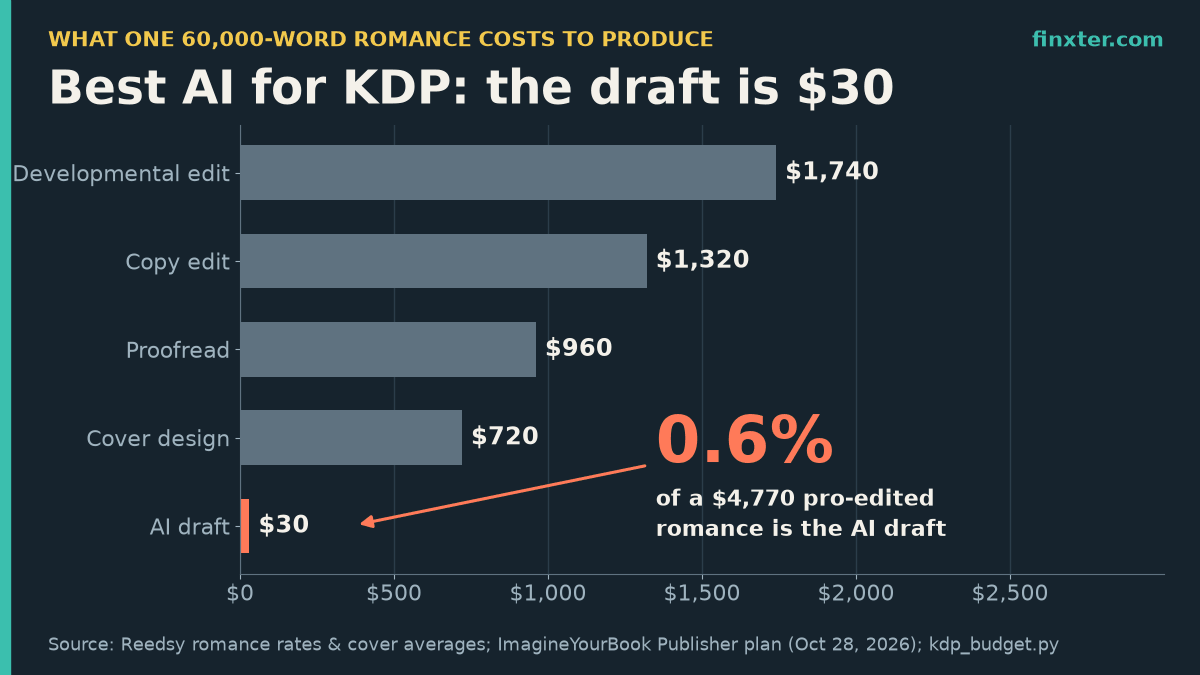
The best AI for KDP is not the one with the cheapest words, because words are already the cheapest thing in your book. At Reedsy’s average romance rates, a professionally edited 60,000-word romance costs about $4,770 to produce, and the AI draft is $30 of that, or 0.6%.
So here is the short answer to “best AI for KDP”. For drafting full-length genre fiction, my top pick is ImagineYourBook. It’s an AI book-writing tool that turns a prompt, outline or notes into a complete draft (the free trial gives you one 10,000-word book), with a cover and Word and EPUB exports. Book Two of a series remembers Book One, and paid plans add Manuscript Rewrite for revising a book you already have. But the bigger lesson of this post is how to judge any AI for KDP: judge it by the editing passes and rework it saves you, not by its price per word.
TL;DR
- A pro-edited 60,000-word romance costs about $4,770 to produce at Reedsy’s average romance rates. The AI draft is $30 of that: 0.6%.
- Even a bootstrap budget (proofread only, included cover) is $990, and the draft is still only 3.0%.
- One developmental edit ($1,740) costs as much as 58 AI drafts; an average romantasy cover ($3,950) as much as 132.
- So the best AI for KDP is the one that saves editing passes: whole-book continuity, series memory, whole-book revision, publishable files. My top pick: ImagineYourBook.
- At $3.99 and KDP’s 70% royalty ($2.75 a sale), a 5-book pro-tier series needs about 8,670 sales to break even; bootstrap needs about 1,799.
The budget nobody puts next to the AI price tag
It’s tempting to compare AI tools by subscription price: $20 against $30 against $60 a month. That is the wrong column to optimize. Here is what one book actually costs when you price every line with public numbers:
- AI draft: ImagineYourBook’s Publisher plan is $59.99 a month for about 120,000 words, so $0.50 per 1,000 words. A 60,000-word draft costs $30 (12 credits).
- Developmental edit: Reedsy’s average freelance rate for romance is $0.029 per word, so $1,740.
- Copy edit: $0.022 per word for romance, so $1,320.
- Proofread: $0.016 per word, so $960.
- Cover: Reedsy’s average romance cover costs $720. A romantasy cover averages $3,950.
On the revenue side, KDP pays 70% of the list price minus delivery costs, which average $0.06 per unit. A $3.99 ebook earns $2.75 a sale in the US store. (If you want the full royalty logic, including the $2.99 and $9.99 edges, my KDP royalty calculator in Python walks through it.)
Assumptions, clearly labeled: the book is 60,000 words, sells at $3.99, and every price is a marketplace average. Your editor may charge more or less. Change the constants and rerun.
"""kdp_budget.py - what one KDP romance costs to produce, and what share the AI draft is.
Rates: Reedsy marketplace averages for romance (checked Oct 28, 2026); ImagineYourBook pricing;
KDP 70% royalty rule. Book length and price are ASSUMPTIONS - change them."""
WORDS = 60_000            # assumption: a typical full-length KU romance
PRICE = 3.99              # assumption: list price of the ebook
DELIVERY = 0.06           # KDP: average delivery cost per unit sold
RATE = {"dev_edit": 0.029, "copy_edit": 0.022, "proofread": 0.016}   # Reedsy, romance, $ per word
COVER = {"romance": 720, "romantasy": 3950}                          # Reedsy, average cover by genre
IYB = {"Author": (29.99, 40_000), "Publisher": (59.99, 120_000), "Mogul": (179.99, 480_000)}

def draft_cost(words=WORDS, plan="Publisher"):
    price, cap = IYB[plan]
    return price / cap * words                     # $0.50 per 1,000 words on Publisher

def budget(tier, words=WORDS, genre="romance"):
    d = {"AI draft": draft_cost(words)}
    if tier == "pro":        # dev edit + copy edit + proofread + designer cover
        d |= {k: RATE[k] * words for k in RATE} | {"cover": COVER[genre]}
    elif tier == "lean":     # self-revise, pay for a copy edit + designer cover
        d |= {"copy_edit": RATE["copy_edit"] * words, "cover": COVER[genre]}
    elif tier == "bootstrap":  # proofread only, use the cover included with the draft
        d |= {"proofread": RATE["proofread"] * words}
    return d

def royalty(price=PRICE):
    return 0.70 * (price - DELIVERY)               # US store, no VAT

def breakeven_sales(tier, **kw):
    return sum(budget(tier, **kw).values()) / royalty()

if __name__ == "__main__":
    print(f"{WORDS:,}-word romance, ${PRICE} ebook, 70% royalty = ${royalty():.2f} per sale\n")
    for tier in ("pro", "lean", "bootstrap"):
        b = budget(tier); total = sum(b.values())
        items = ", ".join(f"{k} ${v:,.0f}" for k, v in b.items())
        print(f"{tier:<9} total ${total:>6,.0f} | draft share {b['AI draft']/total:5.1%} | "
              f"break-even {breakeven_sales(tier):>5,.0f} sales\n          {items}")
    pro = budget("pro")
    print(f"\nDev edit alone = {pro['dev_edit']/pro['AI draft']:.0f} AI drafts")
    print(f"Romantasy cover alone = {COVER['romantasy']/draft_cost():.0f} AI drafts")
    print(f"5-book series, pro tier: ${5*sum(pro.values()):,.0f}, lean: ${5*sum(budget('lean').values()):,.0f}")
Output:
60,000-word romance, $3.99 ebook, 70% royalty = $2.75 per sale

pro       total $ 4,770 | draft share  0.6% | break-even 1,734 sales
          AI draft $30, dev_edit $1,740, copy_edit $1,320, proofread $960, cover $720
lean      total $ 2,070 | draft share  1.4% | break-even   752 sales
          AI draft $30, copy_edit $1,320, cover $720
bootstrap total $   990 | draft share  3.0% | break-even   360 sales
          AI draft $30, proofread $960

Dev edit alone = 58 AI drafts
Romantasy cover alone = 132 AI drafts
5-book series, pro tier: $23,850, lean: $10,350
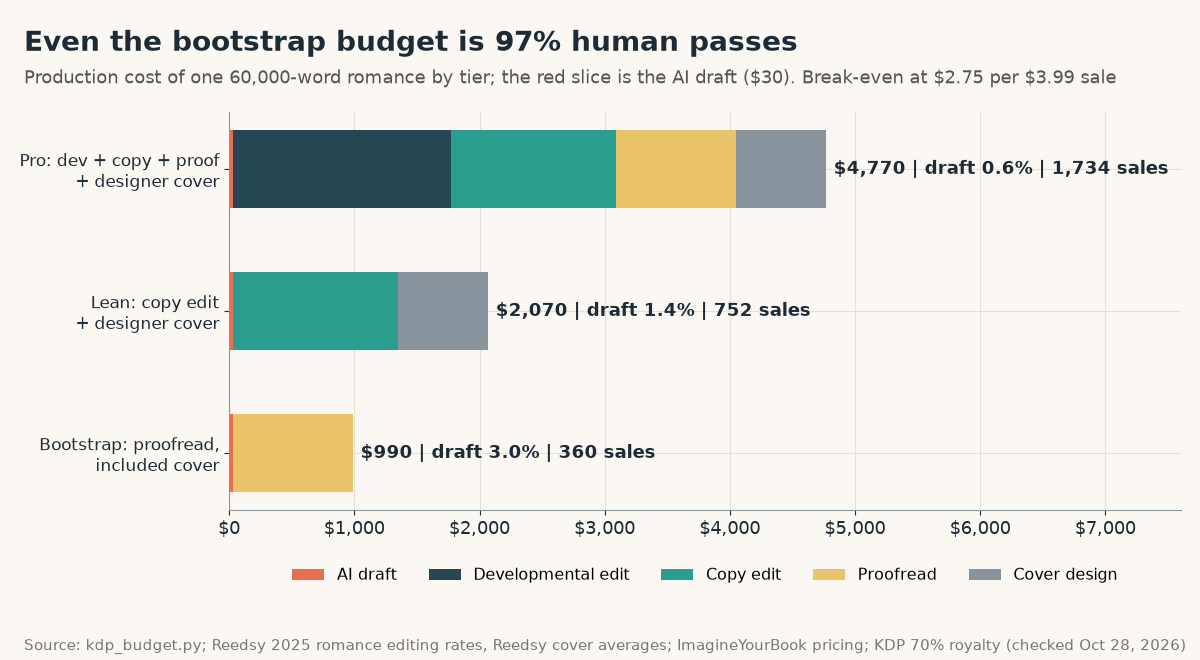
Read the three rows again. Even in the bootstrap tier, where you skip developmental editing and use the cover that comes with the draft, the AI is 3.0% of the cost. In the full pro tier it’s 0.6%. Switching from a $30 draft to a “cheaper” $15 draft would save you 0.3% of the budget. Skipping one developmental edit saves 36%.
That’s the convention-breaking part: the AI’s subscription price barely matters to your profit. What matters is whether its draft is clean enough that you can drop a paid pass.
One human pass costs as much as dozens of AI drafts
Put every line item in a single unit, “AI drafts of this book”, and the shape of a KDP budget becomes obvious:
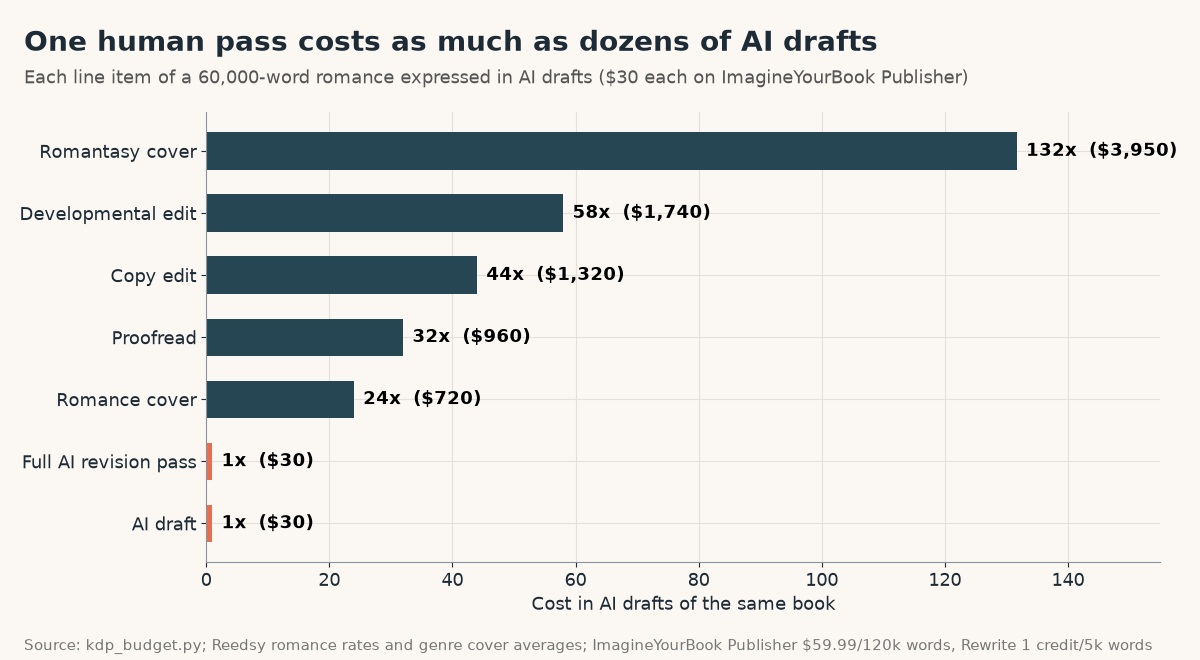
A developmental edit costs as much as 58 AI drafts. A romantasy cover costs as much as 132. In practice that means you can afford to throw away a weak draft and regenerate it, or run a full AI revision pass, many times before you match the cost of one human round. Use that slack. Spending $30 on another revision so that your editor finds fewer problems is usually a better use of money than cutting the $30.
One honest caveat: editors charge per word, not per mistake, so a cleaner draft doesn’t lower the rate. The money comes from skipping passes (going from pro to lean) or from needing fewer rounds of the same pass. That decision is yours, and it depends on how many continuity errors and flat chapters you find when you read the draft yourself.
What to look for in the best AI for KDP
If the draft is 1% of the cost and the edits are most of it, rank tools by what they save downstream:
- Continuity across a whole book and a whole series. Continuity is what developmental editors charge to fix: a character’s eye color, a magic rule, an open subplot. ImagineYourBook compiles a story bible (characters, world rules, open threads, invented terms) when a series book finishes and starts the next volume from it. I did the token math on why chat windows struggle here in best AI for writing a book series.
- Whole-book revision, not chapter-by-chapter pasting. ImagineYourBook’s Manuscript Rewrite costs 1 credit per 5,000 output words. On the Publisher plan (24 credits for $59.99, about $2.50 each) a full 60,000-word revision pass is 12 credits, or $30. That’s the cheapest place in your stack to fix pacing before a human sees it.
- Files you can publish. Word and EPUB exports skip a conversion step. A cover that comes with the draft is what makes the bootstrap tier possible at all.
- A clear commercial-rights and disclosure story. KDP requires you to tell it about AI-generated text, images or translations when you publish, and counts the text as AI-generated “even if you applied substantial edits afterwards”. AI-assisted editing of your own writing doesn’t need disclosure. Tick the box honestly. It doesn’t change your costs, and it’s a KDP requirement, not a suggestion.
What not to rank on: the monthly price difference between two tools. Over a 5-book series, a $10/month difference is smaller than one proofread.
Napkin math: a 5-book romance series
Series are where the budget gets real. The script’s last line prices five books:
- Pro tier: 5 × $4,770 = $23,850, which is about 8,670 sales at $2.75 before you break even.
- Lean tier (self-revise, paid copy edit, designer cover): 5 × $2,070 = $10,350, about 3,762 sales.
- Bootstrap tier (proofread only, included cover): 5 × $990 = $4,950, about 1,799 sales.
The draft line across all five books is $150 in every tier. The tiers differ by up to $18,900, and all of that difference is human passes and covers. So the compounding lever in an AI-assisted KDP portfolio is which passes your readers actually punish you for skipping. My take: readers notice typos and broken continuity in a series much faster than they notice a missing structural edit. A sensible default for a series is: proofread every book, buy one strong cover design for Book One and keep the series look consistent, and save the developmental edit for the book that sets up the series.
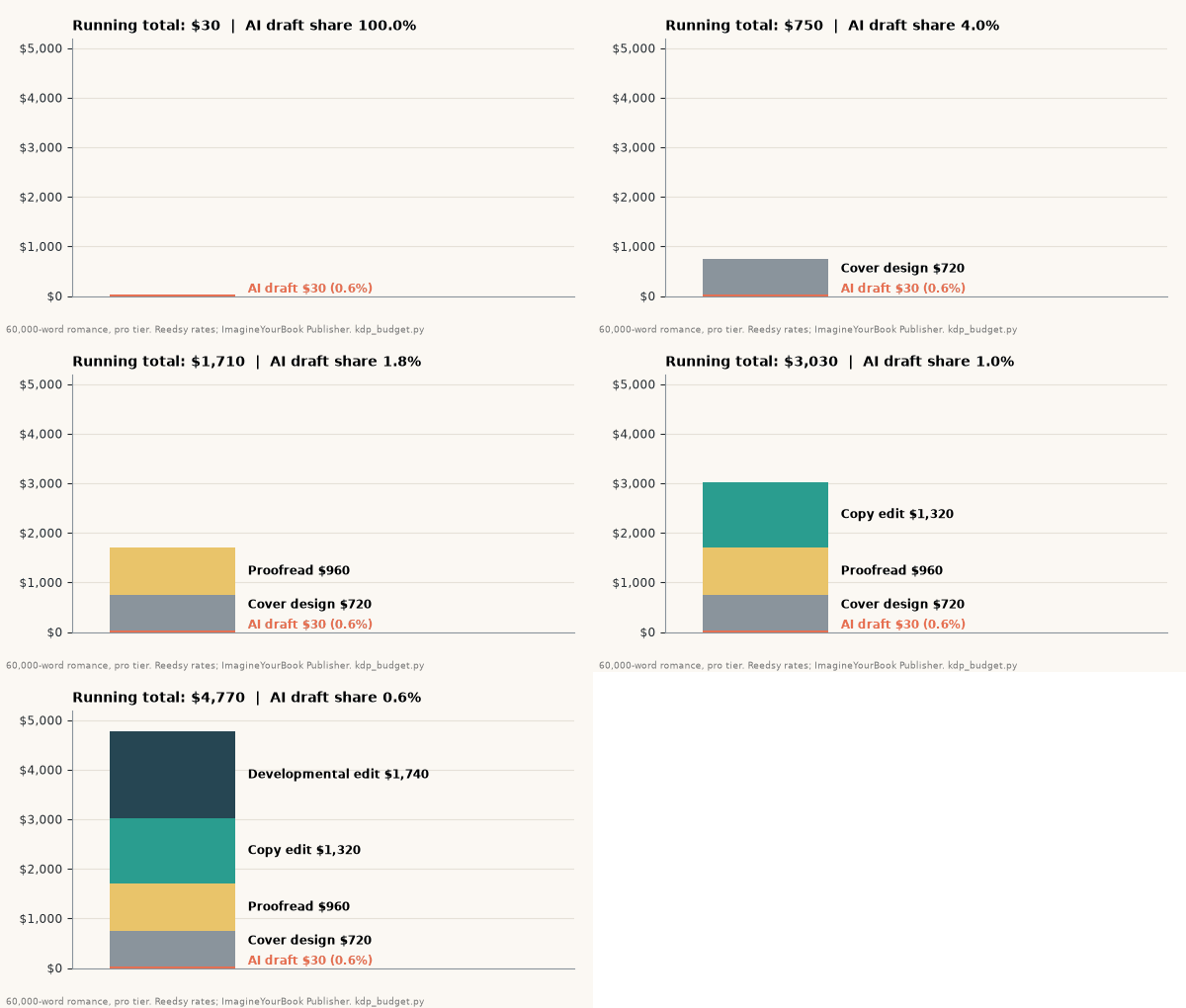
The animation stacks the pro budget line by line. The red sliver at the bottom is the AI draft, and it barely shows. (I tracked raw API costs the same way in what an LLM costs to write a 50,000-word novel. The answer was a few dollars there, too.)
Rule: don’t pick an AI for KDP by its price per word. At $0.50 per 1,000 words the draft is 0.6% of a pro budget. Pick it by how many paid human passes its draft lets you skip, and spend the slack on revision.
The romantasy exception: your cover is the budget
Reedsy’s genre table has one outlier. A romantasy cover averages $3,950, more than five times the $720 romance average and more than twice a full developmental edit for a 60,000-word book. If you write romantasy, the cover is the line to plan for. I compared the options (AI covers, premades, designers) and KDP’s rules in KDP AI book cover. The included cover recreations on ImagineYourBook’s paid plans (4 a month on Author, 12 on Publisher) are worth testing before you commission one.
Your KDP AI stack in five steps
- Draft the whole book in one tool that keeps continuity: outline, chapters and series canon together. Regenerate if the draft is weak. At $30 it’s the cheapest step.
- Read it yourself, then run one whole-book revision pass for the problems you found (pacing, a sagging middle, a character who changed names).
- Pick your tier per book, not per catalog. Pay for the passes that protect read-through: proofread always, copy edit for flagship books, developmental edit for Book One.
- Cover once per series look. A designer for Book One, then consistent variations.
- Disclose AI-generated content in KDP and price with the royalty math (70% of $3.99 minus $0.06 = $2.75).
| Line item (60,000-word romance) | Cost | In AI drafts | Where to save |
|---|---|---|---|
| AI draft (ImagineYourBook Publisher) | $30 | 1 | Don’t: regenerate weak drafts, it’s the cheapest step |
| Whole-book AI revision pass (Manuscript Rewrite) | $30 | 1 | Run it before any human pass |
| Developmental edit ($0.029/word) | $1,740 | 58 | Book One of a series; skip when the draft holds together |
| Copy edit ($0.022/word) | $1,320 | 44 | Flagship books |
| Proofread ($0.016/word) | $960 | 32 | Never skip |
| Romance cover (average) | $720 | 24 | One design per series look |
| Romantasy cover (average) | $3,950 | 132 | Test included cover recreations first |
Limitations
These are marketplace averages for a generic 60,000-word romance. Rush jobs, longer books, heavier worldbuilding and experienced editors cost more, and your own time isn’t priced at all. Sales are never guaranteed, so treat the break-even counts as targets, not forecasts. The 0.6% figure assumes the Publisher plan. On the Author plan ($0.75 per 1,000 words) the draft is $45, or 0.9% of the pro budget, which still makes the same point.
The takeaway
Stop shopping for the AI with the cheapest words. The draft is the smallest line in your KDP budget. Choose the AI that gives you a complete, consistent book you can revise as a whole, then spend the money on the human passes your readers notice. If you want to test that on your own series idea, start a book in ImagineYourBook: the 7-day trial is $0 today and includes one 10,000-word book, but a card is required and the first $29.99 charge comes after 7 days, so cancel before day 8 if it’s not for you. Then run kdp_budget.py with your own editor’s quotes.
Sources (checked October 28, 2026): Reedsy: Freelance editing rates by genre · Reedsy: How much does it cost to publish a book (cover costs by genre) · Reedsy: How much does an editor cost · KDP Help: eBook royalties · KDP Help: Content guidelines (AI content) · ImagineYourBook pricing, credits and trial terms · ImagineYourBook features. Script: kdp_budget.py (shown above). Book length and price are labeled assumptions.