
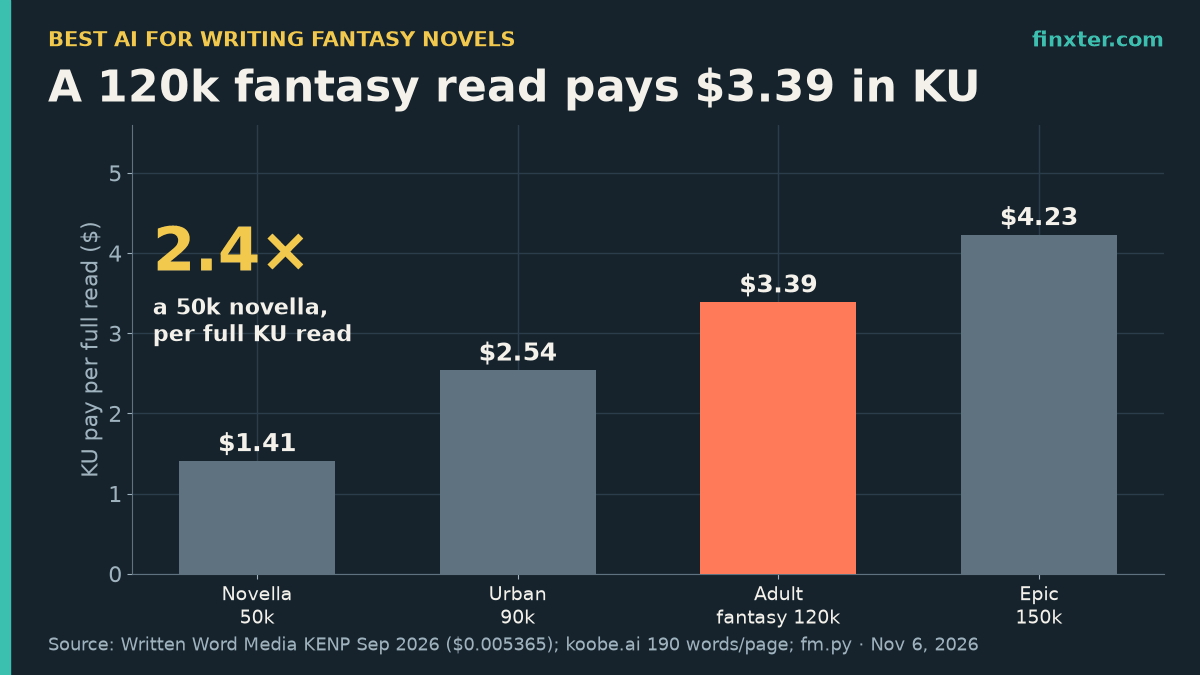
Here is the claim this article defends: when you pick the best AI for writing fantasy novels, length matters more than prose polish. One full Kindle Unlimited read of a 120,000-word fantasy pays about $3.39. A 50,000-word novella pays $1.41. That is 2.4× per reader, and the 120k read pays almost exactly what a $4.99 ebook sale does ($3.43). So your AI tool has to hold a world together across 120,000 words. A tool that writes beautiful chapters and forgets the magic system by chapter 20 will cost you money.
If you want to test that on your own world first, ImagineYourBook drafts a complete 10,000-word text book with a cover in its $0 seven-day trial. That is enough to check whether it keeps your world rules straight before you commit an epic to it.
TL;DR
- One full KU read of a 120,000-word fantasy pays about $3.39 vs $1.41 for a 50k novella: 2.4× (Sep 2026 rate $0.005365, 190 words/page).
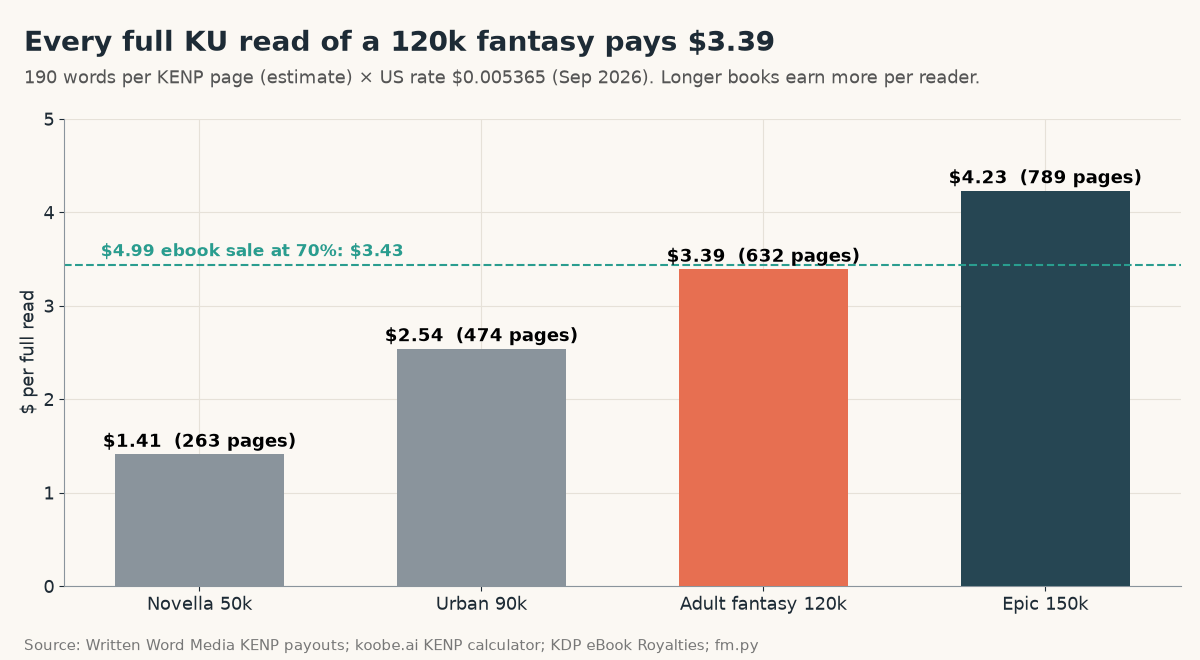
- That 120k read pays about what a $4.99 ebook sale does ($3.43 at 70%).
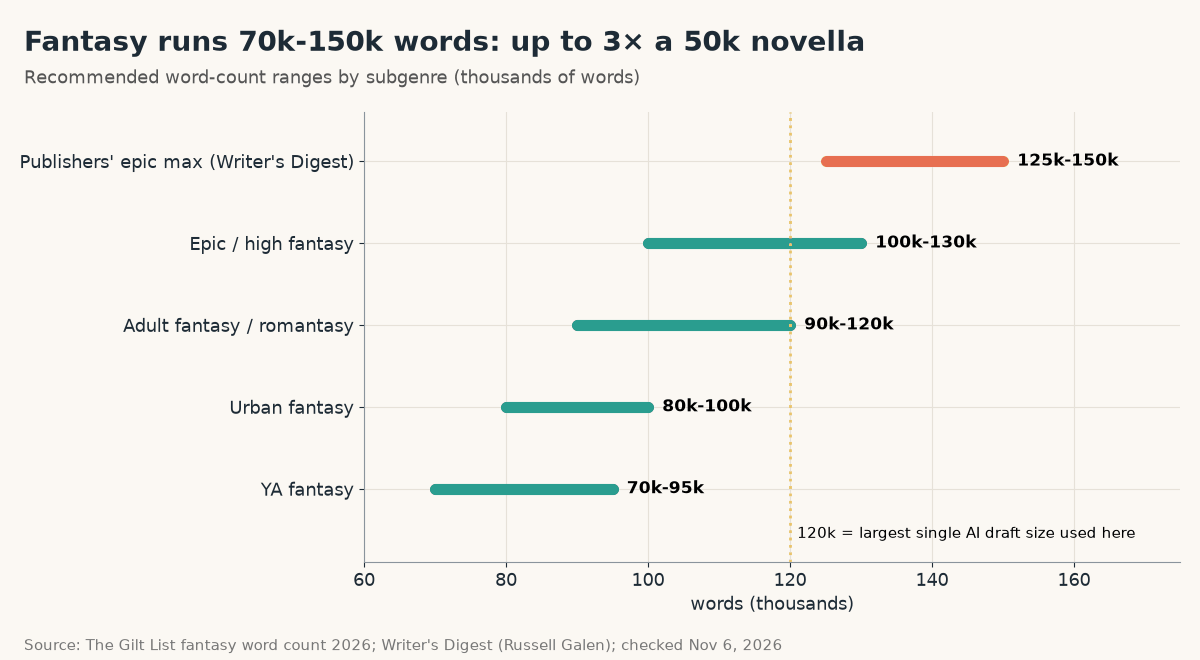
- Fantasy shelves run 70k-150k words; adult fantasy/romantasy 90k-120k (The Gilt List 2026).
- So the best AI for fantasy is the one that keeps world rules, cast and series canon intact across 120k words.
- 18 full reads of one 120k book cover a $59.99 ImagineYourBook Publisher month (24 credits = one 120k epic).
Why fantasy is a length problem first
Fantasy is the long genre. The Gilt List’s 2026 word-count guide puts adult debut fantasy and romantasy at 90,000-120,000 words, epic and high fantasy at 100,000-130,000, urban fantasy at 80,000-100,000 and YA fantasy at 70,000-95,000. Literary agent Russell Galen told Writer’s Digest that publishers “prefer a maximum of 125,000 to 150,000” for epic fantasy, and that longer stories should become multiple volumes.
Romance, the genre most AI book tools were tuned on, sits much shorter. Agent Janet Reid’s rundown gives romance 65-100K and “sweeping, epic fantasy” 150K at a minimum. So a fantasy draft is often double the length of the romance drafts most tool demos show you.
Length breaks AI drafting in three predictable places:
- World rules. Magic costs, map distances and political factions set in chapter 2 must still hold in chapter 38.
- Cast size. Epic fantasy runs multiple POV characters. Every one needs a stable name, voice and secret.
- Series canon. Most fantasy is a series. Book 2 must remember what Book 1 established. Our earlier analysis of the best AI for writing a book series estimated that Book 5 needs about 213,000 tokens of memory.
The money math: why a long fantasy earns more per reader
Kindle Unlimited pays per page read, and Amazon counts pages in KENP (normalized pages). Amazon does not publish a words-per-page figure. The koobe.ai KENP calculator says authors report 170-200 words per KENP page for text-only books and uses 190 for its estimate. I use 190 too (assumption).
Written Word Media lists the US KENP rate for September 2026 at $0.005365 per page, the newest figure on its list (we covered the full history in our KENP rate 2026 post). Multiply the two:
- 50,000 words ÷ 190 ≈ 263 pages × $0.005365 = $1.41 per full read
- 90,000 words ≈ 474 pages = $2.54
- 120,000 words ≈ 632 pages = $3.39
- 150,000 words ≈ 789 pages = $4.23
For comparison, KDP’s eBook Royalties page says the 70% option pays 70% of list price minus delivery costs, with average delivery at $0.06 per unit. A $4.99 sale therefore pays about 0.70 × $4.99 − $0.06 = $3.43. A full KU read of a 120k fantasy pays about the same as selling the book.
The rate moves. The lowest rate in Written Word Media’s 2025-2026 list is $0.004091 (January 2025). At that rate, the same 120k read pays $2.59. That is still 1.8× the September 2026 novella figure. The length advantage holds even in a bad month.
Rate check: the KU per-page rate changes every month. At the January 2025 low of $0.004091, a full 120k read pays $2.59 instead of $3.39. Use the rate in your own KDP report before making decisions.
There is one catch: the money only arrives if readers finish. A reader who quits at chapter 5 pays you for chapter 5. That is why consistency across the whole book, not the opening chapter, is the feature to shop for. Our read-through rate breakdown shows how fast series readers drop off.
What “best AI for writing fantasy novels” should mean
Grade any AI fantasy tool on these five questions, in this order:
- Can it draft the full length you sell? 90k-120k in one project, or split cleanly into volumes.
- Does it keep a story bible? Characters, world rules, invented terms and open threads, carried into the next book.
- Does it plan before it writes? A chapter-by-chapter outline protects the plot from drifting.
- Can you rewrite at book scale? Renaming a kingdom across 120,000 words by hand takes days.
- Does it export KDP-ready files? EPUB, Word and a cover, without a separate API bill.
General chatbots such as ChatGPT or Claude are strong for brainstorming magic systems and fixing single scenes. But you manage the continuity yourself, pasting context in chapter by chapter. Writing-focused apps like Sudowrite or Novelcrafter add story bibles and scene tools, but you still drive the draft scene by scene. Novelcrafter also typically runs on your own AI provider account. If you want to see what raw API drafting costs, our 50,000-word novel API cost post priced it.
What I verified on ImagineYourBook (Nov 6, 2026)
I checked ImagineYourBook’s homepage and pricing page against those five questions:
- Length: draft sizes from about 5,000 to 120,000 words (“Epic”). The pricing table labels an 80k book “XL” and a 120k book “Epic”.
- Series memory: when a series book finishes, it compiles a story bible (characters and arcs, world rules, open threads, invented terms). The next volume starts from that canon and the previous ending. The pricing page says series bibles use no extra credits.
- Planning: Lyra “plans the book” and writes chapter by chapter with continuity context.
- Rewrite: Manuscript Rewrite takes Word, Markdown, text or HTML manuscripts up to 200,000 words. That covers a 150k epic you drafted elsewhere.
- Output: Word, EPUB and Markdown, a cover, and full commercial rights for KDP. It writes text books with a cover only, not illustrated picture books.
Credits: 1 credit per 5,000 words, so a 120k epic uses 24 credits. The Publisher plan is $59.99/month for 24 credits, i.e. one 120k epic or three 40k books. The Author plan is $24.99/month for 8 credits (one 40k book or 2-4 novellas). The site says plainly that sales are never guaranteed, and so do I. A draft is a draft. You still edit, check and own the final book.
Break-even: how many readers pay for one epic draft?
Using the numbers above (assumptions: September 2026 KU rate, 190 words per page, every reader finishes):
- $59.99 Publisher month ÷ $3.39 per full read = 17.7, so 18 full reads of one 120k book cover the draft cost.
- For scale, Reedsy’s human ghostwriting average cited on the ImagineYourBook pricing page is $410 per 1,000 words. That is about $49,200 for 120,000 words. It is a different service with interviews and revisions, so treat it as context, not a like-for-like price.
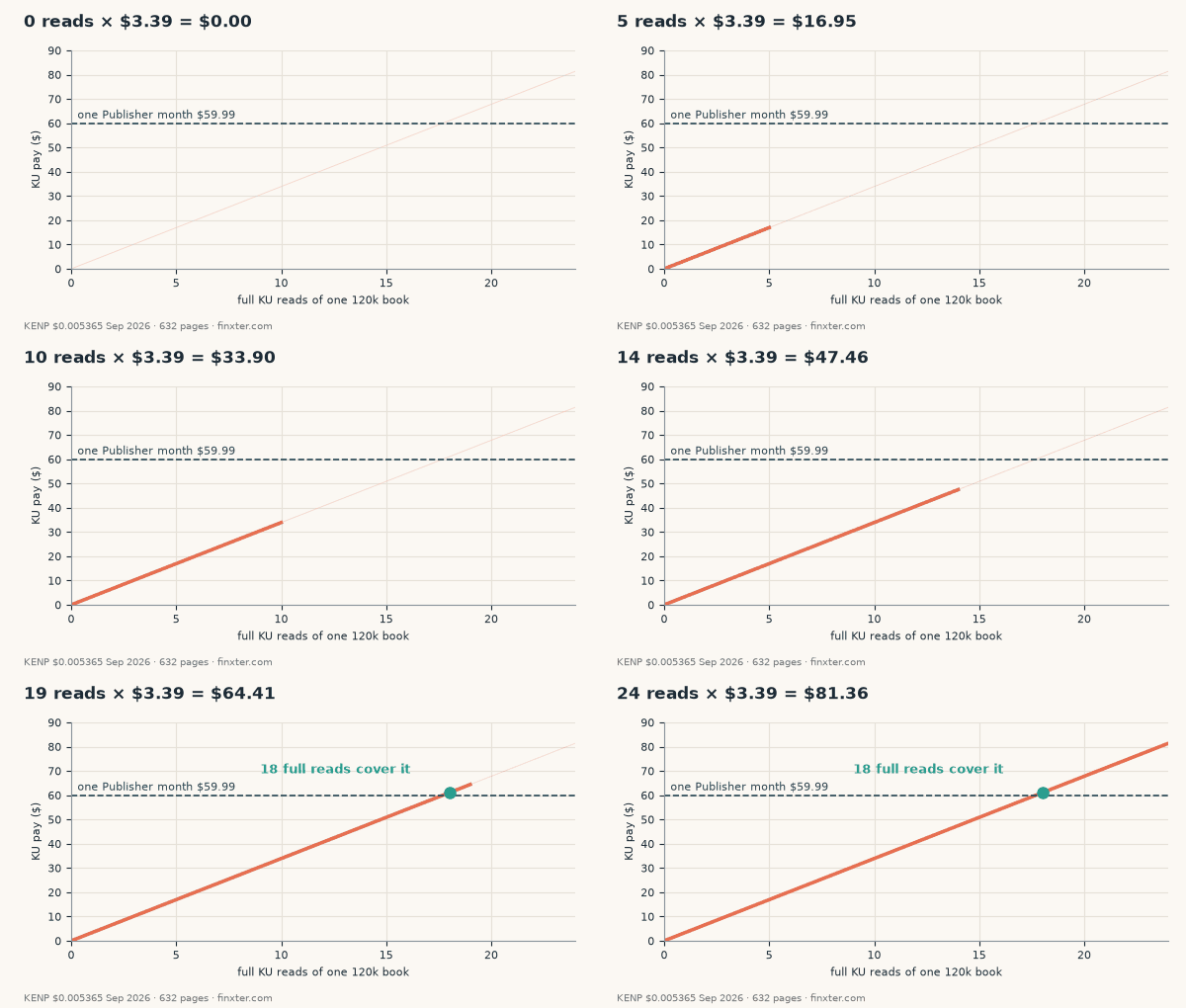
Eighteen full reads is not a launch plan. It is a sanity check. If your fantasy series can’t get 18 readers to finish Book 1, the AI tool isn’t your bottleneck: your cover, blurb and category are.
| Length | KENP pages (est.) | KU pay per full read | IYB credits |
|---|---|---|---|
| Novella 50k | 263 | $1.41 | 10 |
| Urban 90k | 474 | $2.54 | 18 |
| Adult fantasy 120k | 632 | $3.39 | 24 |
| Epic 150k | 789 | $4.23 | 30 (over the 120k single-draft max: split into 2 volumes) |
A 5-step workflow for an AI-assisted fantasy series
- Write the world bible yourself first. Magic rules, their costs, a faction list and a map of distances. Paste it into the brief. ImagineYourBook’s New Book accepts up to 20,000 words of brief and attachments.
- Pick your length by shelf. Romantasy or adult fantasy: 90k-120k. Epic: 120k per volume, and split anything longer, as Galen recommends.
- Draft Book 1 and read it as a reader. Flag every rule break. Fix them in one book-wide rewrite instruction, not 40 manual passes.
- Edit by hand before you publish. Voice, facts, names, sensitivity. Your name goes on the cover.
- Continue from the story bible. Book 2 should start from Book 1’s canon, so read-through isn’t lost to continuity errors.
| Question | Answer | What to do |
|---|---|---|
| Why does length matter? | 120k read = $3.39, 50k = $1.41 | Choose a tool that drafts your real shelf length |
| What breaks first? | World rules, big casts, series canon | Require a story bible that carries into Book 2 |
| Chatbots? | Great for brainstorming and scenes | You manage continuity by hand |
| Over 120k? | Publishers prefer 125k-150k max for epics | Split into volumes |
| Break-even? | 18 full reads cover $59.99 | Fix cover/blurb if Book 1 can’t reach that |
Limitations
- KENP per page is a reported range (170-200 words), not an Amazon number. At 170 words per page, every figure here rises about 12%. At 200, it drops about 5%.
- The KU rate is a US figure that changes monthly. Your KDP report is the real number.
- “Full read” is a best case. Partial reads pay less.
- I verified ImagineYourBook features from its public pages on Nov 6, 2026. I did not benchmark prose quality across tools.
FAQ
What is the best AI for writing fantasy novels?
The one that drafts your full length (90k-120k words) and keeps a story bible of world rules, characters and open threads across chapters and sequels. Chatbots help brainstorm; full-book tools handle continuity.
How long should a fantasy novel be?
The Gilt List (2026) gives 90,000-120,000 words for adult fantasy and romantasy, 100,000-130,000 for epic, 80,000-100,000 for urban and 70,000-95,000 for YA fantasy.
How much does Kindle Unlimited pay for a 120,000-word fantasy?
About $3.39 per full read, assuming 190 words per KENP page (632 pages) and the September 2026 US rate of $0.005365. Partial reads pay less.
Can AI write a 150,000-word epic fantasy?
Not in one ImagineYourBook draft: its largest size is 120,000 words. Split it into two volumes, as publishers often prefer, or expand an existing manuscript with Manuscript Rewrite (up to 200,000 words).
Can I publish an AI-assisted fantasy novel on KDP?
Yes, if you have the rights and follow KDP's current content guidelines. Edit and fact-check every page before publishing; sales are never guaranteed.
Bottom line
The best AI for writing fantasy novels is the one that survives your length. A 120k fantasy earns $3.39 per full KU read, 2.4× a 50k novella, so continuity across the whole book is where the money is. If you want a full-length draft engine with series memory, try ImagineYourBook: $0 today, one 10k-word Small Book in the seven-day trial, then $24.99/month unless you cancel before day 8. Test it on your magic system first, then edit every page before it goes to KDP.
Sources (checked November 6, 2026): Written Word Media: KDP Global Fund payouts & KENP rate · koobe.ai KENP calculator (words per page) · KDP Help: eBook Royalties · The Gilt List: Fantasy Novel Word Count 2026 · Writer’s Digest: Science Fiction & Fantasy Today · Janet Reid: word count by genre · ImagineYourBook pricing and FAQ. Assumptions: 190 words per KENP page, US KENP rate of Sep 2026, full reads, $4.99 ebook at 70% with $0.06 average delivery.