Python Math Module [Ultimate Guide]

Photo by Erol Ahmed on Unsplash

Python’s math module provides you with some of the most popular mathematical functions you may want to use. In this article, I’ll take you through the most common ones. You can also watch the following tutorial video in which I’ll guide you through the article: The math module is part of the Python standard library, … Read more

How to Install Python on Windows? [7 Easy Steps]

Python is the fastest-growing major programming language in the world. Want to participate as a Python coder and install Python on your Windows machine? Here are the seven steps to install Python on Windows: Visit website “Python Releases for Windows”: https://www.python.org/downloads/windows/ Click link “Download Windows x86-64 executable installer” under “Stable Releases” header. A popup opens. … Read more

[NumPy vs Python] What are Advantages of NumPy Arrays over Regular Python Lists?

The Python built-in list data type is powerful. However, the NumPy array has many advantages over Python lists. What are they? Advantages NumPy Advantages Python Lists Multi-dimensional Slicing Library-Independent Broadcasting Functionality Intuitive Processing Speed Less Complicated Memory Footprint Heterogeneous List Data Allowed Many Convenience Methods Arbitrary Data Shape (Non-Square Matrix) Let’s dive into the most … Read more

Top 18 Cool Python Tricks

What are the coolest Python tricks? I’ve compiled this list of the best Python tricks—in reverse order. Without further ado, let’s dive into those crazy one-liner Python features, tricks, and functions: 18. Modifying Iterable Elements 1/2 The function map(func, iter) executes the function func on all elements of the iterable iter. Related article: Which is … Read more

Runtime Complexity of Python List Methods [Easy Table Lookup]

What’s the runtime complexity of various list methods? The following table summarizes the runtime complexity of all list methods. Assume that the length of the data type is defined as n (that is—len(data_type)). You can now categorize the asymptotic complexity of the different complexity functions as follows: Operation Example Complexity Index l[i] O(1) Store l[i] … Read more

Complexity of Python Operations

In this tutorial, you’ll learn the runtime complexity of different Python operations. Then, you’ll learn how to calculate the complexity of your own function by combining the complexity classes of its constituents. This is called “static analysis” The tutorial is loosely based on (source) but it extends it significantly with more practical examples, interactive snippets, … Read more

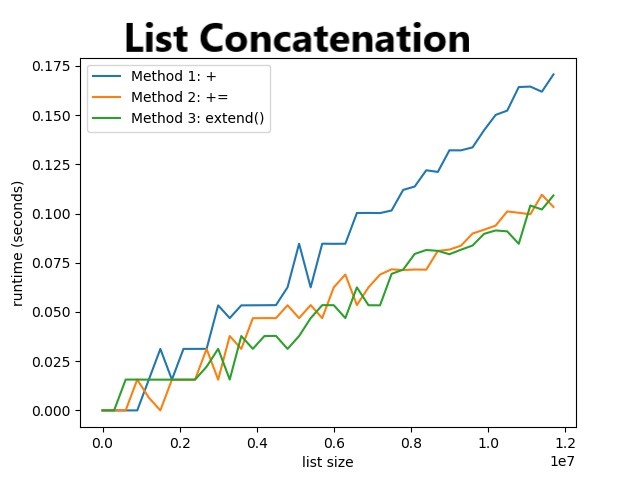
Python List Concatenation: Add (+) vs INPLACE Add (+=) vs extend()

List Concatenation

A wildly popular operation you’ll find in any (non-trivial) code base is to concatenate lists—but there are multiple methods to accomplish this. Master coders will always choose the right method for the right problem. This tutorial shows you the difference between three methods to concatenate lists: Concatenate two lists with the + operator. For example, … Read more

Python Print Function [And Its SECRET Separator & End Arguments]

Everybody knows the print function in Python. It prints a string to the shell–and makes the computation of a Python program explicit to the programmer. But only few coders understand its powerful arguments to format the output. What are they? There are two little-used arguments of the print function in Python. The argument sep indicates … Read more

[Free PDF Download] Coffee Break Python – Mastery Workout

Want to boost your Python skills to the next level as an intermediate coder? Want to know how to overcome being stuck at average coding level? Do you enjoy solving puzzles? We’re excited to release a new fresh, and tough Finxter book with 99 never-seen Python puzzles. It’s the hardest one in our Coffee Break … Read more