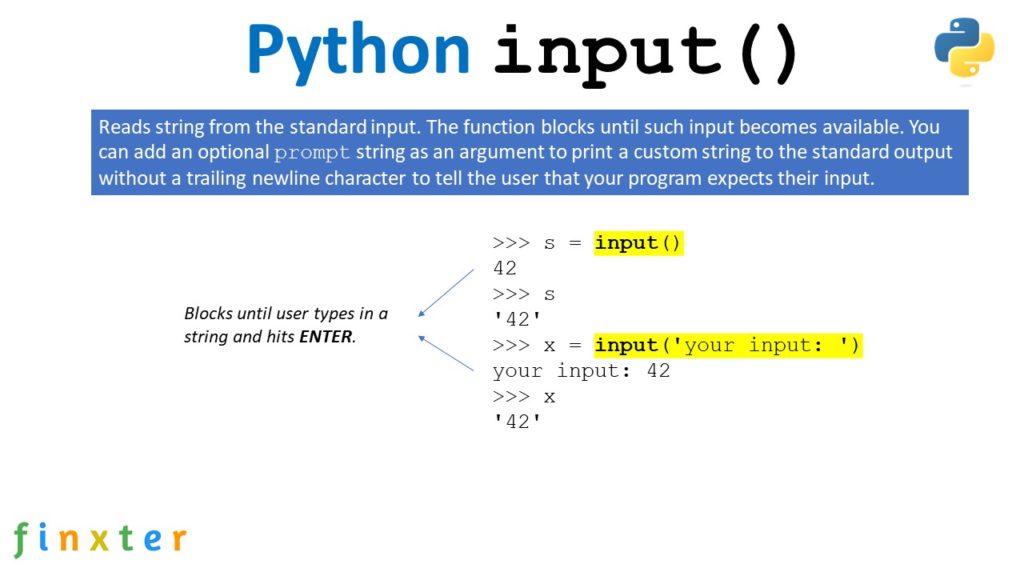
Python input() Function

Python’s built-in input() function reads a string from the standard input. The function blocks until such input becomes available and the user hits ENTER. You can add an optional prompt string as an argument to print a custom string to the standard output without a trailing newline character to tell the user that your program … Read more

Python hash() Function

Python’s built-in hash(object) function takes one object as an argument and returns its hash value. As the hash value is calculated based on the object’s data, two different but equal objects must have the same hash value. It doesn’t follow, though, that two objects with the same hash value are equal—they can have the same … Read more

Python hex() Function — Not a Magic Trick

Python’s built-in hex(integer) function takes one integer argument and returns a hexadecimal string with prefix “0x”. If you call hex(x) on a non-integer x, it must define the __index__() method that returns an integer associated to x. Otherwise, it’ll throw a TypeError: object cannot be interpreted as an integer. Argument integer An integer value or … Read more

Python oct() Function

Python’s built-in oct(integer) function takes one integer argument and returns an octal string with prefix “0o”. If you call oct(x) on a non-integer x, it must define the __index__() method that returns an integer associated to x. Otherwise, it’ll throw a TypeError: object cannot be interpreted as an integer. Argument integer An integer value or … Read more

Python property() — What You Always Wanted to Know But Never Dared to Ask

Object-orientation is great way to encapsulate data in your application. This minimizes complexity and adheres to good software engineering principles. However, attributes in Python can be easily accessed from the outside—they’re not really encapsulated. That’s one of the reason the property() built-in function exists: it allows you to truly encapsulate data with the means of … Read more

Python id() Function

Python’s built-in id(object) function takes a Python object as an input and returns the identity of an object that is a static, unique integer. The identity is static, it never changes throughout the program’s execution, and unique, no other object has the same identity. It is implemented in cPython by returning the address of the … Read more

Python vars() Function

Python’s built-in vars() function returns the __dict__ attribute of an object—a dictionary containing the object’s changeable attributes. Without argument, it returns the local symbol table similar to locals(). Python’s built-in vars() function returns a dictionary of name: value mappings of all the names defined in the local scope or the scope of the optional object … Read more

Python type() Function

Python’s built-in type() function has two purposes. First, you can pass an object as an argument to check the type of this object. Second, you can pass three arguments—name, bases, and dict—to create a new type object that can be used to create instances of this new type. Usage Learn by example! Here’s an example … Read more

A Recursive Pathfinder Algorithm in Python

A simple and effective way to grow your computer science skills is to master the basics. Knowing the basics sets apart the great coders from the merely intermediate ones. One such basic area in computer science is graph theory, a specific subproblem of which—the pathfinder algorithm—we’ll address in this tutorial. So first things first: What … Read more

Python object() Function

Python’s built-in object() function takes no argument and returns a new featureless object—the base and parent of all classes. As such it provides all methods that are common to all Python class instances such as __repr__() and other “dunder” methods. However, unlike for all non-object instances, you cannot assign arbitrary attributes to an instance of … Read more