Lump Sum vs DCA S&P 500: A 3-Month DCA Lost Money More Often Than Investing at Once
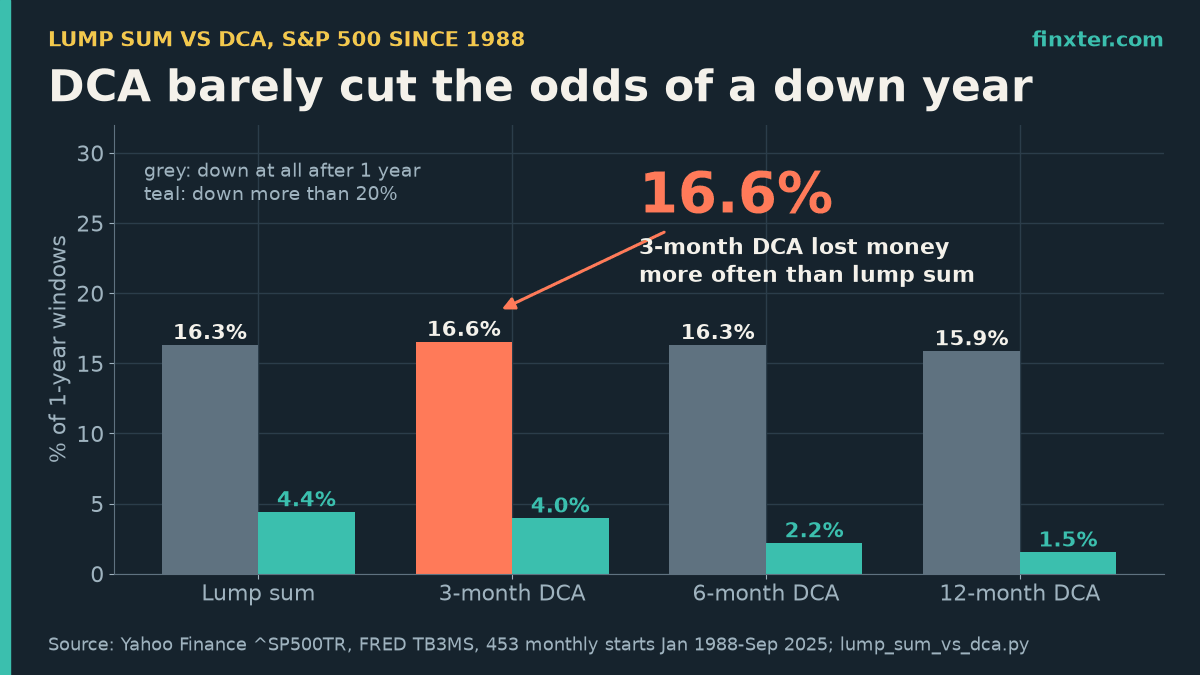
Lump sum vs DCA S&P 500 since 1988: lump sum won 65-78% of 453 start months, and DCA barely changed the odds of a losing year. Python script included.

Lump sum vs DCA S&P 500 since 1988: lump sum won 65-78% of 453 start months, and DCA barely changed the odds of a losing year. Python script included.
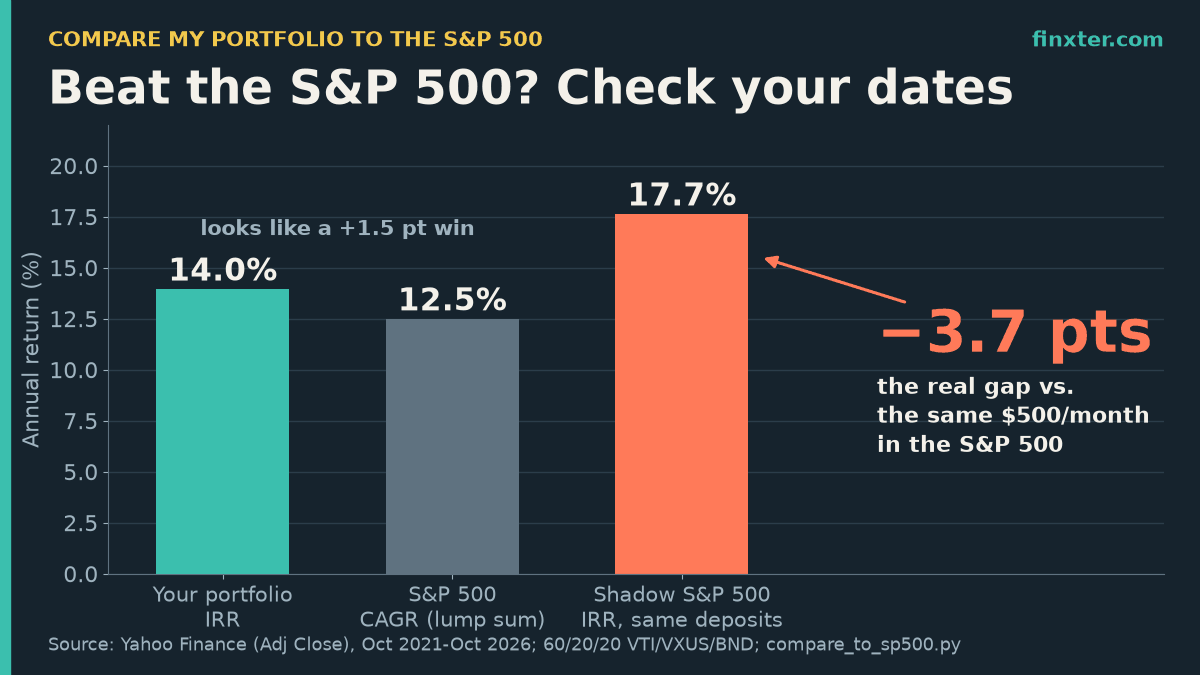
How to compare my portfolio to the S&P 500 the right way: a Python shadow benchmark on 5 years of real data turns a fake +1.5-point win into a 3.7-point loss.

💡 Problem Formulation: Working with data in Python often involves manipulating dataframes, especially if you are using the pandas library. A common operation is extracting the first row of a dataframe for data inspection or further analysis. For instance, if you have a dataframe representing sales data, you might want to preview the first entry … Read more
💡 Problem Formulation: When working with data in Python, there might be scenarios where you need to insert a new row into an existing Pandas DataFrame at a specific position. For instance, you may have a DataFrame holding student grades, and you want to insert a new student’s grade at a precise index without overwriting … Read more
💡 Problem Formulation: When working with data in Python, it’s common to use Pandas DataFrames. Occasionally, there is a need to insert a new row of data at the top of an existing DataFrame. This could be due to a late arrival of important data points that need to be analyzed first or to emphasize … Read more
💡 Problem Formulation: When working with data in Python, efficiently identifying the index of the last row in a DataFrame is crucial for data manipulation and analysis. This article demonstrates various techniques to find the last row index in a Python DataFrame, given a DataFrame as input, with the goal of obtaining the numerical index … Read more
💡 Problem Formulation: When working with data in Python, it’s common to use pandas DataFrames to organize and manipulate data. Sometimes, we start with an empty DataFrame and need to add rows of data to it over time. This article explains how to add a row to an empty DataFrame in Python using pandas, including … Read more
💡 Problem Formulation: Users of pandas, the powerful Python data manipulation library, may often face the need to transpose certain columns into rows within a DataFrame for restructuring data or to facilitate analysis. For instance, converting a DataFrame of user attributes with columns ‘Name’, ‘Age’, and ‘Occupation’ into a row-oriented format, making each attribute a … Read more
💡 Problem Formulation: When working with pandas DataFrames in Python, a common operation is appending a row from one DataFrame to another. Suppose you have two DataFrames, df1 and df2, where df1 contains data regarding monthly sales and df2 holds a new entry for the current month. The goal is to append the row from … Read more
💡 Problem Formulation: When working with data in Python, you often use a DataFrame, which is essentially a table with rows and columns. Occasionally, you might find the need to remove a specific row by its index. For instance, having a DataFrame with user data, and you want to exclude the entry at index 3. … Read more
💡 Problem Formulation: Many data manipulation tasks in Python involve handling data stored in a DataFrame using libraries like pandas. Sometimes, it’s necessary to extract a row of data from a DataFrame and append it to a list for further processing or analysis. For instance, you might wish to collect specific rows based on a … Read more
💡 Problem Formulation: When working with data in Python, data scientists often use Pandas DataFrames – a two-dimensional, size-mutable, and potentially heterogeneous tabular data structure with labeled axes. One common task is determining the number of rows in a DataFrame. For example, if you have a DataFrame containing information on books, you might want to … Read more