How To Extract All Emojis From Text in Python?

Summary: This blog explains the various ways one can extract commonly used Emojis embedded within text. Note: All the solutions provided below have been verified using Python 3.9.0b5. Problem Formulation One has a list with normal text words and emojis, all mixed together, as shown below.  How does one extract only the emojis, into a … Read more

Python input() Function

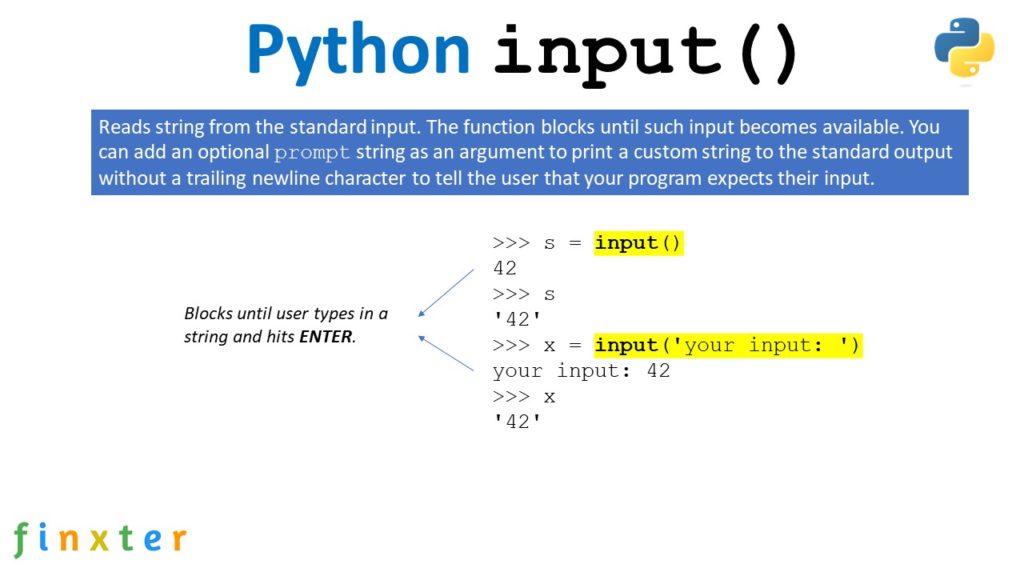
Python’s built-in input() function reads a string from the standard input. The function blocks until such input becomes available and the user hits ENTER. You can add an optional prompt string as an argument to print a custom string to the standard output without a trailing newline character to tell the user that your program … Read more

Python memoryview() — Tame That Strange Beast!

The Python memoryview(arg) function returns a memoryview object of the given bytes or bytearray argument. This exposes the argument’s internal data (buffers) to help you access the data without intermediate copying. Syntax: memoryview(object) Arguments object Bytes or Bytearray object for which the memoryview should be returned Return Value memoryview Returns memoryview of the object. Python … Read more

Python hash() Function

Python’s built-in hash(object) function takes one object as an argument and returns its hash value. As the hash value is calculated based on the object’s data, two different but equal objects must have the same hash value. It doesn’t follow, though, that two objects with the same hash value are equal—they can have the same … Read more

Python hex() Function — Not a Magic Trick

Python’s built-in hex(integer) function takes one integer argument and returns a hexadecimal string with prefix “0x”. If you call hex(x) on a non-integer x, it must define the __index__() method that returns an integer associated to x. Otherwise, it’ll throw a TypeError: object cannot be interpreted as an integer. Argument integer An integer value or … Read more

How to Access Environment Variable Values in Python?

Problem Formulation: Say, you set an environment variable and you want to access it in your Python script. How to get the value of the environment variable? Background: Environment variables are external to the Python environment.Β  They describe the operating system environment we are using. The applications installed use this information to complete specific tasks … Read more

Python oct() Function

Python’s built-in oct(integer) function takes one integer argument and returns an octal string with prefix “0o”. If you call oct(x) on a non-integer x, it must define the __index__() method that returns an integer associated to x. Otherwise, it’ll throw a TypeError: object cannot be interpreted as an integer. Argument integer An integer value or … Read more

How to Plot the Confidence Interval in Python?

Problem Formulation: How to plot the confidence interval in Python? To plot a filled interval with the width ci and interval boundaries from y-ci to y+ci around function values y, use the plt.fill_between(x, (y-ci), (y+ci), color=’blue’, alpha=0.1) function call on the Matplotlib plt module. The first argument x defines the x values of the filled … Read more

Top 10 PyCharm Cheat Sheets

Hey Finxters! We all need cheat sheets for Python and all its intricacies. Python has many libraries and there are so many IDE applications you can useΒ  with it! One of these IDEs is called Pycharm! I want to introduce you to some of Pycharms shortcuts! Let’s get started right away! Full PyCharm Tutorial Finxter … Read more