How to Get an HTML Page from a URL in Python?

This tutorial shows you how to perform simple HTTP get requests to get an HTML page from a given URL in Python! Problem Formulation Given a URL as a string. How to extract the HTML from the given URL and store the result in a Python string variable? Example: Say, you want to accomplish the … Read more

Coding Your Own Google Home and Launch Spotify in Python

Doesn’t this project sound exciting? Project Goal Project goal: code your own Google Home with Python and learn how to use speech recognition to launch Spotify and play songs! Ever wanted to code a powerful yet simple tool that is more bespoke than mainstream devices? We will learn how to implement it in Python with … Read more

How to Loop Through a Python List in Pairs, Sliding Windows, and Batches?

Method 1: Iterating over Consecutive (Sliding) Windows Given are: Python list lst Window size n Problem Formulation: How to loop through the list in consecutive element-windows of size n, so that in each iteration, you can access the n next elements in the list? # INPUT: lst = [‘a’, ‘b’, ‘c’, ‘d’, ‘e’, ‘f’, ‘g’] … Read more

Python iter() — A Simple Illustrated Guide with Video

Python’s built-in iter() function returns an iterator for the given object. For example, iter([1, 2, 3]) creates an iterator for the list [1, 2, 3]. You can then iterate over all elements in the iterator, one element at a time, in a for or while loop such as: for x in iter([1, 2, 3]). Basic … Read more

Python Float Decimal to Octal

Problem Formulation: Given a float number. How to convert it to octal representation? Examples: Consider the following desired conversions from float decimal numbers to their converted float octal numbers. input: 3.14 output: 3.1075 input: 0.01 output: 0.005 input: 12.325 output: 14.246 You can play with some examples here: Solution: The following code function float_to_octal() takes … Read more

Python open() Function — An 80/20 Guide By Example

Python’s built-in open() function opens a file and returns a file object. The only non-optional argument is a filename as a string of the file to be opened. You can use the file object to access the file content. For example, file_obj.readlines() reads all lines of such a file object. Here’s a minimal example of … Read more

Python input() Function

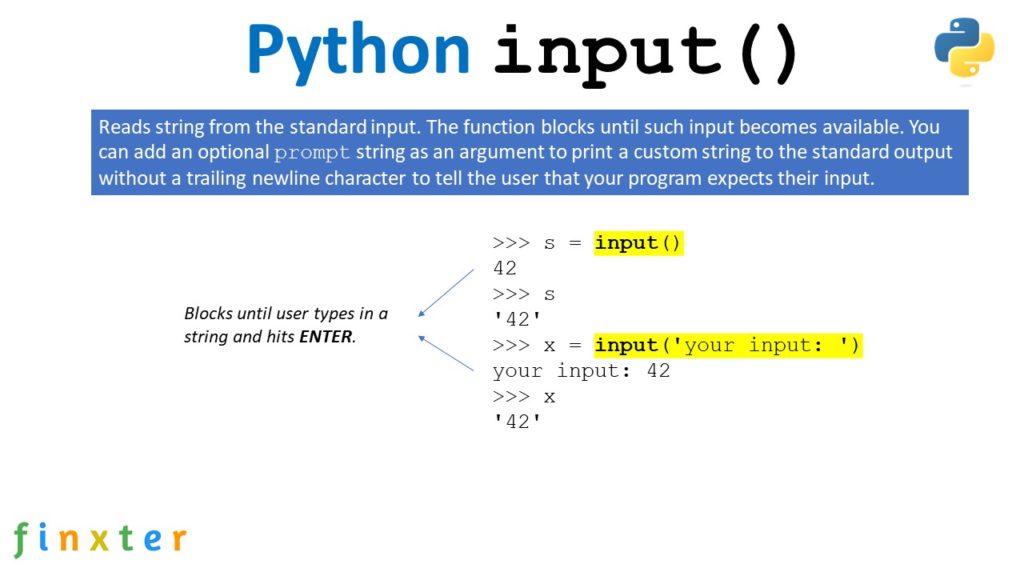
Python’s built-in input() function reads a string from the standard input. The function blocks until such input becomes available and the user hits ENTER. You can add an optional prompt string as an argument to print a custom string to the standard output without a trailing newline character to tell the user that your program … Read more

How to Plot the Confidence Interval in Python?

Problem Formulation: How to plot the confidence interval in Python? To plot a filled interval with the width ci and interval boundaries from y-ci to y+ci around function values y, use the plt.fill_between(x, (y-ci), (y+ci), color=’blue’, alpha=0.1) function call on the Matplotlib plt module. The first argument x defines the x values of the filled … Read more

Python id() Function

Python’s built-in id(object) function takes a Python object as an input and returns the identity of an object that is a static, unique integer. The identity is static, it never changes throughout the program’s execution, and unique, no other object has the same identity. It is implemented in cPython by returning the address of the … Read more

How to Index Elements in NumPy Arrays?

NumPy is a popular Python library for data science for array, vector, and matrix computations. This puzzle introduces basic indexing of elements in NumPy arrays. Problem Formulation: How to index elements in NumPy arrays? Indexing 1D Arrays with Positive Indices The most simple use of indexing is with the square bracket notation and positive integers: … Read more