
You have a year of Bible verses, a notebook of sermon illustrations, and a plan to turn them into a 365-day devotional. Before you write entry one, you need one number: how many words per day? I counted every reading in Charles Spurgeon’s Morning and Evening, checked what two devotional magazines accept today, and ran the result through KDP’s print-cost formula.
Type “how long should a devotional be” into Google and one of the suggestions is “how long should a daily devotional be”. Next to it sit “how long should a devotional book be” and “how long should a morning devotional be”, and the seed “how many words in a devotional” adds “how many words should a daily devotional be” (suggestions I pulled on October 17, 2026).
Here is the short answer: 150 to 300 words for the meditation itself. The longer answer has a twist. If each day starts on a new page, one extra word can double the size of your book.
TL;DR
- Editors’ numbers: The Upper Room edits meditations to 250-300 words; The Secret Place asks for 150-200 (verse and prayer not counted).
- Spurgeon’s Morning and Evening, measured in Python: 732 readings, median 341 words, and only 8 would fit the 250-300 band.
- Reading time is not the problem: even 341 words is 1.4 minutes silent at 238 wpm, 1.9 minutes aloud.
- Page count is: at 233 words per page, a 365-day book with a new page per day is 365 pages at 200 words but 730 pages at 275.
- At a $16.99 list price that is $4.81 vs $0.43 royalty per KDP paperback. Write under 233 words per day, or run entries on.
What devotional editors ask for
Two devotional magazines that take freelance submissions publish their limits.
The Upper Room says edited meditations “will be 250-300 words long, though submissions can be 350-400 words to give editors extra material to work with.” Its writers’ guidelines add the rule every devotional writer should tape to the monitor: “Make only one point. Think snapshot, not movie.”
The Secret Place, a Judson Press quarterly begun in 1937 with a readership of “more than 250,000,” asks for “an original meditation of 150 to 200 words (excluding the Scripture, Thought for Today, and prayer).” It pays $20 for each one it publishes.
Note what those limits count. It’s the meditation only. The key verse, the “Thought for Today” and the closing prayer come on top.
What a classic actually did
Editors’ limits are one data point. So I measured one that chspurgeon.com calls “a beloved daily companion for over a century”: Morning and Evening by Charles Spurgeon (1834-1892), two readings for every day of the year. The public-domain text is free from the Christian Classics Ethereal Library.
The script splits the file at each “Morning, January 1” style heading, drops the navigation link, the key verse and its reference, and counts the words that remain:
# devotional.py - how long should a daily devotional be? (checked October 17, 2026)
import math, re, statistics as st

def readings(path="morneve.txt"):
    """Yield (title, meditation_words) for each Morning/Evening reading."""
    text = open(path, encoding="utf-8").read()
    parts = re.split(r"^((?:Morning|Evening), [A-Z][a-z]+ \d+)\s*$", text, flags=re.M)
    for title, body in zip(parts[1::2], parts[2::2]):
        body = body.split("__________")[0]
        paras = [p.strip() for p in re.split(r"\n\s*\n", body) if p.strip()]
        paras = [p for p in paras if not re.match(r"\[\d+\]Go To", p, flags=re.I)]
        med = paras[2:]                    # drop the key verse and its reference
        words = re.sub(r"\[\d+\]", "", " ".join(med)).replace("--", " ").split()
        yield title, len(words)

w = [n for _, n in readings()]
q = st.quantiles(w, n=10)
print(len(w), st.median(w), round(q[0]), round(q[-1]), min(w), max(w))
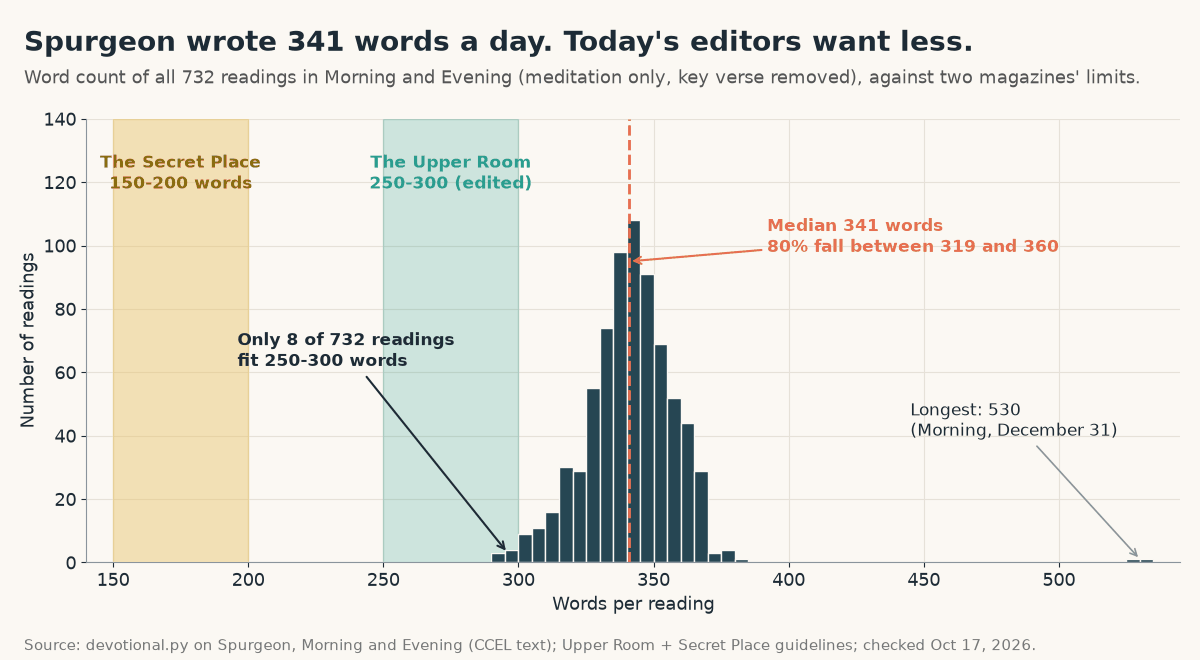
Spurgeon readings: 732 | median 341 | mean 341 | p10 319 | p90 360 | min 290 | max 530
  <=200: 0 (0.0%) | 250-300: 8 (1.1%) | >400: 2 (0.3%)
Three things jump out:
- Spurgeon was very consistent. 80% of his 732 readings fall between 319 and 360 words. The shortest is 290 (Evening, June 19).
- The only long ones are on New Year’s Eve. Both December 31 readings run past 500 words (530 and 528). Nothing else tops 381.
- He would not fit today’s slots. Only 8 of 732 readings land inside the Upper Room’s 250-300 edited range, and none fits the Secret Place’s 200-word cap.
So the modern guideline is a deliberate trim. Spurgeon’s median of 341 is 41 words over the Upper Room’s 300-word ceiling and 141 over the Secret Place’s.
Why short works: under two minutes per day
A devotional is read in a gap: before work, at breakfast, at bedtime with kids. A 2019 meta-analysis by Marc Brysbaert of 190 studies (18,573 participants) put adult silent reading of English non-fiction at 238 words per minute, and reading aloud at 183.
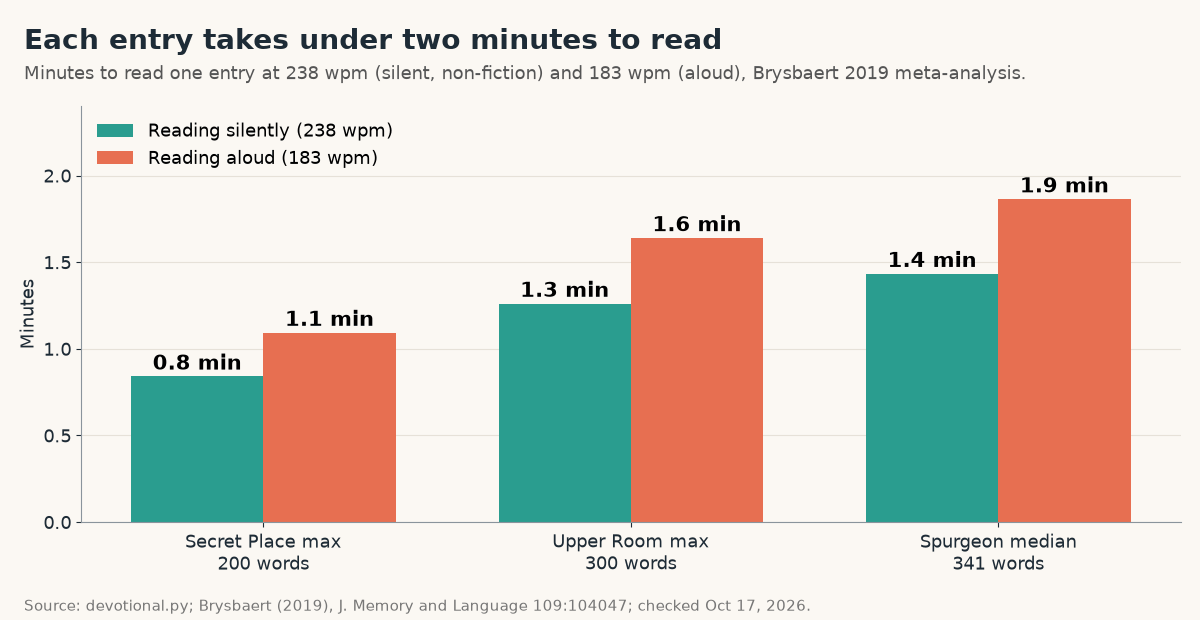
At those rates a 200-word entry takes 0.8 minutes to read silently, a 300-word entry 1.3 minutes, and a Spurgeon reading 1.4. Read aloud to a family, they take 1.1, 1.6 and 1.9 minutes. Every option fits a two-minute habit. The difference that matters is not reading time. It’s the page.
From entry length to book length
Now the book. Kindlepreneur’s survey of 900+ authors found nonfiction on Amazon averages 233 words per page. KDP’s paperback printing cost for a black-ink, regular-trim book sold on Amazon.com is a flat $2.30 from 24 to 110 pages, then $1.00 plus $0.012 per page, up to 828 pages.
You can start each day on a new page, so readers open straight to today’s date, or run the entries on one after another. The script models both layouts.
WORDS_PER_PAGE = 233

def pages(words, wpp=WORDS_PER_PAGE):
    return math.ceil(words / wpp)

def kdp_bw_paperback(p):              # Amazon.com, black ink, regular trim
    if p < 24: return None
    return 2.30 if p <= 110 else round(1.00 + 0.012 * p, 2)

def book(days, words_per_entry, new_page_each_day=True):
    total = days * words_per_entry
    p = days * pages(words_per_entry) if new_page_each_day else pages(total)
    return dict(days=days, wpe=words_per_entry, words=total, pages=p, cost=kdp_bw_paperback(p))
365 days x 200 words =  73,000 words | new page/day  365 pp $5.38 | run-on  314 pp $4.77
365 days x 275 words = 100,375 words | new page/day  730 pp $9.76 | run-on  431 pp $6.17
365 days x 341 words = 124,465 words | new page/day  730 pp $9.76 | run-on  535 pp $7.42
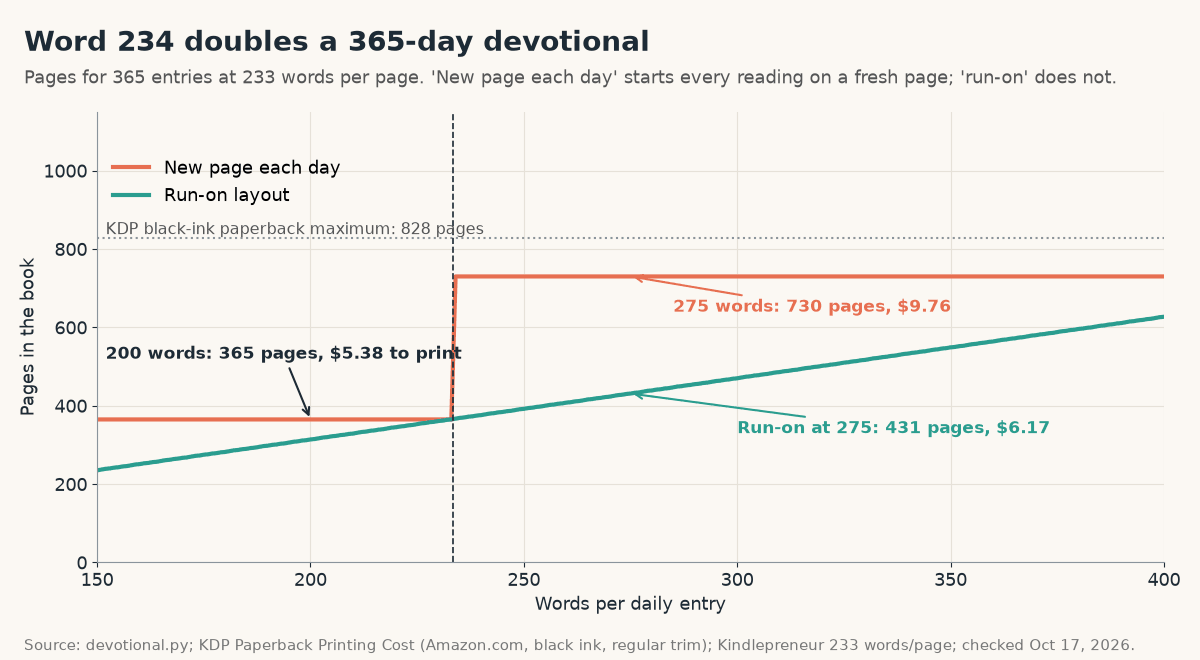
That step in the red line is the whole story. At 233 words or fewer, a day fits one page and the book is 365 pages. At 234 words, every day spills onto a second page, and the book jumps to 730 pages.
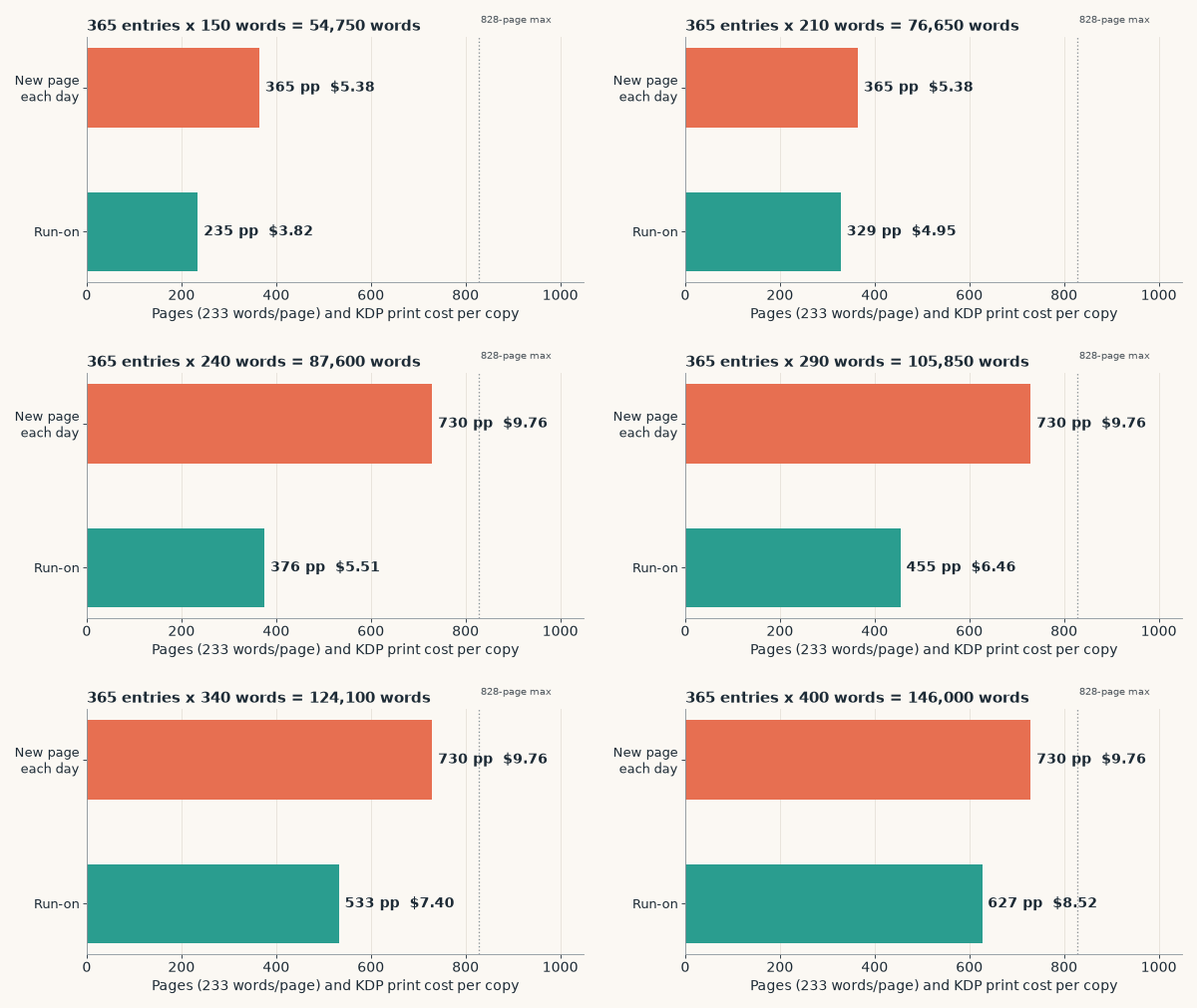
The print cost follows the pages: $5.38 a copy at 200 words, $9.76 at 275. KDP’s paperback royalty on Amazon.com is 60% of list price at $9.99 or more, minus printing. At a $16.99 list price:
- 365 pages: 0.60 × $16.99 − $5.38 = $4.81 per copy
- 730 pages: 0.60 × $16.99 − $9.76 = $0.43 per copy
- 431 pages (275 words, run-on layout): $4.02 per copy
Same book, same price, and the author keeps less than a tenth as much per copy, because each day ran 42 words too long for its page. (If you want to play with list prices, the KDP royalty calculator in Python I built earlier does the rest of that math.)
The 233-word limit is for the meditation alone, and your page also holds a title, a verse and a prayer. So in practice, a one-page-per-day devotional wants a meditation under 233 words. The Secret Place’s 150-200 is a good target. If you want Upper Room-length entries of 250-300 words, plan for a two-page spread per day, or use a run-on layout.
Pick a format, then a length
Not every devotional has to run a year. Here is the same math for shorter formats:
| Format | Words at 200/day | Words at 275/day | Words at 341/day (Spurgeon) | 275/day, new page each day | 275/day, run-on |
|---|---|---|---|---|---|
| 31 days | 6,200 | 8,525 | 10,571 | 62 pp, $2.30 | 37 pp, $2.30 |
| 40 days | 8,000 | 11,000 | 13,640 | 80 pp, $2.30 | 48 pp, $2.30 |
| 90 days | 18,000 | 24,750 | 30,690 | 180 pp, $3.16 | 107 pp, $2.30 |
| 365 days | 73,000 | 100,375 | 124,465 | 730 pp, $9.76 | 431 pp, $6.17 |
A 31-day devotional at Spurgeon’s length is about 10,600 words, the size of a short first book. At 275 words or less, every format up to 90 days stays in KDP’s flat $2.30 print band in a run-on layout.
Drafting a year of entries (and the AI rules)
365 entries is a big writing project: at 200 words, 73,000 words, about 80% of the 90,000 words Kindlepreneur calls standard for a novel. Tools that help with the volume:
- A spreadsheet with one row per day: date, passage, theme, and a word-count column. Use it to catch repeats and stray long entries.
- Reedsy Studio, a free writing app that exports print-ready PDF and EPUB files.
- ImagineYourBook, an AI book-writing tool that turns a prompt or your notes into a ~10,000-word draft with Word and EPUB export: enough for a 31-day devotional to edit line by line.
- A general chatbot for outlines and theme calendars. My API cost breakdown shows that even a 50,000-word draft costs $0.04 to $17 in tokens.
Two rules before you use any of them:
- Magazines may say no outright. The Upper Room’s guidelines state that it “does not publish AI-generated content. Submissions must be the original work of human authors.” If you also plan to submit entries there, write those yourself.
- KDP wants to know. Under KDP’s content guidelines, text created by an AI tool counts as “AI-generated” and must be disclosed, “even if you applied substantial edits afterwards.” Using AI only to brainstorm, edit or error-check your own writing counts as “AI-assisted,” which you don’t have to disclose. (The Medium piece Can Amazon Tell If Your Book Was Written by AI? covers the detection side.)
For a devotional, the personal story is the part readers come for, and the Upper Room lists it first among what a strong meditation contains. A tool can draft structure. Your stories and your prayers have to be yours. The same rule applied to the life-story book for grandchildren I wrote about yesterday: never let a draft invent what didn’t happen.
What the numbers leave out
- 233 words per page is an average. Trim size, font, margins and a verse block all change it. A large-print devotional holds fewer words per page and hits the cliff sooner. Set up your template, measure one real page, and put that number in
WORDS_PER_PAGE. - One book, one author. Spurgeon is one classic, written for readers of his own day. Modern bestselling devotionals aren’t public domain, so I didn’t measure them.
- Two magazines aren’t the market. They are two published limits, not a survey of every devotional publisher.
- Front matter, hardcover and color aren’t in the cost. Everything is US dollars on Amazon.com, checked October 17, 2026.
Try it
- Download
morneve.txtfrom CCEL and rundevotional.pyto reproduce the 341. - Pick your format (31, 40, 90 or 365 days) and your layout (new page per day, or run-on).
- Measure your page template, set
WORDS_PER_PAGE, and write to the number: one point, one story, one prayer.
How long should a daily devotional be? 150 to 300 words for the meditation. If each day gets its own page, stay under your page’s word capacity (about 233 words), or your 365-day book doubles from 365 to 730 pages.