
How much can you make on Kindle Unlimited? About $1.43 every time a subscriber reads a 300-page book to the end, at the average US rate of the last 12 months. So $1,000 a month takes roughly 699 full reads a month, or 23 a day, from a book that size.
That’s the honest per-read answer. The more useful answer is that your income depends on three numbers: the per-page rate (Amazon sets it), your book’s page count, and how many readers finish one book and start the next. Only the last two are yours to change, and the series one is the big lever.
TL;DR
- A full Kindle Unlimited read of a 300-page (KENP) book paid about $1.43 at the 12-month average US rate of $0.004768 per page.
- $1,000 a month takes about 699 full reads of that book, roughly 23 a day.
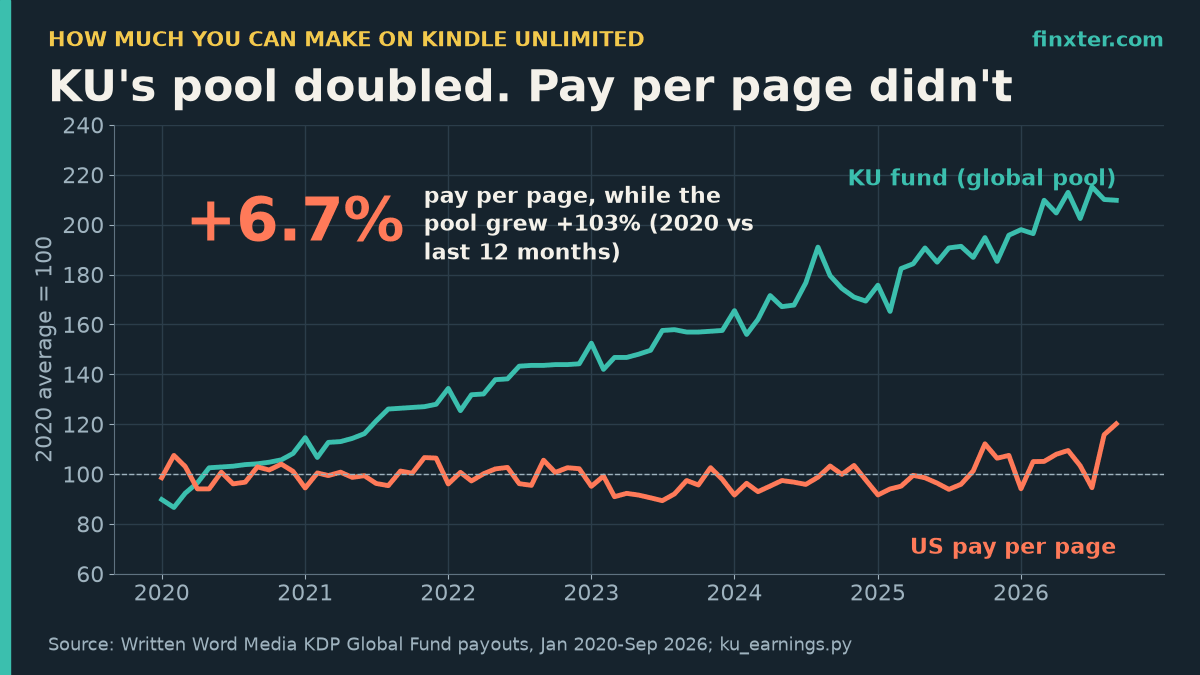
- The KU fund doubled since 2020 (+103%) but pay per page rose only 6.7%.
- A full read beats a $3.99 sale (about $2.70) only past about 566 KENP.
- A five-book series turns $1.43 per reader into $4.41 (Kindlepreneur’s read-through funnel). Python script included.
The biggest number in this article isn’t the page rate. It’s 3.08: in Kindlepreneur’s example month, every 100 full reads of Book 1 turned into 308 books read across a five-book series. More books in the series means more income from every reader you already paid to find. If drafting speed is what keeps your series at two books, ImagineYourBook is the tool I’d start with: an AI book-writing tool that turns your idea, outline or notes into a complete draft with its own cover, exports Word and EPUB on paid plans, and carries your characters and story into Book Two.
How Kindle Unlimited pays you
Kindle Unlimited (KU) doesn’t pay per borrow. Every month Amazon announces a pot of money, the KDP Select Global Fund, and splits it by KENP, Kindle Edition Normalized Pages read. Each page counts once per reader, and KDP caps it at 3,000 KENP per title per customer.
Written Word Media tracks both numbers every month:
- The fund for September 2026 was $65.9 million. Over the last 12 months (October 2025 to September 2026) it paid out $765.0 million. The first KU month, July 2014, had $2.5 million.
- The US per-page rate for September 2026 was $0.005365, the highest of the last 12 months. The lowest was $0.004202 in January 2026. The 12-month average was $0.004768.
A 28% swing between the worst and best month, on a rate you don’t control. That’s why I use the 12-month average for planning and treat a good month as a bonus.
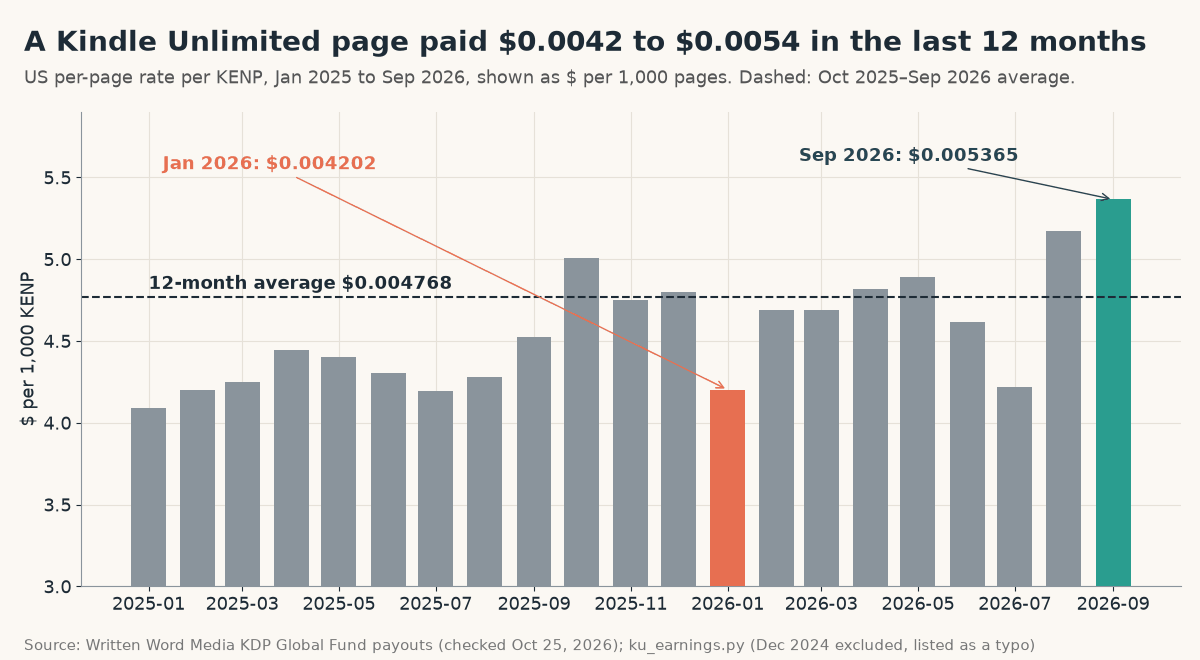
One caution: Written Word Media calculates the per-page rate from the fund and Amazon’s statistics; it isn’t an official Amazon number. When readers asked about small differences, their editor said the figure in your own KDP account is the accurate one. Use theirs for planning, yours for accounting.
The pool doubled. Your page rate didn’t
Here’s the part most “KU income” posts skip. Compare 2020 with the last 12 months:
- The average monthly fund went from $31.4 million to $63.8 million, up 103%.
- The average per-page rate went from $0.004467 to $0.004768, up just 6.7%.
The money grew, but so did the number of pages competing for it. A bigger fund doesn’t make each page worth much more. Growth in your KU income has to come from more pages read, not from Amazon.
What one full read is worth
Earnings per read = KENP x rate. Your book’s KENP count (KENPC) is in your KDP dashboard. If you only know the word count, I assume about 190 words per KENP page below; that’s my rough assumption, so check your own KENPC.
| Book length (KENP) | Rough words (assumed 190/page) | 12-month low | 12-month average | Sep 2026 |
|---|---|---|---|---|
| 200 | ~38k | $0.84 | $0.95 | $1.07 |
| 300 | ~57k | $1.26 | $1.43 | $1.61 |
| 400 | ~76k | $1.68 | $1.91 | $2.15 |
| 500 | ~95k | $2.10 | $2.38 | $2.68 |
Now compare a sale. Kindlepreneur says a $3.99 ebook nets you about $2.70 in royalties. At the 12-month average rate, a full KU read only beats that sale once the book passes about 566 KENP. At September’s peak rate the break-even was 503 KENP.
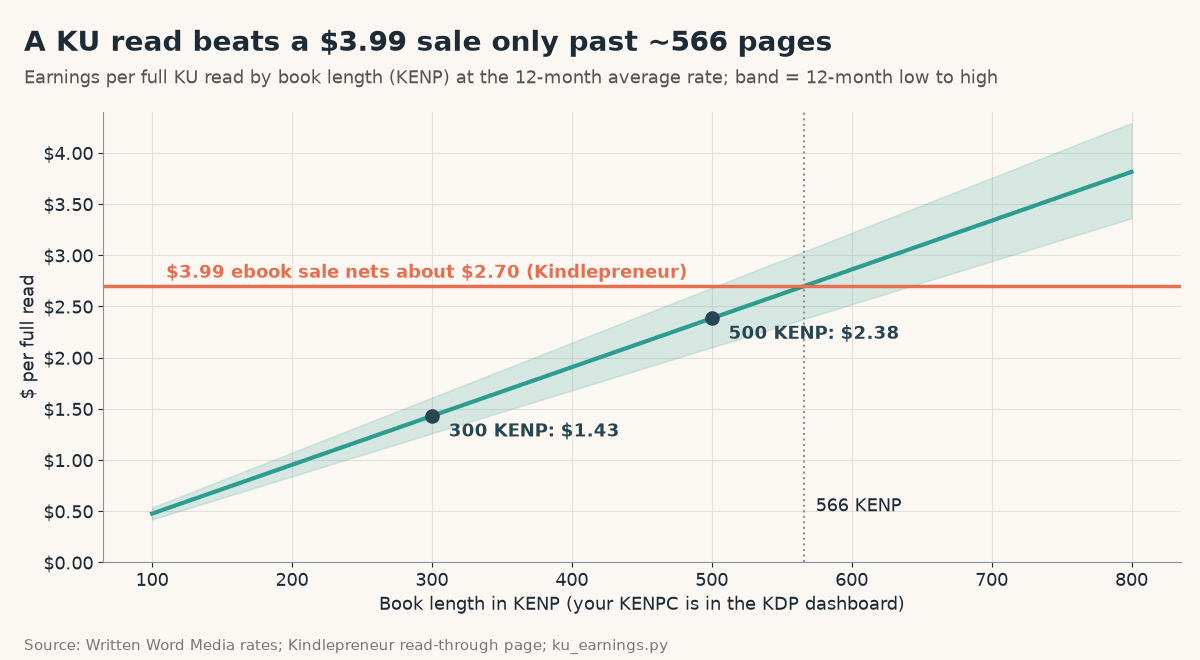
So for a typical novel, one KU read pays less than one sale. KU can still win for a series author, because read-through stacks those smaller payments. Which brings us to the series math.
How many reads you need for $100, $1,000 or $3,000 a month
At the 12-month average rate and a 300-KENP book:
| Monthly KU income | Full reads a month (300 KENP) | Per day |
|---|---|---|
| $100 | 70 | 2.3 |
| $500 | 350 | 11.7 |
| $1,000 | 699 | 23.3 |
| $3,000 | 2,097 | 69.9 |
Seventy full reads a month for $100 sounds reachable. Two thousand for $3,000 is a real business. The question is how you get there without buying every reader one at a time.
The series multiplier: $1.43 becomes $4.41
Kindlepreneur’s read-through example uses one month of KU reads for a five-book series: 100, 65, 50, 48 and 45 full reads of Books 1 to 5. They call 75% Book 1 to Book 2 read-through low for KU, and show an 86.3% example. I use their more conservative 65% funnel.
That funnel means each Book-1 reader reads 3.08 books on average. At 300 KENP per book:
- A standalone book earns $1.43 per reader.
- The same reader, entering a five-book series, earns $4.41.
Same reader, same ad spend, 3.08 times the money. This is also why I’d never judge a KU ad by Book 1 alone; see how to get more Kindle Unlimited page reads for which levers move this funnel, and how to price a KDP ebook series for the sale side.
Napkin math: one series over three years
Now let it compound. These are assumptions, not data: 100 new full reads of Book 1 every month, 300 KENP per book, a new book every three months until the series has five, Kindlepreneur’s funnel from the day each book goes live, and the per-page rate frozen at the 12-month average.
- Month 1, one book live: $143.
- Month 13, five books live: $441 a month, from the same 100 new readers.
- Three-year total: $13,762.
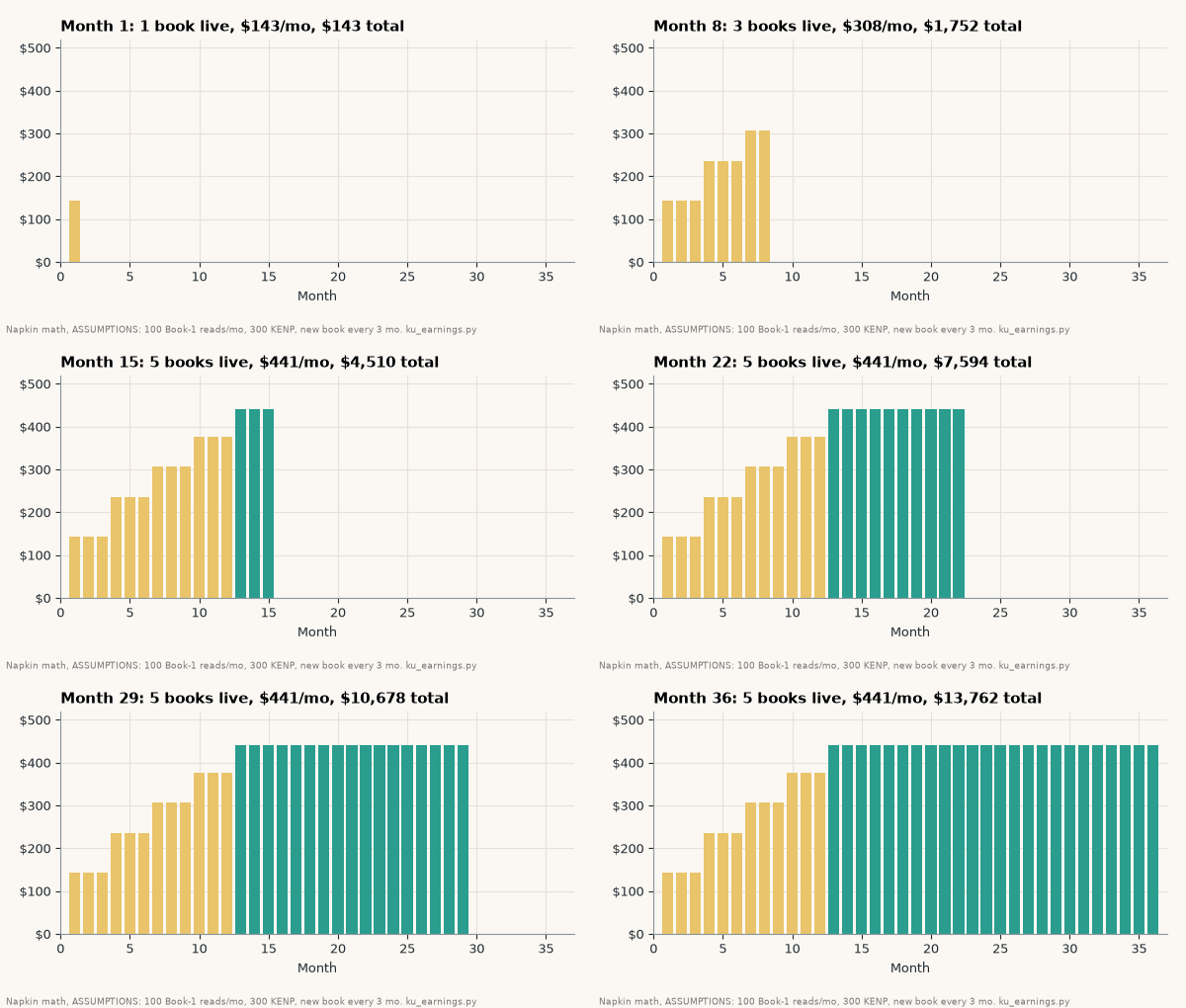
Scale the reader count and the full five-book series pays about $132 a month at 30 Book-1 reads, $441 at 100, and $1,322 at 300. Real series don’t hold readers flat: launches spike and decay, and promotions bring bursts. But the shape is right. Your income grows with the catalogue, not with the rate. For the portfolio version across several series, see how many KDP books you need to make money.
A Python script you can rerun every month
The script below parses the fund and rate table from a saved copy of Written Word Media’s page, drops one obvious typo (the source lists December 2024 as $0.03228, about seven times its neighbours), and prints every number in this article. Change the KENP, the funnel or the reader count to model your own series. If you want to plot it, the Matplotlib guide covers everything used here, and the KDP royalty calculator in Python handles the sales side.
"""ku_earnings.py - how much can you make on Kindle Unlimited (KU)?
Sources (checked 2026-10-25):
  KDP Select Global Fund + US per-page rates: Written Word Media, writtenwordmedia.com/kdp-global-fund-payouts/ (saved src/wwm.txt)
  Read-through funnel 100/65/50/48/45 per month of Book-1 reads: Kindlepreneur, kindlepreneur.com/calculate-series-read-through/
  $3.99 ebook nets "about $2.70" in royalties: same Kindlepreneur page
  KENP paid once per page per customer, max 3,000 KENP per title per customer: KDP help G201541130
Everything marked ASSUMPTION is mine, not a source.
"""
import re, os
MONTHS = "January February March April May June July August September October November December".split()
HERE = os.path.dirname(os.path.abspath(__file__))

def parse():
    t = open(os.path.join(HERE, "src/wwm.txt")).read()
    fund_txt = t[t.index("Total KDP Global Fund Size:"):t.index("US KDP Payout Per Page:")]
    rate_txt = t[t.index("US KDP Payout Per Page:"):]
    pat = r"(%s) (20\d\d)\s*[:–-]?\s*:?\s*\$?\s*\$?\s*([\d.]+)" % "|".join(MONTHS)
    fund = {}
    for m, y, v in re.findall(pat, fund_txt):
        fund.setdefault(f"{y}-{MONTHS.index(m)+1:02d}", float(v) * 1e6)
    rate = {}
    for m, y, v in re.findall(pat, rate_txt[:6000]):
        k = f"{y}-{MONTHS.index(m)+1:02d}"
        if k >= "2020-01": rate.setdefault(k, float(v))
    return dict(sorted(fund.items())), dict(sorted(rate.items()))

FUND, RATE_RAW = parse()
# Dec 2024 is listed as $0.03228 (7x every neighbour): a typo on the source page, excluded.
RATE = {k: v for k, v in RATE_RAW.items() if v < 0.01}
LAST12 = [k for k in RATE if "2025-10" <= k <= "2026-09"]
R_NOW = RATE["2026-09"]; R_AVG12 = sum(RATE[k] for k in LAST12) / 12
R_LO12 = min(RATE[k] for k in LAST12); R_HI12 = max(RATE[k] for k in LAST12)
FUND12 = sum(FUND[k] for k in LAST12)

FUNNEL = [100, 65, 50, 48, 45]          # Kindlepreneur example month: full reads of Books 1-5
EBOOK_NET_399 = 2.70                   # Kindlepreneur: $3.99 ebook nets about $2.70
WPP = 190                              # ASSUMPTION: ~190 words per KENP page; check your book's KENPC in KDP

def per_read(kenp, rate=R_AVG12): return min(kenp, 3000) * rate
def kenp_from_words(words): return words / WPP
def series_per_reader(kenp=300, books=5, rate=R_AVG12):
    """KU income from one Book-1 full read, carried through the Kindlepreneur funnel."""
    return sum(FUNNEL[:books]) / 100 * per_read(kenp, rate)
def reads_needed(target, kenp=300, rate=R_AVG12): return target / per_read(kenp, rate)

def portfolio(months=36, new_readers=100, kenp=300, rate=R_AVG12, release_every=3, max_books=5):
    """ASSUMPTIONS: one series, a new book every `release_every` months up to max_books; `new_readers` Book-1 full
    reads a month, constant; the funnel ratios apply from release on; per-page rate fixed at the 12-month average."""
    out = []
    for m in range(1, months + 1):
        books = min(max_books, 1 + (m - 1) // release_every)
        out.append(new_readers / 100 * sum(FUNNEL[:books]) * kenp * rate)
    return out

def index_2020():
    """Fund and per-page rate, each indexed to its own 2020 average = 100 (Jan 2020 - Sep 2026, Dec 2024 rate missing)."""
    f20 = sum(v for k, v in FUND.items() if k.startswith("2020")) / 12
    r20 = sum(v for k, v in RATE.items() if k.startswith("2020")) / 12
    keys = [k for k in FUND if k >= "2020-01"]
    fi = {k: FUND[k] / f20 * 100 for k in keys}; ri = {k: RATE[k] / r20 * 100 for k in keys if k in RATE}
    f12 = sum(FUND[k] for k in LAST12) / 12
    return fi, ri, f12 / f20 - 1, R_AVG12 / r20 - 1, f20, r20

if __name__ == "__main__":
    print(f"Fund months parsed: {len(FUND)} ({min(FUND)}..{max(FUND)}); rate months since 2020: {len(RATE)} (dropped {sorted(set(RATE_RAW)-set(RATE))})")
    print(f"Sep 2026 fund ${FUND['2026-09']/1e6:.1f}M, rate ${R_NOW:.6f}/KENP")
    print(f"Oct 2025-Sep 2026: fund total ${FUND12/1e6:,.1f}M; rate avg ${R_AVG12:.6f}, low ${R_LO12:.6f}, high ${R_HI12:.6f} ({R_HI12/R_LO12-1:+.0%})")
    print(f"Since Sep 2019: fund ${FUND['2019-09']/1e6:.1f}M -> ${FUND['2026-09']/1e6:.1f}M ({FUND['2026-09']/FUND['2019-09']-1:+.0%})")
    r20 = sum(v for k, v in RATE.items() if k.startswith("2020")) / 12
    print(f"Rate 2020 avg ${r20:.6f} vs last 12 months ${R_AVG12:.6f} ({R_AVG12/r20-1:+.1%})")
    print(f"First KU month Jul 2014 fund ${FUND['2014-07']/1e6:.1f}M")
    for kp in (200, 300, 400, 500):
        print(f"{kp} KENP (~{kp*WPP/1000:.0f}k words): ${per_read(kp, R_LO12):.2f} low / ${per_read(kp):.2f} avg / ${per_read(kp, R_NOW):.2f} Sep 2026 per full read")
    print(f"KENP needed to match a $3.99 sale ($2.70 net): {EBOOK_NET_399/R_AVG12:.0f} at avg rate, {EBOOK_NET_399/R_NOW:.0f} at Sep 2026")
    for t in (100, 500, 1000, 3000):
        print(f"${t:,}/month at 300 KENP: {reads_needed(t):,.0f} full reads a month ({reads_needed(t)/30:.1f}/day)")
    print(f"Series funnel {FUNNEL}: {sum(FUNNEL)/100:.2f} books per Book-1 reader -> ${series_per_reader():.2f} per Book-1 reader (300 KENP)")
    print(f"Single book 300 KENP: ${per_read(300):.2f}; 5-book series uplift x{series_per_reader()/per_read(300):.2f}")
    fi, ri, fg, rg, f20, r20 = index_2020()
    print(f"2020 avg vs last 12 months: fund ${f20/1e6:.1f}M -> ${FUND12/12/1e6:.1f}M a month ({fg:+.0%}); rate {rg:+.1%}")
    p = portfolio()
    print(f"Napkin: 100 Book-1 reads/mo, new book every 3 mo: month 1 ${p[0]:.0f}, month 13 ${p[12]:.0f}, 3-yr total ${sum(p):,.0f}")
    for n in (30, 100, 300):
        print(f"  {n} Book-1 reads/mo -> full 5-book series ${portfolio(new_readers=n)[-1]:,.0f}/month")
Output on October 25, 2026:
Fund months parsed: 147 (2014-07..2026-09); rate months since 2020: 80 (dropped ['2024-12'])
Sep 2026 fund $65.9M, rate $0.005365/KENP
Oct 2025-Sep 2026: fund total $765.0M; rate avg $0.004768, low $0.004202, high $0.005365 (+28%)
Since Sep 2019: fund $25.9M -> $65.9M (+154%)
Rate 2020 avg $0.004467 vs last 12 months $0.004768 (+6.7%)
First KU month Jul 2014 fund $2.5M
200 KENP (~38k words): $0.84 low / $0.95 avg / $1.07 Sep 2026 per full read
300 KENP (~57k words): $1.26 low / $1.43 avg / $1.61 Sep 2026 per full read
400 KENP (~76k words): $1.68 low / $1.91 avg / $2.15 Sep 2026 per full read
500 KENP (~95k words): $2.10 low / $2.38 avg / $2.68 Sep 2026 per full read
KENP needed to match a $3.99 sale ($2.70 net): 566 at avg rate, 503 at Sep 2026
$100/month at 300 KENP: 70 full reads a month (2.3/day)
$500/month at 300 KENP: 350 full reads a month (11.7/day)
$1,000/month at 300 KENP: 699 full reads a month (23.3/day)
$3,000/month at 300 KENP: 2,097 full reads a month (69.9/day)
Series funnel [100, 65, 50, 48, 45]: 3.08 books per Book-1 reader -> $4.41 per Book-1 reader (300 KENP)
Single book 300 KENP: $1.43; 5-book series uplift x3.08
2020 avg vs last 12 months: fund $31.4M -> $63.8M a month (+103%); rate +6.7%
Napkin: 100 Book-1 reads/mo, new book every 3 mo: month 1 $143, month 13 $441, 3-yr total $13,762
  30 Book-1 reads/mo -> full 5-book series $132/month
  100 Book-1 reads/mo -> full 5-book series $441/month
  300 Book-1 reads/mo -> full 5-book series $1,322/month
Summary: what moves your Kindle Unlimited income
| Lever | Who controls it | Number behind it |
|---|---|---|
| Per-page rate | Amazon | $0.004202 to $0.005365 in 12 months; +6.7% since 2020 |
| Book length (KENP) | You | 300 KENP $1.43 vs 500 KENP $2.38 per full read |
| Books in the series | You | 3.08 books read per Book-1 reader: $1.43 becomes $4.41 |
| New Book-1 readers | You (ads, promos, launches) | 30 / 100 / 300 a month: $132 / $441 / $1,322 a month for a 5-book series |
Limits of this math
- The per-page rate is a US figure; other marketplaces pay different rates, and the global fund includes all of them.
- “Full read” assumes readers finish. Partial reads pay only for the pages read.
- The funnel is one example month from one source. Your read-through could be better or worse; measure it from your own page reads.
- KU All-Star bonuses and sales outside KU aren’t included.
- Nothing here is guaranteed income. Most of the money comes from readers who finish one book and want the next.
The takeaway
How much you can make on Kindle Unlimited comes down to pages read x about half a cent. With a 300-page book that’s about $1.43 a reader. A five-book series turns it into about $4.41. The rate moved only 6.7% while the pool doubled, so the lever that matters is the one you control: more good books in the series, released steadily.
If writing the next book is the slow part, try ImagineYourBook to get a full draft of it, then rewrite it in your own voice before it goes live. You pay $0 today for a seven-day trial that includes one 10,000-word Small Book; a payment method is required, and it’s $29.99 a month after seven days unless you cancel. Sales are never guaranteed, but Book Three can’t earn a cent while it’s still an idea.
For more ways to make the math work, the cluster continues with the best AI for writing a book series, and the Medium story Kindle Unlimited pays half a cent a page: here’s what a novel earns works through a single novel.
Sources (checked October 25, 2026): Written Word Media: KDP Global Fund payouts (updated Sep 2026) · Kindlepreneur: How to calculate series read-through · Kindlepreneur: KENP calculator · KDP Help: Kindle Edition Normalized Pages (3,000 KENP cap) · KDP Help: eBook royalties · ImagineYourBook pricing and trial terms. Script: ku_earnings.py (shown above). Napkin math is labeled as assumptions.