
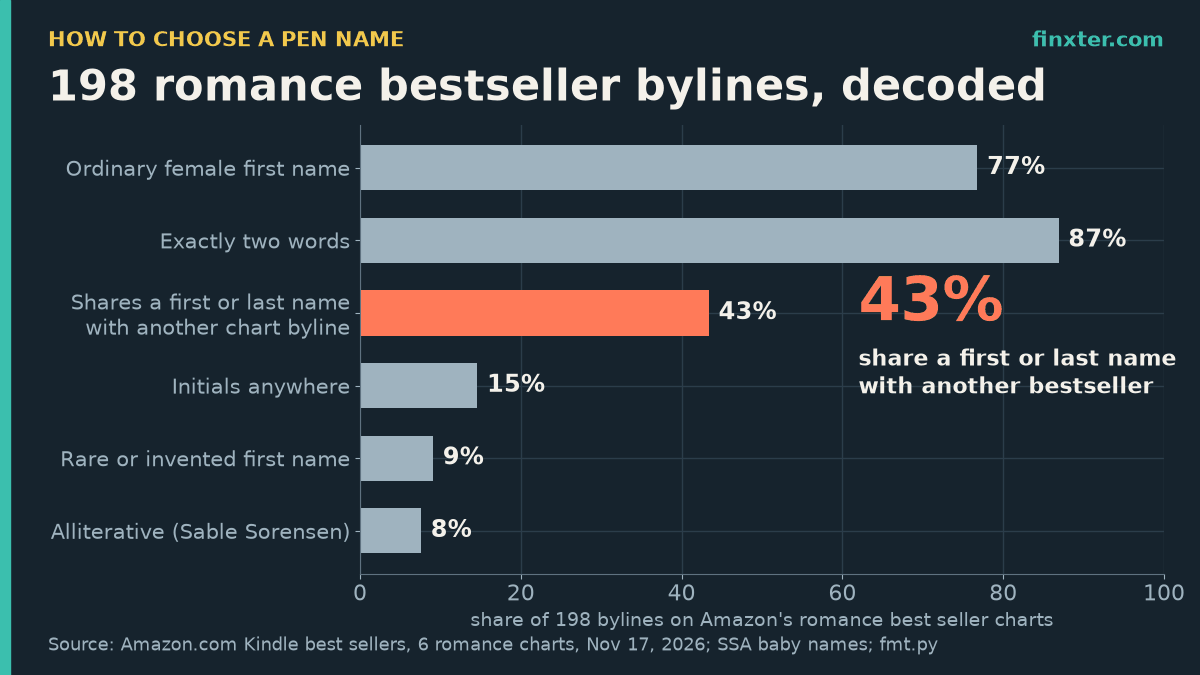
Short answer: to choose a pen name that sells, pick an ordinary first name readers already know, a distinct surname, two words, and about 12 characters, then lock it before you publish. That’s not taste. It’s what the bylines on Amazon’s Kindle romance best seller charts look like today: of 198 authors on six romance charts, 77% use an everyday female first name, 87% use exactly two words, and the median byline is 12 characters long. The twist: 43% of them share a first or last name with another author on the same charts, so “unique” means the full string, not an exotic spelling.
TL;DR
- 77% of 198 romance bestseller bylines use an ordinary female first name; only 3.5% a male-coded one.
- Median byline: 12 characters, two words. 79% run 9 to 14 characters.
- 43% share a first or last name with another chart author: make the surname do the work.
- Genre shifts the rules: romantasy uses invented first names (23%), dark romance uses initials (15%).
- KDP locks the author name on eBooks at publishing (print after 72 hours). Choose once.
Most guides on how to choose a pen name give the same advice: research your genre, keep it easy to spell, check the domain. None of them count. So on November 17, 2026 I loaded nine Amazon.com Kindle best seller charts (six romance lists plus thrillers, SF and fantasy, and literary fiction for contrast), pulled 540 chart slots, and measured every byline: words, length, initials, alliteration, and how readers would read the first name, using US Social Security baby-name data.
A pen name only matters once there are books to put it on. If drafting speed is the bottleneck, ImagineYourBook is the natural first step: an AI book-writing tool that turns an idea or your notes into a complete text-based draft with its own cover, exported as Word or EPUB, with a Series Builder that carries characters and world rules into Book Two. Its pricing page says you can use it to write for several pen names.
How to choose a pen name: what the bestseller data says
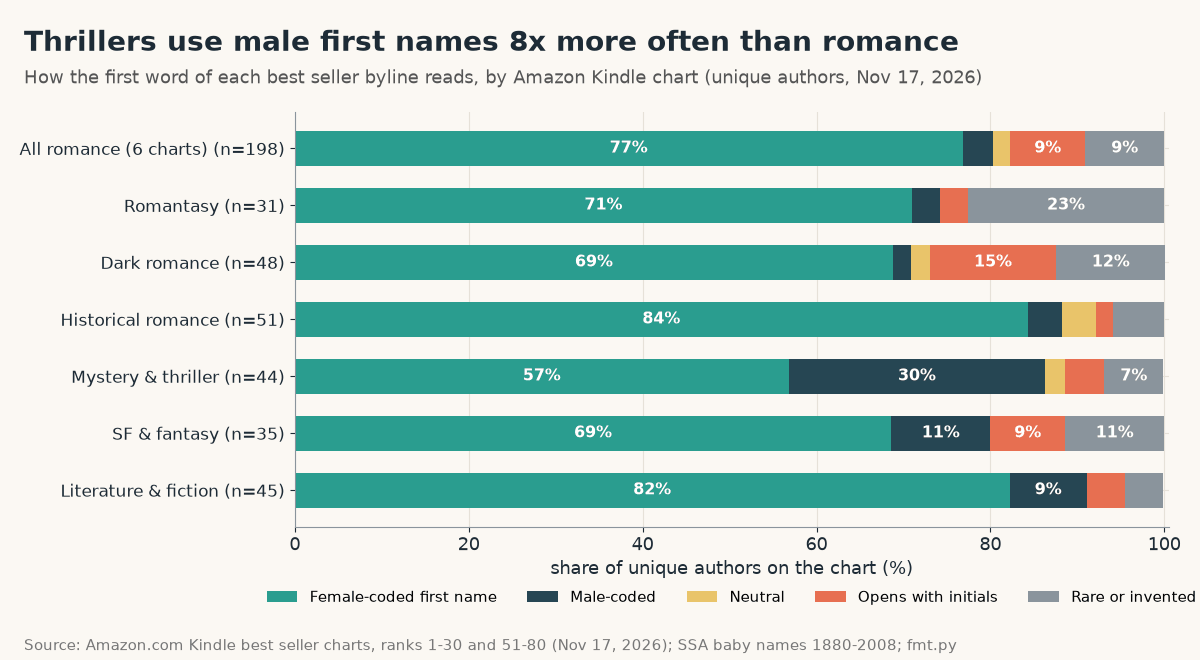
Here is how the first word of each byline reads, chart by chart. “Female-coded” and “male-coded” mean at least 90% of US babies given that name were girls or boys (SSA data, 1880 to 2008). It measures how readers will likely read the name, not the author’s gender.
| Chart | Authors | Median characters | Two words | Opens with initials | Female-coded first name | Male-coded | Rare or invented first name | Alliterative |
|---|---|---|---|---|---|---|---|---|
| All romance (6 charts) | 198 | 12 | 87% | 9% | 77% | 4% | 9% | 8% |
| Romantasy | 31 | 11 | 94% | 3% | 71% | 3% | 23% | 13% |
| Dark romance | 48 | 12 | 85% | 15% | 69% | 2% | 12% | 2% |
| Historical romance | 51 | 12 | 90% | 2% | 84% | 4% | 6% | 12% |
| Mystery, thriller & suspense | 44 | 13 | 82% | 4% | 57% | 30% | 7% | 0% |
| SF & fantasy | 35 | 13 | 74% | 9% | 69% | 11% | 11% | 9% |
| Literature & fiction | 45 | 13 | 84% | 4% | 82% | 9% | 4% | 2% |
Five patterns stand out.
- Romance runs on familiar first names. 77% of romance bylines open with a common female first name, and only 3.5% with a male-coded one. In Mystery, Thriller & Suspense, male-coded first names hold 30%, about 8 times the romance share. If you write romance under a male-sounding name, you’re in a 1-in-30 minority.
- Romantasy is the exception that rewards invention. 23% of romantasy bylines (7 of 31) use a first name outside the SSA top 1,000, such as Briar, Seren, Jaymin, Invi or Penn. A fantasy-flavored first name fits that shelf; on historical romance, where only 6% do, it would look out of place.
- Initials cluster in dark romance. 15% of dark romance bylines open with initials (A. Knightley, K.C. Tracer, I. A. Dice), the highest of any chart. Historical romance is at 2%. Initials read as edgy and neutral, which suits darker heat levels.
- Alliteration is rarer than the guides suggest. Generator sites often say romance authors love alliterative names. On the charts, only 15 of 198 romance bylines alliterate (Sable Sorensen, Scarlett Scott, Helena Hunting), about 8%, and the thriller chart has none. It’s allowed, not expected.
- Two words win. 87% of romance bylines are a plain first name plus surname. Three-part names and hyphenated surnames are under 1 in 7.
The collision problem: 43% share a name with another bestseller
The most useful number in this dataset is the one nobody publishes. Of the 198 romance bylines, 86 share a first name or a surname with at least one other author on the same six charts. There are four Sarahs (Sarah A. Parker, Sarah Adams, Sarah J. Maas, Sarah M. Eden), four Janes, two Sables, two Jasmines, two Harts (Callie and Elodie), two Kennedys, two Foxes and two Monroes.
That tells you two things. First, an ordinary first name doesn’t hurt you; the top of the chart is full of them. Second, the surname has to carry the distinctiveness, because your reader types it into the Amazon search bar. “Nicole Fox” and “Jasmine Fox” both sit on today’s charts; a new “Ava Fox” would likely show up next to their books in search.
Search the surname, not just the full name. Pen name generators check whether the exact full name is taken. On today’s romance charts, the collisions are mostly shared surnames and first names. If an established author in your subgenre already owns your surname, readers who search it will land on their books first.
Length: why 12 characters is the sweet spot
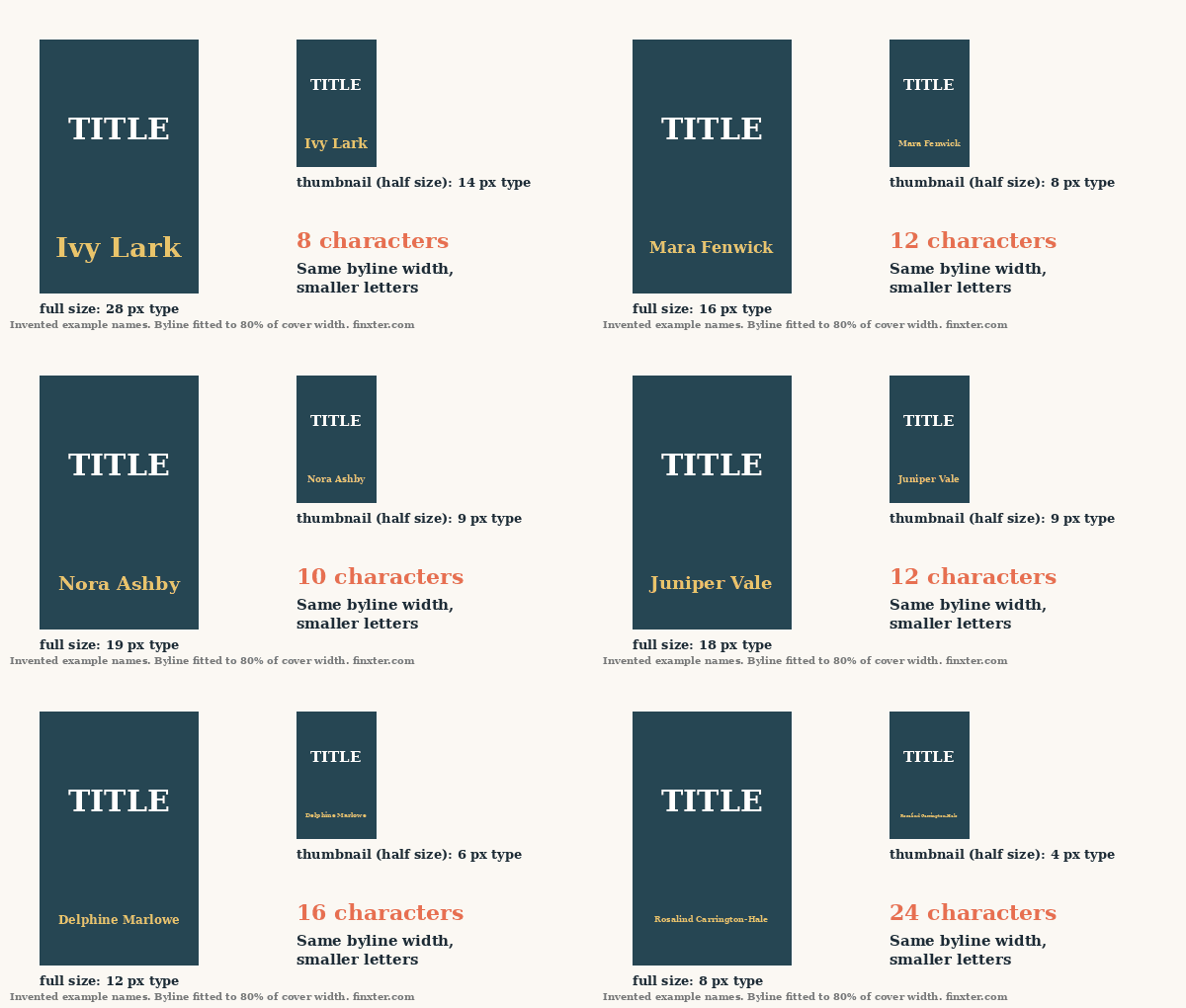
A pen name has to work at thumbnail size, where readers actually meet it. Amazon’s best seller charts render covers 200 pixels tall, which makes a standard 1,600 x 2,560 Kindle cover 125 pixels wide.
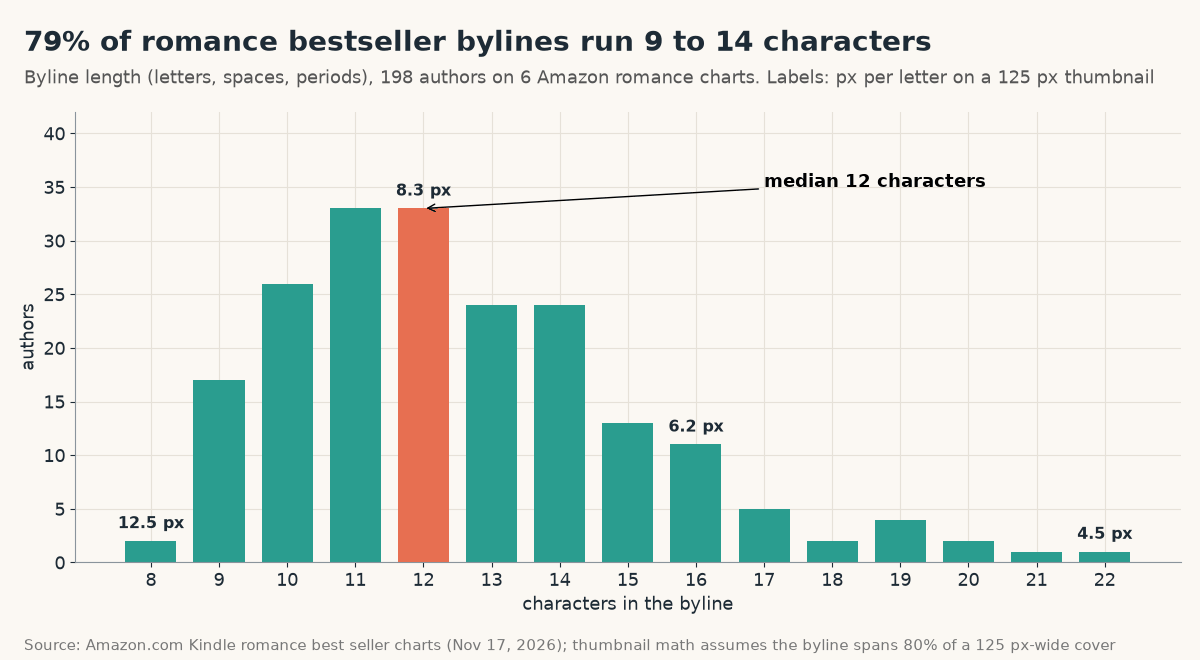
Napkin math (assumption: the byline spans 80% of the cover width, so 100 pixels): a 12-character name gets 8.3 pixels per character. A 22-character name, the longest on the romance charts, gets 4.5. Same width, 45% smaller letters. That’s why 79% of romance bestseller bylines run between 9 and 14 characters, and why initials (L.J. Shen, 9 characters) are a classic fix for long legal names.
If you’re designing that cover with AI tools, the KDP AI book cover cost breakdown covers what a 25-cover series catalog costs by route.
The KDP rules that make the choice permanent
The data says what works. The rules say why you get one shot.
| Rule | What it means for your pen name | Source |
|---|---|---|
| KDP account uses your legal name | Enter the pen name only in each book’s author field, never in account details. Payments and tax forms use your real name. | KDP: Create a KDP account |
| Primary author locks after publishing | Kindle eBook: locked at once. Paperback and hardcover: editable for 72 hours, then locked. A different name means a new edition. | KDP: Update your book details |
| Author Central pages | Create up to 3 author pages yourself and manage up to 7 per account by asking support (Amazon reply quoted by Dale Roberts). | Dale Roberts on Author Central limits |
| Copyright under a pseudonym | You still own it. US term for a pseudonymous work: 95 years from publication or 120 from creation, whichever ends first. You can register without your legal name. | US Copyright Office Circular 32 |
| Trademark (optional) | USPTO base filing fee is $350 per class. Most indie authors skip it until a series brand is earning. | USPTO trademark fees |
The lock is the expensive part. KDP’s help page says the primary author can’t be changed on a Kindle eBook after publishing; print books get a 72-hour window. After that, a different name means a new edition. Plan as if that new listing starts from zero, and look at what you’d be giving up: the median romance title on today’s charts carries 5,042 ratings, and the median romantasy title 66,791.
Pen names also stack. If you split heat levels or subgenres across names, read how multiple pen names change your catalog math first: three names stretch a 25-book catalog from 25 months to 75 at one book a month.
A 20-minute pen name checklist
Run these in order, cheapest first. Each takes a few minutes.
| Step | Check | Pass if |
|---|---|---|
| 1. Shelf fit | Open the top 50 of your exact subcategory and note first-name style (familiar, invented, initials) | Your first name reads like the shelf (77% familiar female names in romance; invented names fit romantasy; initials fit dark romance) |
| 2. Surname clash | Search the surname alone in Kindle Store | No author in your genre owns it in the first page of results |
| 3. Full-name clash | Search the exact full name in Amazon Books, Goodreads and Google | No living author, celebrity or brand uses it |
| 4. Length | Count characters including spaces and periods | About 9 to 14 characters, or use initials to get there |
| 5. Thumbnail test | Put the name on a mock cover and shrink it to 125 px wide | You can still read it |
| 6. Say and spell | Say it once to three people and ask them to type it | All three spell it right |
| 7. Handles | Check a .com domain and your main social handle | Available, or a clean variant you’d print on a cover |
| 8. Lock | Type the exact string into KDP, the cover and Author Central | Identical everywhere, before you click Publish |
Lock the name before launch week, not during it. The KDP launch strategy post covers what happens next, and if you’re still picking a drafting tool for the romance series behind the name, see the best AI for writing romance novels.
Summary
| Question | Answer from the data |
|---|---|
| First name | Familiar and genre-coded: 77% common female names in romance |
| Words and length | Two words (87%), about 12 characters (median) |
| Uniqueness | Distinct surname: 43% of chart bylines share a first or last name |
| Initials | 15% in dark romance, 2% in historical romance |
| Invented first names | 23% in romantasy, 6% in historical romance |
| Alliteration | Optional: 8% of romance bylines, 0% of thrillers |
| When to decide | Before publishing: eBook author field locks immediately |
Limitations. This is one day of charts (November 17, 2026), and only the server-rendered ranks 1 to 30 and 51 to 80 of each list. Bestseller bylines show what survives, not what causes success; a famous author’s name isn’t “good” because of its letters. The SSA list stops at 2008 and the top 1,000 names per year, so some real but uncommon names (Philippa, Jojo) count as rare.
FAQ
How do I choose a good pen name?
Copy your shelf's style, not its names. On Amazon's romance charts, 77% of bestseller bylines use a familiar female first name, 87% are two words, and the median is 12 characters. Then make sure no author in your genre uses your surname.
Can I change my pen name on KDP after publishing?
Not on the same book. KDP locks the primary author on Kindle eBooks once published and on print books 72 hours after publication. To use a different name you publish a new edition.
Should a romance pen name be female?
On today's six Kindle romance charts, 77% of bylines open with a common female first name and only 3.5% with a male-coded one. Initials (9%) are the main neutral alternative.
Do I need to trademark my pen name?
No. You can publish under a pen name without filing anything, and your copyright stays yours. A USPTO trademark application starts at $350 per class, which most indie authors skip early on.
How many pen names can I have on Amazon?
KDP doesn't cap pen names in the author field. Author Central lets you create 3 author pages yourself and manage up to 7 per account through support, per an Amazon reply quoted by Dale Roberts.
The takeaway
How to choose a pen name comes down to one rule: look like your shelf, but own your surname. In romance that means a familiar first name, two words, about 12 characters, a surname no other chart author uses, and a final check before KDP locks the field. Then the name needs books. If you want a series under it soon, ImagineYourBook drafts a complete 10,000-word book with a cover during a 7-day free trial (card required); at standard pricing the first $24.99 charge comes after the trial unless you cancel.
Sources (checked November 17, 2026): Amazon Kindle best sellers: Romance · Romantasy · Contemporary Romance · Dark Romance · Paranormal Romance · Historical Romance · Mystery, Thriller & Suspense · Science Fiction & Fantasy · Literature & Fiction · SSA baby names 1880-2008 (hadley/data-baby-names) · KDP: Update your book details · KDP: Create a KDP account · KDP: eBook cover requirements (1,600 x 2,560 px) · US Copyright Office Circular 32: Pseudonyms · USPTO trademark fee information · Dale Roberts: Author Central pen name limit. Method: 9 Amazon.com Kindle best seller charts loaded November 17, 2026, ranks 1-30 and 51-80 each (540 slots); unique authors per chart; byline length counts letters, spaces and periods; a first name is female- or male-coded when at least 90% of its summed yearly SSA share is girls or boys, and rare when it is outside the SSA top 1,000 for every year 1880-2008. Thumbnail math assumes a 200 px tall chart thumbnail of a 1.6:1 cover and a byline spanning 80% of its width. Not affiliated with any author named.