
A grandparent with a head full of stories and five grandchildren to give them to has three practical questions: how long should the book be, how do I get the words out, and what does it cost to put one copy in each grandchild’s hands? Each one has a number for an answer.
Type “how to write a book for my grandchildren” into Google and one of the suggestions is “how to write my life story for my grandchildren”. It also shows up under “how to write my life story”, next to “how to write my life story using ai” (suggestions I pulled on October 16, 2026).
The people typing that are not rare. AARP’s June 2026 grandparents report counts about 65 million grandparents in the US, with an average of five grandchildren each. So the book is not one gift. It is five, and five copies is where most of the hidden costs live.
Here is the plan, with the math in a small Python script you can rerun with your own numbers.
TL;DR
- AARP’s June 2026 report: grandparents have five grandchildren on average, so plan for five copies.
- At 233 words per page, 20,000 words is about 86 pages: long enough for a KDP hardcover (75-page minimum, ~17,475 words) and inside the flat $2.30 paperback fee (up to ~25,630 words).
- Speech input runs at 161 words per minute versus 53 typing on a phone: 20,000 words is 2.1 hours of talking, or 385 words a week for a year.
- Five copies: $34.00 in KDP hardcover printing or $11.50 in paperback (before shipping), against $225 for Storyworth Basic with four extra books.
- Keeping it private? KDP proof copies work while the book stays in Draft, at 5 per order, with a “Not for Resale” watermark.
Step 1: Pick a length that prints well
Book length is easier to plan in pages than in words. In a survey of 900+ authors, Kindlepreneur found nonfiction books on Amazon average 233 words per page. A memoir is nonfiction, so I used that number.
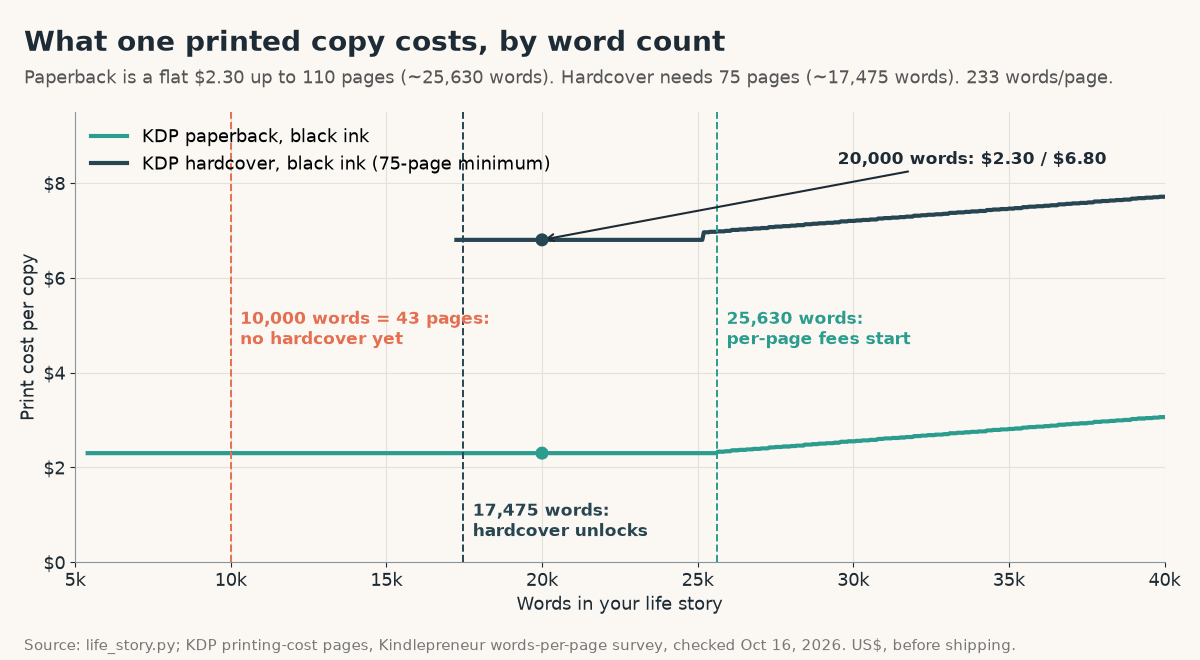
The printing rules come from KDP’s own pages. A black-ink paperback sold on Amazon.com costs a flat $2.30 to print from 24 to 110 pages, then $1.00 plus $0.012 per page. A black-ink hardcover needs at least 75 pages and costs a flat $6.80 up to 108 pages, then $5.65 plus $0.012 per page. (I took the paperback formula apart in my KDP royalty calculator in Python.)
# life_story.py - your life story as a book for the grandchildren, October 2026
import math

WORDS_PER_PAGE = 233                  # Kindlepreneur survey, nonfiction average
SPEAK_WPM, TYPE_WPM = 161.20, 53.46   # Stanford/Baidu study: speech vs phone keyboard

def pages(words, wpp=WORDS_PER_PAGE):
    return math.ceil(words / wpp)

def kdp_paperback(p):                 # Amazon.com, black ink, regular trim
    if p < 24: return None            # below the 24-page minimum
    return 2.30 if p <= 110 else round(1.00 + 0.012 * p, 2)

def kdp_hardcover(p):                 # Amazon.com, black ink, regular trim
    if p < 75: return None            # below the 75-page minimum
    return 6.80 if p <= 108 else round(5.65 + 0.012 * p, 2)

def hours(words, wpm):
    return words / wpm / 60
Running three lengths:
10,000 words =  43 pages | paperback $2.30 | hardcover too short | talk 1.0 h, type 3.1 h
20,000 words =  86 pages | paperback $2.30 | hardcover $6.80 | talk 2.1 h, type 6.2 h
30,000 words = 129 pages | paperback $2.55 | hardcover $7.20 | talk 3.1 h, type 9.4 h
Two thresholds fall out of the output:
- About 17,475 words is the hardcover floor. Below that, at 233 words per page, you have fewer than 75 pages, and KDP won’t print a hardcover. A 10,000-word life story (43 pages) can only be a paperback, unless you use a bigger font or add photos.
- About 25,630 words is the end of the flat fee. Up to 110 pages, the paperback costs the same $2.30 no matter what. After that you pay per page, but slowly: 30,000 words still prints for $2.55.
So 20,000 words is a good target. It is long enough for a hardcover and short enough for the flat paperback price.
Step 2: Talk, don’t type
The hard part is getting the words out of your head. A 2016 study by researchers from Stanford, the University of Washington and Baidu (Ruan et al.) timed people entering English text on a smartphone. Speech recognition came in at 161.20 words per minute, against 53.46 on the phone’s keyboard: 3.0 times faster, with a 20.4% lower error rate.
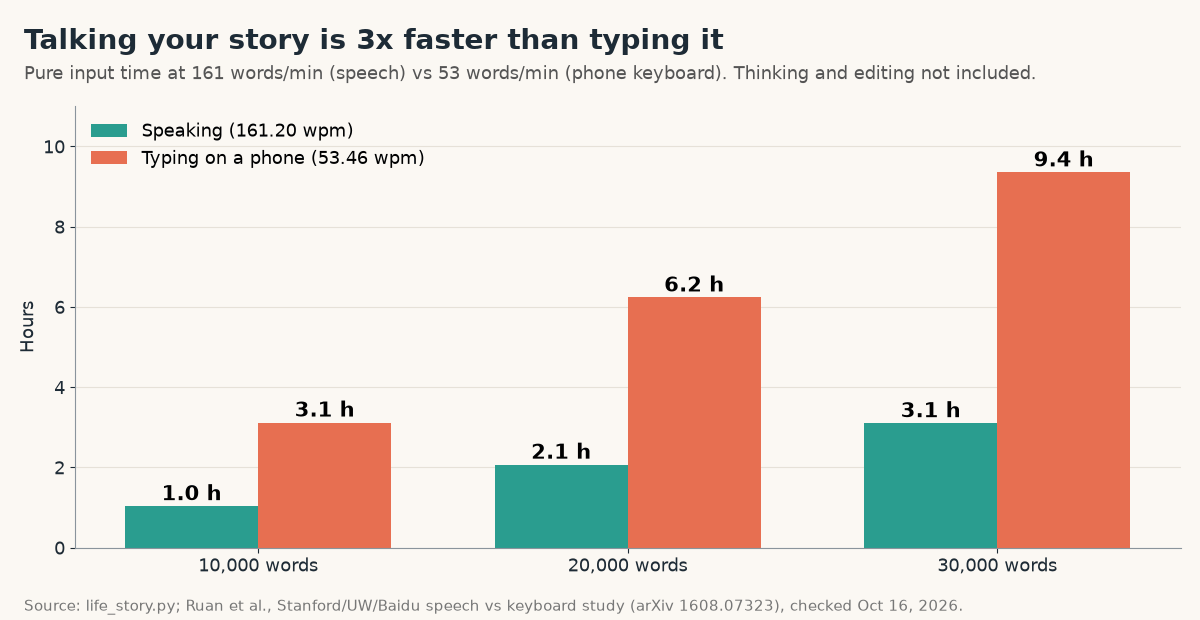
At those speeds, 20,000 words is 2.1 hours of talking or 6.2 hours of thumb-typing. Spread over a year, that is 385 words a week, or about 2.4 minutes of talking. This is the same pace Storyworth sells as a year of weekly questions (its Basic plan even lets you voice-record stories by phone).
Be honest about what that number leaves out. The study measured short messages in a lab, not someone remembering 1968. Thinking, pausing and editing will take far longer than the talking. The math still matters, though: the blank page is not 20,000 words of work. It is 52 short stories. (For the full-novel version of this math, see the Medium piece How Long Does It Take to Write a Book? The Honest Math.)
Prompts that work better than “tell me about your childhood”:
- The house you grew up in, room by room.
- Your first job and what you bought with the first paycheck.
- How you met their grandparent, and what you got wrong on the first date.
- The day each of their parents was born.
- One thing you would tell each grandchild, by name.
Step 3: Turn recordings into chapters
Once you have transcripts, you need a draft with chapters. Some options:
- Do it yourself in Word or Google Docs: free, and slow.
- Storyworth collects your weekly answers and lays them out as a book.
- A general chatbot such as ChatGPT or Claude, one chapter per prompt. My API cost breakdown puts a 50,000-word draft at $0.04 to $17 in tokens, so a 20,000-word memoir costs less.
- ImagineYourBook, an AI book-writing tool that accepts up to 20,000 words of notes and turns them into a ~10,000-word draft in roughly 6 to 15 minutes, with Word and EPUB export. The first book is free with a $0 seven-day trial; after that it’s $29.99 a month. It writes text with a designed cover and no illustrations inside, so you would add your photos when you lay out the print version.
One rule for any tool: an AI draft of a real life must not invent facts. Mark every scene you rebuilt from memory, delete any feelings the tool gave to people who never said them, and read each chapter aloud to someone who was there. It’s your name on the cover, and your grandchildren will treat the book as the true record.
Step 4: Print one copy per grandchild
Now the five copies. With 20,000 words (86 pages):
STORYWORTH = {"Basic (B&W)": (69, 1, 39), "Color": (99, 1, 79), "Unlimited": (199, 2, 69)}

def storyworth(copies, plan="Basic (B&W)"):
    price, included, extra = STORYWORTH[plan]
    return price + max(0, copies - included) * extra

p, n = pages(20_000), 5
print(f"paperback ${n * kdp_paperback(p):.2f}, hardcover ${n * kdp_hardcover(p):.2f}")
for plan in STORYWORTH: print(plan, storyworth(n, plan))
# paperback $11.50, hardcover $34.00
# Basic (B&W) 225 | Color 415 | Unlimited 406
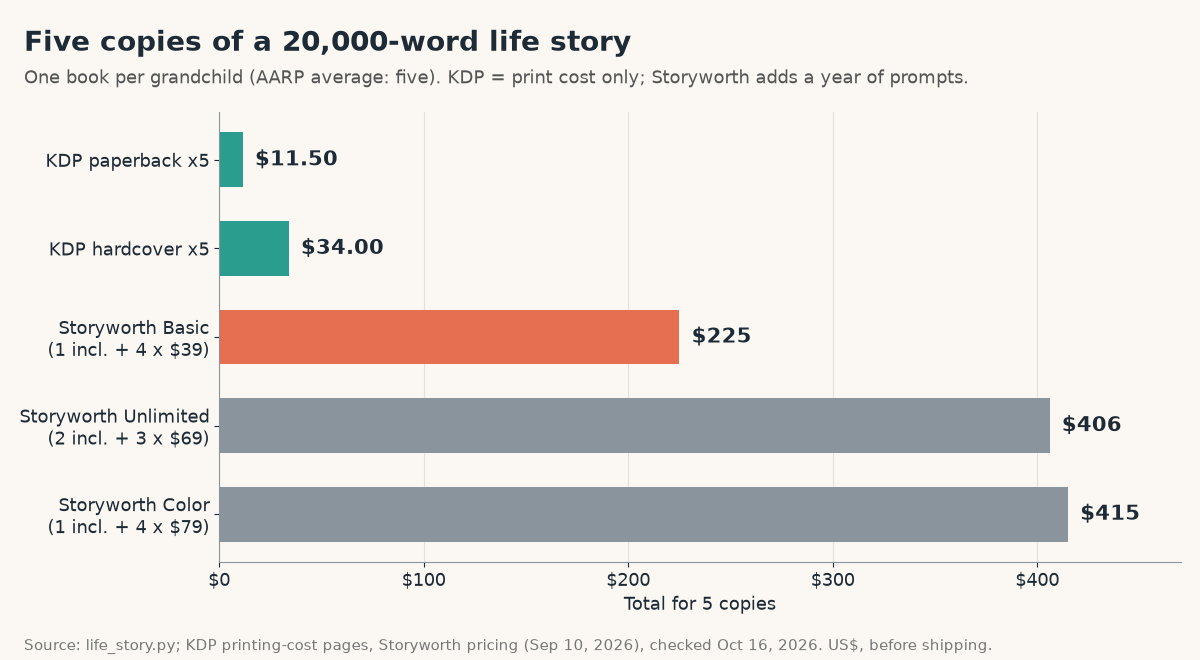
Printing five hardcovers on KDP costs $34.00; five paperbacks cost $11.50. Storyworth’s Basic plan comes to $225: $69 with one book included, plus four extra copies at $39 (Storyworth pricing, updated September 10, 2026). The comparison isn’t fully fair, because Storyworth’s price buys a year of prompts, story calls and the layout, and KDP sells you only the printing. Still, the extra copies are what drive the bill up.
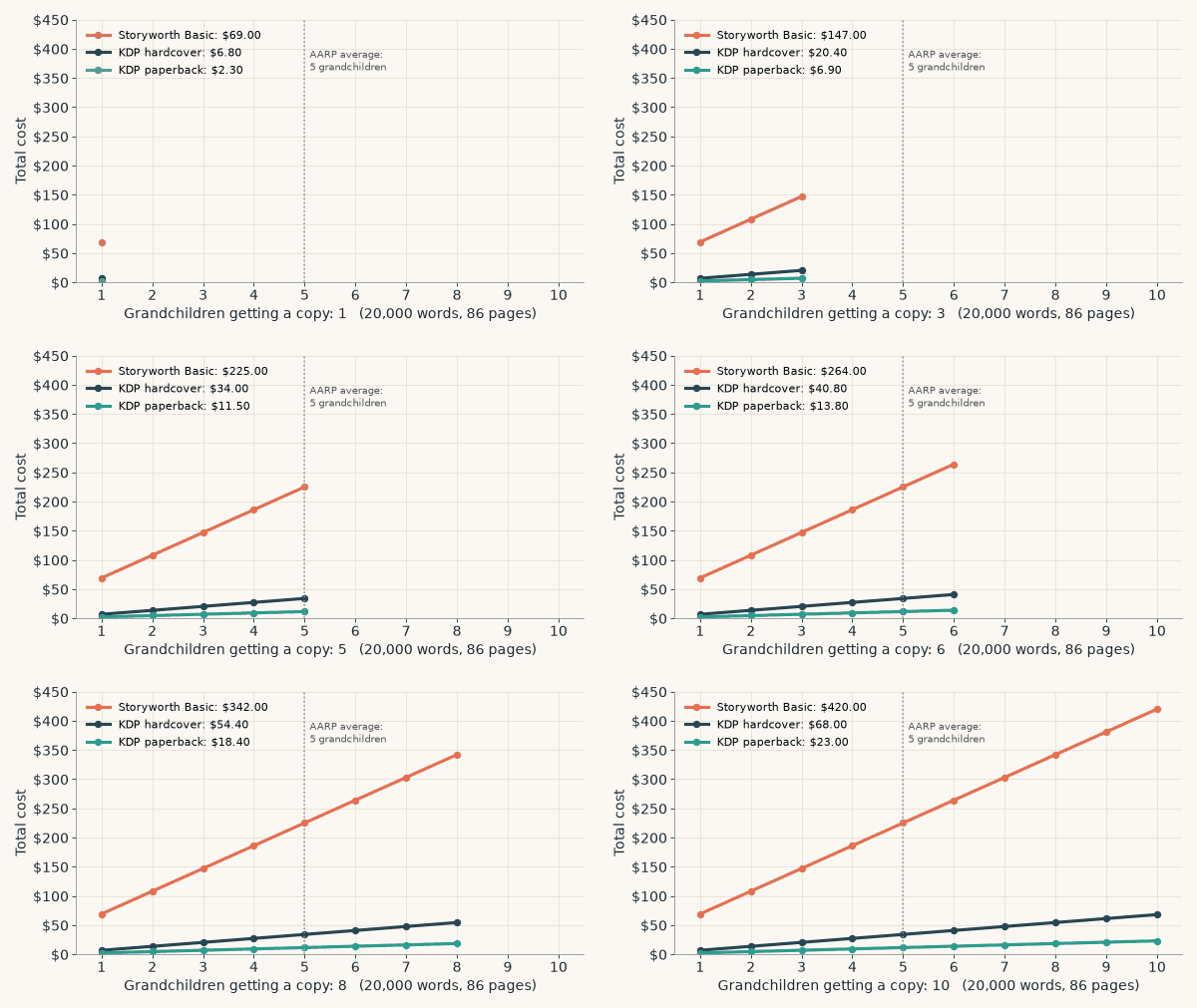
The gap grows with every grandchild. AARP’s 2018 generations data put the Silent Generation at 6.3 grandchildren on average, against 3.9 for Boomers. At ten copies, the chart ends at $420 for Storyworth Basic versus $68 in KDP hardcover printing.
KDP has a catch for a private family book, though. Author copies (up to 999 per order) only work once your book is Live, which means it is for sale on Amazon. If you don’t want your life story public, proof copies work while the book stays in Draft. But they are capped at 5 per order, and they carry a “Not for Resale” watermark and a special barcode. Five per order happens to match the average grandparent.
| Route | Listed for sale on Amazon? | Per copy at 20,000 words | The catch |
|---|---|---|---|
| KDP proof copies | No, the book stays in Draft | $2.30 paperback, $6.80 hardcover + shipping | Max 5 per order; “Not for Resale” watermark and special barcode |
| KDP author copies | Yes, the book must be Live | $2.30 paperback, $6.80 hardcover + shipping | Up to 999 per order, no watermark, but your story is public |
| Lulu | No, printing only | From $4.11 (6×9 paperback) + shipping | You upload a print-ready PDF and cover (or use its Cover Tool) |
| Storyworth | No | $39 B&W hardcover, $79 color | Plan first: $69 Basic, $99 Color, $199 Unlimited |
Whichever route you choose, follow Storyworth’s own advice: order one copy first, check it in person, then order the rest.
What the calculator leaves out
- Shipping. KDP proof and author copies don’t qualify for free or Prime shipping, and KDP won’t give a formula: you only see the cost at checkout. Storyworth includes free US economy shipping for the book that comes with a plan.
- Photos. Color costs a lot more. A premium-color KDP paperback at 86 pages is $1.00 + 86 × $0.065 = $6.59 per copy, nearly three times the black-ink price.
- Your time on layout. KDP and Lulu want print-ready files and a cover. Storyworth and the AI tools take some of that work off your hands.
- Words per page. 233 is an average. A large, grandparent-friendly font lowers it and adds pages.
- Prices change. Everything here is US dollars, checked October 16, 2026.
Try it
- Save
life_story.pyand set your target word count (start with 20,000). - Record one story a week for a year, or one a day for two months.
- Turn the transcripts into chapters, fact-check every line, and print one proof before you order the rest.
How to write your life story for your grandchildren: talk for about two hours in total, check every fact, and print. At 20,000 words, five KDP hardcovers cost $34 to print.