
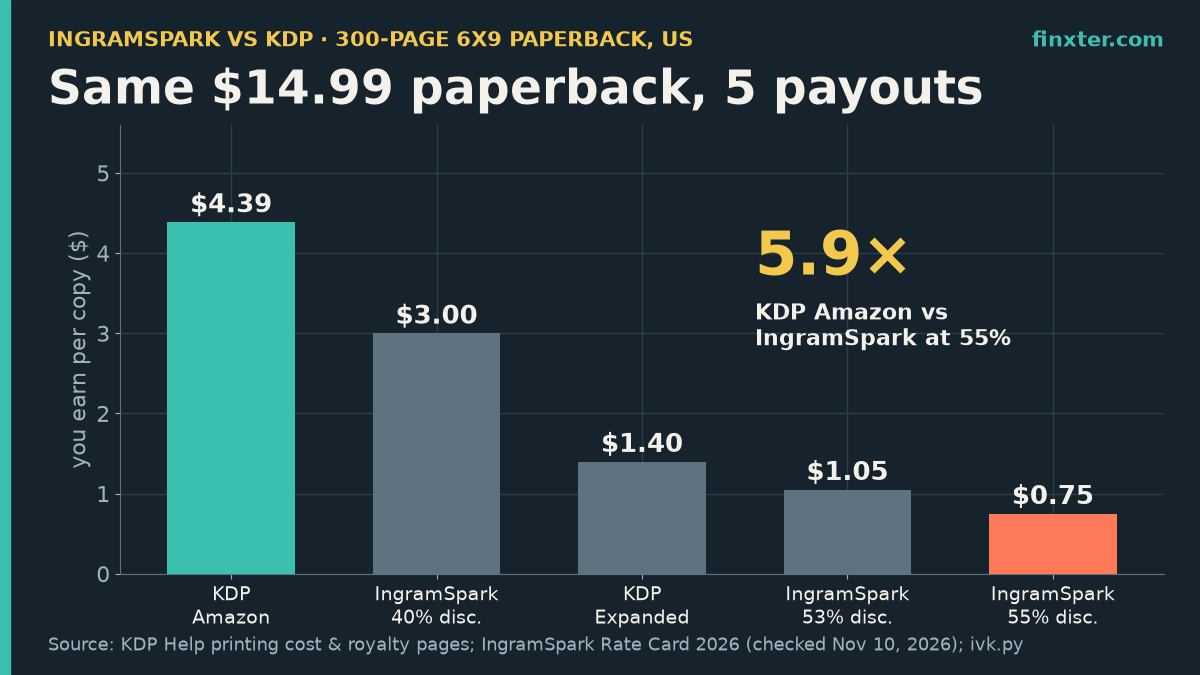
IngramSpark vs KDP: use KDP for every copy sold on Amazon, and add IngramSpark only if you will actually work bookstores or libraries. On a 300-page, 6×9 paperback at $14.99, KDP pays $4.39 per Amazon sale. The same book through IngramSpark pays $3.00 at the lowest US wholesale discount (40%) and $0.75 at the 55% bookstores expect. That’s 6 IngramSpark copies to match 1 KDP copy.
I took both companies’ 2026 price sheets (IngramSpark’s rate card, effective February 1, 2026, and KDP’s paperback and hardcover printing-cost pages) and ran the per-copy payout for every channel side by side, including the IngramSpark fees that most comparison posts leave out. Three results surprised me. A dust-jacket hardcover at $24.99 loses money at a 55% discount. A 352-page paperback at $14.99 earns $0. And KDP’s own Expanded Distribution pays more per copy than IngramSpark at a 53% discount.
If you’re building a print catalog in the first place, my top pick for drafting the books is ImagineYourBook. It’s an AI book-writing tool that turns a prompt or your notes into an editable book draft with a cover and Word/EPUB export, and its Series Builder carries characters and world details into the next book. The distribution math below is the same whichever way you write.
TL;DR
- Same 300-page $14.99 paperback: KDP pays $4.39 per Amazon sale; IngramSpark pays $3.00 at a 40% discount and $0.75 at 55%.
- IngramSpark prints cost more ($5.71 vs $4.60) and it adds a 1.875% distribution fee; setup is free on both.
- KDP Expanded Distribution pays $1.40, more per copy than IngramSpark at 53% ($1.05), but you can’t set its discount or returns.
- At 55%, a $14.99 paperback earns $0 past 352 pages; a $24.99 dust-jacket hardcover loses $1.39 a copy.
- Best setup for most series authors: KDP for Amazon, IngramSpark for stores, with an ISBN you own.
The two payout formulas
Both platforms print on demand and subtract the printing cost from your cut. The difference is the cut.
| KDP (Amazon.com) | IngramSpark (US wholesale) | |
|---|---|---|
| Payout per copy | 60% × list − print (list ≥ $9.99; 50% below) | (1 − discount) × list − print − 1.875% × list |
| Who sets the retailer’s share | Amazon (fixed) | You: 40% to 55% in the US |
| Paperback print, 6×9 black & white | $1.00 + $0.012/page | $1.33 + $0.0146/page (50 lb white) |
| Hardcover print, 6×9 black & white | $5.65 + $0.012/page (case laminate) | $5.31 + $0.0132/page; $7.76 + $0.0147/page with dust jacket |
| Setup fee | $0 | $0 |
Sources: KDP’s paperback royalty page (60% at $9.99 and up on Amazon.com, 40% for Expanded Distribution) and the printing-cost pages above; IngramSpark’s 2026 rate card for print costs, free title setup, and the 1.875% global distribution fee, plus its own guide on why to discount your book for the 40% US minimum and 55% maximum. A 6-inch-wide trim counts as “small” at IngramSpark (under 6.15 inches) and “regular” at KDP.
Two things jump out before any math. IngramSpark’s per-page print rate is about 22% higher ($0.0146 vs $0.012), and its fixed cost is higher too. And on IngramSpark the retailer’s share is a dial you set. IngramSpark itself says a 53% to 55% discount with returns allowed “generally allows for the widest availability”, and anything under 53% can limit bookstore interest (IngramSpark discount worksheet).
Worked example: one 300-page paperback, five channels
Same book, a 300-page 6×9 black-and-white paperback (a full-length novel), list price $14.99:
- KDP print cost: $1.00 + 300 × $0.012 = $4.60
- IngramSpark print cost: $1.33 + 300 × $0.0146 = $5.71
- IngramSpark distribution fee: 1.875% × $14.99 = $0.28
| Channel | Formula at $14.99 | You earn per copy | Copies to match 1 KDP Amazon sale |
|---|---|---|---|
| KDP, Amazon.com | 60% × $14.99 − $4.60 | $4.39 | 1 |
| IngramSpark, 40% discount | 60% × $14.99 − $5.71 − $0.28 | $3.00 | 1.5 |
| KDP Expanded Distribution | 40% × $14.99 − $4.60 | $1.40 | 3.1 |
| IngramSpark, 53% discount | 47% × $14.99 − $5.71 − $0.28 | $1.05 | 4.2 |
| IngramSpark, 55% discount | 45% × $14.99 − $5.71 − $0.28 | $0.75 | 5.9 |
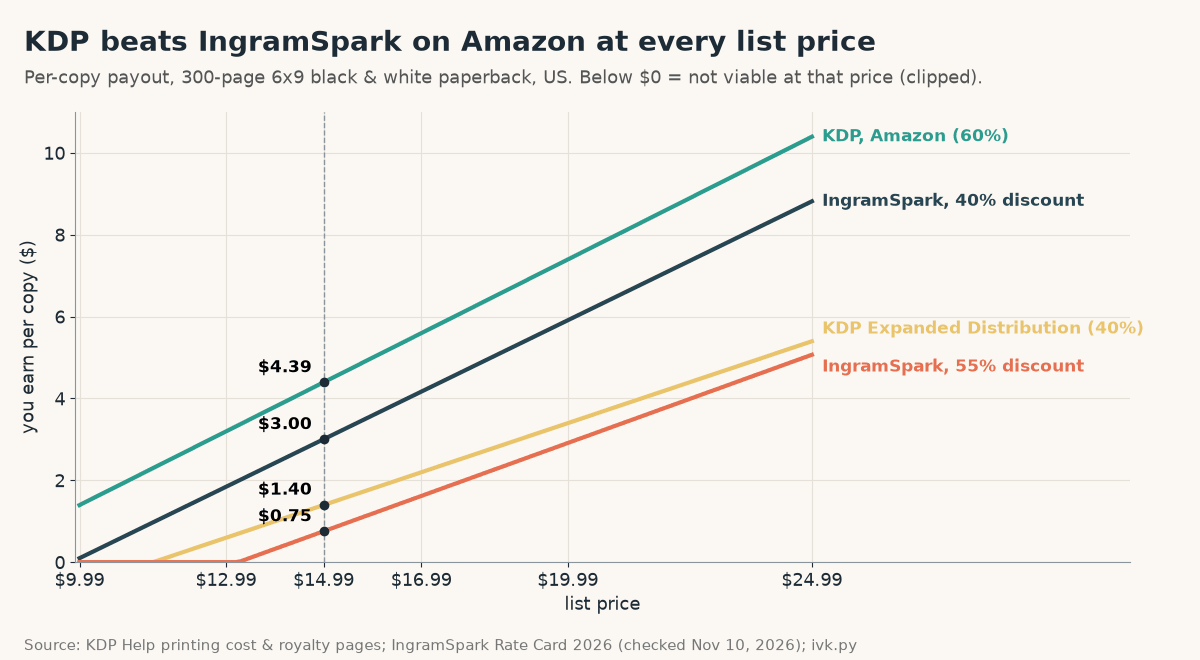
So the honest one-line answer to “IngramSpark vs KDP” for an Amazon-first author: for Amazon sales, KDP wins at every price. KDP’s 60% beats IngramSpark’s best case (60% of list minus the fee at a 40% discount) and its print is cheaper. IngramSpark also distributes to Amazon, so if you publish print only through IngramSpark, Amazon buys your book through Ingram at your discount. Every Amazon sale then pays $3.00 or $0.75 instead of $4.39.
The surprise is the bookstore column. KDP’s Expanded Distribution pays $1.40 on this book, more than IngramSpark at 53% ($1.05) or 55% ($0.75). Per copy, KDP’s checkbox is the better deal. What you don’t control there is the discount, returns, or whether a store will order at all. KDP’s help page says enrollment doesn’t guarantee that any bookstore or library picks the book up. That control is what IngramSpark sells.
The page-count trap: when IngramSpark pays $0
At a 55% discount, IngramSpark keeps nothing back for you on a long book. Solve (45% − 1.875%) × $14.99 − ($1.33 + $0.0146 × pages) = 0, and you get 352 pages. Past that, the formula goes negative, so a 400-page epic fantasy at $14.99 can’t be priced for bookstores at all. You’d have to raise the list price.
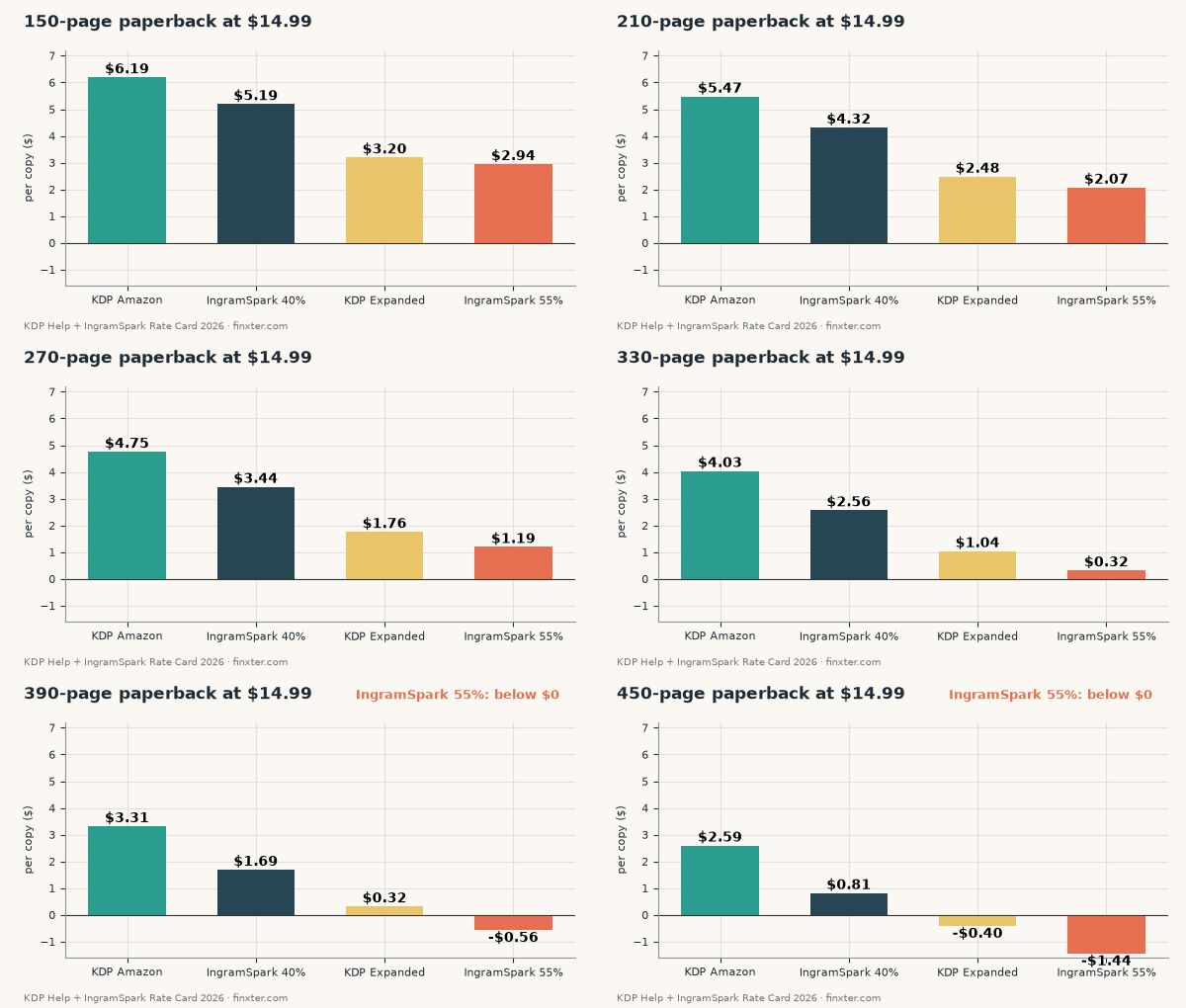
| Pages (at $14.99) | KDP, Amazon | IngramSpark 40% | IngramSpark 55% | KDP Expanded |
|---|---|---|---|---|
| 200 | $5.59 | $4.46 | $2.21 | $2.60 |
| 250 | $4.99 | $3.73 | $1.48 | $2.00 |
| 300 | $4.39 | $3.00 | $0.75 | $1.40 |
| 350 | $3.79 | $2.27 | $0.02 | $0.80 |
| 400 | $3.19 | $1.54 | below $0 | $0.20 |
That’s why long-book genres feel IngramSpark’s squeeze first. If your fantasy books run 120,000 words, check the math before you tick the 55% box. (For why epics still pay on Kindle Unlimited, see best AI for writing fantasy novels.)
Hardcover: IngramSpark’s real advantage, and its trap
Hardcover is where IngramSpark is genuinely different. KDP offers a case-laminate hardcover and, per its hardcover help page, hardcovers aren’t eligible for Expanded Distribution, so a KDP hardcover reaches Amazon and nobody else. IngramSpark prints case laminate and dust-jacket hardcovers and offers both to its wholesale network.
Same 300 pages, list price $24.99:
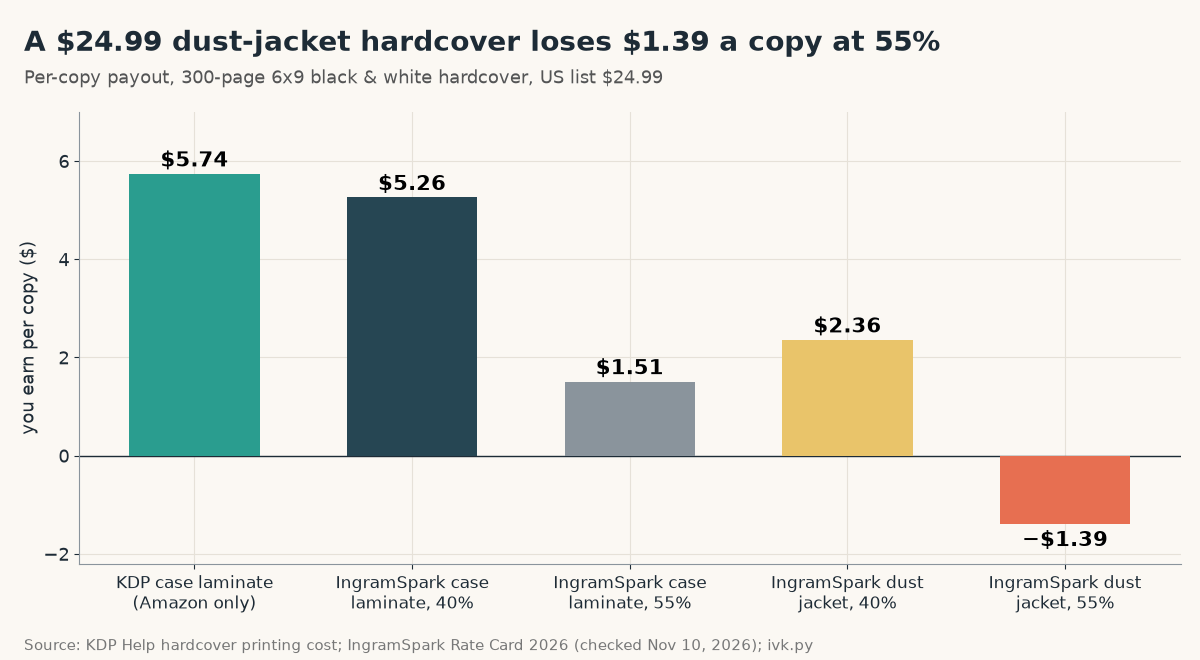
The case-laminate print costs are almost identical ($9.25 at KDP, $9.27 at IngramSpark), so at a 40% discount IngramSpark pays $5.26 against KDP’s $5.74. The dust jacket is the trap: it costs $12.17 to print, and at 55% the formula comes out at −$1.39 per copy. You need a list price of at least $28.22 just to reach $0 at 55%, and $20.94 at 40%.
Before you choose a dust jacket: at a 55% discount, a 300-page jacketed hardcover needs a list price of at least $28.22 just to earn $0. Price for the jacket, or stick with case laminate.
The setup most pros use: both, with your own ISBN
IngramSpark’s own FAQ answers this one: it isn’t exclusive, and if you publish print directly with KDP, you just don’t select KDP’s Expanded Distribution (IngramSpark FAQ). The catch is the ISBN. KDP’s free ISBN “can only be used on KDP” (KDP ISBN help), and IngramSpark’s free US ISBN only works on IngramSpark and carries its “Indy Pub” imprint (IngramSpark free ISBNs). To run both on one edition you need an ISBN you own; IngramSpark sells US authors one for $85 during setup, per the same FAQ.
Napkin math for a series. Assumptions (mine, not data): a 5-book series of 300-page paperbacks at $14.99, each selling 100 print copies a year on Amazon and 10 to stores and libraries.
| Setup | Amazon copies (500/yr) | Store copies (50/yr) | Yearly print income |
|---|---|---|---|
| KDP only, Expanded off | 500 × $4.39 = $2,195 | 0 (not available) | $2,195 |
| KDP + Expanded Distribution | $2,195 | 50 × $1.40 = $70 | $2,265 |
| KDP for Amazon + IngramSpark 55% | $2,195 | 50 × $0.75 = $37.50 | $2,232.50 |
| IngramSpark only, 55% | 500 × $0.75 = $375 | $37.50 | $412.50 |
| IngramSpark only, 40% | 500 × $3.00 = $1,500 | 50 × $3.00 = $150 | $1,650 |
The ISBN cost for the hybrid is 5 × $85 = $425 once. In this example, the store copies add only $37.50 to $70 a year, so for an Amazon-first romance catalog the bookstore channel is about events, libraries, and reach, not royalties. The setup that really costs money is IngramSpark-only: at a 55% discount it gives up $1,782.50 a year against KDP on the same sales. If you’re still deciding where your ebooks go, that’s a separate choice: see KDP Select vs wide.
How to decide in four questions
- Will you sell to stores or libraries yourself (signings, local shops, library pitches)? No: use KDP only. Yes: add IngramSpark at 53% to 55% with returns allowed.
- Do you want a dust-jacket hardcover? Only IngramSpark prints one. Price it at $28.22 or more for 55%, or accept a 40% discount online.
- Is your paperback longer than about 350 pages at $14.99? Then 55% doesn’t work at that price. Raise the price or use 40%.
- Did you buy your own ISBN? Needed for the hybrid. Without one, pick a platform per edition.
Run your own numbers with the KDP paperback royalty calculator, and fold the ISBN and cover costs into what it costs to self-publish on KDP.
| Situation | Better choice | Why (per-copy math) |
|---|---|---|
| Paperback sold on Amazon | KDP | $4.39 vs $3.00 (40%) or $0.75 (55%) at $14.99 |
| Paperback for bookstores and libraries | IngramSpark at 53-55%, returnable | You set discount and returns; earns $0.75-$1.05 at $14.99 |
| Bookstore reach without extra setup | KDP Expanded Distribution | $1.40 per copy, but no control and no order guarantee |
| Dust-jacket hardcover | IngramSpark only | Needs list ≥ $28.22 at 55% or ≥ $20.94 at 40% |
| Case-laminate hardcover on Amazon | KDP | $5.74 vs $5.26 at 40%; KDP hardcovers can’t use Expanded Distribution |
| Paperback over ~350 pages at $14.99 | KDP, or raise the price | IngramSpark 55% payout hits $0 at 352 pages |
Limitations
- US, black and white, 6×9 only. Other markets, trims, and color change the costs; both price sheets publish them.
- IngramSpark list rates. Its rate card says it may raise prices once a year by up to 5%, and returns (if you allow them) are not included here.
- No shipping or author copies. Ordering your own copies to sell at events has different math on both platforms.
- Sales volumes in the series table are assumptions, not data; swap in your KDP and IngramSpark reports.
FAQ
Is IngramSpark or KDP better for paperbacks?
For copies sold on Amazon, KDP: a 300-page $14.99 paperback pays $4.39 there vs $3.00 through IngramSpark at a 40% discount. IngramSpark is better only for bookstore and library sales you actively pursue.
Can I use IngramSpark and KDP at the same time?
Yes. IngramSpark is not exclusive; publish print on KDP for Amazon, leave KDP Expanded Distribution off, and use an ISBN you own, since neither platform's free ISBN works on the other.
How much does IngramSpark charge in 2026?
Title setup is free. Its February 2026 rate card adds a 1.875% global distribution fee on list price and prints a small black-and-white paperback for $1.33 plus $0.0146 per page.
What wholesale discount should I set on IngramSpark?
IngramSpark allows 40% to 55% in the US and recommends 53-55% with returns for bookstores. At 55% a 300-page $14.99 paperback pays $0.75; at 40%, $3.00.
Does KDP do dust-jacket hardcovers?
No. KDP prints case-laminate hardcovers, which aren't eligible for Expanded Distribution. IngramSpark prints dust-jacket hardcovers, at $7.76 plus $0.0147 per page for a small black-and-white book.
The takeaway
IngramSpark vs KDP isn’t really either/or. For the copies you sell on Amazon, KDP pays more per book at every price we checked: $4.39 against $3.00 or $0.75 on a $14.99 paperback. IngramSpark earns its place for dust-jacket hardcovers and real bookstore work, as long as you buy your own ISBN and keep long books above the zero line.
The bigger lever is how many books you have to distribute in the first place. ImagineYourBook drafts complete text-based books up to 120,000 words with a cover, and Series Builder keeps a series consistent from book to book. The free trial gives you one 10,000-word book; it needs a card, the first $24.99 Author payment starts after 7 days, and you can cancel before then (pricing). Edit every draft yourself; no tool or platform guarantees sales.
Sources (checked November 10, 2026): IngramSpark Rate Card 2026 · IngramSpark: Why Should I Discount My Book? · IngramSpark FAQ · IngramSpark: Free ISBNs · KDP Help: Paperback Royalty · KDP Help: Paperback Printing Cost · KDP Help: Hardcover Printing Cost · KDP Help: ISBN and Imprint · ImagineYourBook pricing. Assumptions: 300-page 6×9 black-and-white book on white paper, US list prices; IngramSpark list print rates (no quantity discount, returns not modeled); series sales volumes in the napkin table are illustrative.