
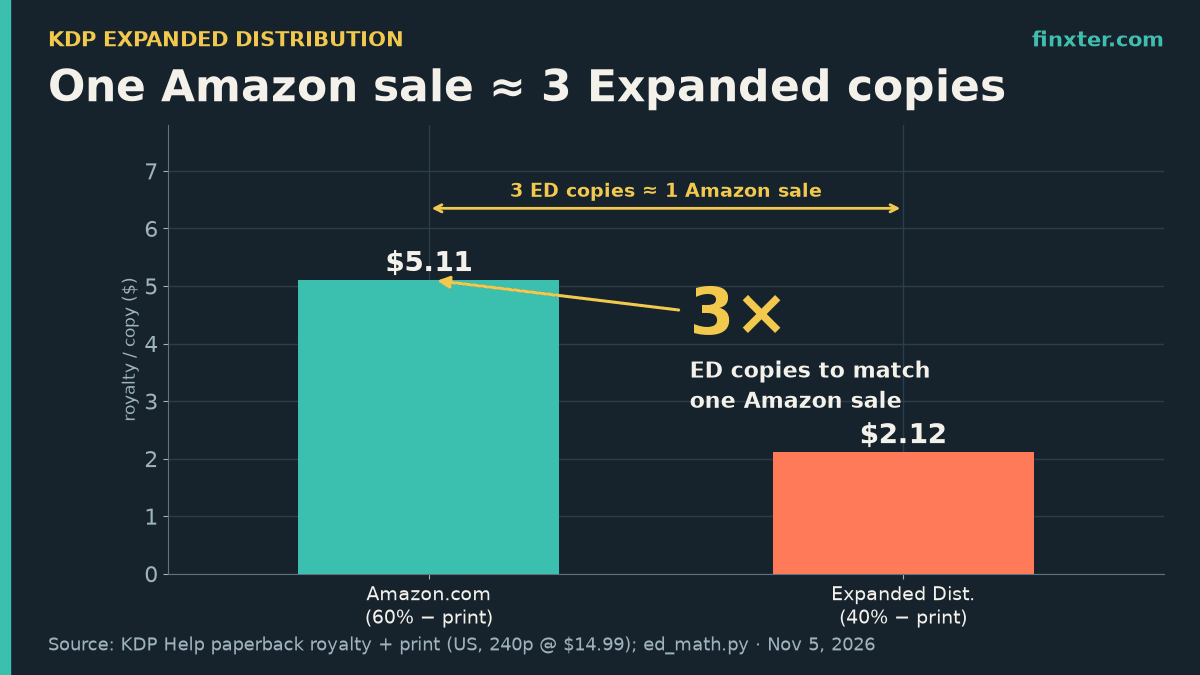
Is Expanded Distribution on KDP worth it? Not as free reach. A $14.99, 240-page paperback earns $5.11 on Amazon.com and only $2.12 through Expanded Distribution after print cost — so you need about 3 bookstore or library copies to match one Amazon sale. Tick the box only when that lower-paying demand is real, not aspirational.
Amazon’s own help page makes the gap plain: Expanded Distribution pays 40% of list minus printing, while Amazon.com paperbacks at $9.99+ pay 60% minus printing. Below is the per-copy napkin math, a price sweep that shows when ED collapses to cents, and a rule of thumb for romance-series catalogs.
If you’re drafting the next paperback in a series, ImagineYourBook is an AI book-writing tool that turns a prompt or notes into a ~10,000-word draft with Word/EPUB export (and Series Builder / Manuscript Rewrite when you’re chaining titles). The distribution decision below is separate from drafting — get the royalty math right first.
TL;DR
- Expanded Distribution pays 40% of list − print; Amazon.com paperbacks at $9.99+ pay 60% − print (KDP Help).
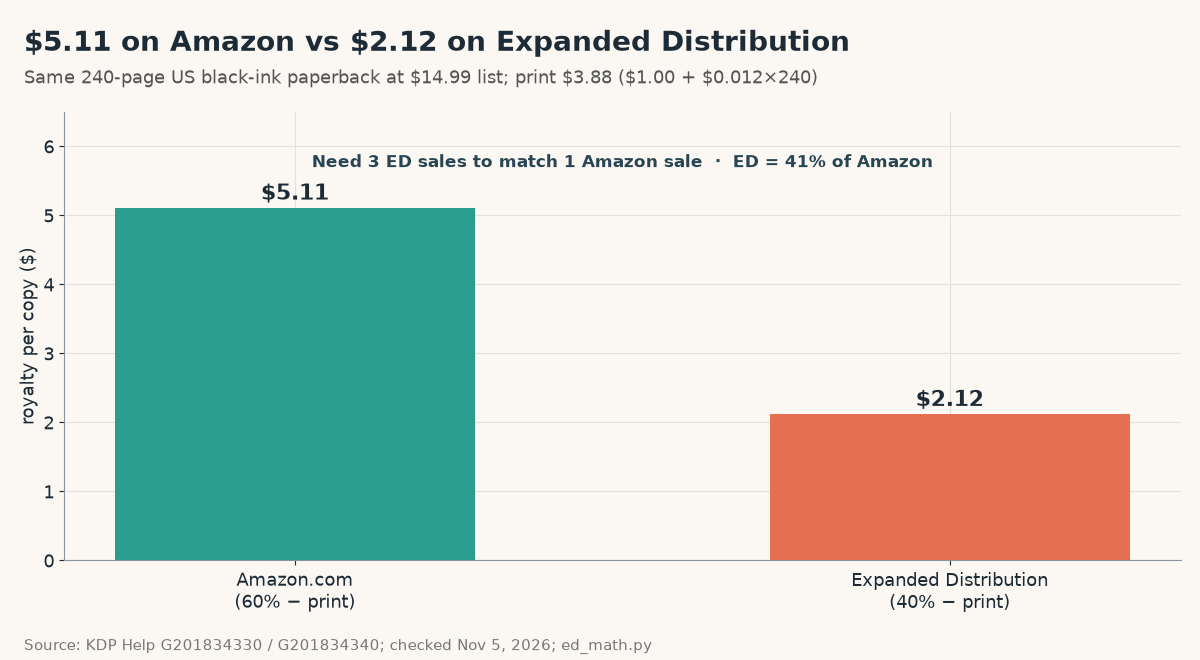
- On a $14.99, 240-page book: Amazon $5.11, ED $2.12 — about 3 ED copies per Amazon sale (41% of Amazon royalty).
- At $9.99 the same book keeps $0.12 on ED vs $2.11 on Amazon (~18×).
- Enrollment is free and does not guarantee bookstore/library orders; hardcovers are not eligible; availability can take ~8 weeks.
- Enable ED for additive bookstore/library demand; ignore aspirational reach when your print money is Amazon-native.
What Expanded Distribution actually is
Straight from KDP Help: Expanded Distribution (checked November 5, 2026):
- Free to enroll. Checking the box on paperback Rights & Pricing does not cost money.
- Channels: KDP makes the paperback available to distributors so booksellers and libraries can find and order it (US and UK distributors; buyers elsewhere may order through them).
- No guarantee. Enrollment does not guarantee distributor acceptance or that any bookstore or library will order.
- Hardcover: not eligible. Paperbacks only.
- Timeline: up to about eight weeks before the book is orderable in those channels; metadata and price changes can take similarly long to propagate.
- Reporting: Expanded Distribution royalties show in reports roughly 30 days after month-end, and are paid about 60 days after distributors report sales — slower than Amazon channel sales.
Eligibility filters matter for catalog builders: journals, notebooks, coloring books, public-domain reprints, high-ink interiors, and several recycled/low-content patterns are routinely declined. A standard fiction paperback at a common trim (for example 6×9 black ink) is usually eligible; check KDP’s trim chart before you enroll.
The royalty formulas (Amazon vs Expanded Distribution)
From KDP Help: Paperback Royalty:
| Channel | Formula (US) |
|---|---|
| Amazon.com | (50% or 60% × list price) − printing cost. 60% when list ≥ $9.99; 50% at ≤ $9.98 |
| Expanded Distribution | (40% × list price) − printing cost |
Amazon’s own worked example on that page: list $15, printing $5 → Amazon royalty $4.00, Expanded Distribution royalty $1.00. That is a 4× gap on identical manufacturing assumptions.
Printing cost comes from KDP Help: Paperback Printing Cost. For a US regular-trim black-ink paperback with 110–828 pages: $1.00 + $0.012 per page.
Worked napkin math: same paperback, two channels
Assumptions (ours, labeled): 240-page 6×9 black-ink paperback, US marketplace, list price $14.99 (a common romance-paperback band). Print = $1.00 + $0.012 × 240 = $3.88.
| Channel | Calculation | Royalty per copy |
|---|---|---|
| Amazon.com (60%) | 0.60 × $14.99 − $3.88 | $5.11 |
| Expanded Distribution (40%) | 0.40 × $14.99 − $3.88 | $2.12 |
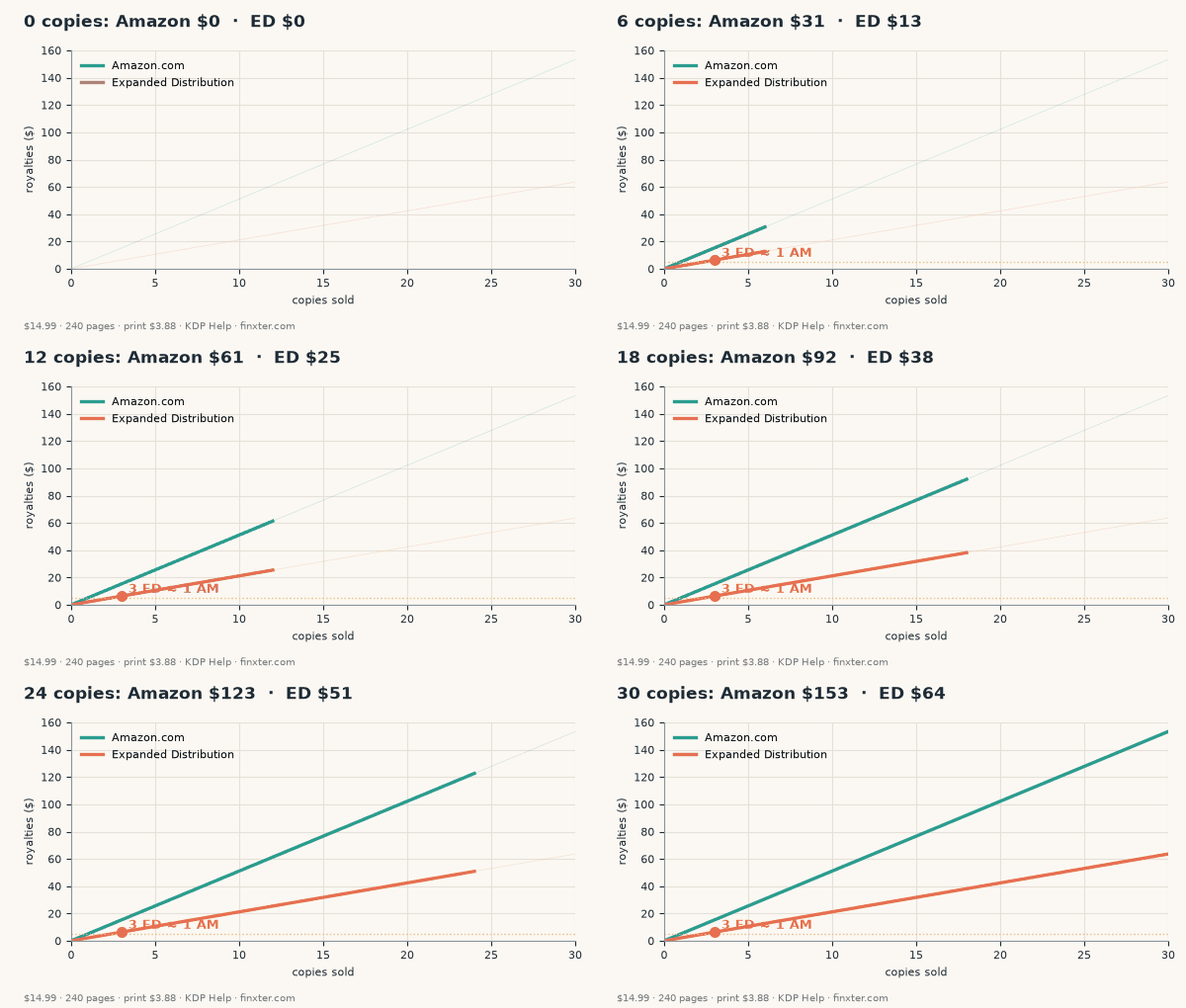
So Expanded Distribution keeps about 41% of the Amazon royalty on that book. Ceiling-divide: you need 3 Expanded Distribution sales to match 1 Amazon sale ($5.11 ÷ $2.12 ≈ 2.41).
The same $14.99 list on a 300-page book (print $4.60) earns $4.39 on Amazon and $1.40 on Expanded Distribution — about 4 ED copies per Amazon copy. Longer books widen the gap because print is a bigger share of the 40% slice.
For the full Amazon-side formula and price cliffs, see our KDP paperback royalty calculator and the older KDP royalty calculator.
Price sweep: when Expanded Distribution pays pennies
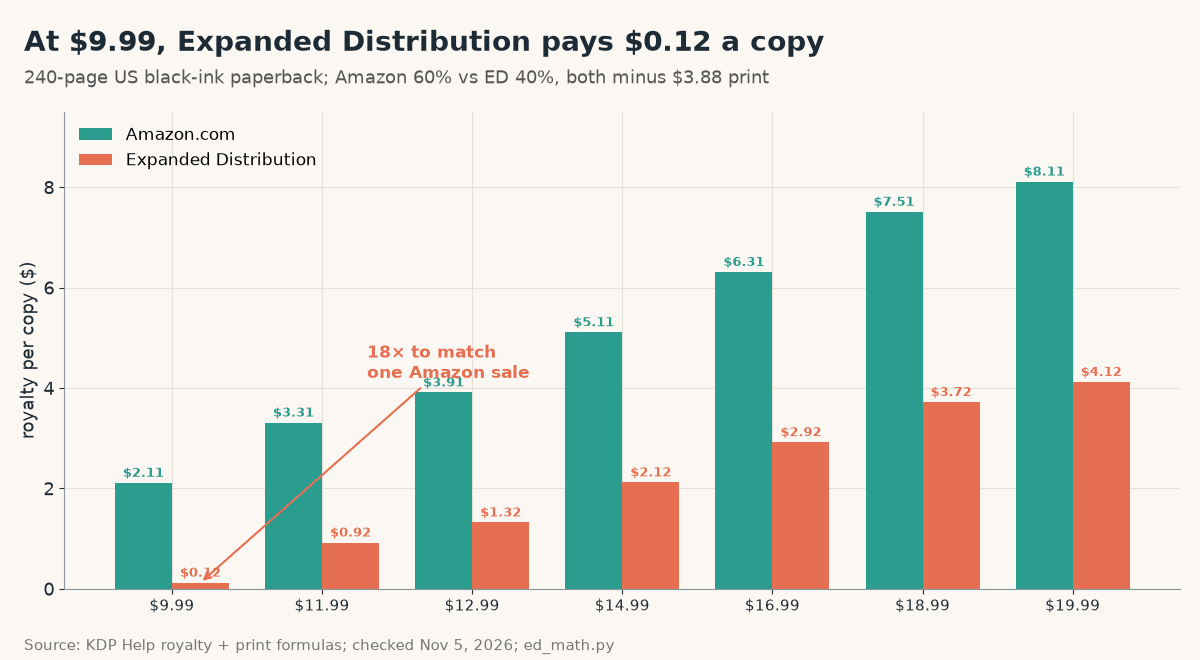
Holding the 240-page print cost fixed and sweeping list price:
| List price | Amazon royalty | ED royalty | Amazon ÷ ED | ED copies to match 1 Amazon |
|---|---|---|---|---|
| $9.99 | $2.11 | $0.12 | 17.58× | 18 |
| $11.99 | $3.31 | $0.92 | 3.60× | 4 |
| $12.99 | $3.91 | $1.32 | 2.96× | 3 |
| $14.99 | $5.11 | $2.12 | 2.41× | 3 |
| $16.99 | $6.31 | $2.92 | 2.16× | 3 |
| $18.99 | $7.51 | $3.72 | 2.02× | 3 |
| $19.99 | $8.11 | $4.12 | 1.97× | 2 |
Two takeaways:
- At $9.99 you keep $0.12 on Expanded Distribution versus $2.11 on Amazon — about 18 bookstore copies to match one Amazon sale. The 40% slice barely clears print.
- Higher list prices shrink the multiple (toward ~2× at $19.99) but never close it: Expanded Distribution always starts from 40%, Amazon from 60%.
If you are still choosing the ebook/paperback price band, pair this with how to price a KDP ebook — ebook and print pricing interact, but Expanded Distribution only touches the paperback channel.
When Expanded Distribution is (and isn’t) worth enabling
Enrollment is free, so the decision is about expected additive demand, not a fee.
Worth enabling when:
- You already get (or can create) bookstore, library, or academic interest — local events, library marketing, course adoptions, indie-bookstore relationships.
- Those buyers would not have purchased the same copy on Amazon. Then each ED sale is pure upside at $2.12 on our $14.99 example.
- Your paperback clears eligibility (fiction at a supported trim; not low-content / high-ink / public-domain patterns distributors reject).
Usually not worth obsessing over when:
- Your catalog is Amazon-first romance/romantasy with almost all print demand on Amazon.com. Aspirational “maybe a bookstore will stock it” rarely pays the 2–18× gap.
- Your list price sits near $9.99, where ED royalty collapses toward cents.
- You expected hardcover Expanded Distribution — hardcovers are not eligible.
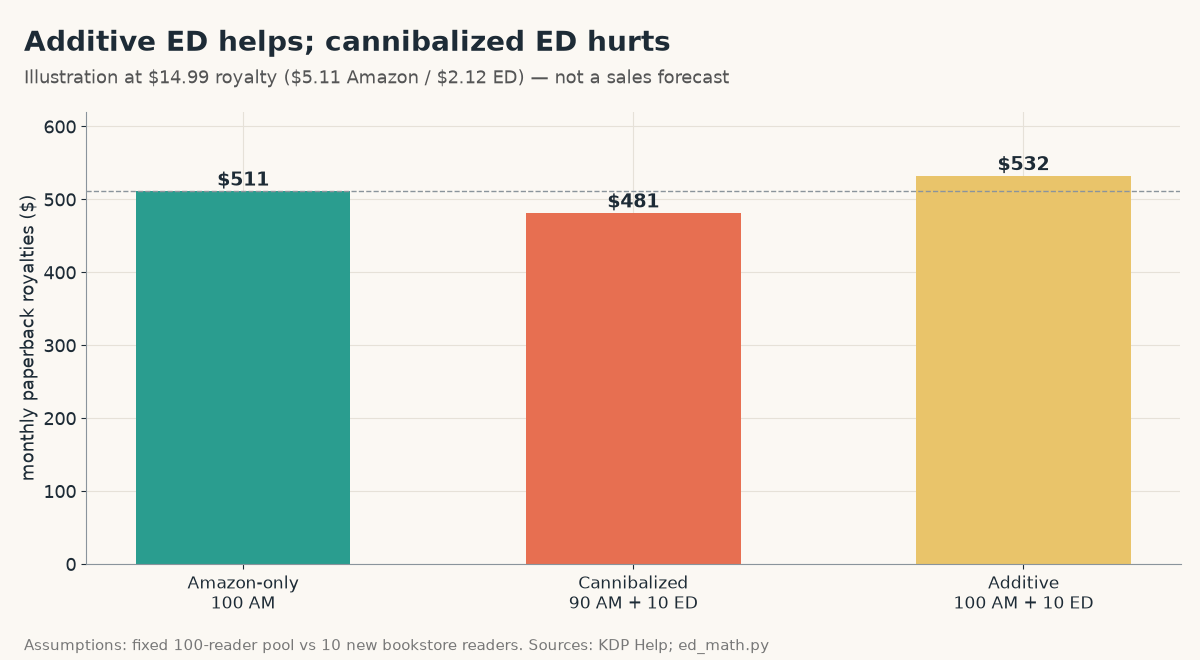
Cannibalization check (illustration, not a forecast): 100 Amazon paperbacks at $14.99 earn $511. If 10 of those readers instead buy via Expanded Distribution, you get 90 × $5.11 + 10 × $2.12 = $481 — worse than Amazon-only. If those 10 are new bookstore readers on top of 100 Amazon sales, you earn $532. Same 10 ED copies; opposite verdict. The switch is only “worth it” when the demand is additive.
For catalog strategy beyond print channels — Select vs wide on the ebook side — see KDP Select vs wide. Expanded Distribution is a paperback toggle and does not put your ebook in bookstores.
| Question | Answer | What to do |
|---|---|---|
| Is ED free to turn on? | Yes — no enrollment fee | Tick the box only if eligible |
| What does ED pay? | 40% × list − print | Compare to 60% − print on Amazon.com ≥ $9.99 |
| $14.99 / 240 pages? | Amazon $5.11, ED $2.12 (~3×) | Expect ~41% of Amazon royalty per ED copy |
| $9.99 / 240 pages? | Amazon $2.11, ED $0.12 (~18×) | Avoid judging ED at the $9.99 floor |
| When is it worth it? | Additive bookstore/library demand | Cannibalized Amazon sales lose money |
| Hardcover? | Not eligible for Expanded Distribution | Paperback only |
Free to enroll ≠ free money. Expanded Distribution costs $0 to enable, but each sale starts from a 40% royalty slice. On our $14.99 example that is $2.12 after print — useful only when the buyer would not have purchased on Amazon.
Practical checklist for a romance-series paperback
- Confirm trim/ink eligibility on KDP’s Expanded Distribution chart (6×9 black ink is typically fine).
- Price the paperback with the 40% − print math open, not only the 60% Amazon number. Use KDP’s Rights & Pricing grid; it updates estimated ED royalty live.
- Prefer list prices where ED still clears meaningful dollars (our sweep: $12.99+ looks far healthier than $9.99 for a 240-page book).
- Enroll, publish, and wait up to ~8 weeks before judging “no sales.”
- Read ED as its own report line. If units stay near zero for months and you have no bookstore/library plan, the box is harmless but not a growth lever — put energy into Amazon conversion and series read-through instead.
- Budget production honestly; Expanded Distribution does not change what editing and covers cost. Our cost to self-publish on KDP break-even tables still apply.
FAQ
Is Expanded Distribution on KDP worth it?
Yes when bookstore or library demand is real and additive. On a $14.99, 240-page book you keep $2.12 per ED copy vs $5.11 on Amazon — about 3 ED sales per Amazon sale.
What royalty does KDP Expanded Distribution pay?
40% of the list price effective in the channel at purchase, minus printing costs, taxes and withholding. Amazon.com paperbacks at $9.99+ use 60% minus printing instead.
How many Expanded Distribution sales equal one Amazon sale?
Divide Amazon royalty by ED royalty. At $14.99 / 240 pages that is $5.11 ÷ $2.12 ≈ 2.41, so 3 ED copies. At $9.99 it is about 18.
Does Expanded Distribution cost money to enable?
No. Enrollment is free. It also does not guarantee distributor acceptance or bookstore orders, and availability can take up to about eight weeks.
Can hardcovers use KDP Expanded Distribution?
No. KDP states hardcover books are not eligible. Expanded Distribution is a paperback option only.
Should romance series authors enable Expanded Distribution?
Enable it if you have (or can create) additive bookstore/library demand. If almost all paperback sales are Amazon-native, the 40% rate rarely moves the catalog needle.
Bottom line
Is Expanded Distribution on KDP worth it? Enable it when bookstore or library demand is real and additive; treat it as optional when your paperback money is Amazon-native. On a $14.99, 240-page book you keep $5.11 on Amazon and $2.12 on Expanded Distribution — roughly 3 ED copies per Amazon copy — and at $9.99 that multiple jumps to about 18.
Drafting the next title in the series is still the bottleneck most catalogs feel first. ImagineYourBook turns a prompt or notes into a draft with cover and Word/EPUB export; the Author plan is $24.99/mo after a 7-day trial ($0 today with a card; cancel before day 8 for no charge). Use the trial for one Small Book (~10k words), then keep human editing on anything you enroll in Expanded Distribution — distributors and bookstores are not a shortcut around craft.
Sources
Sources (checked November 5, 2026): KDP Help: Expanded Distribution · KDP Help: Paperback royalty · KDP Help: Paperback printing cost · Finxter: KDP paperback royalty calculator · ImagineYourBook pricing (trial and Author plan). Napkin assumptions: 240-page (or 300-page) US regular-trim black-ink paperback; list prices as labeled. Scenario counts (100 / 90 / 10) are illustrations, not forecasts.