

Are KDP ads worth it? For a standalone ebook, usually not in 2026; for a series of three or more books, often yes. At a 10% conversion rate, a $3.99 standalone can pay at most $0.27 per click before Amazon ads lose money, while fiction clicks now cost $0.70 to $0.90 on average. A five-book series at $3.99 can pay up to $0.83.
So the question isn’t really whether the ads work. It’s whether one new reader is worth more than the clicks it takes to find them. Below is the napkin math, a short Python calculator for your own numbers, and a real campaign where one change took the same ads from -$58 to +$779 a month.
TL;DR
- Break-even cost per click = conversion rate × value of one new reader. Fiction clicks cost $0.70-0.90 in 2026 (Weekend Publisher).
- A $3.99 standalone earns $2.69 per sale, so at 10% conversion it can pay only $0.27 a click.
- A five-book series at $3.99 is worth $8.29 per new reader (Kindlepreneur read-through), so it can pay $0.83.
- At $0.80 a click, 1,000 clicks lose $531 on a standalone and make $29 on the full-price series.
- Real campaign: moving Book 1 from free to $2.99 + KU turned -$58 into +$779 a month. Python calculator included.
The numbers say a series pays for ads and a single book doesn’t. That makes catalog depth the real ad strategy: Book 2 and Book 3 need to exist before the ad budget does. If drafting is the bottleneck, ImagineYourBook is the tool I’d start with. It’s an AI book-writing tool that turns a prompt or your notes into a complete draft (the trial covers one 10,000-word book) with its own cover, exports Word and EPUB, and has a series mode so Book Two remembers Book One’s characters and open threads.
The only formula you need: break-even cost per click
Every Amazon ad report tells you what a click cost. What it doesn’t tell you is the most a click is allowed to cost:
Break-even CPC = conversion rate × value of one new reader
- Conversion rate is new readers per click. Weekend Publisher, which has managed over $225,000 of author ad spend for 350+ authors, calls 5% good and 10% excellent for fiction on Amazon ads.
- Value of one new reader is everything that reader earns you: the Book 1 royalty, plus the later books they go on to read.
The other side of the comparison is what clicks actually cost. Weekend Publisher’s 2026 benchmark for fiction is 70 to 90 cents per click, up from about 20 cents in 2017. Ad Badger’s app data for the whole Books category (January to August 2026) is much lower, $0.38 per click at an 18% conversion rate. That category average also includes big publishers, nonfiction and print, so treat it as the optimistic ceiling for a debut fiction author, not the expected case.
What one new reader is worth
On a $3.99 ebook, KDP’s 70% option pays 70% of the list price minus a delivery cost of $0.15 per MB (US). For a 1 MB file that’s $2.69 per sale.
For series math I use Kindlepreneur’s read-through example: for every 100 readers of Book 1, 65 read Book 2, 50 Book 3, 48 Book 4 and 45 Book 5. In Kindle Unlimited (KU), a 300-page book (assumption) pays about $1.43 per full read at Written Word Media’s 12-month average of $0.004768 per page. That’s the same KU rate I used in how much you can make on Kindle Unlimited.
| New reader comes in through | Books they can read | Value per new reader |
|---|---|---|
| Standalone, $3.99 sale | 1 | $2.69 |
| 5-book series, Kindle Unlimited | 5 (funnel 100/65/50/48/45) | $4.41 |
| 5-book series, $3.99 sales | 5 (funnel 100/65/50/48/45) | $8.29 |
Weekend Publisher reports a range of 30 cents to 12 dollars per new reader across the fiction accounts it works in, so these three cases sit inside the real-world range. The gap between $2.69 and $8.29 is the whole argument of this article: same Book 1, same ad, three times the allowed click price, purely because more books exist.
The break-even grid
Multiply each reader value by each conversion rate and you get the most you can pay per click:

Read it against the 70-90 cent fiction band:
- Standalone: even at an excellent 10% conversion rate, the limit is $0.27. Only at Ad Badger’s 18% books-wide rate does it reach $0.48, still well below what fiction clicks cost.
- 5-book KU series: $0.44 at 10%, $0.79 at 18%. It works only if your book converts unusually well or you find cheaper long-tail targets.
- 5-book series at $3.99: $0.83 at 10% conversion, right in the fiction CPC band. That’s break-even, not profit, so it pays only when your conversion is good and your bids stay disciplined.
Here’s what that means in dollars per 1,000 clicks at 10% conversion, sweeping the click price from 20 cents to $1.20:

At $0.80 a click, 1,000 clicks cost $800. The standalone loses $531, the KU series loses $359, and the full-price series makes $29. At 2017’s 20-cent clicks all three would have been profitable, which is why older “ads are a no-brainer” advice doesn’t match what authors see now.
A real campaign: same ads, -$58 to +$779
Weekend Publisher published one client’s numbers. The author had a four-book fantasy series with Book 1 permanently free and Books 2 to 4 at $4.99:
- Before: $218 of Amazon ads in a month, 194 free downloads of Book 1, $160 revenue. Cost per new reader $1.12, value per new reader $0.82, a loss of about $58.
- After moving Book 1 to $2.99 and the series into KU: $553 of ads, 660 sales, $1,332 revenue. Cost per new reader $0.84, value $2.02, a profit of $779.
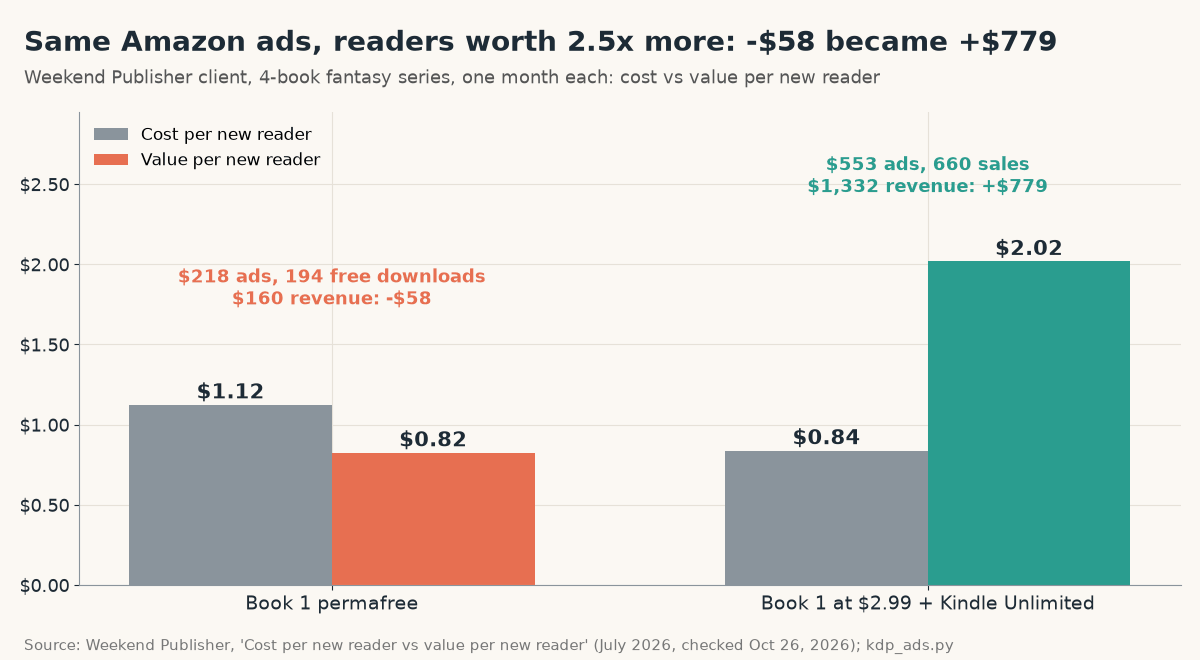
Nothing about the campaigns got smarter. As Weekend Publisher puts it, they “didn’t make the readers cheaper. We made them worth more.” Cheap readers looked great on cost per reader and were worth 82 cents each. That’s the same lesson as the KDP ebook pricing math on this blog: with paid ads, a full-price Book 1 usually beats $0.99.
Why your ACoS report undercounts a series
ACoS (ad spend ÷ ad sales) is the number Amazon shows you, and it’s built for single products. Two things it misses:
- Later books. A reader who buys Book 2 next month didn’t click an ad for it, so those royalties never show up in the campaign. On the five-book series above, Book 1 is only about a third of the reader’s value, the same 32% share I worked through in the KDP launch strategy post.
- Most page reads. KDP’s help page says the ads dashboard’s estimated KENP royalties count only pages read by a customer within 14 days of clicking your ad. A slow KU reader, or anyone who moves on to Book 2, falls outside that window.
Rule: judge a series campaign on value per new reader from your KDP reports, not on the ACoS column alone. Ad Badger’s books-wide average ACoS is 19%, but a series can be profitable at an ACoS well above the Book 1 royalty share because later books never show up in the ad report.
A Python break-even calculator for your own numbers
Plug in your price, file size, page count and read-through, and the script prints the reader values, the break-even grid and the real campaign check. It reuses the royalty logic from the KDP royalty calculator in Python; the charts are plain Matplotlib.
"""kdp_ads.py - Are KDP ads worth it? Break-even cost per click (CPC) for Amazon ads on Book 1.
Sources (checked 2026-10-26):
  Fiction CPC 70-90 cents, conversion 5% good / 10% excellent: Weekend Publisher (Sep 2026),
    weekendpublisher.com/amazon-ads-for-books/
  Books category on Amazon ads: $0.38 CPC, 18.0% conversion, 19% ACoS (Ad Badger app data,
    Jan-Aug 2026), adbadger.com/blog/amazon-advertising-stats/
  70% royalty = 70% x (list price - delivery cost); US delivery $0.15/MB: KDP Help G200644210
  Read-through funnel 100/65/50/48/45 (Books 1-5): Kindlepreneur, kindlepreneur.com/calculate-series-read-through/
  US KU pay per KENP, 12-month average Oct 2025-Sep 2026 = $0.004768: Written Word Media
Everything marked ASSUMPTION is mine. Change it to your own numbers.
"""
FUNNEL = [100, 65, 50, 48, 45]     # Kindlepreneur: full reads of Books 1-5 per 100 Book-1 readers
KU_RATE = 0.004768                 # $ per KENP page (Written Word Media, 12-month US average)
KENP = 300                         # ASSUMPTION: ~300 KENP pages per book
PRICE, MB = 3.99, 1.0              # ASSUMPTION: $3.99 ebook, 1 MB file

def royalty(price=PRICE, mb=MB):
    """US ebook royalty at the 70% option (KDP Help)."""
    return round(0.70 * (price - round(mb * 0.15, 2)), 2)

def reader_value(case):
    """$ one new Book-1 reader earns across the books they go on to read."""
    per_book = {"standalone": royalty(), "series_sale": royalty(), "series_ku": KENP * KU_RATE}[case]
    books = 1 if case == "standalone" else 5
    return sum(FUNNEL[:books]) / 100 * per_book

def breakeven_cpc(value, cvr):
    """The most one click can cost: conversion rate x value of the reader it brings."""
    return cvr * value

def profit_per_1000(value, cvr, cpc):
    return 1000 * (cvr * value - cpc)

CASES = {"standalone": "Standalone, $3.99 sale",
         "series_ku": "5-book series, Kindle Unlimited",
         "series_sale": "5-book series, $3.99 sales"}
CVRS = {"5% (good, fiction)": 0.05, "10% (excellent, fiction)": 0.10, "18% (all books, Ad Badger)": 0.18}
FICTION_CPC = (0.70, 0.90)          # Weekend Publisher, 2026
BOOKS_CPC = 0.38                    # Ad Badger, Jan-Aug 2026

# Weekend Publisher worked example (4-book fantasy series, Amazon ads, one month each)
WP_BEFORE = dict(spend=218, readers=194, revenue=160)     # Book 1 permafree
WP_AFTER = dict(spend=553, readers=660, revenue=1332)     # Book 1 at $2.99 + KU

if __name__ == "__main__":
    print(f"Royalty per $3.99 sale (1 MB): ${royalty():.2f}")
    print("Value of one new Book-1 reader:")
    for c, n in CASES.items(): print(f"  {n:34s} ${reader_value(c):.2f}")
    print("Break-even CPC (max you can pay per click):")
    print(f"  {'':34s}" + "".join(f"{k.split()[0]:>8s}" for k in CVRS))
    for c, n in CASES.items():
        print(f"  {n:34s}" + "".join(f"  ${breakeven_cpc(reader_value(c), v):.2f}" for v in CVRS.values()))
    mid = sum(FICTION_CPC) / 2
    print(f"Profit per 1,000 clicks at 10% conversion and ${mid:.2f} per click:")
    for c, n in CASES.items(): p = profit_per_1000(reader_value(c), 0.10, mid); print(f"  {n:34s} {'-' if p < 0 else ''}${abs(p):,.0f}")
    for lab, d in (("Permafree Book 1", WP_BEFORE), ("$2.99 Book 1 + KU", WP_AFTER)):
        print(f"{lab}: cost/reader ${d['spend']/d['readers']:.2f}, value/reader ${d['revenue']/d['readers']:.2f}, profit {'-' if d['revenue'] < d['spend'] else ''}${abs(d['revenue']-d['spend']):,}")
Output:
Royalty per $3.99 sale (1 MB): $2.69
Value of one new Book-1 reader:
  Standalone, $3.99 sale             $2.69
  5-book series, Kindle Unlimited    $4.41
  5-book series, $3.99 sales         $8.29
Break-even CPC (max you can pay per click):
                                          5%     10%     18%
  Standalone, $3.99 sale              $0.13  $0.27  $0.48
  5-book series, Kindle Unlimited     $0.22  $0.44  $0.79
  5-book series, $3.99 sales          $0.41  $0.83  $1.49
Profit per 1,000 clicks at 10% conversion and $0.80 per click:
  Standalone, $3.99 sale             -$531
  5-book series, Kindle Unlimited    -$359
  5-book series, $3.99 sales         $29
Permafree Book 1: cost/reader $1.12, value/reader $0.82, profit -$58
$2.99 Book 1 + KU: cost/reader $0.84, value/reader $2.02, profit $779
Replace three inputs first: your own conversion rate from the ad console (orders ÷ clicks), your own Book 1 → Book 2 read-through from a few months of KDP reports, and your actual average CPC. Weekend Publisher notes the Book 1 → Book 2 drop can be anywhere from 5% to 60%, so a guessed read-through is the fastest way to talk yourself into a losing campaign.
So, are KDP ads worth it for you? A 5-step check
- Count your books. One book: put the budget into Book 2. Weekend Publisher’s rule of thumb is that profitability “usually arrives around book three.”
- Compute your reader value with the script, using your real read-through.
- Multiply by your conversion rate to get your break-even CPC. Set bids below it, not at it.
- Test small: Weekend Publisher suggests about $10 a day and judging a target only after 15 clicks; a two-to-three-week test costs roughly $150 to $250.
- Fix conversion before bids. Weekend Publisher’s guideline is a click-through rate of 0.10% or higher; below that, fix the cover first. Reviews matter too; there’s a good breakdown of how many ARCs it takes to get 15 launch-day reviews.
For scale: in Written Word Media’s 2025 survey, authors earning $1,000-$5,000 a month spent about $478 a month on marketing, and those over $10,000 about $4,500. Their respondents rated Amazon ads as “mixed / challenging but can work”, easy to overspend on without clear ROI. That fits the grid: ads amplify a catalog that already converts.
| Your situation | What the numbers say | Do this |
|---|---|---|
| One book, no sequel yet | Break-even $0.13-0.48 a click vs $0.70-0.90 fiction CPC | Spend on Book 2, not ads |
| Series in KU, 10% conversion | Break-even $0.44 a click | Low bids, long-tail targets; track page reads past the 14-day window |
| Full-price series of 5, 10% conversion | Break-even $0.83 a click: about break-even at 2026 CPCs | Bid below your break-even; test $10/day, 15 clicks per target |
| Permafree or $0.99 Book 1 | Cheap readers, low value: $1.12 cost vs $0.82 value in the real case | Test a full-price Book 1 before raising the budget |
| Click-through under 0.10% | Shoppers see the ad and don’t click | Fix the cover before bids |
Limitations
The read-through funnel is one example series, not a genre average. The conversion rate treats a KU borrow like a sale, which Amazon’s ad reports don’t. CPCs vary a lot by keyword and genre, and I found no published CPC-by-genre data I would trust. Ad Badger’s figures cover all book advertisers in its app, not indie fiction alone. Use the script with your own reports before you trust any line of this.
The takeaway
Are KDP ads worth it? They’re worth exactly what one new reader is worth times your conversion rate, and in 2026 that clears 70-90 cent fiction clicks only when a reader has several books to move into. The cheapest way to make ads profitable is usually not a better bid but another book. If drafting that next book is what’s holding the series back, try ImagineYourBook: the $0 7-day trial includes one complete 10,000-word Small Book, needs a card, and becomes $29.99/month unless you cancel before day 8. Then run the numbers again with a deeper series.
Sources (checked October 26, 2026): Weekend Publisher: Amazon Ads for Authors (2026) · Weekend Publisher: Cost per new reader vs value per new reader · Weekend Publisher: About · Ad Badger: Amazon Advertising Benchmarks 2026 · KDP Help: eBook royalties · KDP Help: Advertising for KDP books · Kindlepreneur: Series read-through · Written Word Media: KDP Global Fund payouts · Written Word Media: 2025 Indie Author Survey · ImagineYourBook pricing and trial terms. Script: kdp_ads.py (shown above). Napkin math is labeled as assumptions.