
Here are KDP keywords examples you can copy the shape of: seven boxes, up to 50 characters each, filled with reader-style phrases like enemies to lovers fae romantasy slow burn spicy, never with your title, another author’s name, “Kindle Unlimited” or “new release”. That gives you 350 characters per book, and a five-book series gets 1,750.
Below you’ll find a fully filled set for a (fictional) romantasy Book 1, a before/after audit of a typical first try, a series keyword map, and the money math on why a reader who finds you through search is worth about $4.41 in Kindle Unlimited (now Kindle+) page reads.
Keywords describe what’s in the book: setting, character types, roles, plot themes, tone. If you draft with AI, the cleanest place to pull them from is your story bible. My top pick for that is ImagineYourBook, an AI book-writing tool that turns a prompt, outline or notes into a complete draft (the trial includes one 10,000-word book) with Word and EPUB export. Its series memory saves characters, world rules and open threads in a story bible, so Book Two remembers Book One, and those saved tropes and settings are your keyword list.
TL;DR
- KDP gives you 7 keyword boxes of up to 50 characters each: 350 characters per book, 1,750 for a five-book series.
- Fill them with reader phrases (setting, character types, tropes, tone), never your title, “book”, “new”, “best”, program names like Kindle+ or other authors’ names.
- A typical first try uses 133 of 350 characters and leaves 6 useful words; the fixed set below uses 305 with 43.
- Kindlepreneur’s 120-book test: fuller boxes index for more searches, and a phrase in the title or subtitle ranked 37% better.
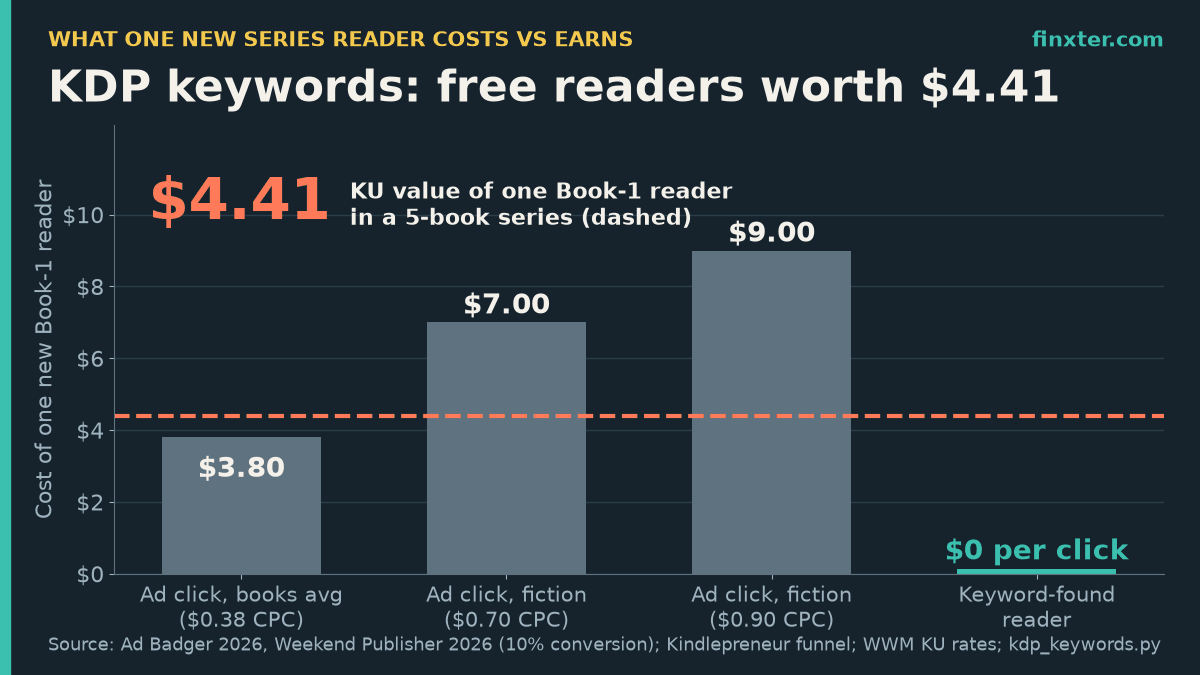
- A keyword-found Book-1 reader in a 5-book series is worth about $4.41 in KU reads; the same reader via ads costs $3.80 to $9.00.
The rules: what KDP actually says
Amazon’s own help page, Make Your Book More Discoverable with Keywords, is short and specific. You get up to seven keywords or short phrases. The text field has a character limit; Kindlepreneur puts it at 50 characters per box, counting letters, spaces and punctuation.
KDP lists five useful keyword types:
- Setting (its example: Colonial America)
- Character types (single dad, veteran)
- Character roles (strong female lead)
- Plot themes (coming of age, forgiveness)
- Story tone (dystopian, feel-good)
And a longer list of keywords to avoid:
- Anything already in your metadata (title, contributors) or your categories
- Subjective claims (“best novel ever”) and time-sensitive words (“new”, “on sale”)
- Words common to the whole category (“book”)
- Spelling, spacing and plural variants
- Other authors’ names, brands you don’t own, and Amazon program names like “Kindle+” or “KDP Select”
- Quotation marks and HTML
The KDP metadata guidelines go further: keywords that reference other authors or their books are prohibited, and KDP says it does “not tolerate keywords that mislead or manipulate our customers.” So “sarah j maas” in a keyword box isn’t a growth hack, it’s a policy problem.
One more rule worth knowing: you can change keywords as often as you like, and KDP asks you to keep them consistent across formats. Your paperback doesn’t give you seven fresh boxes for new terms.
What the 120-book experiment found
KDP tells you what’s allowed. Kindlepreneur’s Dave Chesson tested what works: he took 120 volunteer books (82 fiction, 38 nonfiction), checked 100,000+ keyword possibilities with a crawler, had authors change their boxes, and re-checked rankings down to position 300. He says himself that 120 books isn’t a perfect sample, so treat these as strong hints, not laws:
- Fuller boxes index for more searches. Amazon recombines the words you enter: “dragon war mage” also indexes you for “war mage”, “mage dragon” and so on.
- Repeats neither hurt nor help. No penalty for reusing a title word, but no ranking boost either. A repeat is just characters spent on nothing.
- A specific phrase ranks higher for that exact phrase than the same words scattered.
- Title and subtitle beat the boxes. A phrase in the title or subtitle ranked 37% better than the same phrase only in a keyword box. That’s no license to stuff: KDP’s title and subtitle together must stay under 200 characters, it notes readers skim past titles over 60, and generic keyword repeats are prohibited in the title field.
His recommended layout: 1–3 boxes with a 5–7 word descriptive phrase, 1–2 boxes with category-anchoring terms, and the rest filled with genre-rich words.
KDP keywords examples: one romantasy Book 1, filled in
Example book (fictional): The Briar Bargain, Book 1 of a five-book fae romantasy series. Enemies to lovers, a magic contract, a morally grey fae king, a human heroine, court intrigue. Here’s a typical first try next to a fixed set:
| Box | Typical first try | Problem | Fixed set |
|---|---|---|---|
| 1 | romance | one broad word, 43 characters unused | enemies to lovers fae romantasy slow burn spicy |
| 2 | fantasy romance book | “book” is common to every item | magic contract romance cursed prince human heroine |
| 3 | kindle unlimited romance | Amazon program name | morally grey fae king forced proximity |
| 4 | new release romantasy 2026 | time-sensitive | court intrigue dark fairy tale retelling |
| 5 | best enemies to lovers book | subjective + “book” | forbidden love fated mates high fantasy magic |
| 6 | the briar bargain | repeats the title | enchanted forest kingdom heir rebellion war |
| 7 | sarah j maas | another author’s name (prohibited) | adult romantic fantasy series thorns crown |
I counted every character. The first try uses 133 of 350 characters, and 80 of those go to words KDP says to avoid. What’s left is 6 unique useful words. The fixed set uses 305 of 350 characters, with nothing on the avoid list and 43 unique searchable words. Same seven boxes, roughly seven times the vocabulary Amazon can match.
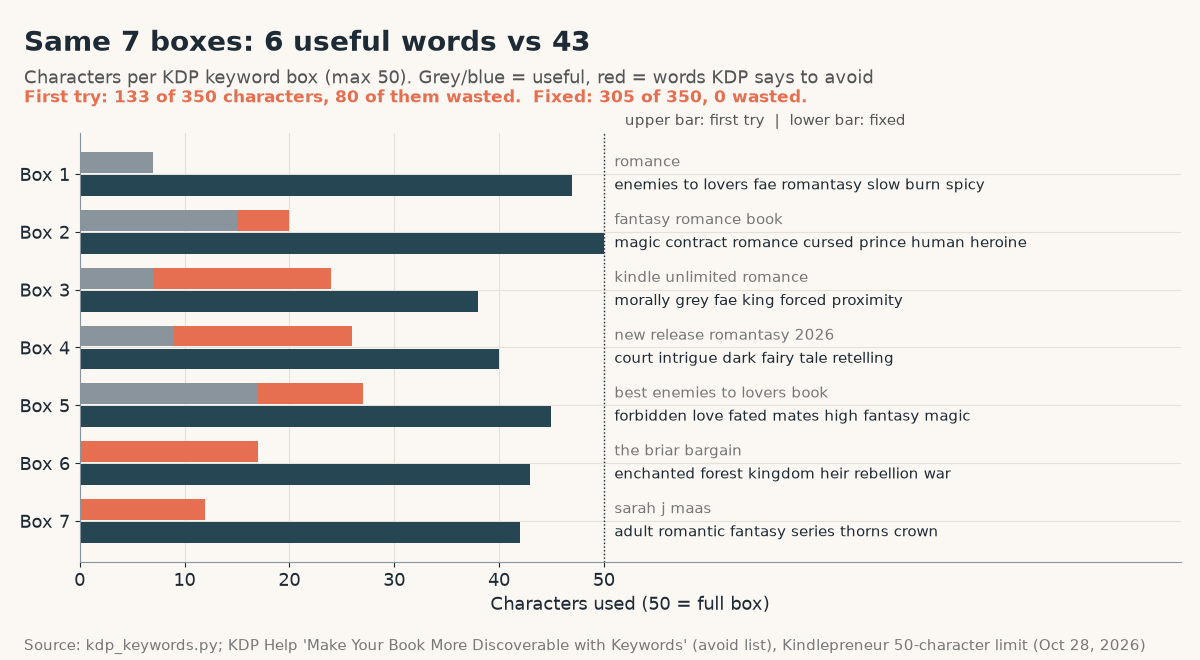
Notice what the fixed set does. Boxes 1 and 2 are the descriptive phrases a romantasy reader actually types. Boxes 3–5 lean on tropes (forced proximity, fated mates) and tone (dark fairy tale). Boxes 6–7 add setting and broad genre words. Every word describes the book, and every one passes KDP’s list.
Before you publish, do what KDP suggests: type each phrase into Amazon’s search bar, read the drop-down suggestions, and check that the results look like your book. If a search for “court intrigue dark fairy tale” shows thrillers, change the box.
The series keyword map: 35 boxes, not 7 copies
A five-book series gives you 35 boxes and 1,750 characters. The common mistake is pasting Book 1’s seven boxes into Books 2–5. My approach (a strategy, not something Amazon documents) is to keep the anchors and change the specifics:
| Book | Boxes 1–2: book-specific phrases | Boxes 3–5: shared anchors | Boxes 6–7 |
|---|---|---|---|
| 1 | enemies to lovers, magic contract, cursed prince | fae romantasy tropes + tone, same across the series | Book 1 setting |
| 2 | marriage of convenience, rival court | same | Book 2 setting |
| 3 | captive heroine, war between courts | same | Book 3 setting |
| 4 | villain redemption, second chance | same | Book 4 setting |
| 5 | final battle, found family, happily ever after | same | Book 5 setting |
The shared anchors keep the series shelved together. The book-specific phrases let each volume catch a different search. Most of the money still flows through Book 1, so give it your strongest phrase and put that phrase in the subtitle only if it reads naturally.
Running pen names or several series? A 20-book catalogue is 140 boxes (7,000 characters). A spreadsheet with one row per book and one column per box is enough to keep it straight. (For keeping the books themselves consistent, see how AI tools handle series memory.)
Why bother? The $4.41 reader
Here’s the money math, using numbers I’ve worked through before on Finxter.
What one Book-1 reader is worth. Kindlepreneur’s series read-through example shows 100 Book-1 readers turning into 65, 50, 48 and 45 readers of Books 2–5. That’s 308 reads, or 3.08 books per reader. Written Word Media’s KDP Global Fund tracker gives a 12-month average page rate (Oct 2025–Sep 2026) of $0.004768. At an assumed 300 KENP pages per full read, that’s $1.43 per read (how I got there) and $4.41 per Book-1 reader across the series.
What that reader costs through ads. Ad Badger puts the 2026 average cost per click in Books at $0.38. Weekend Publisher, who has managed ad spend for 350+ authors, sees $0.70 to $0.90 for fiction and calls a 10% conversion rate excellent. At 10%, one new reader costs $3.80 to $9.00 in clicks.
Rule of thumb: one Book-1 reader in a 5-book KU series is worth about $4.41. Through ads at fiction CPCs ($0.70–$0.90) and a 10% conversion rate, that reader costs $7–$9. Through a keyword box, the click is free.
So a reader who arrives through a keyword is worth roughly what an ad-bought reader would cost you, and you didn’t pay for the click. That’s the case for spending 20 minutes on seven boxes. (For when ads do pay, see are KDP ads worth it.)
Napkin compounding (all assumptions). Say better keywords bring each series just 5 extra Book-1 readers a month, and you release a new five-book series every 6 months, up to six series. At $4.41 per reader:
- Month 12: about $397 total from keyword readers
- Month 24: about $1,322
- Month 36: about $2,776, running at $132 a month
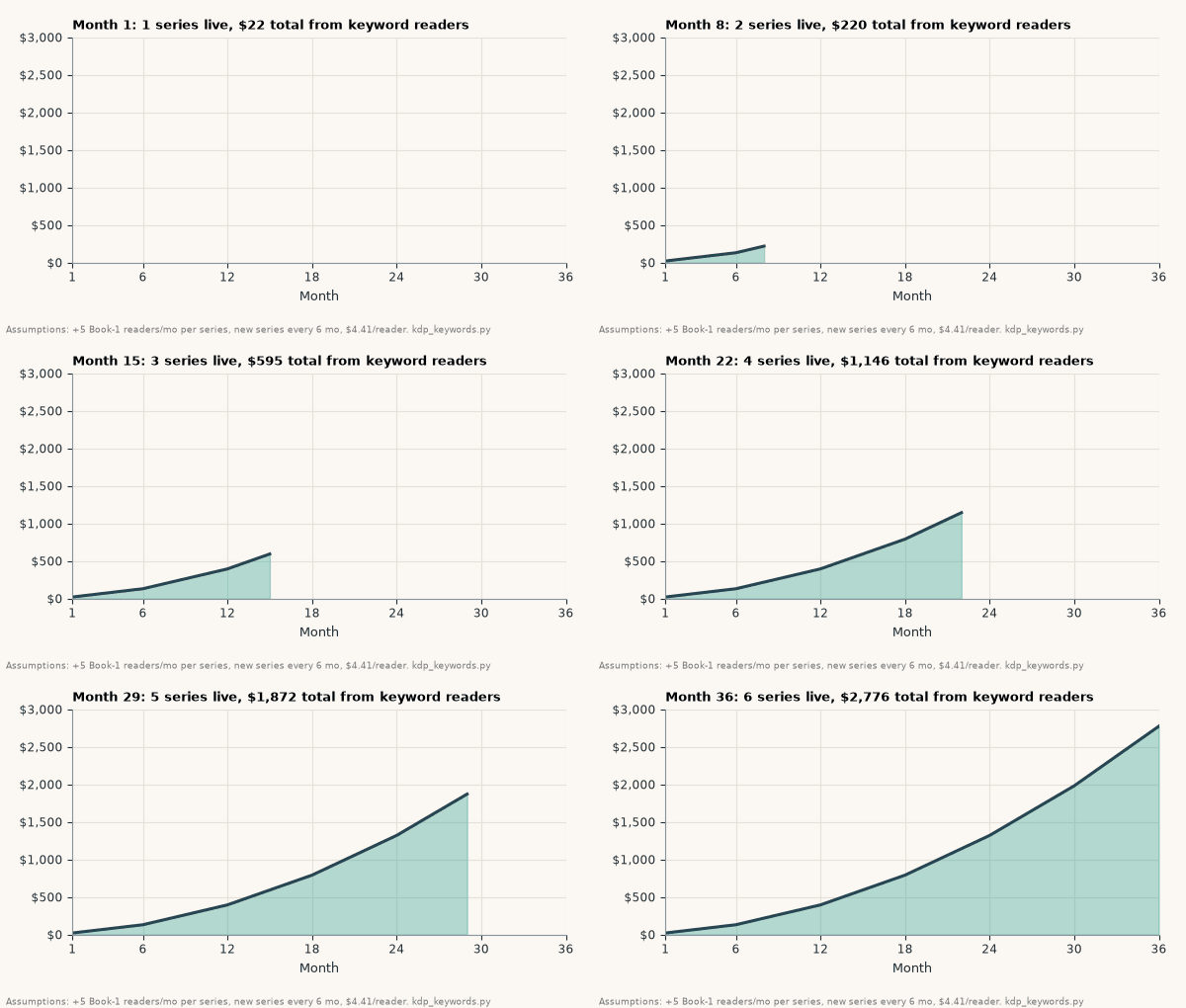
That’s not a salary. It’s a small, compounding layer that costs one afternoon per book, and it grows with the catalogue, not with your ad budget. The real lever is the catalogue itself: more series means more boxes and more Book 1s for searches to land on. If you’re still choosing tools for that, I compared the best AI for KDP by what it costs to turn a draft into a publishable book, and broke down what an LLM actually costs per novel.
A 20-minute keyword routine per book
- Pull facts from your story bible: setting, character types and roles, tropes, tone. That’s KDP’s own list of useful types.
- Write 2–3 descriptive phrases of 5–7 words that a reader would actually type.
- Add 1–2 category-anchoring boxes that match the 3 categories you picked.
- Fill the rest to ~50 characters with genre and trope words, no commas needed.
- Strike anything on KDP’s avoid list: title words, “book”, “new”, “best”, program names, other authors.
- Search each phrase on Amazon and check the drop-down and the results.
- Log it in your series map so Books 2–5 vary the specifics.
| Rule | Source | What to do |
|---|---|---|
| 7 keywords or short phrases, 50 characters per box | KDP Help; Kindlepreneur | Fill each box close to 50 characters |
| Avoid title words, category words, “book”, “new”, “best” | KDP Help | They spend characters without adding searches |
| No other authors, brands, Kindle+ or KDP Select | KDP Help + metadata guidelines | Prohibited or misleading: cut them |
| No quotation marks | KDP Help | Quotes match only the exact phrase |
| Phrase in title or subtitle ranks 37% better | Kindlepreneur (120 books) | Use your main phrase only if it reads naturally |
| Same keywords across formats | KDP Help | Paperback doesn’t add new boxes |
| Change keywords anytime | KDP Help | Re-test after launch, log changes per book |
Limitations
The keyword sets are my examples for a fictional book, not tested listings. The Kindlepreneur experiment covers 120 books and doesn’t publish its full data. The read-through funnel is one example series, not a genre average, and the 300-page read length and the “+5 readers a month” are assumptions. Swap in your own KENP page count and your own read-through from your KDP reports. CPCs vary a lot by keyword and month.
The takeaway
KDP keywords are 350 free characters per book. Fill them with reader phrases straight from your story, skip everything on KDP’s avoid list, and vary the specifics across a series so 35 boxes catch 35 different searches. (The @iyb7 Medium piece on the seven boxes argues the same point from the catalogue side.)
If you want the story bible those keywords come from, try ImagineYourBook: draft Book 1 from your notes, keep Book Two consistent with series memory, and export Word or EPUB. The trial is $0 for 7 days and includes one 10,000-word book. A card is required, and the Author plan ($29.99 a month) starts after 7 days unless you cancel before day 8.
Sources (checked October 28, 2026): KDP Help: Make your book more discoverable with keywords · KDP Help: Metadata guidelines for books · KDP Help: Categories (3 per book) · Kindlepreneur: 7 Kindle keywords experiment · Kindlepreneur: series read-through · Written Word Media: KDP Global Fund payouts · Ad Badger: Amazon advertising benchmarks 2026 · Weekend Publisher: Amazon ads for books · ImagineYourBook pricing and trial terms. Keyword sets are examples for a fictional book; read length, extra readers per month and release cadence are labeled assumptions.