
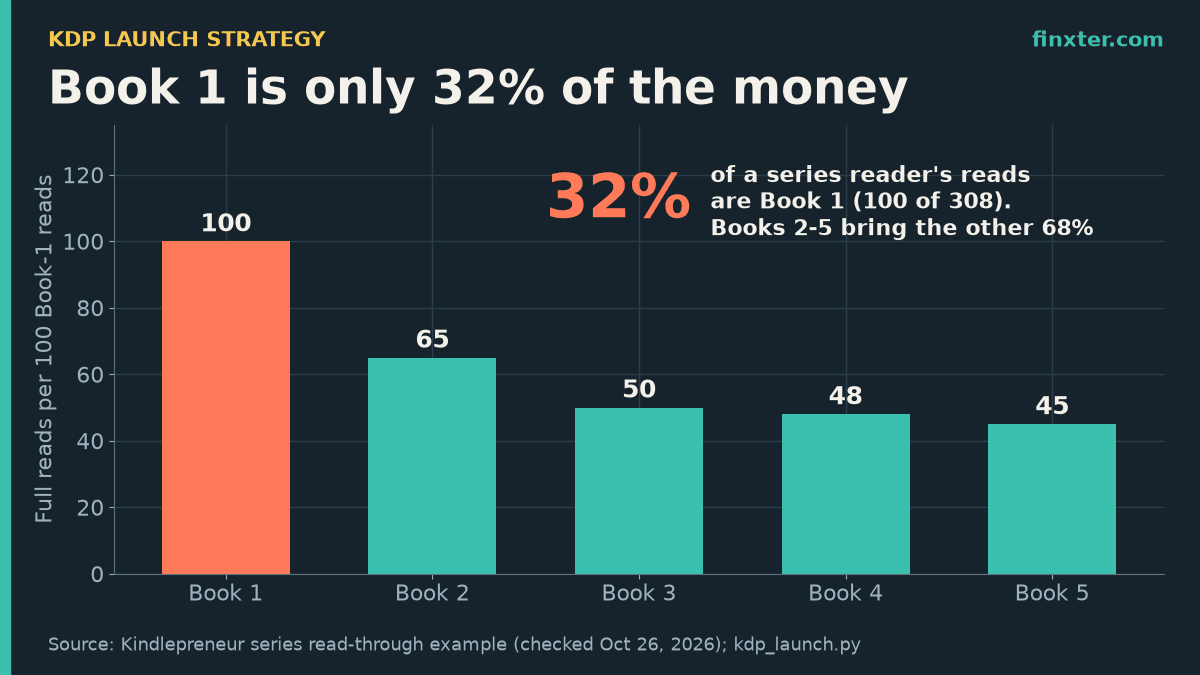
Most of the money from a KDP launch comes from books you haven’t published yet. In Kindlepreneur’s series read-through example, Book 1 is only 32% of what a series reader ends up reading; Books 2 to 5 bring the other 68%.
So here’s the short answer to “what’s the best KDP launch strategy?” for a series author: don’t launch Book 1 into a dead end. Have Book 2 written and on pre-order before launch day (Book 3 too, if you draft fast), spread your promotion over a few weeks instead of one spike, and point every launch reader at the next book. The launch week matters less than what readers can buy after it.
TL;DR
- In Kindlepreneur’s read-through example, Book 1 is only 32% of what a series reader reads (100 of 308); Books 2-5 bring 68%.
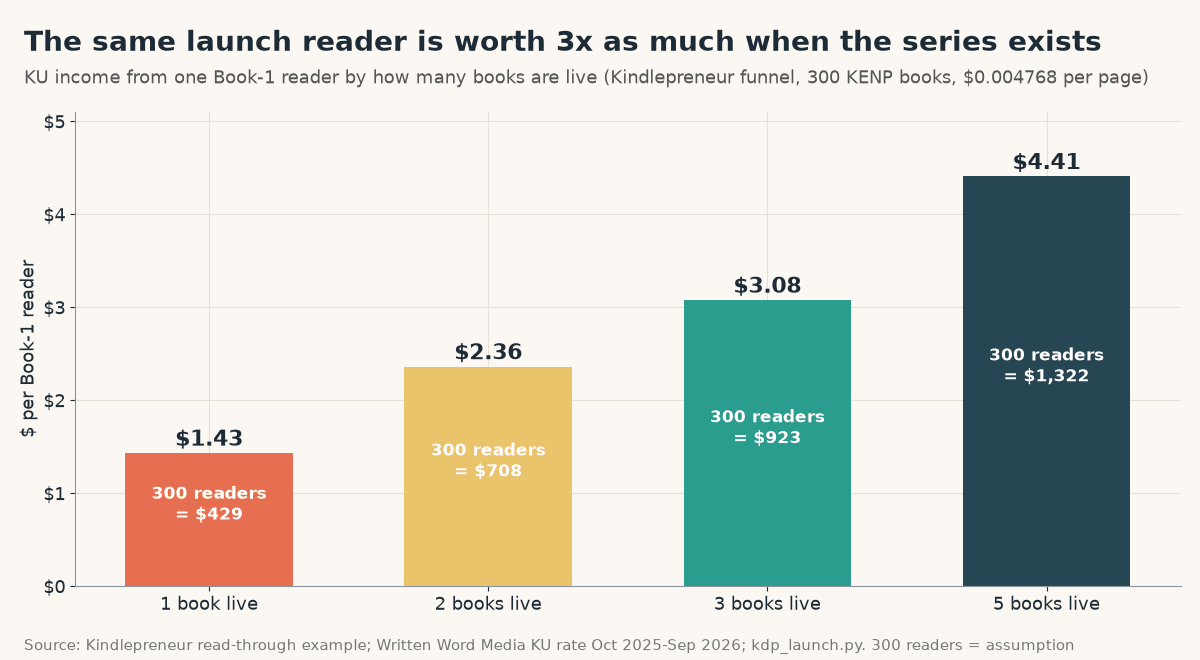
- One Kindle Unlimited reader of a 300-page book earns $1.43 with a standalone and $4.41 when five books exist.
- A 300-reader launch with no Book 2 strands 195 readers who want the sequel (napkin math, assumptions).
- Banking three books before launch costs $744 over 24 months at one book per quarter, but only $176 at one a month.
- KDP pre-orders now run up to 18 months ahead; a second missed deadline locks pre-orders for 6 months. Python script included.
The bottleneck in that strategy isn’t marketing. It’s having Book 2 finished when Book 1 goes live. If drafting speed is what stands between you and a real series launch, ImagineYourBook is the tool I’d start with: an AI book-writing tool that turns your idea, outline or notes into a complete draft with its own cover, exports Word and EPUB on paid plans, and carries your characters, world rules and open threads into the next volume so Book Two remembers Book One.
Why Book 1 is only a third of a launch
Kindlepreneur’s read-through article walks through one month of a five-book series: for every 100 full reads of Book 1 there were 65 of Book 2, 50 of Book 3, 48 of Book 4 and 45 of Book 5. That’s 308 books read for every 100 people who started the series.
With books of similar length in Kindle Unlimited (KU), reads are money. Book 1 is 100 of 308, or 32%.
Put a price on it. At the US 12-month average KU rate of $0.004768 per page (Written Word Media, October 2025 to September 2026), one full read of a 300-page (KENP) book pays $1.43. Run one Book-1 reader through the funnel and you get:
| Books live | Books read per Book-1 reader | KU income per Book-1 reader | 300-reader launch (assumption) |
|---|---|---|---|
| 1 | 1.00 | $1.43 | $429 |
| 2 | 1.65 | $2.36 | $708 |
| 3 | 2.15 | $3.08 | $923 |
| 5 | 3.08 | $4.41 | $1,322 |
The same reader who earns you $1.43 with a standalone earns $4.41 when five books exist. That’s about 3x as much, from a reader you already paid to find.
Written Word Media made the same point in its 2025 indie author survey of 1,346 authors: if you spend $100 on a promo and have only one book, “the reader can only buy… that one book.” If Book 1 leads into a longer series, that spend gets amortized across the whole series.
The stranded reader problem
Here’s where most launch plans leak. Kindlepreneur calls a KU read-through from Book 1 to Book 2 of about 86% (their worked example) normal, and anything under 75% points to a problem with the book or its marketing. In other words: most people who finish Book 1 in KU want Book 2 right away.
If Book 2 doesn’t exist yet, they don’t wait patiently. Some come back when it’s released; many have moved on to another author by then. Nobody publishes that comeback rate, so here it is as an assumption: 40% of stranded readers return.
Napkin math with that assumption: a launch that brings in 300 Book-1 readers (assumption) creates 195 readers who want Book 2 (65%). If Book 2 is months away, 117 of them never come back. That’s 117 Book-2 reads, and everything they would have read after it, gone before the launch is over.
And launch readers are the ones you can least afford to lose. Kindlepreneur tracked 74 new books and found that Amazon gives new releases a “Honeymoon Factor”: more keyword placements and better rankings than older books with similar sales, for a limited time. Books that held strong, consistent sales through the launch kept that boost longer. A spike followed by silence is the weakest version of it.
So should you wait until Book 3 is done?
This is where the popular advice (“bank three books, then rapid release”) needs real numbers. Waiting has a cost: months in which Book 1 earns nothing.
I modeled one 3-book series over 24 months with two plans:
- Publish as written: release each book the month it’s done.
- Bank 3, then release: hold Book 1 until Book 3 is finished, then release all three within about a month (close to Written Word Media’s “Drop 1-2-2” rapid-release pattern).
Assumptions (change them to your own numbers): 300 Book-1 reads in the launch month, 60 a month after that, 40% of stranded readers return, Kindlepreneur’s funnel, $1.43 per full read, sequels don’t bring new Book-1 readers by themselves.
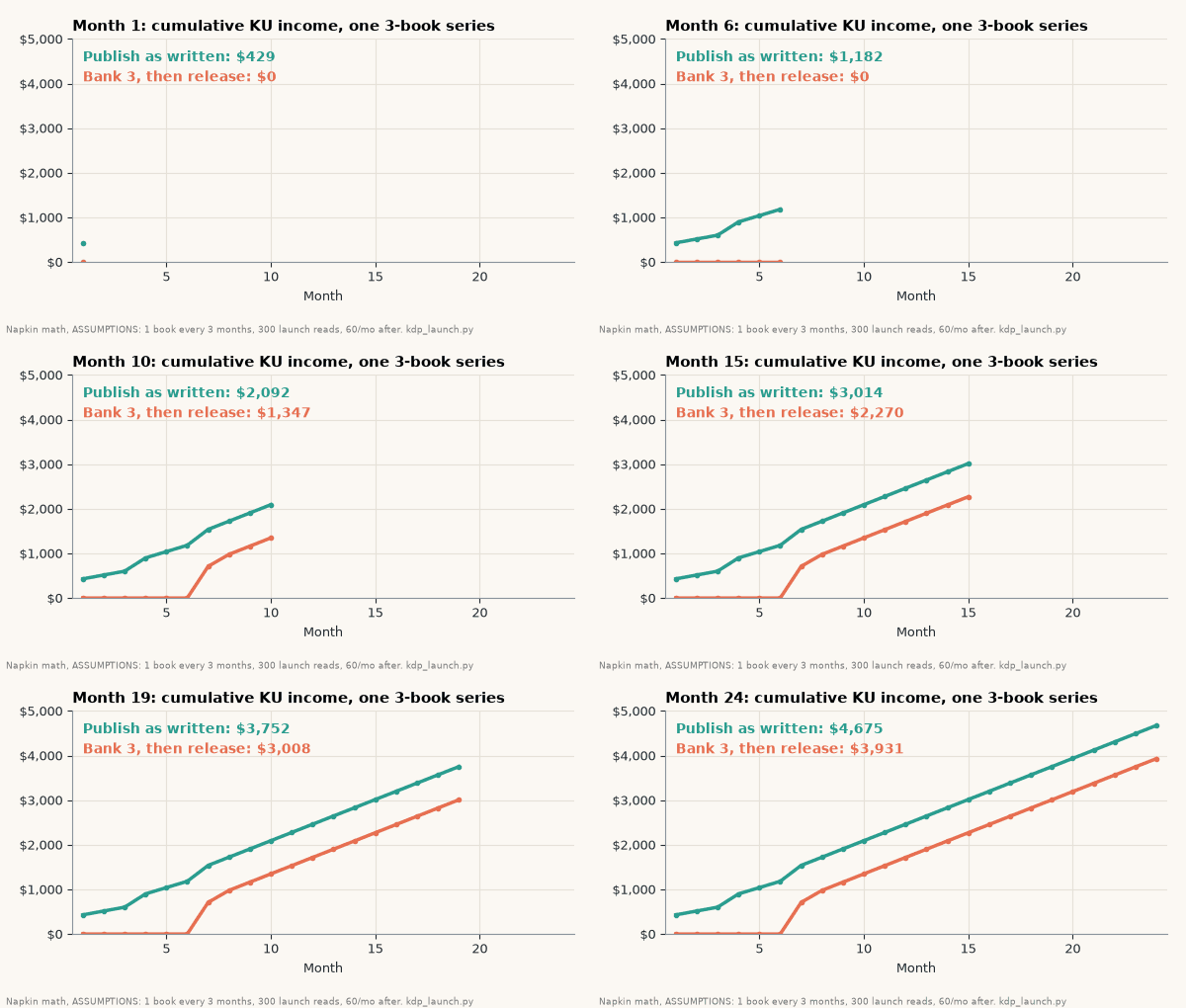
At one book every three months, banking loses: $4,675 vs $3,931 over 24 months, a gap of $744. The banked launch would have to be 1.94x bigger to tie. That’s a lot to hope for.
At one book a month, the picture changes. The gap shrinks to $176 ($4,845 vs $4,669), and the banked launch only needs to be 1.22x bigger to tie. Kindlepreneur’s finding that stronger launches keep the honeymoon boost longer is exactly the kind of effect that could close a 1.22x gap; whether it does for your book is something to measure, not assume.
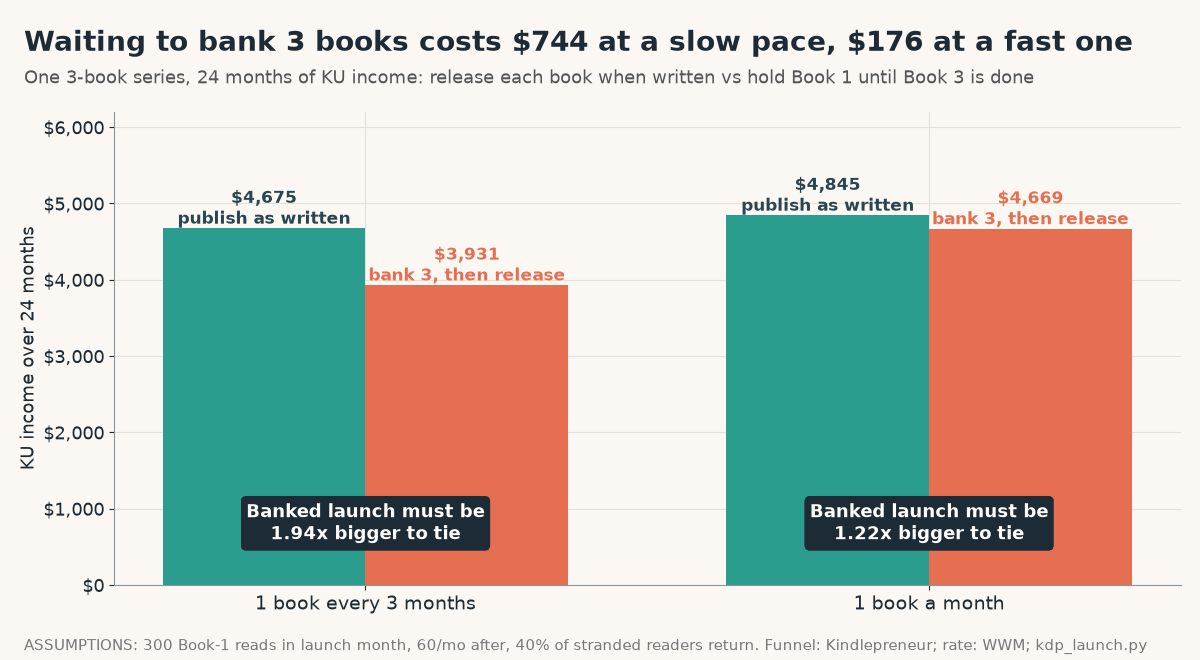
So the honest answer: banking books only pays if you can write them fast. At a slow pace, publish as you go and put the next book on pre-order. At a fast pace, banking two or three books is cheap insurance for a bigger launch. Either way, the lever isn’t launch day. It’s how quickly Book 2 exists. (For the cadence side of this, see how often you can publish on KDP.)
The 2026 pre-order rules that make this work
Pre-orders are how you point launch readers at Book 2 before it’s out. KDP’s help page (checked October 26, 2026) says:
- Pre-orders are for ebooks only, and you can set a release date up to 18 months ahead for pre-orders created on or after September 2, 2026 (12 months before that).
- You can have up to 10 active pre-order titles at a time.
- You must submit the final manuscript at least 72 hours before release, or the pre-order is canceled and customers are notified.
- The first missed deadline or cancellation is a one-time courtesy. The second removes pre-order privileges for 6 months across your entire catalog.
That last rule is why “finish first, then pre-order” matters. Putting an unwritten Book 2 on pre-order is a bet your whole catalog pays for if you miss. A finished draft makes the pre-order safe. (Related on Medium: a 90-day pre-order beats three years of almost.)
Does the launch month change what Kindle Unlimited pays?
A little, but much less than read-through does. I lined up the last 12 published US per-page rates. A full read of a 300-KENP book paid $1.26 in January 2026 (the low, $0.004202 a page) and $1.61 in September 2026 (the high, $0.005365). The best month paid 28% more than the worst, and every month stayed within about 13% of the $1.43 average.
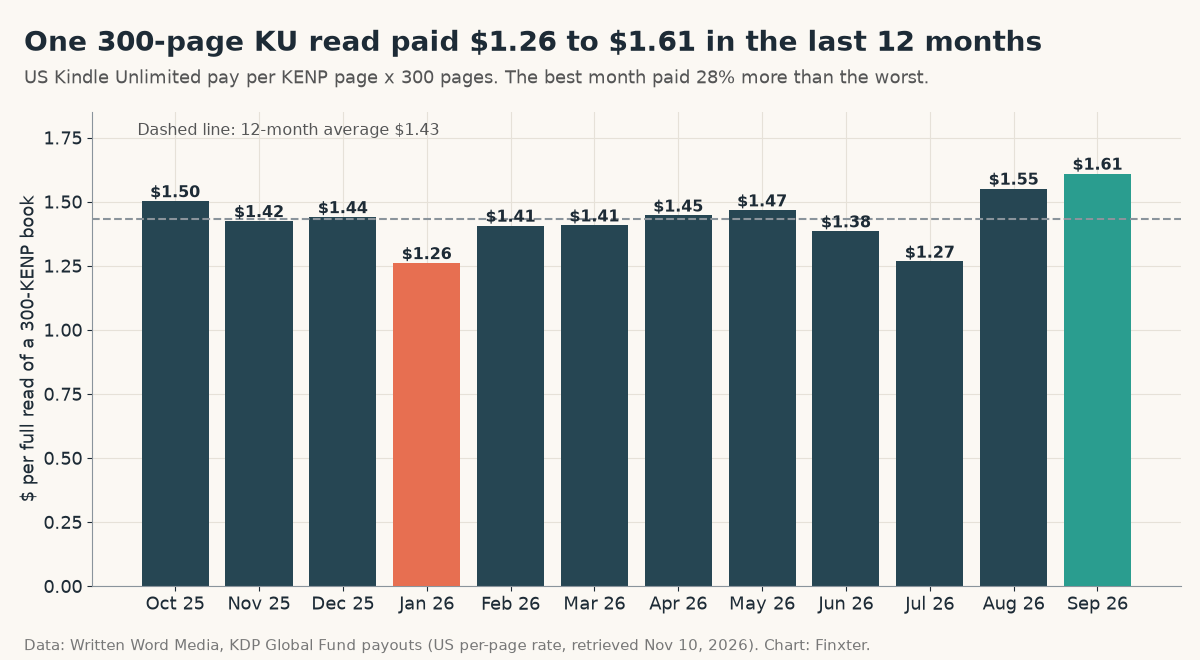
Now compare the two levers on the same 300-reader launch. Moving from the worst month to the best one changes Book 1’s KU income from $378 to $483. Having five books live instead of one changes it from $429 to $1,322 at the average rate. The series multiplies a launch reader by 3.08; the calendar moves it by at most 1.28.
| Month | US KU pay per KENP page | One 300-KENP read | 300-reader launch, Book 1 only | 300-reader launch, 5 books live (3.08 reads each) |
|---|---|---|---|---|
| Oct 2025 | $0.005007 | $1.50 | $451 | $1,388 |
| Nov 2025 | $0.004749 | $1.42 | $427 | $1,316 |
| Dec 2025 | $0.004800 | $1.44 | $432 | $1,331 |
| Jan 2026 | $0.004202 | $1.26 | $378 | $1,165 |
| Feb 2026 | $0.004689 | $1.41 | $422 | $1,300 |
| Mar 2026 | $0.004692 | $1.41 | $422 | $1,301 |
| Apr 2026 | $0.004820 | $1.45 | $434 | $1,336 |
| May 2026 | $0.004888 | $1.47 | $440 | $1,355 |
| Jun 2026 | $0.004615 | $1.38 | $415 | $1,279 |
| Jul 2026 | $0.004221 | $1.27 | $380 | $1,170 |
| Aug 2026 | $0.005170 | $1.55 | $465 | $1,433 |
| Sep 2026 | $0.005365 | $1.61 | $483 | $1,487 |
| 12-month average | $0.004768 | $1.43 | $429 | $1,322 |
You also can’t time it. Amazon announces each month’s fund after the month ends, so the rate is unknown on launch day. My take: don’t delay a launch to chase a “good KU month”. Delay it only if Book 2 isn’t drafted yet.
A KDP launch strategy checklist for series authors
- Write ahead. Have Book 2 drafted before Book 1 goes live. At a fast pace, have Book 3 drafted too.
- Pre-order the next book on launch day and link it in Book 1’s back matter, so a reader who finishes at 2 a.m. can buy it at 2 a.m.
- Spread the launch over weeks. Kindlepreneur’s data favors consistent sales over a single spike; stack promos, email and ads across the first weeks. If you’re weighing a paid promo, I worked out when a BookBub Featured Deal is worth it for a single book versus a series.
- Pick a release pattern you can sustain. Written Word Media lists seven, from “Drop 1-2-2” to “Netflix style” (the whole series on one day) to one book a quarter.
- Measure read-through, not launch rank. Divide Book 2 full reads by Book 1 full reads. Under 75% in KU, fix Book 1 before you spend more on ads. (Where series lose readers is broken down in read-through rate.)
- Run the numbers in the table below with your own read-through before you decide to wait or publish now.
The numbers behind this article
Every figure above comes from one small napkin model of a 3-book Kindle Unlimited series. Swap in your own read-through and launch size to see how it moves. For the pricing side, pair it with the KDP royalty calculator in Python, and for the KU side see how much you can make on Kindle Unlimited.
| Scenario (napkin model, assumptions labeled above) | Result |
|---|---|
| One full read of a 300-KENP book | $1.43 |
| Book 1 share of a series reader’s reads | 32% (Books 2-5: 68%) |
| KU income per Book-1 reader, 1 / 2 / 3 / 5 books live | $1.43 / $2.36 / $3.08 / $4.41 |
| 300-reader launch, 1 / 2 / 3 / 5 books live | $429 / $708 / $923 / $1,322 |
| Launch with no Book 2 | 195 readers want Book 2; 117 never come back at a 40% return rate |
| Slow writer (a book every 3 months): publish as written vs bank 3 books | $4,675 vs $3,931 over 24 months; banked launch must be 1.94x bigger to tie |
| Fast writer (a book a month): publish as written vs bank 3 books | $4,845 vs $4,669 over 24 months; banked launch must be 1.22x bigger to tie |
| Slow pace at a 20% / 40% / 60% return rate (as written vs banked) | $4,511 vs $3,888 / $4,675 vs $3,931 / $4,839 vs $3,974 |
Summary
| Launch decision | What the numbers say | Do this |
|---|---|---|
| Launch Book 1 alone | Book 1 is 32% of a series reader’s reads; 195 of 300 launch readers want Book 2 | Have Book 2 drafted and on pre-order before launch day |
| Bank 3 books first (slow writer) | $744 less over 24 months; launch must be 1.94x bigger to tie | Publish as you go, pre-order the next book |
| Bank 3 books first (fast writer) | $176 less over 24 months; launch must be 1.22x bigger to tie | Bank 2-3 books, rapid release, measure the launch |
| Pre-order an unwritten book | 72-hour deadline; second miss = 6 months without pre-orders | Pre-order only finished drafts |
| One-day launch spike | Kindlepreneur: consistent sales keep the honeymoon boost longer | Spread promos and ads over several weeks |
Limits of this math
- The funnel is one example month from one source. Your read-through may be better or worse; measure your own.
- The 300 launch readers, 60 a month after, and the 40% comeback rate are assumptions, not data. The model shows how the result moves when you change them (20% comeback: $4,511 vs $3,888 at the slow pace).
- KU only, US rate, equal-length books. Sales, other marketplaces and ad costs aren’t included.
- Written Word Media’s survey data is self-reported and, in their words, correlation is not causation. Nothing here is guaranteed income.
FAQ
What is the best KDP launch strategy for a series?
Don’t launch Book 1 into a dead end. Have Book 2 drafted and on pre-order before launch day, spread promotion over several weeks instead of one spike, and point every launch reader at the next book. In Kindlepreneur’s read-through example, Book 1 is only 32% of what a series reader ends up reading.
How far ahead can I set up a KDP pre-order?
Up to 18 months for ebook pre-orders created on or after September 2, 2026 (12 months before that). You can have 10 active pre-orders, and the final manuscript is due at least 72 hours before release; a second missed deadline removes pre-order privileges for 6 months.
Should I wait until my whole series is written before launching?
Only if you write fast. In this napkin model, a slow writer who banks 3 books earns $744 less over 24 months and needs a 1.94x bigger launch to catch up; a fast writer loses only $176 and needs 1.22x. Either way, have Book 2 drafted first.
How much does one Kindle Unlimited read pay?
At the US 12-month average of $0.004768 per KENP page (October 2025 to September 2026), a full read of a 300-page book pays about $1.43. Over those 12 months it ranged from $1.26 (January 2026) to $1.61 (September 2026).
Does the launch month matter for Kindle Unlimited income?
Less than read-through. The best month in the last 12 paid 28% more per page than the worst, but having five books live multiplies a launch reader’s KU income 3.08 times. Amazon also announces each month’s rate after it ends, so you can’t time it.
The takeaway
A KDP launch strategy that only plans launch week optimizes 32% of the money. The other 68% depends on whether the next book exists when the reader is ready for it. Draft ahead, pre-order the next book, spread the launch out, and only bank a whole series if you can write it fast.
If Book 2 is the part that’s slow, try ImagineYourBook to get a complete draft, then revise it in your own voice before it goes on pre-order. You pay $0 today for a seven-day trial that includes one 10,000-word Small Book; a card is required, and it’s $24.99 a month after seven days unless you cancel before day 8. Sales are never guaranteed, but a launch reader can’t buy a sequel that’s still an idea.
More in this cluster: the best AI for writing a book series.
Sources (checked October 26, 2026; KENP rates and pricing rechecked November 10, 2026): Kindlepreneur: How to calculate series read-through · Kindlepreneur: The Honeymoon Effect (74 new books tracked) · Written Word Media: KDP Global Fund payouts · Written Word Media: 2025 Indie Author Survey · Written Word Media: Sustainable rapid releasing · KDP Help: Kindle eBook Pre-Order · ImagineYourBook pricing and trial terms. Napkin math is labeled as assumptions.