
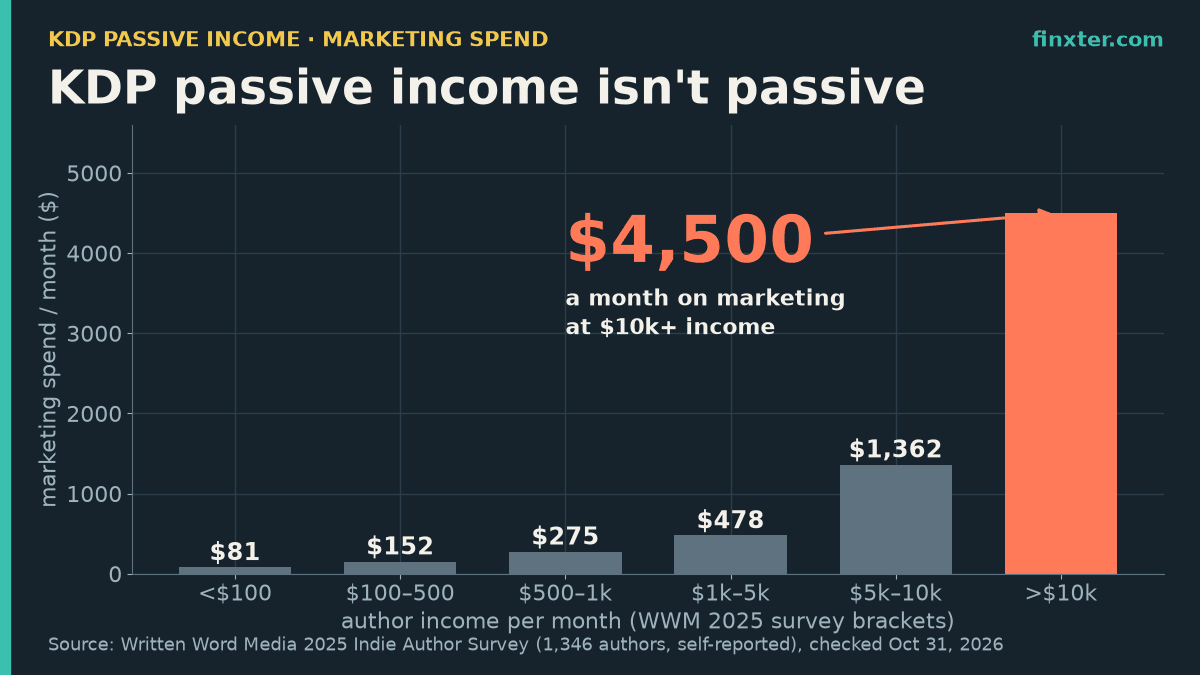
The indie authors who earn the most are the least passive about it. In Written Word Media’s 2025 survey of 1,346 authors, the group making over $10,000 a month reported spending about $4,500 a month on marketing, and the spend rises at every income rung below them.
So is KDP passive income real? Partly. Old books really do keep paying after you stop working on them, and for many authors that backlist is about half of their income. But it is a decaying asset. In my napkin model below, a catalog that stops getting new books loses half its royalties every 18 months. What looks passive from the outside is a catalog that’s still growing, plus a marketing budget that never goes to zero.
Here’s the data, the catalog math, and what to plan for if you want a book business that keeps paying.
The one input that moves every number in this post is how many books you can finish. My top pick for that is ImagineYourBook. It’s an AI book-writing tool that turns a prompt or your notes into a complete draft (a ~10,000-word book in the free trial), exported as Word or EPUB with a cover. Its series continuation carries a story bible with your characters, world rules and open threads into the next volume, and Manuscript Rewrite reworks a manuscript you already have.
TL;DR
- KDP passive income is real but not hands-off: in WWM’s 2025 survey, authors earning $10k+/month spend about $4,500 a month on marketing.
- Authors with 25+ books have a median of about $3,000 a month; about 80% of authors with 1–3 books earn under $100.
- Backlist is about 50% of income for the median Authors Guild poll respondent, but ~90% of a title’s sales come in its first five years (Reimers).
- Napkin model: stop publishing and income halves every 18 months ($3,642 → $1,825 → $364 a month).
- A steady cadence plateaus at one book’s lifetime royalties × books per month (≈ $4,863 a month at one book a month, in the model).
The survey: income rises with spend, not instead of it
Written Word Media (the company behind Freebooksy and Bargain Booksy) runs a yearly indie author survey. The 2025 edition had 1,346 responses. 77% of respondents are self-published, and 83% name Amazon as their top revenue source. The data is self-reported and skews toward serious genre-fiction authors, which is pretty much the KDP portfolio crowd.
Average monthly marketing spend, by monthly income:
| Monthly income | Avg. marketing spend / month | Spend as share of bracket midpoint (napkin) |
|---|---|---|
| Under $100 | $81 | 162% |
| $100–$500 | $152 | 51% |
| $500–$1k | $275 | 37% |
| $1k–$5k | $478 | 16% |
| $5k–$10k | $1,362 | 18% |
| Over $10k | $4,500 | ≤45% (at the $10k floor) |
The midpoint column is my napkin math, not the survey’s. It divides the average spend by the middle of each bracket. It shows two things:
- The bottom bracket loses money. Authors earning under $100 a month spend $81 on marketing. Even at the top of the bracket, that’s 81% of income.
- Spend falls to about 16–18% of income in the middle, then climbs again. At $10,000 a month, $4,500 is 45% of the bracket’s floor. Authors who earn more than $10,000 spend a smaller share, but nobody in the top group is coasting.
The 2023 edition of the survey also asked about time. On average, authors spent 31 hours and $617 a month on marketing. That’s a part-time job before you’ve written a word.
Catalog size does the rest
The other strong pattern in the 2025 survey is catalog size. About 80% of authors with 1–3 books earn under $100 a month. At 5–9 books the median is around $50 a month. Authors with 25+ books have a median of about $3,000 a month, and 40%+ of them earn $5,000 or more. I broke that ladder down in how many KDP books to make money.
Romance shows up most often in the top tiers: 21% of respondents, but about 44% of the over-$10k group. The survey credits series read-through, which is also why Book 1 earns only about a third of a series’ money.
The backlist is real: about half of income
The truly passive part does exist. In a 2024 Authors Guild member poll (392 responses, mostly traditionally published authors), the median author got 50% of their income from backlist and back-in-print books. 35.7% got more than 80% of their income that way.
But a backlist decays. In an expert report filed in the Hachette v. Internet Archive case, economist Imke Reimers concluded that for bestseller-list titles and most of the books in the suit, “around 90% of their sales occur in the first five years” after publication. That’s traditional-publishing data, not KDP data. I use it below as an assumption, not a measured KDP fact.
Napkin math: what happens when you stop
Assumptions (example only, change them to your own):
- Every book’s monthly royalties fall by the same share each month, so that 90% of its lifetime royalties arrive in its first five years (Reimers). That works out to 3.8% less per month, or half every 18 months.
- You publish one book a month.
- The model is calibrated so that the month your 25th book comes out, the catalog earns $3,000 a month, the WWM median at 25+ books. That means each new book earns about $183 in its launch month and about $4,863 over its lifetime. About 37% of that comes in year one.
- Marketing spend, KDP price changes, series read-through spikes and Kindle+ rate swings are left out.
Now publish for three years (36 books) and stop:
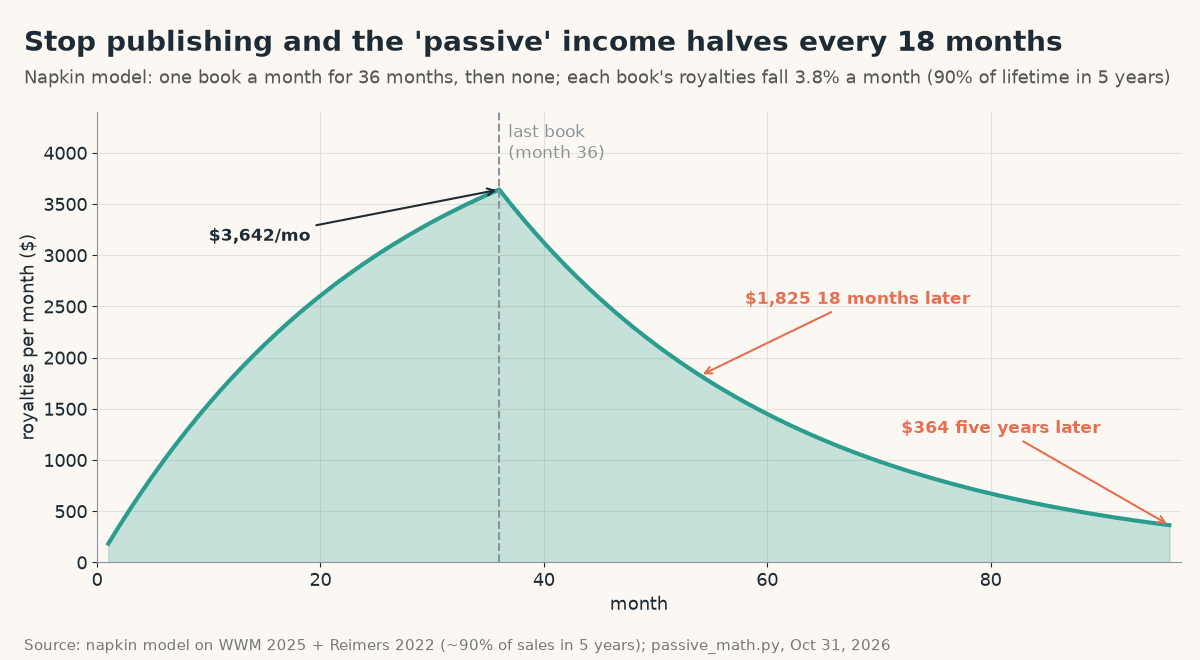
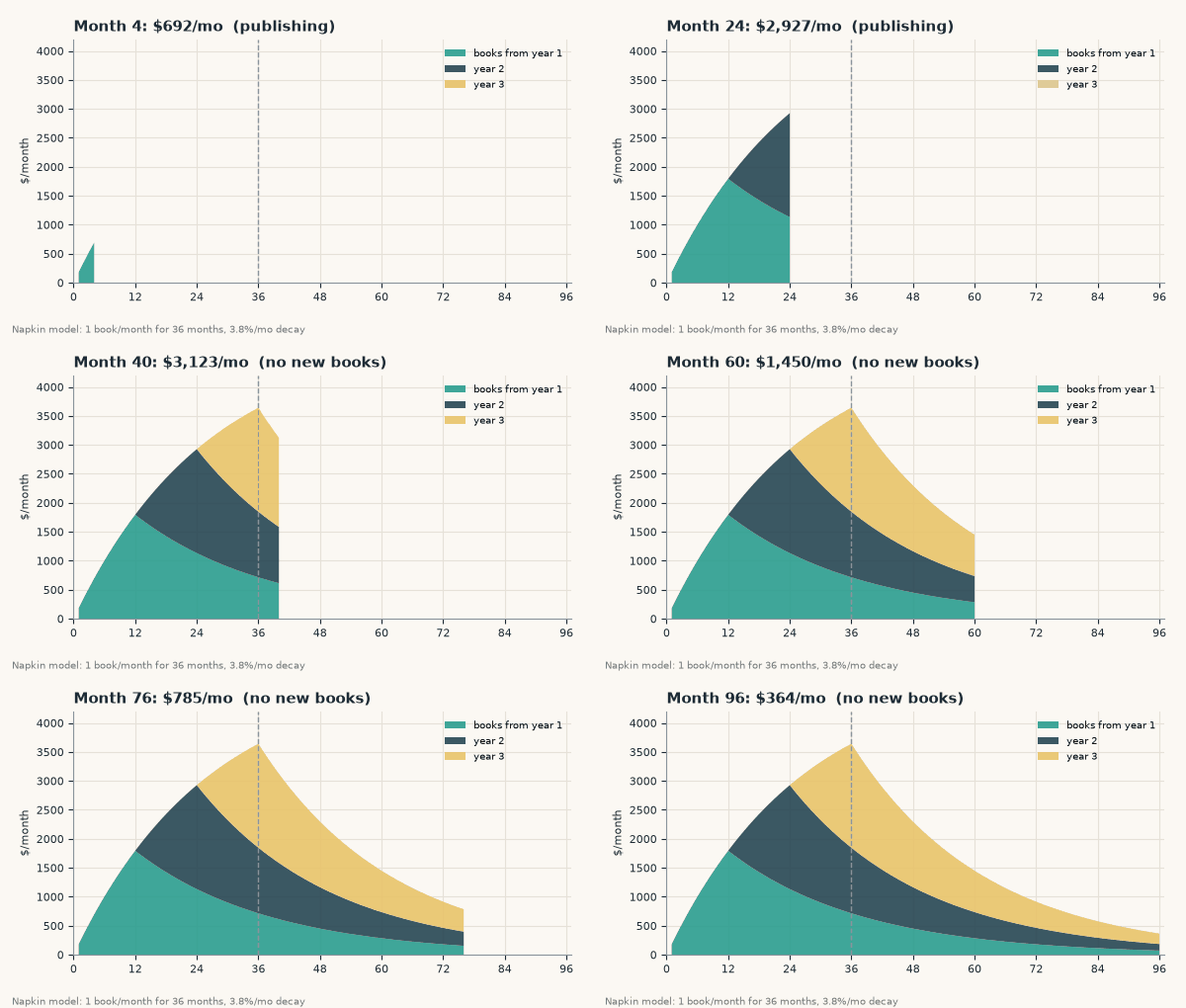
- At month 36 the catalog earns $3,642 a month. About 51% of that comes from books more than a year old, which lines up with the Authors Guild’s 50% backlist median.
- 18 months later, with no new books, it earns $1,825: half.
- Five years after the last book it earns $364, a tenth of the peak.
That tail is real money. The 60 months after you stop still bring in about $84,000 in this model. But it’s a pension that shrinks, not a salary that holds steady.
Why a catalog plateaus instead of compounding forever
“Books compound” is half true. Each new book adds to the pile, but older books shrink at the same time. So with a steady release pace, income climbs toward a ceiling:
monthly ceiling ≈ one book’s lifetime royalties × books per month
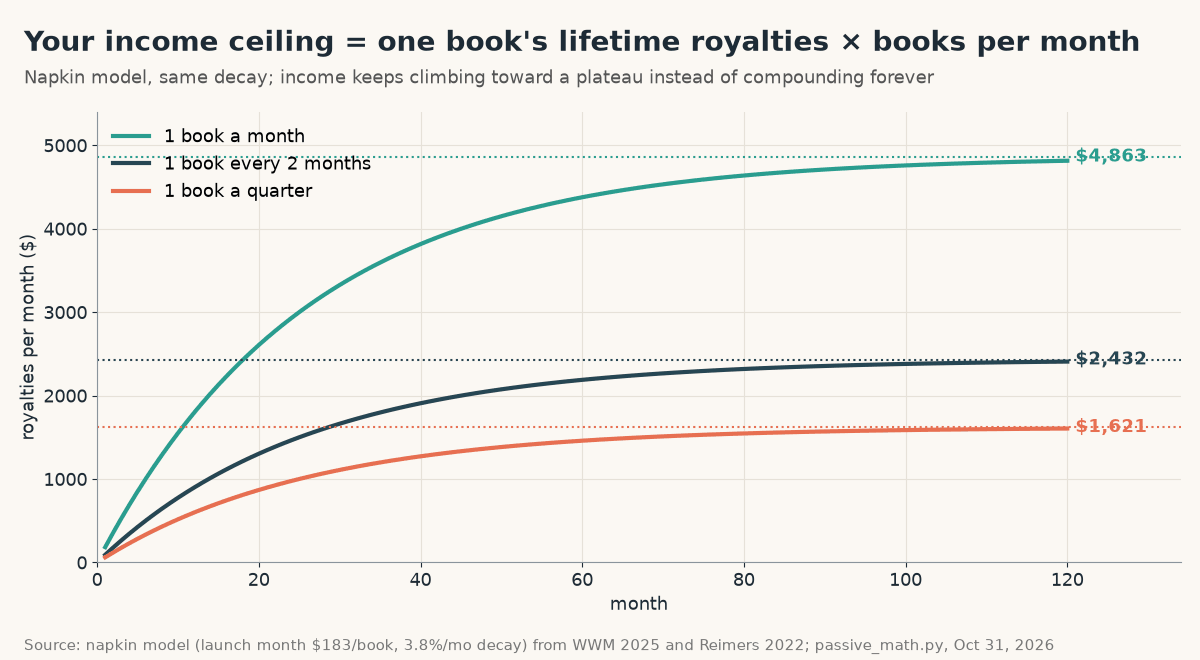
With my $4,863-per-book assumption:
- 1 book a month levels off near $4,863 a month.
- 1 book every 2 months levels off near $2,432.
- 1 book a quarter levels off near $1,621.
You can raise that ceiling in only two ways. Either each book earns more over its life (series read-through, better covers and blurbs, smarter pricing, ads that pay back), or you publish more often. Marketing is the first lever. That’s why the top bracket spends $4,500 a month, and why I worked out the break-even cost per click for KDP ads. Cadence is the second, and KDP’s own limits are generous: I covered them in how often can you publish on KDP.
So what’s actually passive?
A fair way to describe KDP passive income:
- Passive per book, not per business. Once a book is out, it keeps earning with no extra work, just less every month.
- Active at the business level. Holding income flat means replacing the decay. In the model at $3,642 a month, the backlist loses about 3.8% a month, roughly $137. A new book’s ~$183 launch month more than covers that, but only if the book actually comes out.
- Marketing is a running cost. In the 2025 survey it never drops to zero at any income level. Budget it as a percentage, not a one-off. The @iyb7 Medium story How Much Does a First-Time Author Spend in Year One? prices that monthly bill for a first book.
- Top earners own their reader channels. In the 2025 survey, authors with an email list had a median of about $300 a month, versus about $15 without one. Roughly half of the $10k+ group also sells direct. If you want to test a small direct product next to your books (a workbook, a character-bible template, a companion guide), FirstSale.ai is a guided planner with AI prompts for shaping and launching a $29 digital product. The first phase needs no signup or card.
| Question | Number | What to do |
|---|---|---|
| Is KDP income passive? | $4,500/mo marketing at $10k+ income (WWM 2025) | Budget marketing as a running cost, not a launch cost |
| How big must the catalog be? | Median ~$3,000/mo at 25+ books | Plan cadence to reach 25 books, ideally in series |
| How much is backlist? | Median 50% of income (Authors Guild) | Keep old books’ covers, blurbs and back matter current |
| What if I stop? | Halves every ~18 months (napkin model) | Treat the backlist as a shrinking pension |
| Where does it level off? | Lifetime royalties per book × books/month | Raise both: read-through and release pace |
Limits of this math
- The survey is self-reported, and it shows correlation, not cause. Spending $4,500 won’t get you to $10,000. Authors at $10,000 can afford to spend it.
- The 3.8%-a-month decay comes from traditional bestseller and suit-title data. Long-running series on KDP can decay more slowly, especially when a new release revives Book 1. Rapid-release spikes can also decay faster. Plug in your own sales history: use the share of a book’s royalties that came in its first year, and solve for the monthly decay.
- Results aren’t guaranteed. The median author at 5–9 books earns around $50 a month.
The takeaway
KDP passive income is the leftover from active work: a growing catalog, a series that pulls readers forward, and a marketing budget that scales with income. Plan for the ceiling (lifetime royalties per book × books per month), raise both factors, and treat the backlist as a slowly shrinking pension, not a finish line. For a wider view of AI side income, see Finxter’s 12 ways to make money with AI and what an LLM actually charges to draft a 50,000-word novel.
If the next book is your bottleneck, ImagineYourBook is the tool I’d try first for turning your notes into a complete draft, then into Book Two of the series. The trial is $0 today with a card required. It includes one 10,000-word Small Book, and the first $29.99 charge (Author plan, about 40,000 words a month) comes after 7 days, so cancel before day 8 if it’s not for you. Then edit the draft into your own voice and publish.
Sources (checked October 31, 2026): Written Word Media: 2025 Indie Author Survey Results · Written Word Media podcast: 2025 Author Survey · Written Word Media: The State of Indie Authorship (2023) · Authors Guild: Importance of Backlist and Back-in-Print Sales (Mar 2024) · Expert Report of Imke Reimers, Hachette v. Internet Archive (2022) · ImagineYourBook pricing and trial terms · FirstSale.ai. Napkin assumptions: equal monthly decay with 90% of lifetime royalties in five years, one book a month, calibrated to $3,000 a month at the 25th book; marketing costs, price changes and read-through spikes left out.