
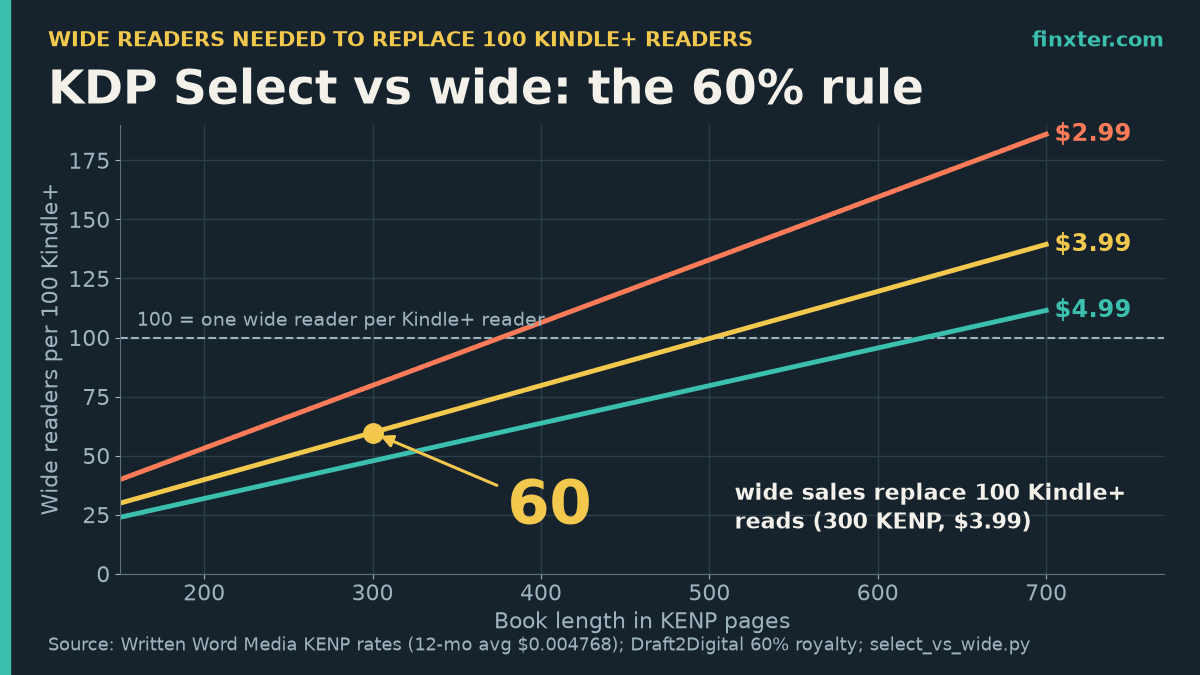
Leaving KDP Select doesn’t mean you have to replace every Kindle+ reader you give up. For a 300-page, $3.99 ebook, 60 full-price readers on Apple, Kobo and the other wide stores earn what 100 Kindle+ readers paid you in page reads.
That sounds like an easy win for going wide. It isn’t, and the same math tells you exactly when it is. So here’s the short answer to KDP Select vs wide: stay in Select if your books are long (500+ KENP pages at $3.99) or your wide stores don’t yet bring you at least 6 readers for every 10 you get through Kindle+. Go wide (or mixed) with shorter, higher-priced books once they do. Below is the napkin math, a stress test for the first Kindle+ fund with listening, and what Amazon’s October 2026 switch from Kindle Unlimited to Kindle+ changes.
TL;DR
- One full Kindle+ read of a 300-page book pays $1.43 (12-month US average $0.004768 per page); one $3.99 wide sale through Draft2Digital nets $2.39.
- So 60 wide readers replace 100 Kindle+ readers for that book. Past 502 KENP at $3.99, a borrow pays more than a wide sale.
- The monthly rate moved the break-even between 53 and 67 wide readers per 100 over the last 12 months.
- A 5-book series with 200 new Kindle+ readers a month earns about $881 a month in page reads; going wide needs about 120 new wide readers a month to match.
- Among authors earning $5,000+ a month, 43% are all-in on Select and 15% fully wide (Written Word Media 2025). Kindle Unlimited is now called Kindle+.
- New: the October 2026 fund (first with listening) rose to $67.7 million; even a 20% page-rate drop would move the break-even only from 60 to 48 wide readers per 100.
Whichever way you go, the bigger lever is the same: more books in the series. Every extra book adds read-through in Kindle+ and gives wide readers more to buy. If drafting is your bottleneck, ImagineYourBook is the tool I’d start with. It’s an AI book-writing tool that turns a prompt or your notes into a complete book draft with its own cover, built for romance and romantasy series so Book Two remembers Book One’s characters and world; paid plans export Word and EPUB.
First, what actually changed: Kindle Unlimited is now Kindle+
On October 22, 2026, Amazon renamed Kindle Unlimited to Kindle+ and added eligible audiobooks to the subscription, as Written Word Media reported the same day. The money mechanics for ebooks didn’t change: KDP says ebooks enrolled in KDP Select are automatically included in Kindle+, and you’re paid from the KDP Select Global Fund by Kindle Edition Normalized Pages (KENP), once per page per subscriber.
What’s new is audio. Kindle+ listening is US-only at launch. Virtual Voice audiobooks join automatically when their ebook is in Select, and ACX audiobooks qualify only if they’re exclusive to Audible, Whispersync-enabled and made on the Pay for Production model. Amazon says it is adding money to the fund for listening, but it hasn’t published per-page rates for listening, and Written Word Media flags that the long-term effect on ebook page rates is unknown.
So for the ebook decision, the rules are the same as before:
- Exclusivity: while a book is in KDP Select, KDP says you “cannot distribute your book digitally anywhere else, including on your website.” Print stays free to sell anywhere.
- Term: enrollment runs in 90-day periods. You get three days from the start of a period to cancel without contacting KDP.
- Perks: up to 5 Free Book Promotion days per 90-day period, and Kindle Countdown Deals (Amazon.com and Amazon.co.uk only).
- Pot size: Written Word Media lists the September 2026 fund at $65.9 million, paying $0.005365 per US page.
The one number that decides it: wide readers per 100 Kindle+ readers
When you go wide, you keep your Amazon sales but lose your Kindle+ page reads. Those have to come back as sales at other stores. So the only question is how many wide sales replace one Kindle+ read.
Two sourced inputs do the work:
- Value of one Kindle+ read. The US per-page rate averaged $0.004768 over the 12 months from October 2025 to September 2026 (Written Word Media’s monthly list). A full read of a 300-KENP book pays 300 × $0.004768 = $1.43.
- Value of one wide sale. Draft2Digital, a popular distributor for going wide, pays about 60% of list price at Apple, Kobo, Barnes & Noble and Tolino. A $3.99 ebook nets $2.39 per sale.
Divide one by the other: $1.43 / $2.39 = 0.60. Every 100 full Kindle+ reads are worth 60 wide sales. That’s the hook at the top, and it’s just arithmetic.
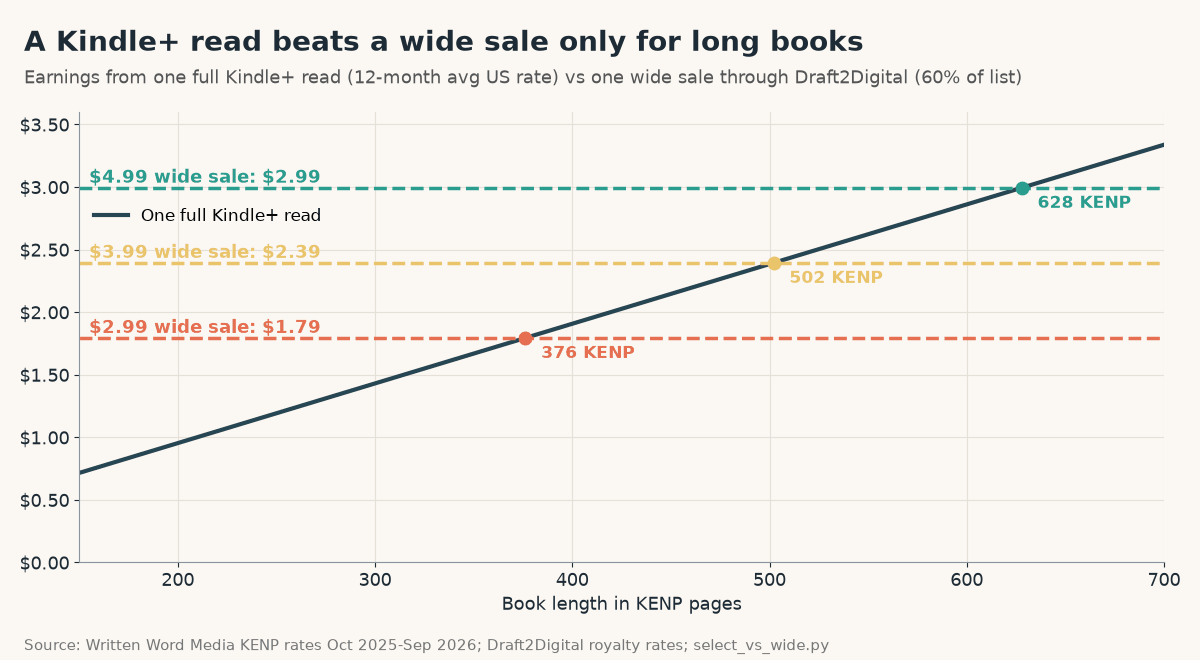
The catch is in the chart. A Kindle+ read scales with length; a sale doesn’t. At $3.99 the two lines cross at 502 KENP. Past that, one borrow pays more than one wide sale, and you’d need more than 100 wide readers to replace 100 Kindle+ readers. If you write long romance or romantasy novels, that’s exactly where Select wins on the math.
| Book length (KENP) | One Kindle+ read pays | $2.99 wide | $3.99 wide | $4.99 wide |
|---|---|---|---|---|
| 200 | $0.95 | 53 | 40 | 32 |
| 300 | $1.43 | 80 | 60 | 48 |
| 400 | $1.91 | 106 | 80 | 64 |
| 500 | $2.38 | 133 | 100 | 80 |
| 600 | $2.86 | 159 | 120 | 96 |
Read the table like this: a $4.99, 300-KENP novella series needs only 48 wide readers per 100 lost Kindle+ readers. A $2.99, 600-KENP doorstopper needs 159. Price and length together decide it, not a gut feeling about “Amazon dependence.”
The rate moves, so the rule moves too
The per-page rate isn’t fixed. In the last 12 months it ranged from $0.004202 (January 2026) to $0.005365 (September 2026). For the 300-KENP, $3.99 book, that moves the break-even between 53 and 67 wide readers per 100.
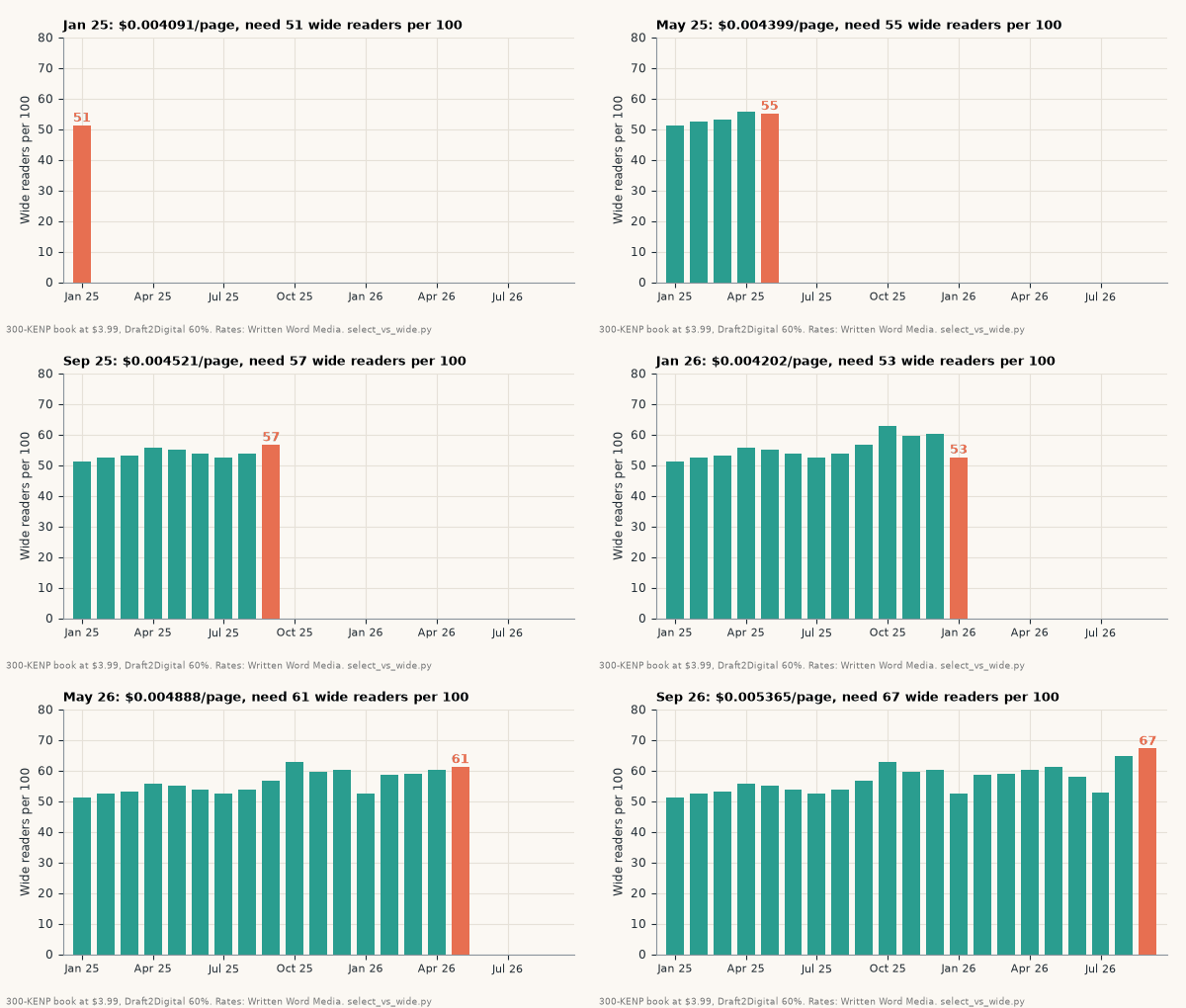
The September 2026 rate was the highest in the 12 months, which pushes the bar up to 67. If you’re deciding right now, use the 12-month average, not one good month. And keep an eye on the October and November rates, the first months with audiobook listening in the pot.
October 2026: the first Kindle+ fund with listening in it
Amazon announced the October 2026 KDP Select Global Fund on November 14: $67.7 million, up $1.8 million (2.7%) from September’s $65.9 million, according to the Publishing Map’s log of KDP Community fund posts. It is the first month Amazon’s help pages describe as paying for pages listened as well as pages read. As of November 17, 2026, neither KDP nor Written Word Media has published an October per-page rate.
That matters for this decision because the fund now pays for more pages. If listening pages grow faster than the extra money, the per-page rate drops, and Select gets weaker for ebooks. I can’t tell you the October rate, but I can tell you how much a drop would move the rule:
| US rate scenario | $ per KENP | One 300-KENP read | Wide readers per 100 ($3.99, 300 KENP) | Select wins past | 5-book series example, Kindle+ $/month |
|---|---|---|---|---|---|
| January 2026 (12-month low) | $0.004202 | $1.26 | 53 | 570 KENP | $777 |
| 12-month average | $0.004768 | $1.43 | 60 | 502 KENP | $881 |
| September 2026 (12-month high) | $0.005365 | $1.61 | 67 | 446 KENP | $991 |
| Average minus 10% (listening dilutes pages) | $0.004291 | $1.29 | 54 | 558 KENP | $793 |
| Average minus 20% | $0.003814 | $1.14 | 48 | 628 KENP | $705 |
Even a 20% drop would only move the 300-KENP break-even from 60 to 48 wide readers per 100, and the “long books stay” line from 502 to 628 KENP. That is the same swing a $1 price change makes. So don’t pull a series out of Select on rumors about listening; wait for the October rate, then re-run the table with it. I track every monthly rate in KENP rate 2026.
A worked example: a 5-book romance series
Here’s a full series in numbers. The read-through funnel is Kindlepreneur’s example (for every 100 readers of Book 1: 65, 50, 48 and 45 read Books 2 to 5). The reader count is my assumption.
- Assumption: 200 new Kindle+ subscribers start Book 1 each month and finish it; every book is 300 KENP and $3.99.
- Books read in Kindle+ per month: 200 × 3.08 = 616.
- Kindle+ income: 616 × $1.43 = $881 a month.
- To replace that wide, you’d need 368 wide sales a month, which with the same read-through is about 120 new wide readers starting Book 1 every month.
So the honest version of the hook: going wide with this series makes sense only if Apple, Kobo, B&N and the rest can bring in about 120 new series readers a month on top of your Amazon buyers. That’s 60% of your Kindle+ inflow, all from outside Amazon, which is still the top revenue source for 83% of the indie authors Written Word Media surveyed.
Here are the crossovers for the three common ebook prices in one place:
| Wide price | Net per wide sale (Draft2Digital ~60%) | Kindle+ read pays more past | Wide readers per 100 Kindle+ readers (300 KENP) |
|---|---|---|---|
| $2.99 | $1.79 | 376 KENP | 80 |
| $3.99 | $2.39 | 502 KENP | 60 |
| $4.99 | $2.99 | 628 KENP | 48 |
Swap in your own KENPC (it’s on your KDP Bookshelf), your price, and the rate. If you want to project the whole series over years, the KDP royalty calculator in Python and the Kindle Unlimited earnings breakdown use the same rate and funnel. If you’re choosing a wide distributor, I compared the fees in KDP vs Draft2Digital.
What successful authors actually do
Written Word Media’s 2025 Indie Author Survey asked how authors use KDP Select. Across all authors, 38% had every book in Select and 30% were fully wide. Among authors earning over $5,000 a month, 43% were all-in on Select and only 15% fully wide.
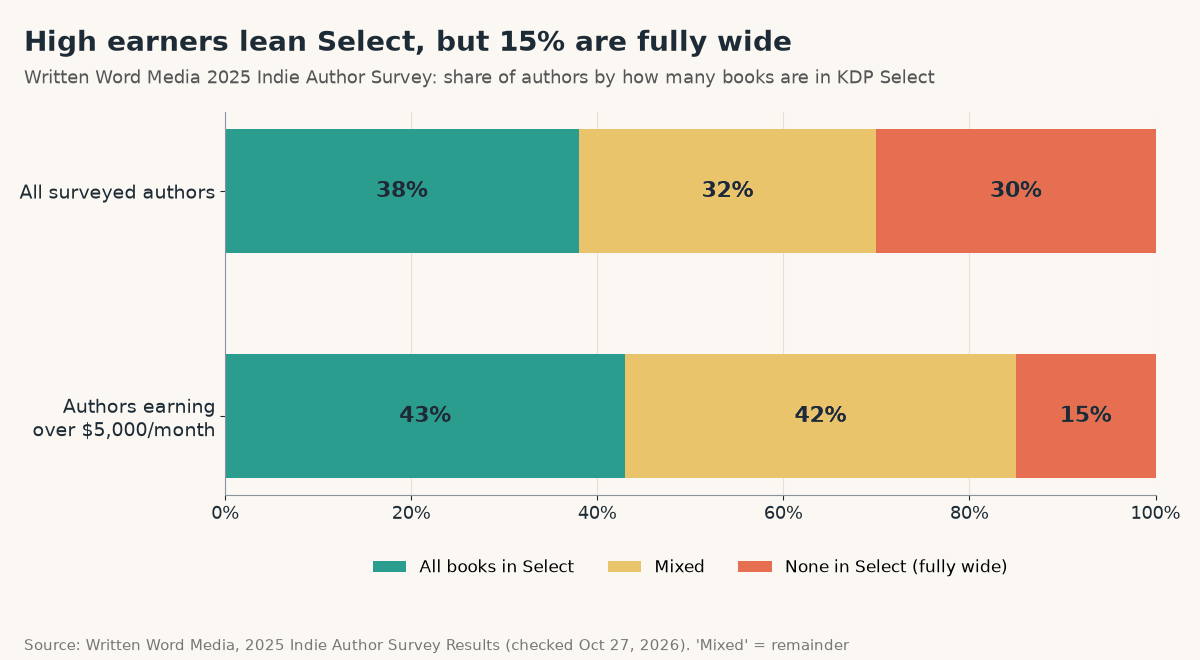
Two things stand out. Fully wide is half as common among high earners. But “mixed” is the biggest jump, from 32% to 42%. Written Word Media stresses this is correlation, not proof that Select causes higher income, and that fully wide high earners exist too. Amazon’s lead is slowly shrinking, though: it was the top revenue source for 91% of respondents in 2023, 87% in 2024 and 83% in 2025.
The mixed pattern fits the math: long books that win on page reads stay in Select, while shorter or higher-priced titles go wide.
Rule: compare readers, not royalties per unit. A Kindle+ borrow always looks smaller than a sale on one book, but the decision is how many readers each channel brings you. Compute your break-even (wide readers per 100 Kindle+ readers) before you pull a series out of Select.
How to decide in 90 days
The survey authors suggest a simple test: one series in Select for 90 days, then wide for the next 90, and compare real numbers. Here’s how to make that test clean:
- Compute your break-even first. Use the tables above with your KENPC, price and the 12-month rate. Write down “I need X wide readers per 100 Kindle+ readers.”
- Count Kindle+ readers, not page reads. Divide monthly KENP for Book 1 by its KENPC. That’s your Kindle+ reader inflow.
- Go wide with the right books. Start with the shortest or highest-priced series, where X is lowest. Keep long books in Select.
- Mind the calendar. You can’t sell an enrolled ebook elsewhere until its 90-day term ends, so time the switch to the end of a term.
- Judge on 90 days of wide sales. If wide readers per 100 lost Kindle+ readers beat X, stay wide. If not, re-enroll; nothing stops you.
Pricing interacts with all of this. A higher price lowers X; see how to price a KDP ebook series. And if you stay in Select, the four levers for more Kindle Unlimited page reads still apply under the Kindle+ name.
| Your situation | What the math says | Do this |
|---|---|---|
| Long books (500+ KENP) at $3.99 or less | A Kindle+ read pays as much as a wide sale or more | Stay in Select |
| Novellas or 200-300 KENP at $4.99 | 32-48 wide readers replace 100 Kindle+ readers | Strong case to test wide |
| Wide stores bring under 6 readers per 10 Kindle+ readers | Below break-even for a 300-KENP $3.99 book | Stay in Select, revisit in 90 days |
| Big catalog, mixed lengths | Break-even differs per series | Go mixed: long series in Select, short ones wide |
| Audiobooks via ACX or Virtual Voice | Kindle+ listening rates not published yet | Wait for real listening rates before re-planning |
FAQ
Is KDP Select worth it in 2026?
For long books, usually yes. One full Kindle+ read pays $0.004768 per KENP page at the 12-month US average, so past 502 KENP a borrow earns more than a $3.99 wide sale through Draft2Digital ($2.39). Shorter or higher-priced books can do better wide if other stores bring enough readers.
How many wide readers do I need to replace Kindle+ readers?
For a 300-KENP, $3.99 ebook, 60 wide readers replace 100 Kindle+ readers. At $4.99 it’s 48, at $2.99 it’s 80. Over the last 12 months’ rates the $3.99 figure ranged from 53 to 67.
Can I sell my ebook on other stores while in KDP Select?
No. While an ebook is enrolled you can’t distribute it digitally anywhere else, including your own website. Paperbacks and hardcovers can be sold anywhere. Enrollment runs in 90-day terms.
Did the switch to Kindle+ change KDP Select royalties?
The ebook mechanics didn’t change: you’re paid per KENP page from the KDP Select Global Fund. October 2026 was the first fund that also pays for pages listened; it rose to $67.7 million, but the October per-page rate hadn’t been published as of November 17, 2026.
What percentage of successful authors are in KDP Select?
In Written Word Media’s 2025 Indie Author Survey, 43% of authors earning over $5,000 a month had every book in Select, 42% were mixed and 15% were fully wide. Across all authors it was 38%, 32% and 30%.
Limitations
The 60% royalty is Draft2Digital’s; going direct to a store pays that store’s own rate, so plug yours into the tables. The math assumes your Amazon sales don’t change when you go wide and that Kindle+ subscribers wouldn’t have bought the book anyway, both simplifications. Audiobook listening rates aren’t public yet. And the 200-reader series is an example, not a forecast.
The takeaway
KDP Select vs wide isn’t a loyalty question. It’s one division: value of a Kindle+ read over value of a wide sale. For a 300-page, $3.99 book that’s 60 wide readers per 100; for long books it’s over 100, which is why many high earners keep their long series in Select. Whichever side wins for you, the series that earns most is the one with more books in it. If writing Book Two through Book Five is what’s holding you back, try ImagineYourBook. Its $0 trial runs 7 days and includes one 10,000-word book; it needs a card, and the first $24.99 payment starts after 7 days unless you cancel before day 8. For more series tools, see the best AI for writing a book series. The charts here were made with Matplotlib.
Sources (checked October 27, 2026; Kindle+ fund and rates rechecked November 17, 2026): The Publishing Map: Kindle+ payouts log (October 2026 fund) · Written Word Media: Kindle Unlimited Is Now Kindle+ (Oct 22, 2026) · Written Word Media: KDP Global Fund payouts and per-page rates · Written Word Media: 2025 Indie Author Survey · Draft2Digital: Ebook royalty rates · KDP Select: exclusivity FAQ · KDP Help: KDP Select · KDP Help: Kindle+ · KDP Help: Royalties in Kindle+ · KDP Help: Free Book Promotions · Kindlepreneur: Series read-through · ImagineYourBook pricing and trial terms. Napkin math is labeled as assumptions.