
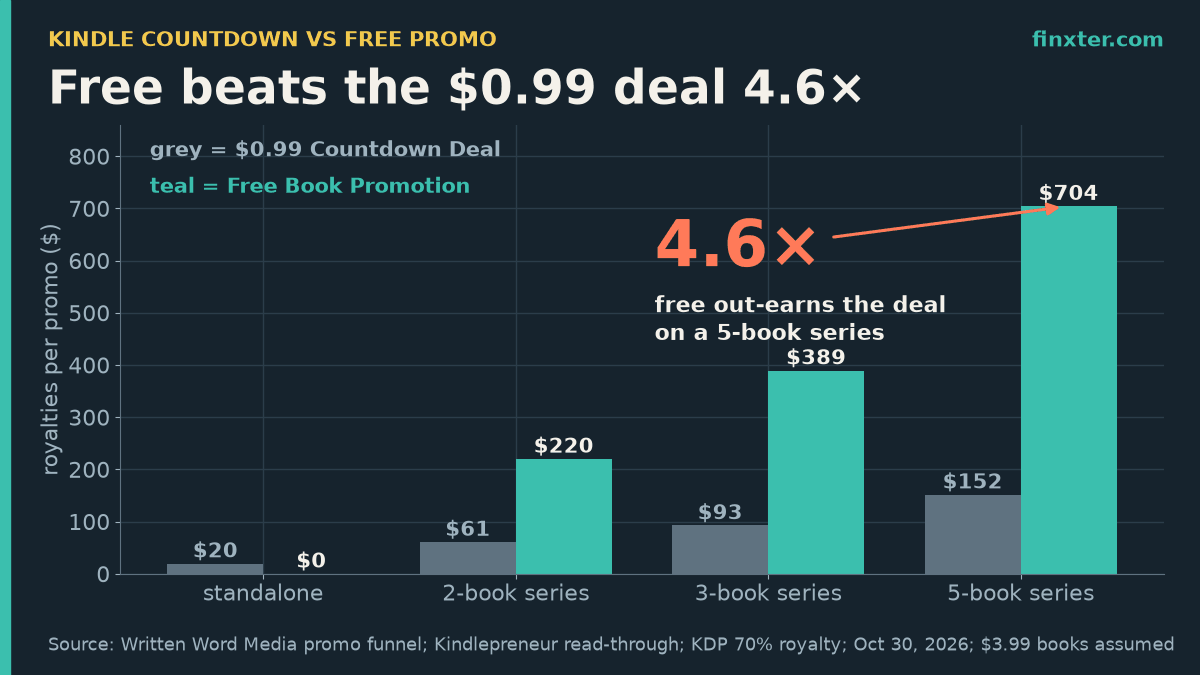
A reader who grabs your book during a Free Book Promotion is worth about 83% less than one who pays $0.99 in a Kindle Countdown Deal. Yet on a five-book series, the free promotion still earns about 4.6 times as much money, because free moves roughly 27 times as many copies.
So here is the short answer to Kindle Countdown vs Free Book Promotion: if Book 1 has at least one paid sequel behind it, run the free days. If the book is a standalone, run the Countdown Deal, because a free standalone has nothing left to sell. KDP only lets you pick one of the two per 90-day KDP Select term, so this is a real trade-off you make four times a year for every book in your catalog.
Below: Amazon’s rules, the napkin math, the one number that tells you when free stops working (a 2.2% Book 2 read-through), and a portfolio schedule.
Both tools only pay off when there is a next book to sell, so for portfolio publishers the real constraint is usually the next manuscript, not the promo calendar. My top pick for that job is ImagineYourBook. It is an AI book-writing tool that turns a prompt or your notes into a complete book draft (a 10,000-word book in the trial), exported as Word or EPUB with a cover. Its Series Builder carries your story bible, characters and open threads into Book Two, which is exactly the sequel a free Book 1 needs.
TL;DR
- KDP Select lets you run either a Free Book Promotion (up to 5 days, all marketplaces) or one Kindle Countdown Deal (up to 7 days, .com and .co.uk) per 90-day term.
- A Countdown Deal keeps your 70% royalty at $0.99; free days pay $0 and don’t count toward paid rank.
- Per copy, a $0.99 buyer is worth about $5.05 on a 5-book series, a free download $0.88 (83% less).
- Per promo, free still earns 4.6× more on a 5-book series ($704 vs $152) because it moves ~27× the copies.
- Standalone? Use the Countdown Deal. Series Book 1? Go free, unless fewer than 2.2% of downloaders buy Book 2.
The rules: what KDP actually allows
Both promotions are perks of KDP Select (the Kindle+ program). KDP’s help pages for Kindle Countdown Deals and Free Book Promotions set these rules:
| Rule | Kindle Countdown Deal | Free Book Promotion |
|---|---|---|
| Reader pays | Discounted price, with a countdown clock | $0 |
| Your royalty | Your normal rate at the deal price (70% stays 70% below $2.99) | None while free |
| Length | 1 hour to 7 days, one run, up to 5 price steps | Up to 5 days per term, all at once or split |
| Stores | Amazon.com and Amazon.co.uk only | All KDP marketplaces |
| Eligibility | In KDP Select 30+ days; list price $2.99–$24.99 (£1.99–£15.99) | From day 2 of the Select term |
| Price rules | Discount of at least $1; list price frozen 30 days before and 14 days after | None |
| Rank | Counts as paid sales | Free list only; not counted on Paid lists |
| Per 90-day term | One deal, and then no free days | Up to 5 days, and then no Countdown Deal |
Three details matter most for the money:
- The Countdown Deal keeps your 70%. KDP: “If you have selected the 70% royalty option, you’ll earn 70% even if the price is below $2.99.” Normally a $0.99 eBook earns 35%. I wrote up that quirk on Medium in A $0.99 Kindle Countdown Deal still pays 70%.
- Free pays nothing, and doesn’t help your paid rank. KDP: “you won’t receive royalties for it while the Free Book Promotion runs”, and “Free Book Promotions do not count towards the ranking in Paid lists.”
- It’s either/or. KDP: “Only one type of promotion can be used during the KDP Select enrollment period.” Unused free days don’t roll over.
The data: free gets the crowd, paid gets the readers
Written Word Media, which runs the Freebooksy and Bargain Booksy promo newsletters, laid out a baseline funnel in a webinar on how free promos can grow your author business. Their numbers are illustrative, but in their words “based in the reality of our business”:
- From the same 10,000 promo impressions, a $0.99 book gets “probably 300 people clicking through and maybe 30 sales”.
- A free book gets “closer to a thousand clicks, and then 800 people are going and grabbing that first book”.
- But “a read through percentage of, on average, around 50% for paid books, only about 10% for free books.”
Their conclusion: the free promo ends up “3, 4, 5 x as profitable” for a series author, and “If you only have one book, then free is not running.”
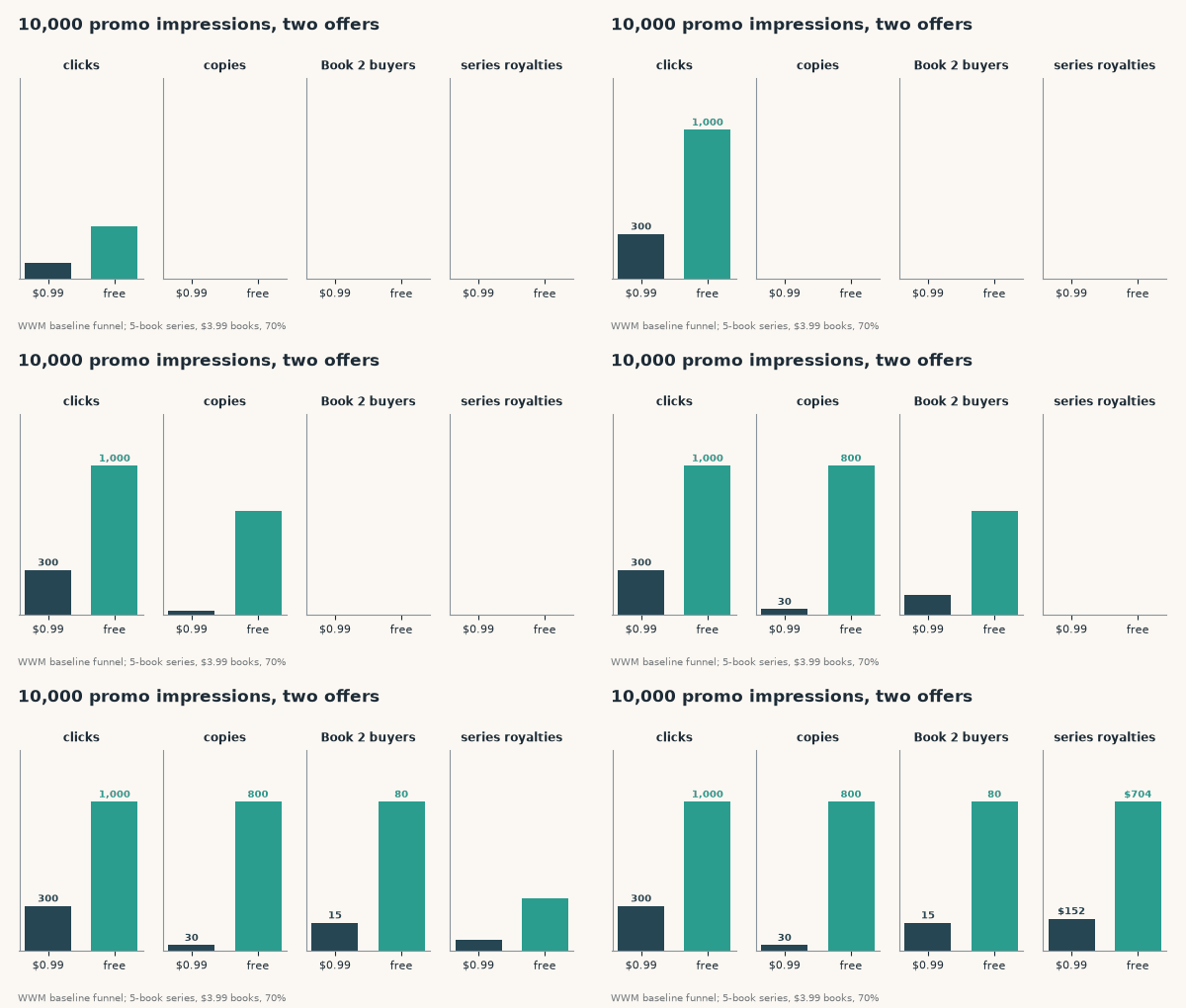
Those are the two numbers that fight each other: 27× more copies (800 vs 30) against a 5× lower read-through (10% vs 50%). To see who wins, you have to price a reader.
Napkin math: what one copy is worth
My assumptions (change them to your own):
- A five-book series, every book listed at $3.99 on the 70% royalty option, with about $0.06 delivery cost per copy (KDP charges $0.15 per MB; I assume a 0.4 MB novel file). That’s $2.75 per full-price sale.
- During the deal, Book 1 sells at $0.99 with the 70% rate kept: $0.65 per sale.
- Book 2 read-through from WWM: 50% for buyers, 10% for free downloaders.
- After Book 2, the same five-book funnel I used in how to write a romance book series (Kindlepreneur’s example: 65 → 50 → 48 → 45 readers), so 77%, 96% and 94% of readers continue from Book 2 to 3, 3 to 4, and 4 to 5.
- Only sales are counted. Kindle Unlimited page reads, rank effects and reviews are left out on both sides.
A reader who starts Book 2 is then worth $8.80 in later royalties. That gives:
- Countdown buyer: $0.65 + 50% × $8.80 = $5.05
- Free downloader: $0 + 10% × $8.80 = $0.88
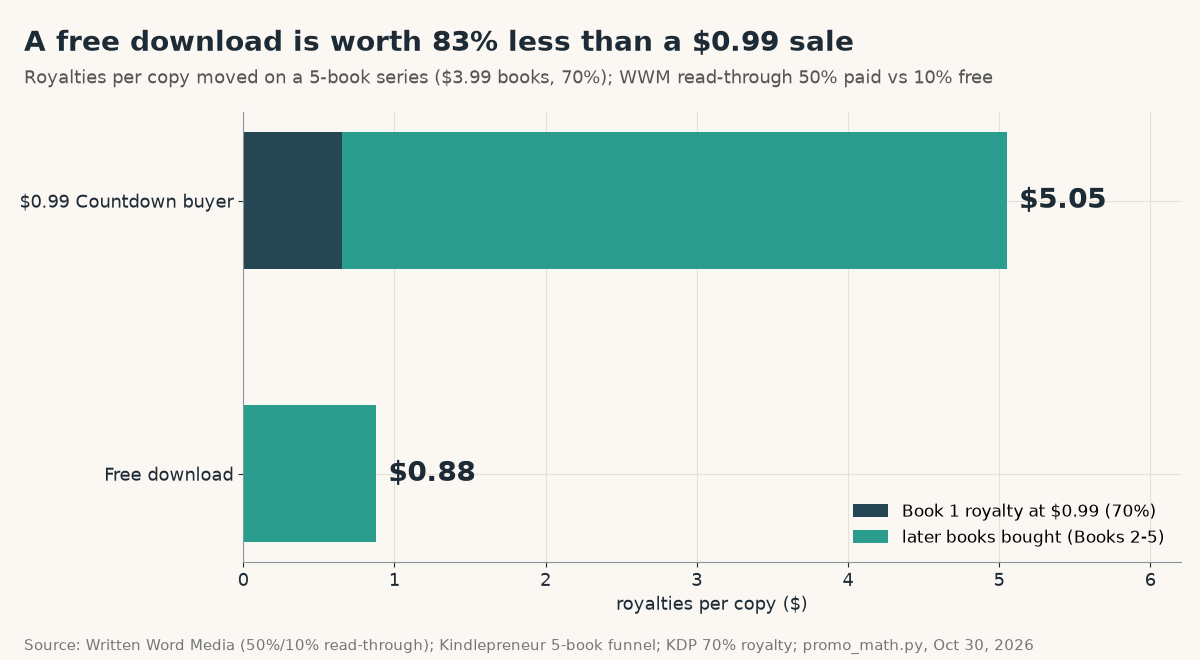
So a free reader is worth about 83% less. Put differently, free has to move 5.7 times as many copies as the Countdown Deal just to tie. WWM’s baseline funnel moves 27 times as many.
Per promo: free wins on every series length
Multiply by WWM’s 30 sales and 800 downloads, and do it for different series lengths:
| Catalog behind Book 1 | $0.99 Countdown (30 sales) | Free promo (800 downloads) | Winner | Free loses below this Book 2 read-through |
|---|---|---|---|---|
| Standalone | $20 | $0 | Countdown | – |
| 2-book series | $61 | $220 | Free, 3.6× | 2.8% |
| 3-book series | $93 | $389 | Free, 4.2× | 2.4% |
| 5-book series | $152 | $704 | Free, 4.6× | 2.2% |
A standalone is the one place the Countdown Deal wins outright: $20 against $0. Add one paid sequel and free jumps ahead 3.6×. At five books it is $704 against $152, or 4.6×, which lands inside WWM’s own “3, 4, 5 x” range.
Why? Book 1 at $0.99 is only about 13% of what a Countdown buyer is worth ($0.65 of $5.05). Giving that away is cheap if it multiplies the people who might start Book 2.
The number that tells you when free stops working
The weak spot in the free math is that 10% read-through. Freebie hunters download books they never open. One r/KDP author shared real numbers from a three-day free run on Book 1: 719 downloads, then paid sales that were “tiny, like a handful”. (Interesting detail: Book 2 then outsold Book 1, which is exactly the read-through the free run is meant to buy.)
So ask the inverse question: how low can free read-through fall before the Countdown Deal wins? With 800 downloads against 30 sales, the answer is 2.2%. Below that, the $0.99 deal earns more.
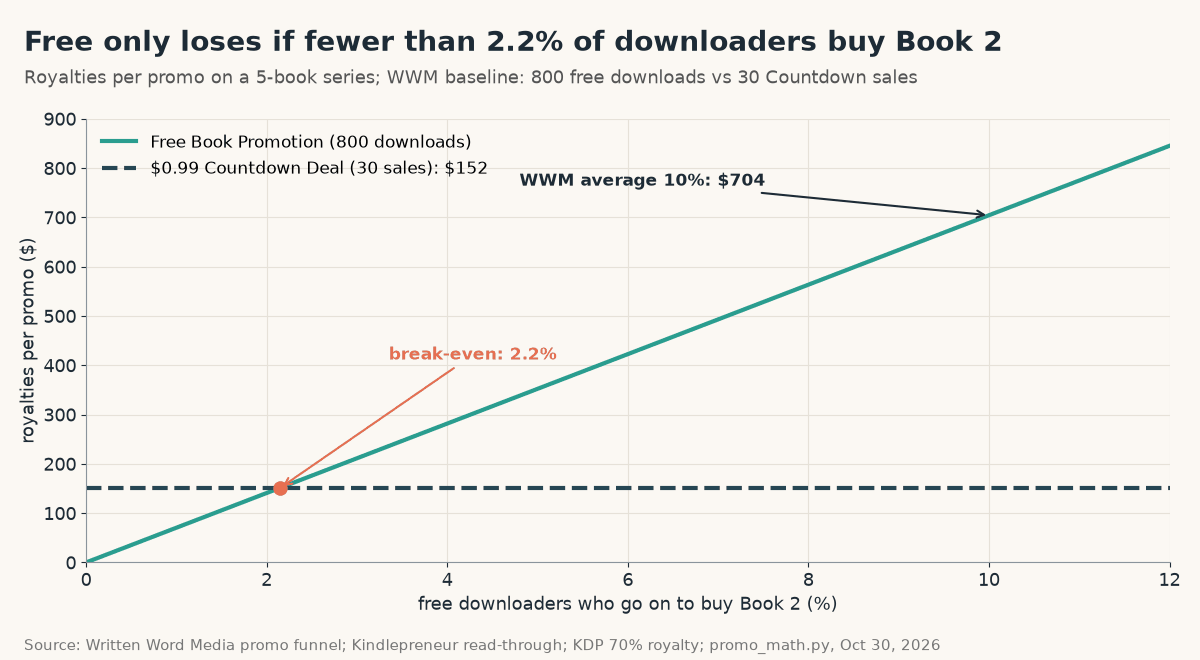
The same math in copies: at a 10% read-through, a free run needs about 172 downloads to match a 30-sale Countdown Deal. That’s a low bar if you book a promo newsletter, and a real risk if you don’t. The UK guide at Publishing.co.uk estimates that a standalone free promo with no marketing produces only 50–200 downloads, against 2,000–10,000 when stacked with paid promo sites.
How to check your own number: after your next free run, count Book 2 sales (and Book 2 KENP reads divided by its page count) in the 30 days after the promo, then divide by Book 1 free downloads. Above about 2–3%, keep running free days on Book 1. Below that, switch Book 1 to a Countdown Deal next term, or fix the end of Book 1 first (a direct link to Book 2 on the last page, and a cliffhanger or next-couple teaser that fits your romance subgenre).
Before you schedule anything: a Countdown Deal must end at least 14 days before your KDP Select term ends unless the book renews, can’t be edited within 24 hours of its start, and freezes your list price for 30 days before and 14 days after. Free days can’t be scheduled for a future term, and a day you cancel mid-run is lost.
A portfolio schedule that uses both
Because the either/or rule applies per book and per 90-day term, a catalog of several series can run both tools every quarter:
- Book 1 of each series: Free Book Promotion, in a 2–5 day run, booked together with one or two promo newsletters. Free days work in every KDP marketplace, not just the US and UK.
- Standalones, holiday novellas and box-set-adjacent singles: Countdown Deal from $3.99 down to $0.99, so you keep 70% and buyers see the clock. Remember the price freeze: your list price can’t change 30 days before or 14 days after.
- Book 2 or 3 of a series you are pushing: an occasional Countdown Deal timed with the Book 1 free run, so new readers find the next book discounted. That is consistent with WWM’s advice on series promotion to consider discounting Books 2 and 3 too.
- Don’t overrun it. Publishing.co.uk recommends no more than 2–3 free promos and 2–3 Countdown Deals per book per year, because the rank boost shrinks with every repeat.
Price the series around this. My earlier post on how to price a KDP ebook found a $3.99 list price with occasional $0.99 deals gets most of both worlds, and KDP Select vs wide covers whether you should be in Select at all. If you rely on Kindle Unlimited reads after the promo, the levers in how to get more Kindle Unlimited page reads stack on top.
Limits of this math
- WWM’s funnel is a rounded, illustrative baseline from a webinar, not a published study. Your click and read-through rates will differ by genre, cover and promo site.
- I count only sales. Countdown buyers who are Kindle Unlimited members may borrow Book 2 instead of buying it, and free downloads earn no page reads for Book 1 itself, as Writer Margins notes.
- Promo newsletter fees are left out. Both offers usually need them, so subtract your real costs from each side.
- Reviews, also-bought data and paid-rank lift are ignored on both sides.
The takeaway
Judged per reader, the Countdown Deal wins easily: $5.05 against $0.88. Judged per promo, the free run wins on every series length from two books up, because it puts 27 times as many copies into readers’ hands, and it only loses if fewer than about 2.2% of downloaders buy Book 2. For a standalone, use the Countdown Deal. For Book 1 of a series, use the free days and track that one ratio.
The lever behind all of this is having Book 2 (and 3, 4 and 5) ready to sell. If drafting is your bottleneck, ImagineYourBook turns a prompt or notes into a complete draft with a cover, and its Series Builder keeps Book Two consistent with Book One. The trial is $0 today with a card, includes one 10,000-word book, and you cancel before day 8 to avoid the first charge (Author plan: $29.99/month for about 40,000 words). It writes text books with a cover, not illustrated picture books.
Sources (checked October 30, 2026): KDP Help: Kindle Countdown Deals · KDP Help: Free Book Promotions · Written Word Media: How free promos can grow your author business · Written Word Media: How to promote your series · Kindlepreneur: How to calculate series read-through · Publishing.co.uk: KDP free days vs Countdown Deals 2026 · Writer Margins: Countdown Deals and free promotions · r/KDP: first series, free-run numbers · ImagineYourBook pricing and trial terms. Assumptions: five-book series, $3.99 list on the 70% option, $0.06 delivery per copy, $0.99 deal price, WWM’s illustrative 30-sale / 800-download funnel, sales only (no KU reads, promo fees or rank effects).