
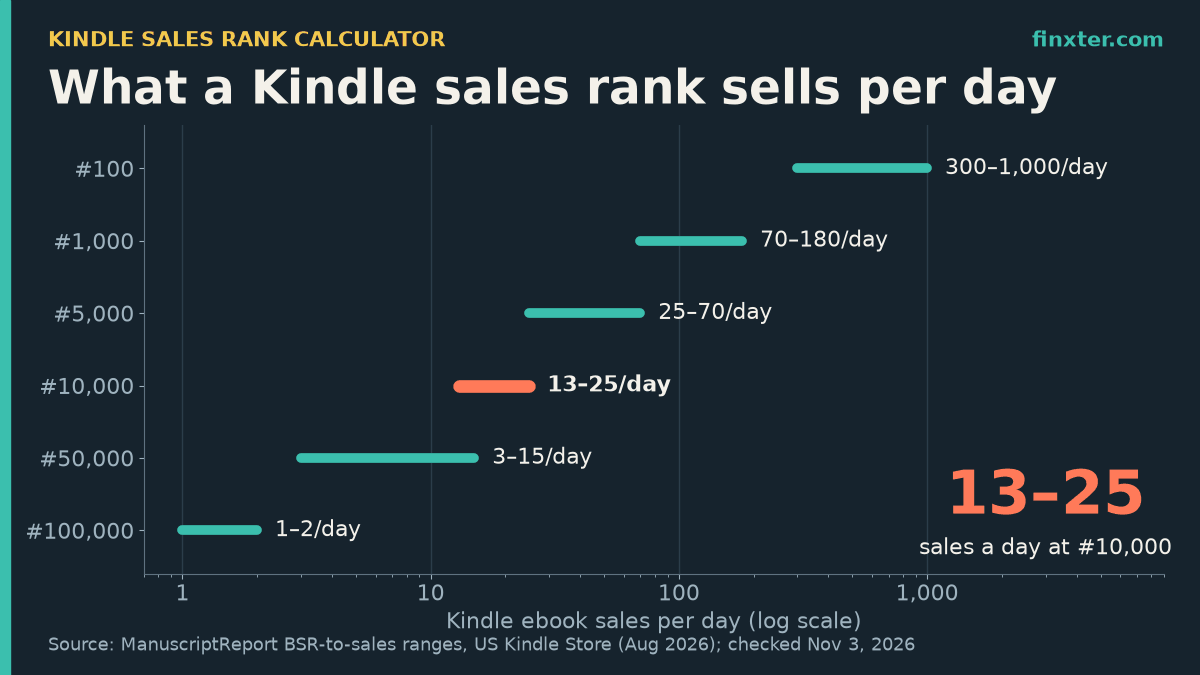
A Kindle sales rank of #10,000 means roughly 13–25 ebook sales a day in the US store, and #100,000 means about 1–2 a day. Past #500,000, the number stops tracking sales at all. Those are the August 2026 ranges from ManuscriptReport’s Kindle sales rank calculator, which triangulates six published estimators. The rest of this post shows where the calculators disagree, what each rank pays at $4.99, and the rank your catalog actually needs.
TL;DR
- Kindle sales rank → sales a day (US, ManuscriptReport Aug 2026): #1,000 ≈ 70–180, #10,000 ≈ 13–25, #100,000 ≈ 1–2. Past #500,000 rank stops tracking sales.
- Calculators disagree by 2–3×. TCK: 26 sales in one day reach #10,000, but holding it takes 390 a month.
- At $4.99 (70%, $3.45 a copy), holding #10,000 pays about $1,350–$2,600 a month; #100,000 about $100–$200.
- Romance top 10 needs 696–1,849 sales a day; Romance > Time Travel needs 19–48.
- Portfolio napkin math: $3,000/month = one book at #4,200 or ten books at #44,000.
Here’s the part most rank posts skip: a portfolio publisher doesn’t need one book at a great rank. Ten books at a mediocre rank pay the same. If more books is your bottleneck, my top pick is ImagineYourBook. It’s an AI book-writing tool that turns a prompt or your notes into a complete draft with a cover (the trial includes one 10,000-word book), exports Word and EPUB, and its Series Builder carries your story bible, characters and open threads into the next volume.
The Kindle sales rank calculator table (2026)
Amazon doesn’t publish sales numbers, so every Kindle sales rank calculator is a curve fitted to observed data. I pulled three of them on November 3, 2026: ManuscriptReport’s ranges (measured August 2026), PublishRank’s 2025 chart, and the formula inside TCK Publishing’s calculator script.
| Kindle Store rank | ManuscriptReport (sales/day) | PublishRank (sales/day) | TCK: sales in one day to hit it | TCK: sales per month to hold it |
|---|---|---|---|---|
| #100 | 300–1,000 | 100–300 | 1,074 | 16,111 |
| #1,000 | 70–180 | 50–100 | 200 | 3,001 |
| #5,000 | 25–70 | 20–40 | 50 | 749 |
| #10,000 | 13–25 | 8–20 | 26 | 390 |
| #50,000 | 3–15 | 3–6 | 5 | 76 |
| #100,000 | 1–2 | 1–3 | 2 | 35 |
| #500,000 | under 1 | under 1 | 0 | 5 |
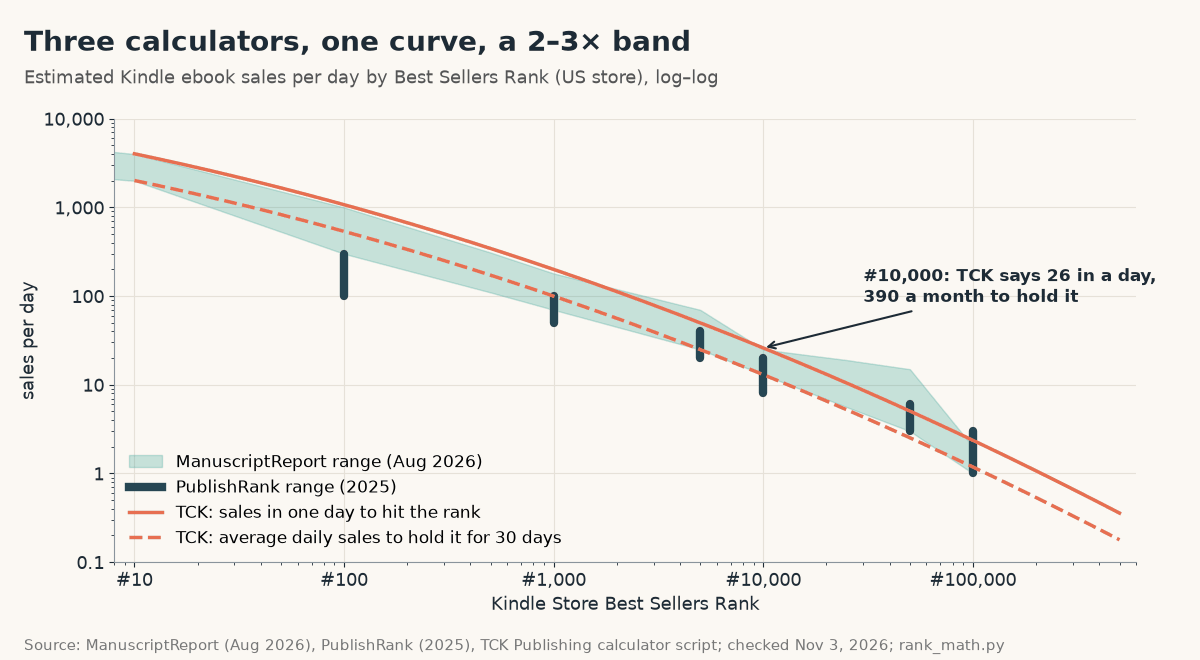
Three things jump out.
The ranges are wide on purpose. ManuscriptReport says its band exists because “the six published estimators this curve is triangulated from disagree”. At #50,000, the band runs from 3 to 15 sales a day. That’s a 5× spread. Treat the band as the answer, not the midpoint.
TCK has two numbers per rank, and they’re both right. TCK uses what it calls “The Rule of 15”: the monthly sales needed to hold a rank, divided by 15, is what you’d need in a single 24-hour burst. Amazon weights recent sales more, so one strong day can lift a book to a rank it can’t hold. At #10,000, that’s 26 sales in one day versus 390 a month to stay there. 390 a month is 13 a day, which is exactly the bottom of ManuscriptReport’s band.
Calculators drift. TCK’s page text still says #1,000 takes 2,778 sales a month or 185 in a day. The live script multiplies by an extra 1.08 and returns 3,001 and 200. Same tool, 8% apart. Rank-to-sales curves are estimates that get recalibrated, so check the date on any chart you trust.
What Amazon itself says about sales rank
KDP’s Sales Ranking help page (checked November 3, 2026) is short and blunt:
- Rankings are relative. Your rank can drop while your sales stay flat, because other books sold more.
- Ranks update at least once per day, but changes can take up to 2 days to show.
- Recent activity is weighted more heavily, but the book’s entire history counts.
- Each format (ebook, paperback, hardcover, audiobook) has its own Best Sellers Rank.
- A book can be ranked in up to three Best Seller category lists.
- Free Book Promotion downloads don’t count towards the paid lists.
And the line every calculator user should read: sales rank “is not an accurate way to track your book’s activity”. For your own books, your KDP reports are the truth. A sales rank calculator is for other people’s books: competitors, comps, and categories you’re thinking of entering.
Don’t use a calculator to audit your own sales. KDP says sales rank “is not an accurate way to track your book’s activity”. Your KDP reports show real units and page reads. Use rank calculators for competitors, comps and category research.
What each rank pays at $4.99
Now the money. At a $4.99 list price on the 70% royalty option, KDP pays 70% of the price minus delivery costs, which its pricing page puts at an average of $0.06 a copy. That’s $3.45 per sale.
| Rank held for a month | Sales/month (ManuscriptReport) | Royalties/month | Sales/month (TCK, to hold it) | Royalties/month |
|---|---|---|---|---|
| #100,000 | 30–60 | $104–$207 | 35 | $121 |
| #50,000 | 90–450 | $311–$1,553 | 76 | $262 |
| #10,000 | 390–750 | $1,346–$2,588 | 390 | $1,346 |
| #5,000 | 750–2,100 | $2,588–$7,245 | 749 | $2,584 |
| #1,000 | 2,100–5,550 | $7,245–$19,148 | 3,001 | $10,353 |
Napkin math. Assumptions: every unit is a $4.99 sale at 70%, $0.06 delivery, US store only, no Kindle Unlimited page reads, no ad spend.
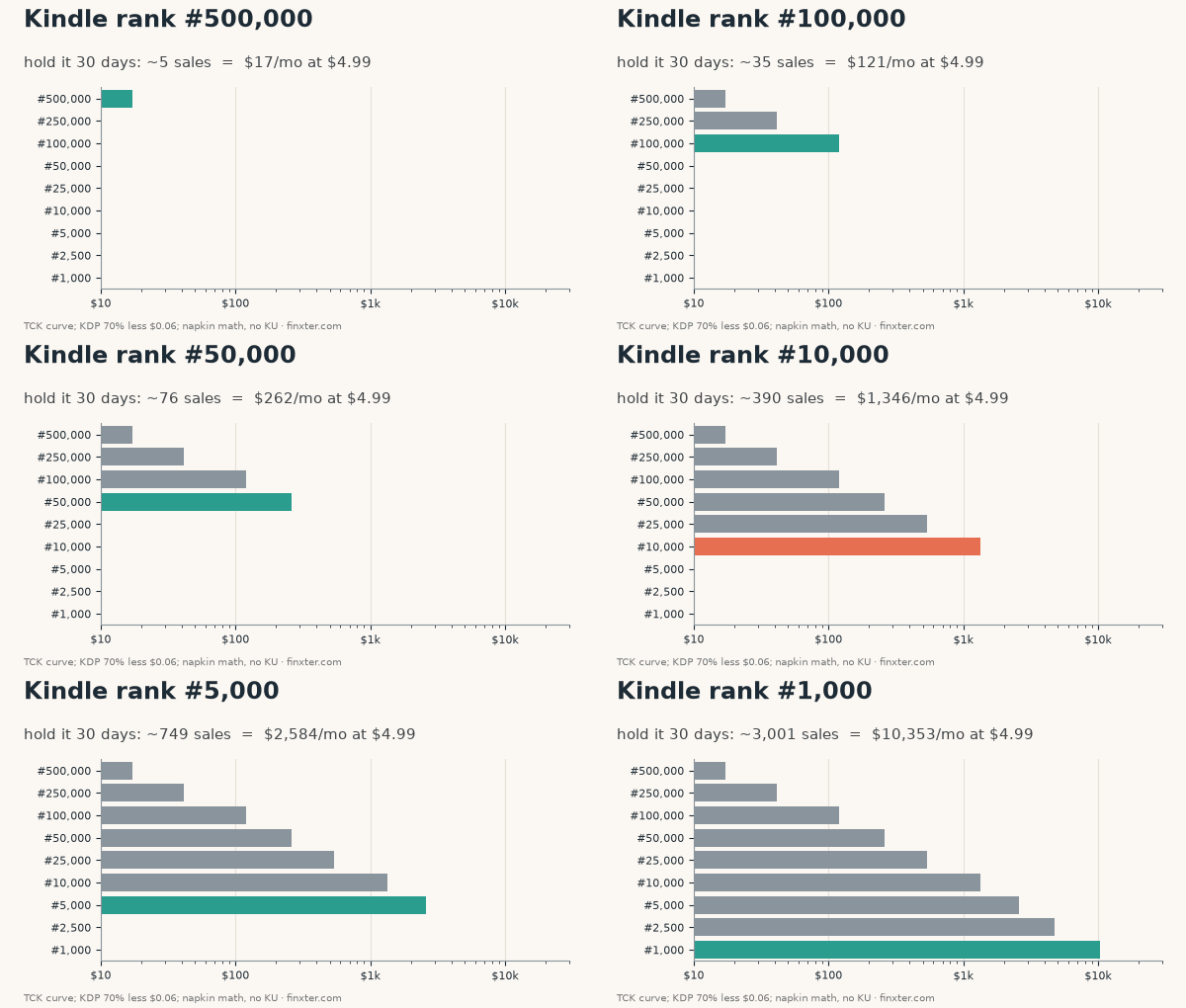
So a book holding #10,000 earns somewhere around $1,350–$2,600 a month from sales alone. A book stuck at #100,000 earns about $100–$200. That’s more than a 10× difference in income between two ranks that look like they differ by “one extra zero”.
The Kindle Unlimited catch
If a competitor is in Kindle Unlimited, their rank overstates their sales. Borrows count towards rank too, but the sources disagree on how much:
- ManuscriptReport: a KU borrow counts “once the reader opens the book”.
- Kindlepreneur (Dave Chesson, from his tracking data): a KU download is “only 0.7 as influencive as a book sale”.
- TCK Publishing (from a few hundred KDP Select books): Amazon counts one sale for rank when KENP read reaches “about 65%” of the book’s estimated page count.
Either way, a KU book’s “sales” from a calculator are really sales plus borrows. Borrows pay per page read, not $3.45 each. The US KENP rate ran $0.0042–$0.0054 per page from January to September 2026, so check my KENP rate 2026 tracker before you turn a competitor’s rank into dollars.
Romance: the rank you need depends on the shelf
A store-wide rank only matters relative to the shelf you’re trying to climb. ManuscriptReport measured 525 Kindle categories in August 2026 by reading the store-wide rank of each category’s top 10 books. For romance authors, the results are dramatic.
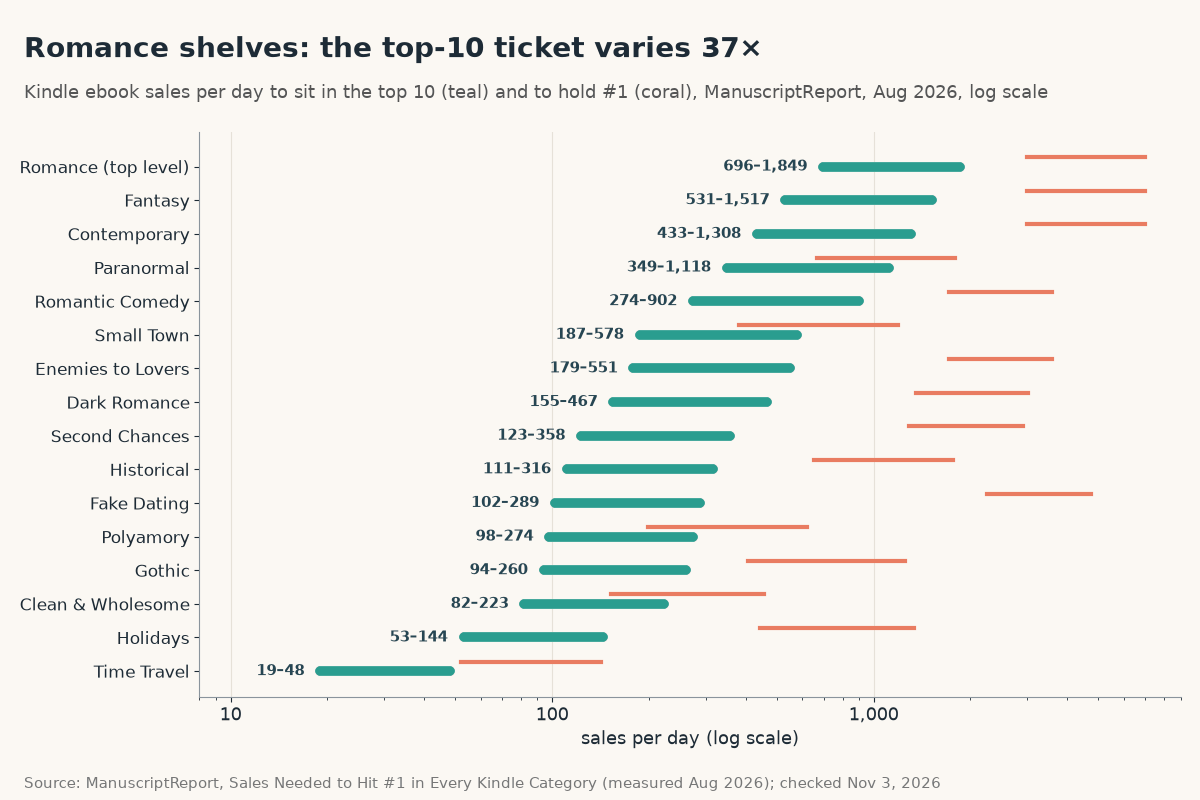
- To sit in the top 10 of Romance itself, a book needs 696–1,849 sales a day. Holding #1 takes 3,000–7,000. That’s the same ceiling as the whole store.
- Romance > Time Travel lets you into the top 10 at 19–48 a day. That’s a 37× cheaper ticket on the same store.
- Dark Romance sits in the middle: 155–467 a day for a top-10 spot. (If that’s your lane, here are the AI tools I’d try for dark romance.)
- Romance categories run a median 80% indie, according to the same dataset. You’re competing against other self-publishers, not a Big Five marketing budget.
Across all 525 shelves, 184 need fewer than 100 sales a day to hold #1. The median category needs 78–212. This is why category picks and the 7 keyword boxes matter so much (here’s my guide to KDP keywords with examples). A book selling 30 a day is invisible in Romance and in the top 10 of Time Travel.
The portfolio math: one book at #4,200 or ten at #44,000
Here’s the question a portfolio publisher should actually ask: what rank does each book need to hold for my income goal?
Take $3,000 a month from sales. At $3.45 a sale, that’s 870 sales a month. Run that through TCK’s hold-for-a-month curve:
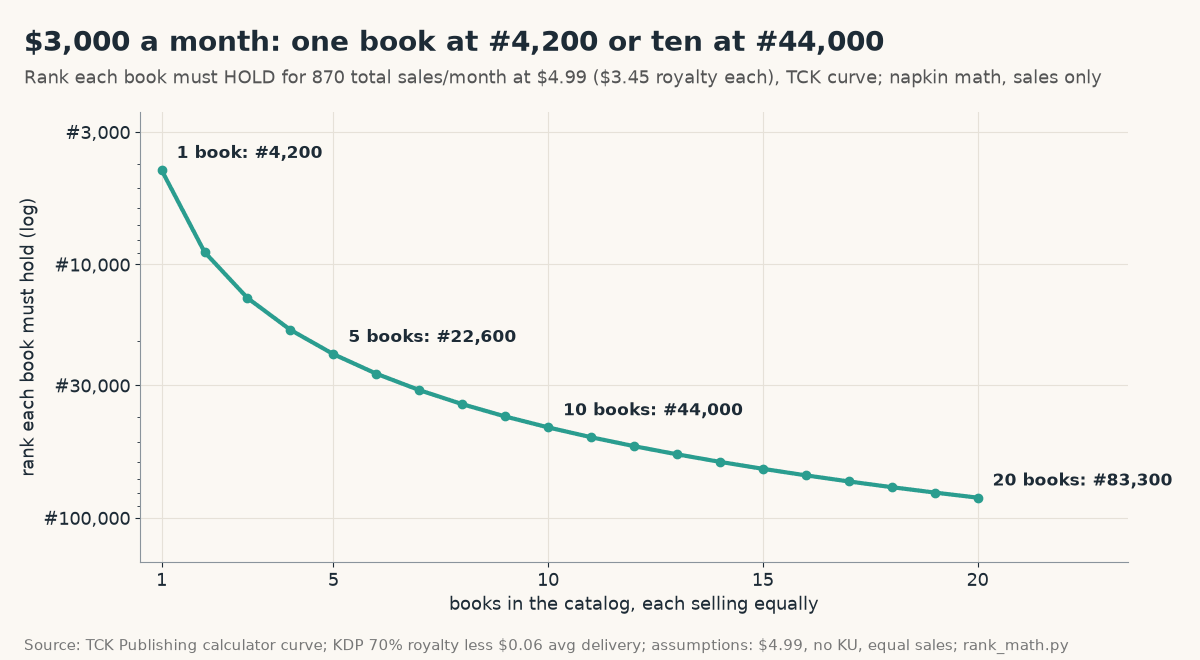
| Books in catalog | Sales/month per book | Rank each book must hold |
|---|---|---|
| 1 | 870 | about #4,200 |
| 5 | 174 | about #22,600 |
| 10 | 87 | about #44,000 |
| 20 | 44 | about #83,300 |
Napkin math with the same assumptions as above, plus equal sales per book (real catalogs are lumpier).
One book at #4,200 is a hit. Ten books each at #44,000 are a working midlist. Per ManuscriptReport’s own description, anything under #100,000 means “roughly a copy a day or better”, and under #50,000 is “a solid mid-list performer”. The catalog route trades one lottery ticket for ten realistic ones. For series authors it’s even better, because every new book is another door back to Book 1. I ran that side of the math in how many KDP books it takes to make money.
How to use a Kindle sales rank calculator in 5 steps
| Step | What to do | Watch out for |
|---|---|---|
| 1. Copy the right number | Use the store-wide “#X in Kindle Store” rank from Product details | The category ranks underneath are shelf ranks, not store-wide |
| 2. Pick the format | Ebook, paperback and audiobook each have their own rank | Don’t feed a paperback rank into an ebook curve |
| 3. Read a band, not a point | Take the range (e.g. 13–25 a day at #10,000) | Single-number tools hide a 2–3× error band |
| 4. Check a few days | Note the rank on 3–5 different days | KDP updates at least daily; one-day spikes don’t hold |
| 5. Adjust for KU and season | If the book is in KU, part of the ‘sales’ are borrows | Nov–Dec needs more sales for the same rank |
Summary
| Question | Number | What to do |
|---|---|---|
| What does #10,000 sell? | 13–25 a day (8–20 per PublishRank) | Quote it as a range |
| What does #100,000 sell? | 1–2 a day | A working backlist title, not a hit |
| One day vs. holding a rank? | #10,000: 26 in a day vs. 390 a month | Judge launches on week 2, not day 1 |
| What does a rank pay? | #10,000 ≈ $1,350–$2,600/mo at $4.99 | Subtract KU borrows for KU books |
| Which romance shelf? | Top 10: 696–1,849/day (Romance) vs. 19–48 (Time Travel) | Pick 3 categories you can actually rank in |
| One book or ten? | $3,000/mo: #4,200 vs. ten at #44,000 | Grow the catalog, not one rank |
Limitations
Every number above is an estimate, including mine. ManuscriptReport and PublishRank are US-only; non-US stores are smaller, so the same rank means fewer copies. PublishRank notes that November and December need more sales to hold any given rank, which matters if you’re reading this in November. Paperback rank runs on its own curve: TCK’s print formula gives about 25 sales in a day at #10,000, close to its ebook number but not the same thing. The dollar tables ignore Kindle Unlimited, ad spend and taxes. If you want to plug in your own prices, my KDP royalty calculator does the per-copy part.
The takeaway
A Kindle sales rank calculator answers “how many copies is that book selling?” in a band, not a number: #10,000 is 13–25 a day, #100,000 is 1–2. Use it to size categories and competitors, never to audit your own sales. And if the rank you need for your income goal looks out of reach for one book, divide it across more books. Ten books at #44,000 pay the same as one at #4,200.
If drafting the next ten books is the slow part, try ImagineYourBook to get a complete first draft, then revise it in your own voice. You pay $0 today for a seven-day trial that includes one 10,000-word Small Book. A card is required, and the first $29.99 monthly charge happens after seven days unless you cancel before day eight.
Sources (checked November 3, 2026): ManuscriptReport: Amazon Book Sales Calculator, BSR to sales ranges (updated Aug 2026) · ManuscriptReport: Sales needed to hit #1 in every Kindle category (525 categories, Aug 2026) · PublishRank: Amazon BSR to sales chart (2025) · TCK Publishing: Amazon Book Sales Calculator and Rule of 15 (formula from its calculator script) · Kindlepreneur: KDP sales rank calculator, KU download weighting · KDP Help: Sales Ranking · KDP Help: eBook royalties (70% option, $0.06 average delivery). Napkin assumptions: $4.99 list price, 70% royalty, $0.06 delivery, US store, sales only (no Kindle Unlimited), equal sales per book in the portfolio table.