
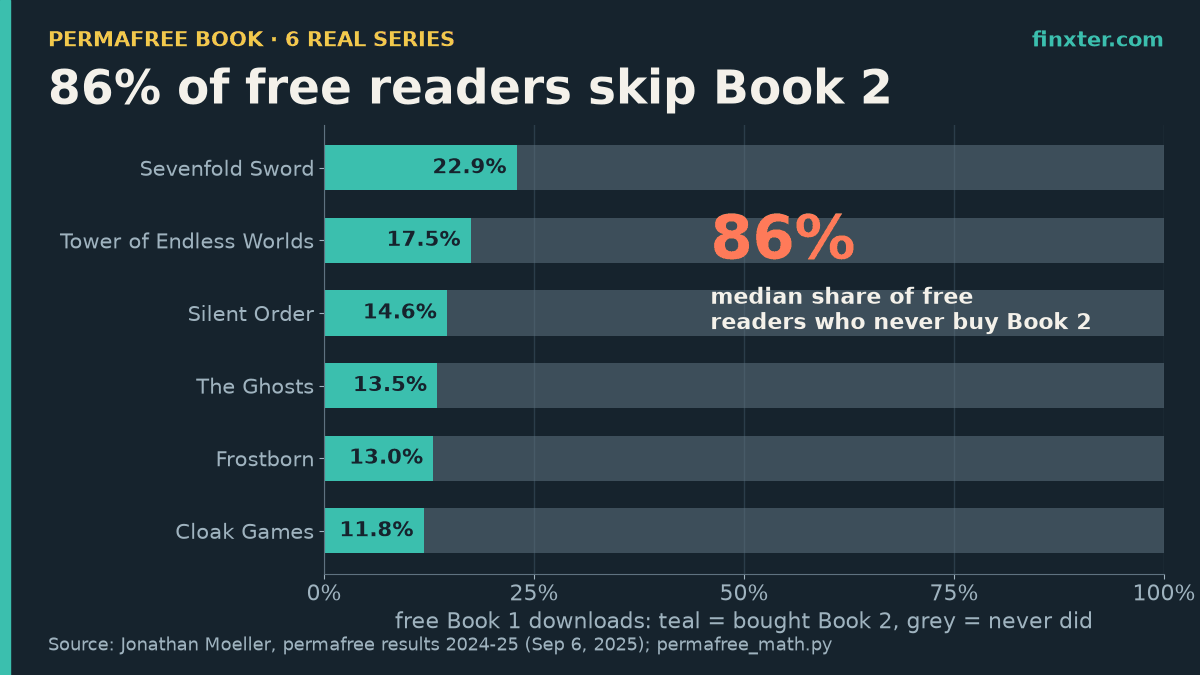
A permafree book loses 86% of its readers at the first paywall, and that is the good news. In six permafree series tracked by fantasy author Jonathan Moeller over 2024 and 2025, a median of just 14% of free Book 1 downloads went on to buy Book 2. But 94–100% of those buyers kept going to the final book.
So what is a permafree book, and is it worth it? A permafree book is a Book 1 you set to $0.00 for good, so every new reader can try your series risk-free. On Amazon you can’t type $0.00 into KDP. You make the book free at other retailers and ask Amazon to price-match. On a 5-book series at $3.99, the median free download is worth about $1.49 in later sales, so permafree wins when it brings in at least 5.6 times as many readers as a paid Book 1.
Below: the funnel, the per-download math, the series-length rule, and the exact KDP steps.
TL;DR
- A permafree book is a Book 1 that stays at $0. On Amazon you get there by making it free at other retailers and asking KDP to price-match.
- In six permafree series (Moeller, 2024–25), a median 14% of free downloads bought Book 2; 86% never did.
- But 94–100% of Book 2 buyers went on to the final book: the leak is one step, not the whole funnel.
- On a 5-book series at $3.99, a free download is worth about $1.49; a paid Book 1 buyer is worth $8.32, so free must bring 5.6x the readers.
- Longer series flip the math: at 10 books the break-even drops to 4.3x. Permafree is a series tool, not a standalone tool.
The funnel: one leak, then a pipe
Most read-through advice assumes readers drain away book by book. Kindlepreneur’s read-through guide uses a typical paid funnel of 100 → 65 → 50 → 48 → 45 buyers across a five-book series: the drop is spread out, the biggest one at Book 2.
Free readers behave differently. Here is Moeller’s data (share of free Book 1 downloads that bought Book 2, then the last book):
| Series (Book 1 permafree) | Bought Book 2 | Bought final book | Book 2 buyers who finished |
|---|---|---|---|
| The Ghosts | 13.47% | 12.72% | 94.4% |
| Frostborn | 13.00% | 12.93% | 99.5% |
| Sevenfold Sword | 22.93% | 22.81% | 99.5% |
| Cloak Games | 11.85% | 11.67% | 98.5% |
| Silent Order | 14.64% | 14.54% | 99.3% |
| Tower of Endless Worlds | 17.46% | 17.46% | 100.0% |
Two things stand out:
- The leak is at one step. Between 77% and 88% of free downloaders never pay for anything. Plenty of free books are simply never read: even among BookBub’s deal readers, only 60% say they always read the discounted books they grab.
- After Book 2 the pipe is almost sealed. Divide final-book buyers by Book 2 buyers and you get 94.4% for The Ghosts and 98.5–100% for the other five. Someone who pays for Book 2 has already chosen you.
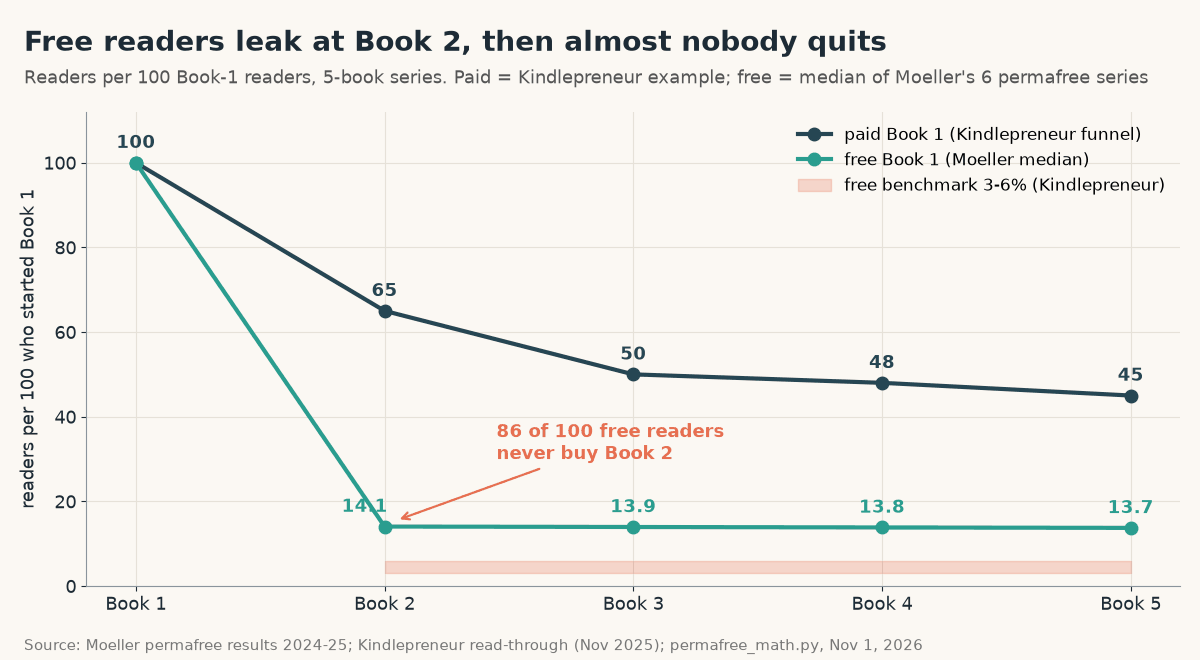
Moeller is a veteran with many finished series, so don’t assume his rates. Kindlepreneur warns that with a free Book 1 you “should be expecting something closer to 3–6%” of readers to buy Book 2. That gap matters, so I run both through the math below.
If you want a Book 2 that free readers actually buy, the writing has to deliver first. The step that makes permafree possible at all is having Books 2–5 ready. If drafting is your bottleneck, ImagineYourBook is my top pick for series authors: it turns a prompt or your notes into a full draft with a cover and Word/EPUB export, and its Series Builder carries a story bible (characters, world rules, open threads) into the next volume, so Book Two remembers Book One.
What one free download is worth
Assumptions for this napkin math (label them as such and swap in your own):
- Books 2–5 sell at $3.99, which nets “about $2.70” per sale at the 70% royalty (Kindlepreneur’s figure; the KDP formula subtracts a delivery fee of $0.15 per MB).
- Free readers follow Moeller’s pattern: a Book 2 rate, then a near-flat line to the final book.
- Paid readers follow Kindlepreneur’s 100/65/50/48/45 funnel.
Free download, median series: about 14 of 100 readers buy Books 2, 3, 4 and 5. That is $1.49 per download (range $1.27 for Cloak Games to $2.47 for Sevenfold Sword).
Paid Book 1 buyer: 100 + 65 + 50 + 48 + 45 = 308 sales per 100 buyers, so 3.08 × $2.70 = $8.32 per buyer.
Break-even: $8.32 ÷ $1.49 = 5.6 free downloads per paid reader (3.4 to 6.5 across Moeller’s series).
At Kindlepreneur’s 3–6% benchmark, a free download is worth only $0.32–$0.65, and you need 13 to 26 free downloads per lost paid reader.
Is that achievable? The best public data point is old but large: in its 2015 and 2016 surveys, Smashwords found free books on Apple got 41 times the downloads of paid books. In the 2015 survey, its 200 bestselling series with a free series starter earned 66% more than the 200 bestselling series without one, on average and at the median. Treat those as direction, not a forecast. The free-book market is more crowded now.
Series length is the real lever
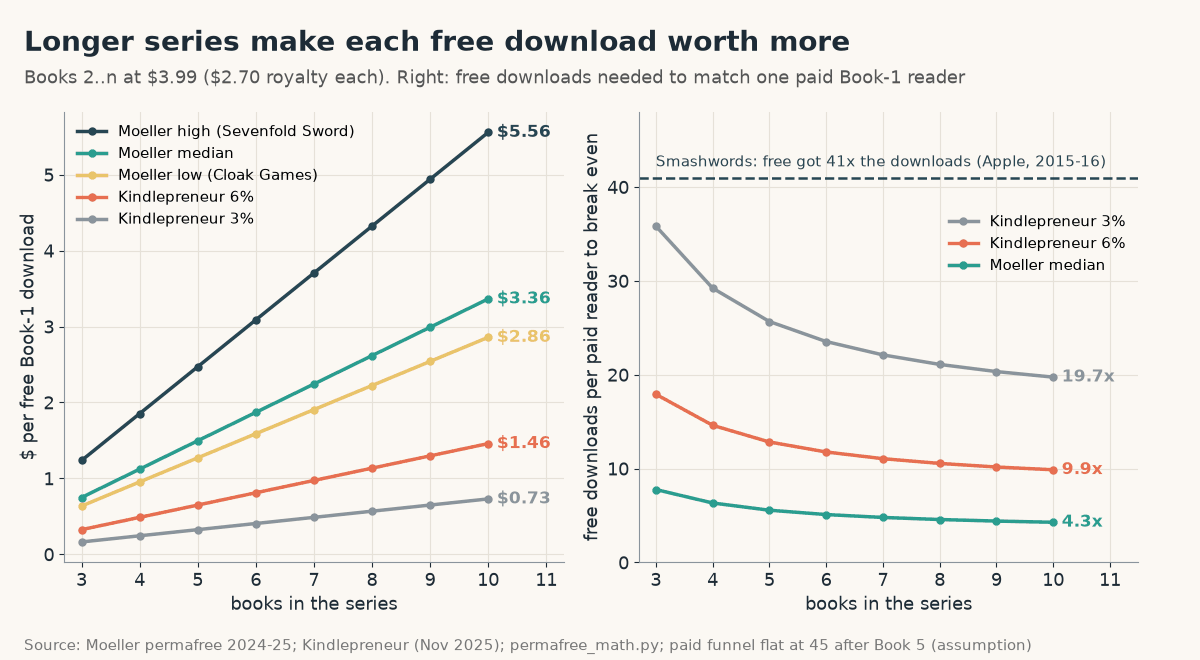
Every extra book adds another $2.70 × 14% to each free download, while the cost of giving Book 1 away stays the same. The right side of the chart shows the break-even multiple falling:
- 3 books: you need 7.8 free downloads per paid reader at Moeller’s median, 36 at Kindlepreneur’s 3%.
- 5 books: 5.6 at Moeller’s median, 26 at 3%.
- 10 books: 4.3 at Moeller’s median, 9.9 at 6%, 19.7 at 3%.
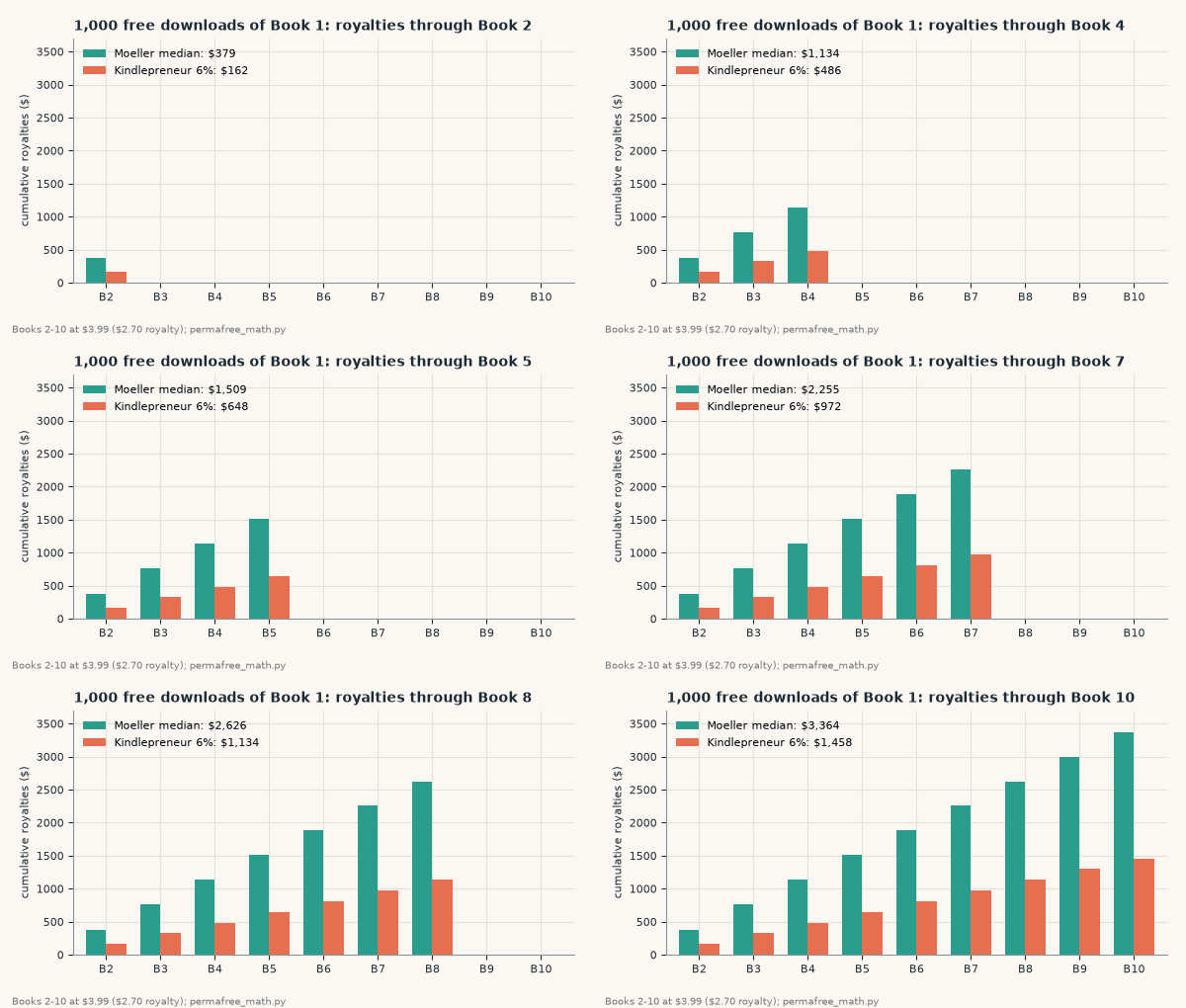
Put differently: 1,000 free downloads on a 10-book series are worth about $3,364 at Moeller’s median and $1,458 at Kindlepreneur’s 6%. Watch the gap build book by book:
That’s why Moeller sums up the strategy as “write five books and make the first one free”. BookBub’s permafree guide reports that more than 75% of its authors saw higher sales of their other books after a free promotion, and that the lift was up to five times higher when the free book was part of a series. One author it quotes runs ads mostly on free first-in-series books, “emphasizing my longer series so the cost of advertising is spread across more books.”
The portfolio takeaway for AI-assisted publishers: permafree is a series tool, not a book tool. A standalone has no Book 2 to pay for it. With three books it’s a gamble on a high Book 2 rate. With five or more, even a mediocre conversion usually clears the bar. If you’re still planning the series, see how to write a romance book series, where Book 1 accounts for only 32% of a paid five-book series’ sales.
How to make a book permafree on Amazon (step by step)
KDP has no $0.00 price option. Amazon’s pricing terms say it may sell your book “at a lower price to match a third party’s price”, and that is the door you use.
| Step | What to do | Watch out |
|---|---|---|
| 1. Leave KDP Select (Book 1 only) | Untick auto-renew in Manage KDP Select and wait for the 90-day term to end | Books 2+ can stay enrolled; exclusivity is per eBook |
| 2. Go wide with Book 1 | Publish at Apple Books, Kobo, Barnes & Noble and Google Play, directly or via an aggregator such as Draft2Digital | Same title, cover and author name everywhere |
| 3. Set $0.00 there | Set the list price to free at each retailer (or once in the aggregator) | Check every store and region shows $0 |
| 4. Ask KDP to price-match | KDP Help → Contact Us → Pricing → Price Matching; per region: ASIN / Kindle Store / links to the free listings / 0.00 | Amazon only matches the regions you request |
| 5. Wait and verify | Can take up to a few days; check each Amazon store | Amazon isn’t obligated to match; request well before a promo |
| 6. Wire the back matter | Book 2 link right after “The End”, plus your series page and newsletter | This is where the 86% leak is fixed or not |
The KDP Select catch: enrollment is per eBook, and an enrolled eBook “can only be distributed through KDP and public libraries” during its 90-day term (KDP help). So Book 1 has to leave Select to be free elsewhere, but Books 2+ can stay in Kindle Unlimited (now branded Kindle+). That hybrid is common: free wide funnel at the top, page reads below.
Don’t break exclusivity by accident: if Book 1 is still in its KDP Select term, it can’t be free (or on sale) anywhere else. Turn off auto-renew first, let the term run out, then go wide.
If you’d rather keep Book 1 in KU, you get five free days per 90-day term instead. I ran that comparison in Kindle Countdown vs Free Book Promotion (free still won 4.6× on a 5-book series), and the full exclusivity trade-off is in KDP Select vs wide. Note that Kindlepreneur calls an 86% Book 1 → Book 2 read-through normal in KU and 75% low, so a KU-heavy romance series gives up more by pulling Book 1 out.
Make the free reader count
Since the whole loss happens before Book 2, every lever sits at the end of Book 1:
- Back matter first. Put the Book 2 link on the page right after “The End”. In BookBub’s guide, author Jane Steen did exactly that and saw later-series sales nearly double in the month after a feature.
- Target the downloads. Moeller’s warning: downloads from people who’d never buy your genre don’t convert, and bot-farm downloads can get the free book delisted or your account suspended. Targeted ads and genre promo sites beat raw volume.
- Measure your own rate. Book 2 sales ÷ Book 1 free downloads over the same months, then compare it with Kindlepreneur’s 3–6% and Moeller’s 12–23%. If you’re near 3%, fix Book 1’s ending and back matter before you pay for promos.
- Budget ads per download. Your break-even cost per free download is your value per download: about $1.49 at Moeller’s median on 5 books, $0.32 at 3%. If you’re using ads, the KDP ads math shows how to set that ceiling.
| Question | Number | What to do |
|---|---|---|
| How many free readers buy Book 2? | Median 14% (Moeller); 3–6% (Kindlepreneur) | Measure your own rate before paying for promos |
| Who finishes after Book 2? | 94–100% of Book 2 buyers | Spend your effort on Book 1’s ending and back matter |
| Value of a free download (5 books, $3.99)? | $1.49 median; $0.32–$0.65 at 3–6% | Use it as your max cost per download |
| Break-even vs a paid Book 1 buyer? | 5.6x downloads (13–26x at 3–6%) | Smashwords saw 41x on Apple (2015–16) |
| Series length? | 10 books: 4.3x break-even, $3,364 per 1,000 downloads | Go permafree at 5+ books |
| KU? | Book 1 must leave Select; Books 2+ can stay | Or use 5 free days per 90-day term instead |
Limitations
- Moeller’s six series are finished series, all from one author of fantasy and science fiction, measured over 2024–2025. Romance numbers may be higher or lower.
- The Smashwords multipliers are from 2015–2016 Apple data. They show the direction, not today’s level.
- The paid funnel is Kindlepreneur’s illustrative example, and I hold it flat at 45 after Book 5 (assumption). The $2.70 royalty assumes $3.99 and a small file.
- Price-matching is up to Amazon. Retailers may match slowly or not at all, so request it well before any promo.
The takeaway
A permafree book doesn’t fail when 86% of readers never buy Book 2. That’s the expected outcome. It fails when there isn’t enough series behind Book 1 to pay for the 14% who stay. Write the series first, then make Book 1 free once you have five books (or at least three plus a strong Book 2 rate), and measure your own Book 2 conversion before you spend on promos.
If the next three books are what stands between you and a permafree funnel, ImagineYourBook can draft them with series memory, so you spend your time on the edit and the back matter. The trial costs $0 today with a card on file and includes one complete 10,000-word Small Book. The first $29.99 charge comes after 7 days; cancel before day 8 if it’s not for you.
Sources (checked November 1, 2026): Jonathan Moeller: Permafree Results For Indie Authors (Sep 2025) · Kindlepreneur: How to calculate series read-through (Nov 2025) · BookBub Insights: permafree guide (Oct 2026) · Smashwords 2015 survey · Smashwords 2016 survey · Written Word Media: how to make your book free on KDP · KDP Help: KDP Select enrollment · KDP Help: Digital Book Pricing Page · ImagineYourBook pricing and trial terms. Napkin assumptions: Books 2+ at $3.99 netting $2.70, free readers follow Moeller’s Book 2 → final pattern, paid readers follow Kindlepreneur’s example funnel held at 45 after Book 5. Related: the KDP royalty calculator for checking your own per-sale royalty.