
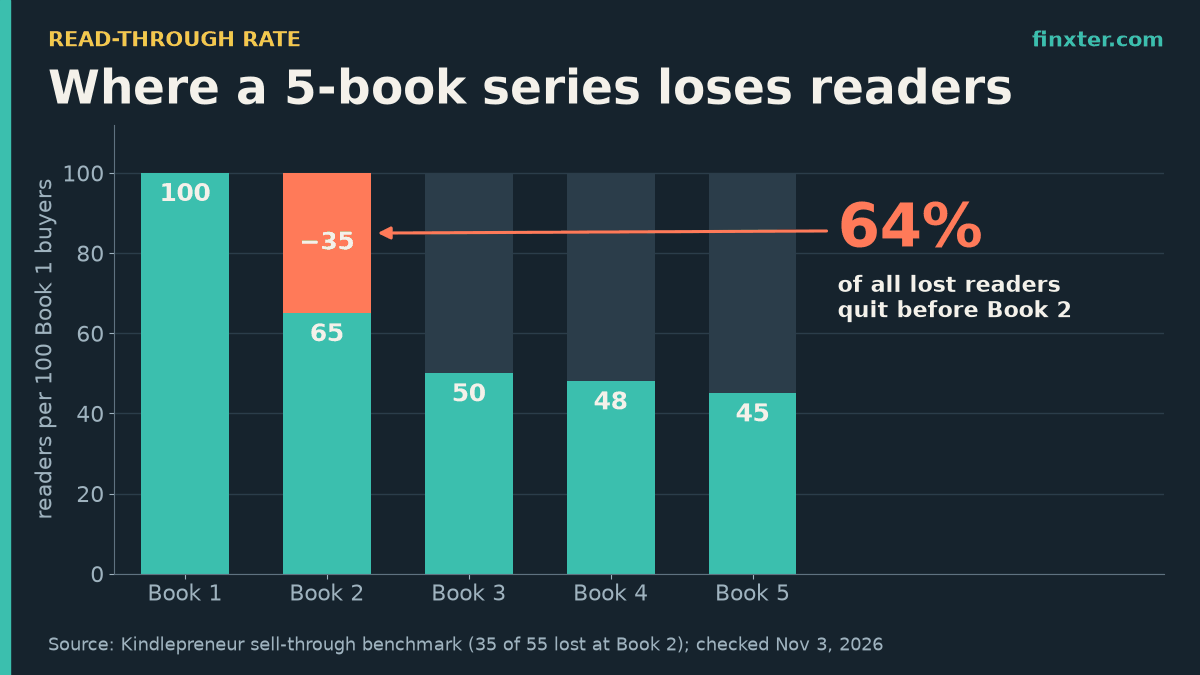
Most series authors picture readers trickling away a few at a time, book after book. They don’t. In Kindlepreneur’s 5-book sell-through benchmark, 35 of the 55 readers the series loses are gone before Book 2 even starts. That’s 64% of all the leakage, at one step.
So what’s a good read-through rate? For paid sales, Book 1 to Book 2 is usually 50–60%, and below 50% is a warning sign. In Kindle Unlimited, around 86% is normal and 75% is low. Later books usually hold 77–96% of the readers who got that far.
The surprising part is where that leaves your next hour of work. A 10-point fix at the end of Book 1 pays about three-quarters as much as writing a whole Book 6. If the gap you need to close is getting Book 2 and Book 3 out while Book 1 readers are still hungry, a series-aware drafting tool like ImagineYourBook is the natural next step. Its “Book Two remembers Book One” memory carries characters, canon and voice into the next volume.
TL;DR
- Good read-through rate, Book 1→2: 50–60% for paid sales (below 50% is a problem), about 86% in Kindle Unlimited (75% is low), 3–6% from a free Book 1.
- In Kindlepreneur’s 5-book benchmark, 35 of 55 lost readers (64%) leave before Book 2; later steps hold 77–96%.
- A real 9-book series (Mike Grist) lost 72% of its leavers at the first step; Book 1 had 235 reviews, Book 2 had 40.
- Napkin math ($3.99 books, $2.70 royalty): +10 points at Book 1→2 = +$0.86 per Book 1 buyer, 76% of what writing Book 6 adds ($1.14).
- Break-even ad cost: $0.42 a click at 65% read-through and 1 sale per 20 clicks; $0.24 with a 99¢ Book 1.
What read-through rate means (and how to calculate it)
Read-through rate is the share of readers of one book who go on to read the next. IngramSpark’s definition is the simplest one: if 100 people read Book 1 and 75 read Book 2, your Book 1→2 read-through is 75%. If 60 of those 75 read Book 3, Book 2→3 is 80%, and Book 1→3 is 60%.
Two flavors matter on Amazon:
- Sell-through (paid sales): divide Book 2 sales by Book 1 sales for the same period. Kindlepreneur’s example: 247 ÷ 428 = 57.7%.
- KU read-through: convert page reads to full reads first. Divide KENP pages read by the book’s KENPC (shown in your KDP Select info). Kindlepreneur’s example: 91,303 pages ÷ 402 = 227 full reads of Book 1, and 196 of Book 2, which gives 86.3%.
| Step | Paid sales (sell-through) | Kindle Unlimited |
|---|---|---|
| 1. Pick a window | A stable-price period where both books were live | Same window; avoid promo spikes |
| 2. Count Book 1 | Units sold (add box-set sales that contain Book 1) | KENP pages read ÷ KENPC = full reads |
| 3. Count Book 2 | Units sold | KENP pages read ÷ Book 2’s KENPC |
| 4. Divide | Book 2 ÷ Book 1 (e.g. 247 ÷ 428 = 57.7%) | Book 2 ÷ Book 1 (e.g. 196 ÷ 227 = 86.3%) |
| 5. Repeat per step | Book 3 ÷ Book 2, … and last book ÷ Book 1 | Same; KU usually runs higher than paid |
Benchmarks: what’s a good read-through rate?
The numbers people quote cluster tightly once you split them by format.
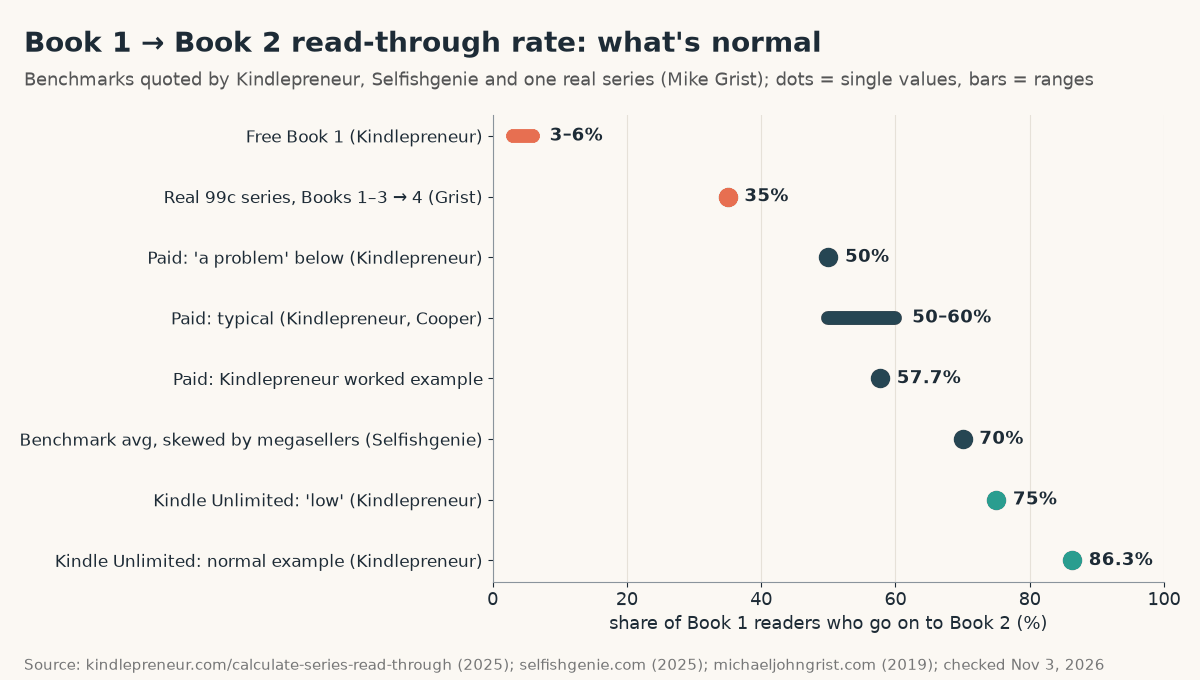
- Paid, Book 1→2: “Many authors see something in the neighborhood of 50-60%,” Kindlepreneur writes, and “if it’s less than 50%, there’s a problem you need to address.”
- Kindle Unlimited: about 86% is normal. “I would consider 75% to be low” for a KU book that has found its audience.
- Free Book 1: expect 3–6% of free readers to buy Book 2.
- 99¢ Book 1: sell-through is typically 10–30% lower than at full price, because more bargain buyers never open the book.
- The “70%” benchmark: Selfishgenie Publishing quotes 70% from Book 1 to 2 as a benchmark average. It also warns that megasellers like Harry Potter and Jack Reacher skew that number, so the average indie author shouldn’t expect it.
Why the leak is at Book 2, not at the end
Here’s Kindlepreneur’s one-month 5-book table, read as a funnel:
| Book | Sales | Book-on-book | Cumulative | Readers lost at this step |
|---|---|---|---|---|
| 1 | 100 | – | – | – |
| 2 | 65 | 65.0% | 65% | 35 |
| 3 | 50 | 76.9% | 50% | 15 |
| 4 | 48 | 96.0% | 48% | 2 |
| 5 | 45 | 93.8% | 45% | 3 |
That’s 55 readers lost by Book 5, and 35 of them (64%) left at the very first step. Once a reader has bought two books, the book-on-book rate climbs into the 90s. Kindlepreneur calls the rising book-on-book rate “expected”.
A real series shows the same shape. Mike Grist tracked his 9-book Last Mayor series, with Book 1 often at 99¢ and box sets in the mix. Only 35% of readers moved from his first step (Book 1 plus the Books 1–3 box set) to the second (Book 4 plus the 4–6 box set). By Book 7, he was down to 10%. Of the 90 readers per 100 he lost by Book 7, 65 (72%) dropped at that first step.
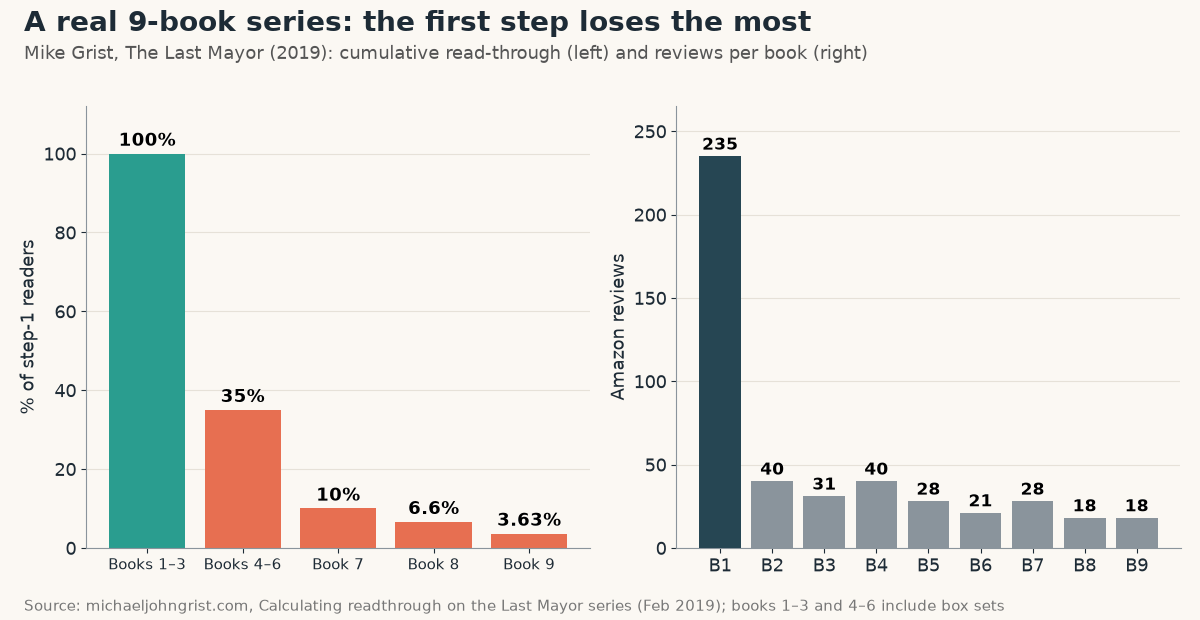
His review counts tell the same story without any math: 235 reviews on Book 1 against 40 on Book 2. The later books average higher star ratings, too, because “only the fans are still reading.”
Napkin math: what a read-through point is worth
Assumptions (all from Kindlepreneur’s article): every book at $3.99, which pays about $2.70 in royalties; the book-on-book rates from the table above; paid sales only, no KU; ad conversion of 1 sale per 20 clicks (their improved example).
Per 100 Book 1 buyers, the series sells 100 + 65 + 50 + 48 + 45 = 308 books. That’s 3.08 books per Book 1 buyer, or $8.32 in royalties.
Now compare three ways to spend your next month:
- Lift Book 1→2 by 10 points (65% → 75%). Every later book gains 10/65 more readers: +$0.86 per Book 1 buyer, or +$864 per 1,000 buyers.
- Lift Book 2→3 by 10 points (76.9% → 86.9%). Only Books 3–5 benefit, and from a smaller base: +$0.50.
- Write Book 6, holding Book 5’s 93.75% carry-over: +$1.14.
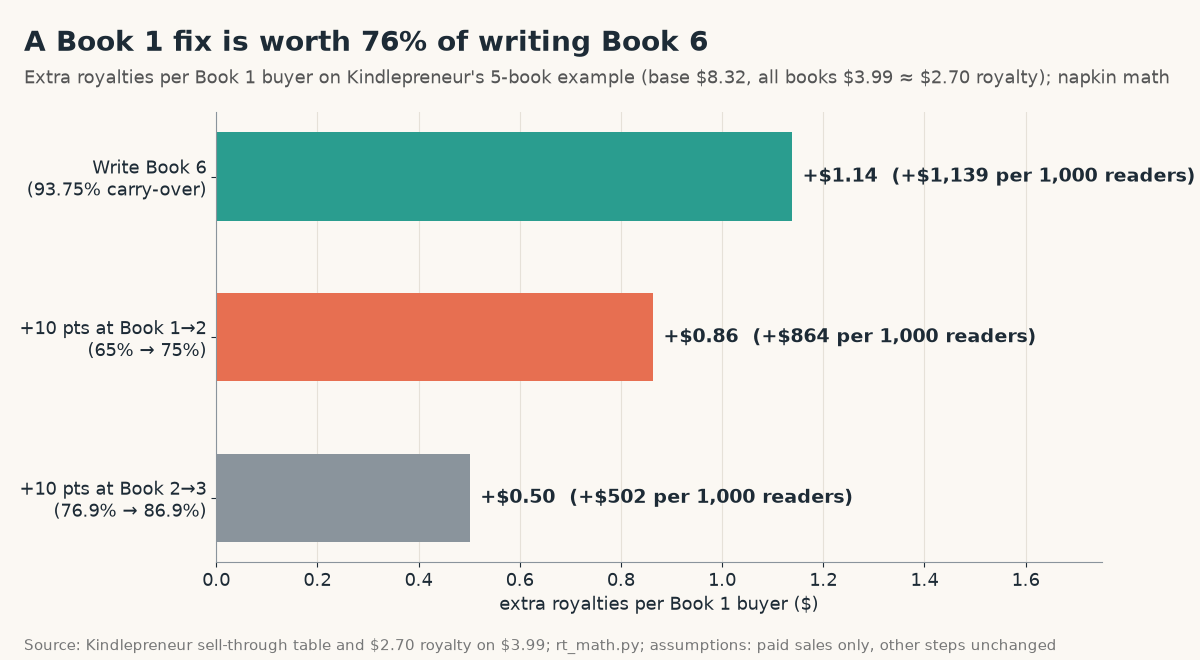
The fix at the end of Book 1 pays 76% of what a whole new novel pays, and 1.7× what the same fix pays one book later. A new ending, a stronger hook into Book 2, and better back matter take days. Book 6 takes months.
The same math sets your ad ceiling. Break-even cost per click is value per Book 1 buyer ÷ clicks per sale. At 65% read-through that’s $8.32 ÷ 20 = $0.42 a click. With a 99¢ Book 1 ($0.35 royalty) and read-through 20% lower (the midpoint of Kindlepreneur’s 10–30%), each Book 1 buyer is worth only $4.84, and the ceiling drops to $0.24.
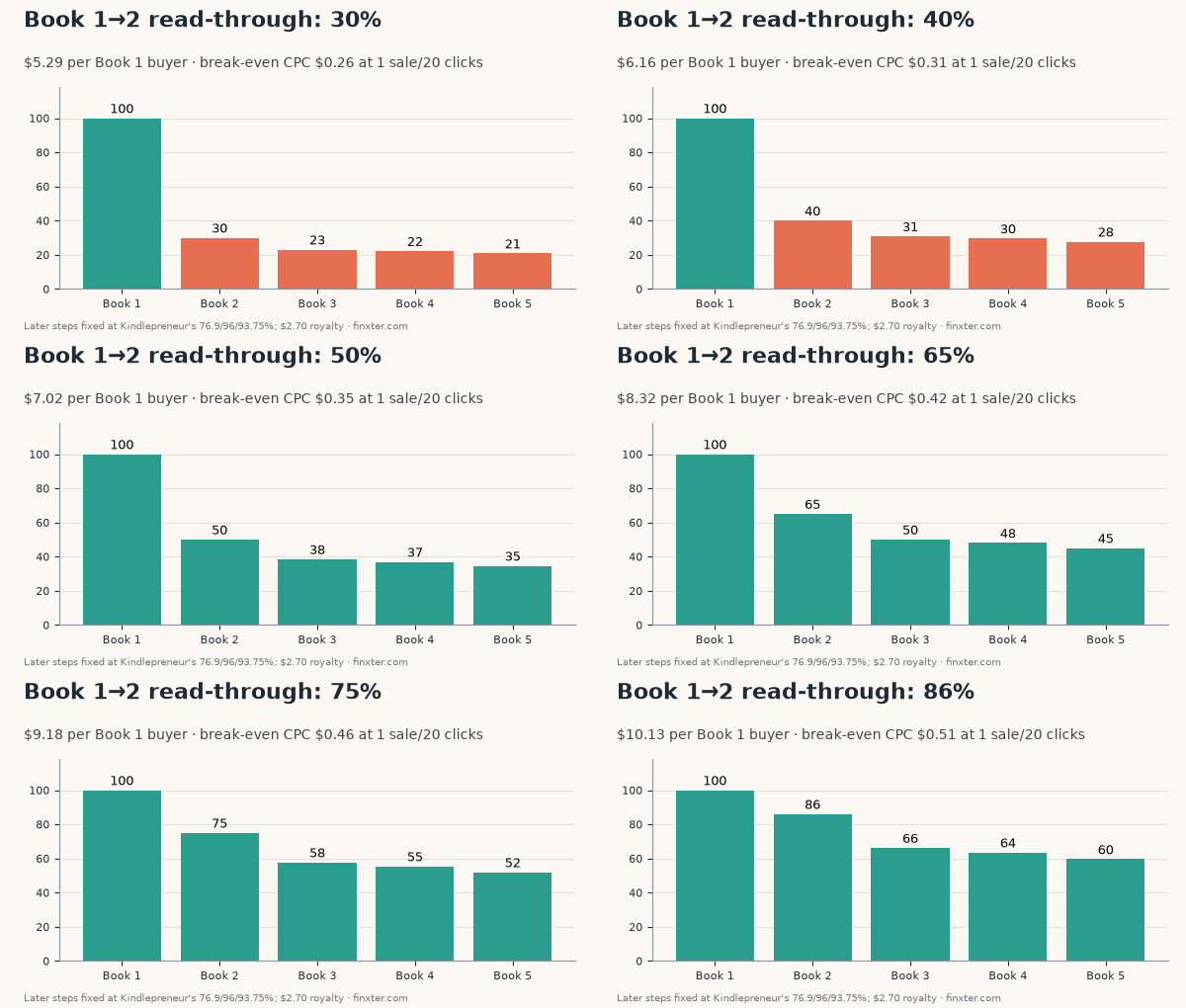
Drag the Book 1→2 rate from 30% to 86% and the whole series moves with it. Value per Book 1 buyer rises from $5.29 to about $10.13 in this example, because everything downstream of Book 2 inherits the change. More on that ad math in Are KDP Ads Worth It?.
How to raise your read-through rate
Selfishgenie splits the causes into reader-driven ones (taste, fatigue, distraction), which you can’t fix, and author-driven ones, which you can:
- Make Book 1 a real series entry. Link the books as a series on Amazon, and write a series blurb as strong as the single-book blurbs.
- Back matter that sells Book 2. Put the opening of Book 2 at the end of Book 1. Selfishgenie suggests at least 5,000 words. Add a universal link to the series page (no ads there, plus a “buy the whole series” button). Remember that adding a book changes the series page ASIN, so update those links.
- Category and cover honesty. Readers who bought the wrong genre don’t buy Book 2.
- Price steps. Kindlepreneur warns that a jump from $2.99 to $4.99 loses fence-sitters, and that a 99¢ Book 1 typically costs 10–30% in sell-through.
- Release timing. If Book 2 is only a few months old, the rate hasn’t caught up yet. Measure a window where both books were live at stable prices.
- Read the 1–3 star reviews of Book 1. Kindlepreneur says that’s usually where the answer is.
Don’t compare a free or 99¢ Book 1 to the 50–60% benchmark. Kindlepreneur expects 3–6% from free readers and 10–30% lower sell-through at 99¢. Compare like with like, and measure over a period with stable prices.
For the bigger picture, see why Book 1 is only 32% of the money, how a permafree Book 1 still pays at low conversion, and how to write a romance book series that earns its read-through.
| Question | Number | What to do |
|---|---|---|
| Good Book 1→2 rate (paid)? | 50–60%; under 50% = problem | Read Book 1’s 1–3 star reviews |
| Good Book 1→2 rate (KU)? | ~86% normal; 75% is low | Check genre/cover fit if below 75% |
| Free or 99¢ Book 1? | Free: 3–6%; 99¢: 10–30% lower | Judge free funnels on downloads × rate |
| Where do readers leave? | 64% of losses before Book 2 (example); 72% at step 1 (Grist) | Fix the Book 1 → 2 handoff first |
| What’s +10 points worth? | +$0.86 per Book 1 buyer vs +$1.14 for Book 6 | Fix the ending and back matter before writing Book 6 |
| Max ad cost per click? | $0.42 (65%, 1:20); $0.24 with 99¢ Book 1 | Price ads off series value, not Book 1 |
Limits of these numbers
The 5-book table is Kindlepreneur’s worked example for one month, not a survey of thousands of series. Grist’s numbers are one author’s 2019 data, with box sets merged in. Every benchmark here is self-reported by authors or advisers. Treat them as ranges to check against your own KDP reports, not as targets.
The takeaway
Your read-through rate is decided mostly at one handoff: the last page of Book 1 and the first page of Book 2. Fix that step before you write Book 6, and price your ads off the value of a Book 1 buyer, not the price of Book 1.
The other half is having Book 2 and Book 3 ready while readers still care. If you want first drafts of the next volumes that keep the same characters, canon and voice, ImagineYourBook writes full text-based book drafts with a cover. Its Publisher plan covers about three 40,000-word novels a month for $59.99. The 7-day trial is $0 today and includes one 10,000-word book, but a card is required and the $29.99 Author plan starts unless you cancel before day 8. Edit the draft into your own book before it carries your name.
Sources (checked November 3, 2026): Kindlepreneur: How to Calculate Series Read-Through (updated Nov 8, 2025) · Selfishgenie Publishing: Upping Your Read Through Rates (2025) · Mike Grist: Calculating readthrough on the Last Mayor series (Feb 2019) · IngramSpark: Marketing a Book Series: The Power of Read-Through. Napkin assumptions: all books $3.99 (~$2.70 royalty), 99¢ Book 1 pays $0.35, paid sales only, 1 sale per 20 ad clicks, later read-through steps unchanged when one step is lifted, Book 6 keeps a 93.75% carry-over.