
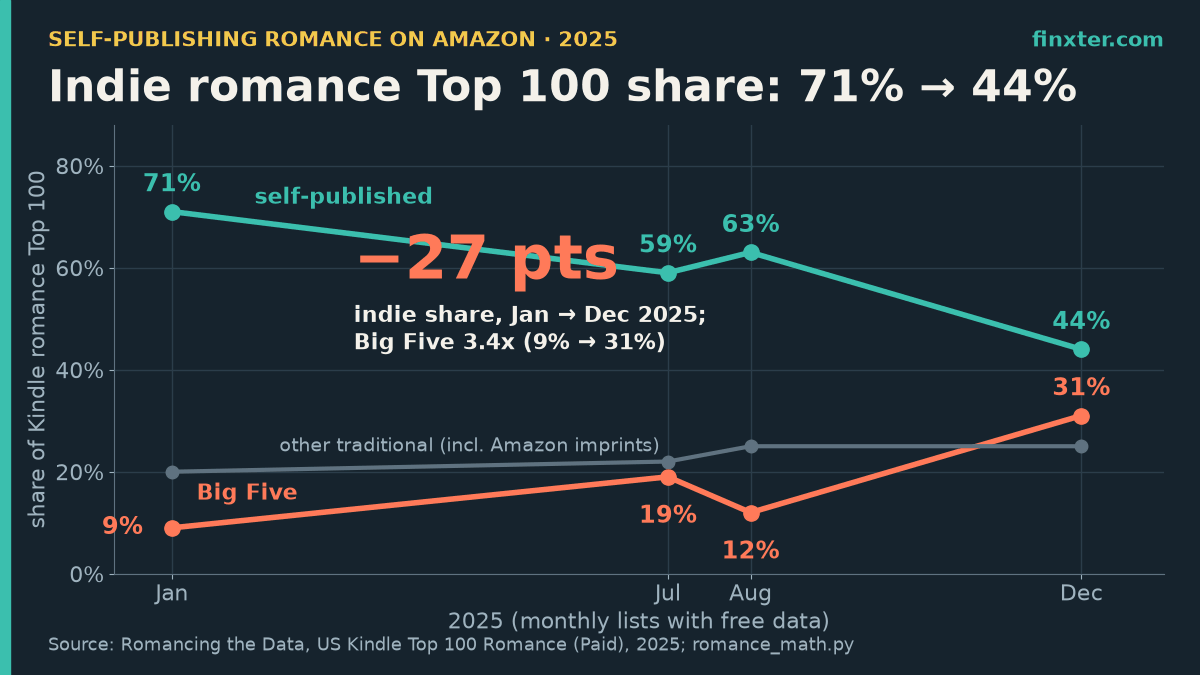
Self-publishing romance novels on Amazon got harder in 2025, not easier. Indie books held 71% of the Kindle Store’s Top 100 romance bestsellers in January and only 44% in December, while Big Five titles more than tripled, from 9% to 31% (Romancing the Data).
And yet romance is still the best bet an indie author has. Romance writers are 21% of the 1,346 authors in Written Word Media’s 2025 survey, but about 44% of the ones earning over $10,000 a month.
So how do you self-publish a romance novel on Amazon in 2026? You publish it as a Kindle eBook through Kindle Direct Publishing (KDP). Price it between $2.99 and $12.99 to get the 70% royalty, decide per subgenre whether it goes into Kindle+ (the new name for Kindle Unlimited), and, most important, write it as Book 1 of a series. About three in four Top 100 romance bestsellers are part of one (77% in July 2025, 76% in August).
If drafting a whole series is your bottleneck, my top pick is ImagineYourBook. It’s an AI book-writing tool that turns a prompt or your notes into a full draft with a designed cover, exported as Word or EPUB. Its Series Builder carries a story bible, characters and open threads into Book Two.
Below: what changed on the bestseller list, why romance still wins on income, the Kindle+ split by subgenre, and what one romance reader is worth.
TL;DR
- Self-publish romance on Amazon through KDP: Kindle eBook, priced $2.99–$12.99 for 70%, Kindle+ decided per subgenre, written as a series.
- In 2025 the indie share of the Kindle romance Top 100 fell from 71% to 44%; the Big Five went from 9% to 31%.
- Romance is still the top indie earner: 21% of authors, about 44% of those making $10k+ a month (Written Word Media 2025).
- Kindle+ share ranges from 71% (dark romance) to 38–39% (historical, romantasy) as of October 2026.
- Napkin math: one reader of a 5-book series is worth $6.15 in Kindle+ reads or $12.79 in sales.
What happened to indie romance in 2025
Romancing the Data compiles a monthly Top 100 from the US Kindle Store’s paid romance bestsellers. Its full-year review shows a steady shift:
- Self-published: 71% in January → 44% in December, down 38%.
- Big Five: 9% → 31%, “more than 3 times” where it started.
- Amazon’s own imprints: from a low of 6% in July to 20% in October and November.
- Kindle Unlimited share of the list: from a high of 91% in April to 74% in December.
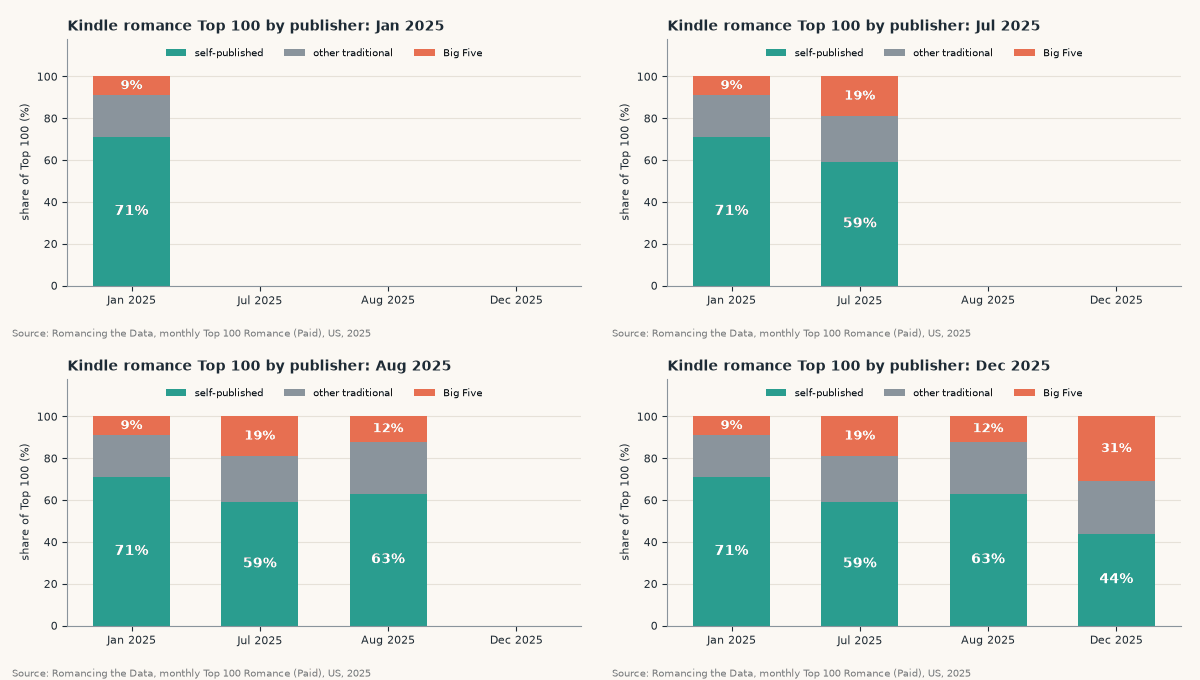
Two caveats before you panic. The author says the year-end spike may be partly seasonal: traditional publishers release less in November and December, and their bestsellers sell as holiday gifts. And trad hits like Sarah J. Maas and Rebecca Yarros swing the list on their own. In April and May, with no Maas book on it, “other traditional” dropped to 10% and 13%.
Still, the direction matters for a portfolio. Bestseller slots are free visibility. When trad and Amazon imprints take more of them, an indie series has fewer of them to land in, and paid traffic matters more.
Here’s what the indie-heavy months looked like when you open the list:
| Kindle romance Top 100 | July 2025 | August 2025 |
|---|---|---|
| Self-published | 59% | 63% |
| Part of a series | 77% | 76% |
| In Kindle Unlimited | 75% | 77% |
| Average length (print pages) | 444 | 442 |
| Average price | $6.85 | $5.87 |
| Priced under $5 | 41% | 52% |
The pattern is consistent: long books (about 440 print pages on average), series (76–77%), mostly under $10, mostly in Kindle Unlimited. That’s the shape of a bestselling indie romance.
Why romance still pays best
If the list is getting more crowded, why write romance at all? Because the income data hasn’t moved against it.
Written Word Media’s 2025 Indie Author Survey breaks down which genres show up as income rises. Romance is 21% of all respondents, but:
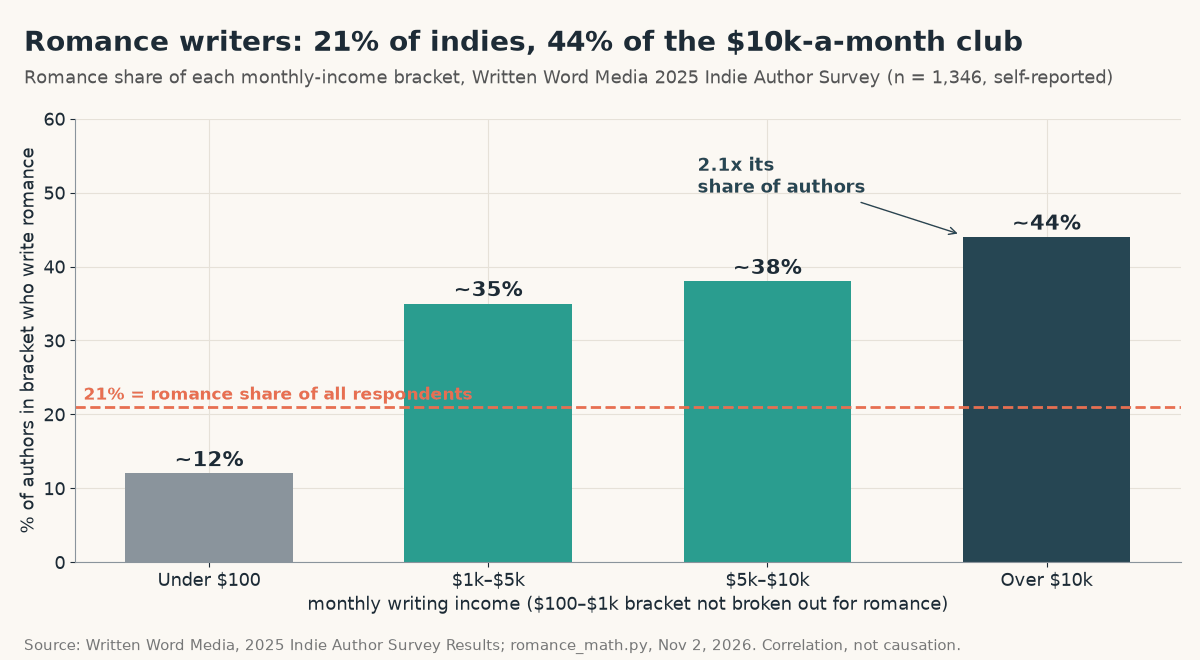
That’s 2.1 times its share of authors in the top bracket. The romance share climbs at every step, from about 12% of authors earning under $100 a month to about 44% of those earning over $10,000. Paranormal romance is even more extreme: 4% of authors overall, about 11% of the over-$10k group.
The survey is careful about the caveats: it’s self-reported, skews toward serious commercial indies, and correlation isn’t causation. Its own explanation is the one you’d expect: series read-through, high consumption and trope-driven reader communities.
The catalog data points the same way. Authors with 25+ books had a median income of about $3,000 a month, and more than 40% of them earned $5,000+. Most of those very high earners had their books in series, the survey notes. I walked through that funnel in how to write a romance book series, where Book 1 earns only about a third of the series’ money.
Kindle+ or wide? Your subgenre decides
Amazon renamed Kindle Unlimited to Kindle+ on October 22, 2026; the KDP terms work the same way. Whether to enroll depends heavily on your subgenre. Romintel scans the Amazon top 50 in each romance subgenre daily and published the July vs October 2026 shares on November 1:
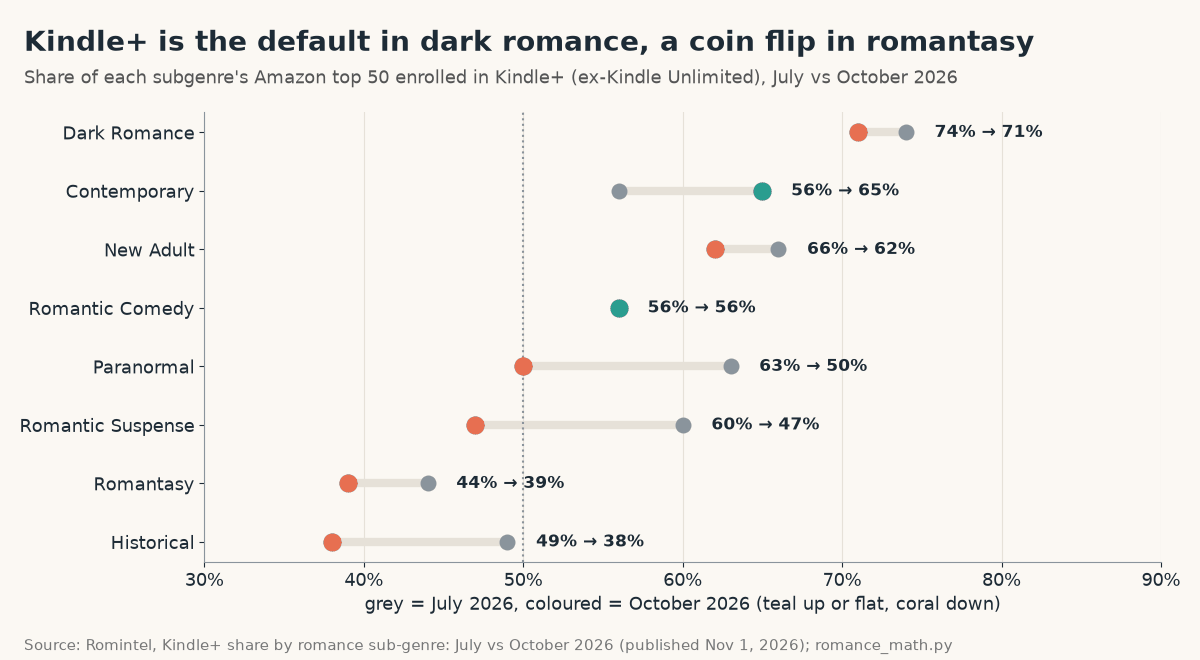
- Dark romance is still the most Kindle+-heavy subgenre at 71%. Going wide there means asking readers to pay for something their subscription already covers.
- Contemporary went the other way, up 9 points to 65%, so indie Kindle+ books took more of that chart.
- Paranormal and romantic suspense each lost 13 points (to 50% and 47%). Historical fell 11 to 38%. Autumn trad releases, almost never in Kindle+, explain part of it.
- Romantasy is only 39% Kindle+. That’s the subgenre where Maas and Yarros live.
Kindle+ books sat at a median list price of $5.99 in most subgenres and $4.99 in paranormal and historical.
Written Word Media’s survey shows both paths work at the top. Among authors earning over $5,000 a month, 43% had every book in KDP Select and 15% were fully wide; the rest mixed. For the full trade-off math, see KDP Select vs wide.
AI and KDP: if an AI tool wrote the actual text, KDP counts it as AI-generated, “even if you applied substantial edits afterwards”, and asks you to say so when you publish. Using AI only to brainstorm, edit or error-check your own writing is AI-assisted and doesn’t need disclosing.
Napkin math: what one romance reader is worth
Here’s what a reader who starts your series is worth. The assumptions (mine, not Amazon’s):
- A 5-book series of 80,000-word novels. At about 190 words per KENP page, that’s 421 KENP per book.
- Readers follow Kindlepreneur’s example read-through funnel: 100 → 65 → 50 → 48 → 45. That’s 3.08 books per Book-1 reader.
- A full Kindle+ read pays 421 × the 2026 average KENP rate of $0.00474 = $2.00 (see KENP rate 2026 for the monthly numbers).
- A sale at the $5.99 Kindle+ median pays 70% × ($5.99 − $0.06 average delivery cost) = $4.15.
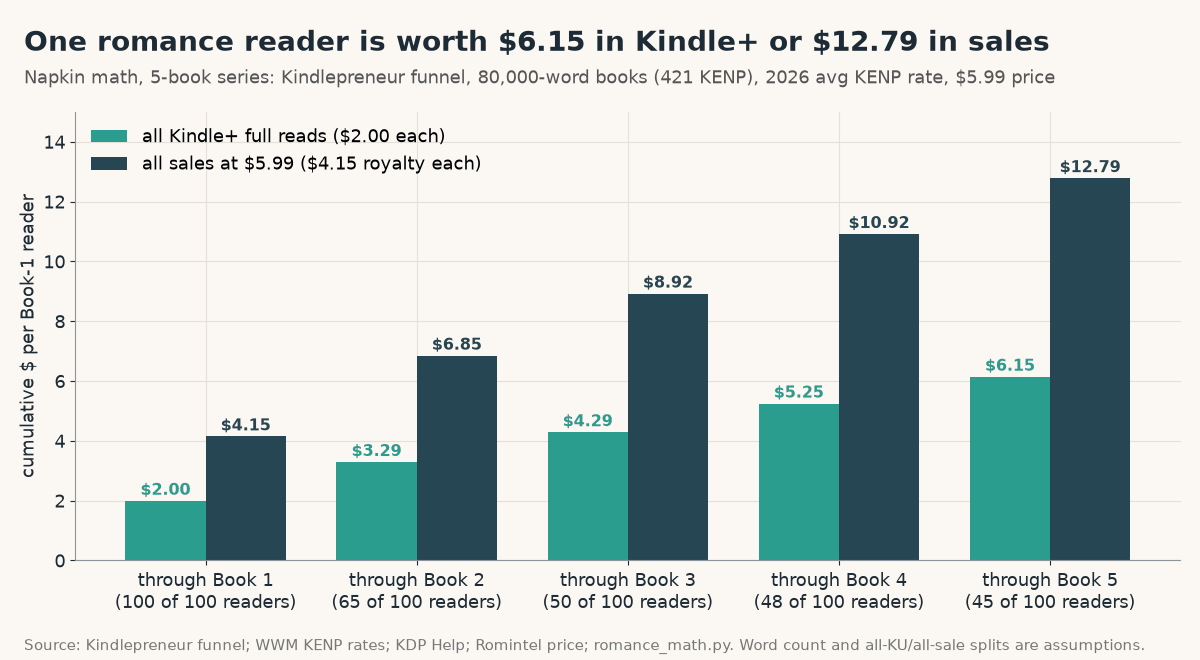
So one romance reader is worth about $6.15 if every book is borrowed and read through Kindle+, or $12.79 if every book is bought. Real catalogs sit in between.
Turn that into the 25-book median of $3,000 a month and you need roughly 488 new Kindle+ readers a month, or 235 buyers, across your catalog. That’s why a crowded Top 100 matters: those readers have to find Book 1 somewhere, and 2025 gave indies fewer free bestseller slots to do it.
It’s also why the series is the product, not the book. The same reader is worth $2.00 (Kindle+) or $4.15 (sale) with one book and three times that with five.
How to self-publish a romance novel on Amazon, step by step
| Step | What to do | Number to know |
|---|---|---|
| 1. Pick the subgenre | Check how much of its top 50 is in Kindle+ before you write | Dark 71% Kindle+, romantasy 39% (Oct 2026) |
| 2. Plan a series | Outline Books 1–5 and the hook that sells Book 2 | 76–77% of Top 100 romance is in a series |
| 3. Write long enough | Full-length novels; romance readers binge | Top 100 average about 440 print pages |
| 4. Upload to KDP | Kindle eBook (DOCX or EPUB) plus cover; answer the AI-content question honestly | AI-generated text must be disclosed; AI-assisted editing doesn’t |
| 5. Price for 70% | List price in the 70% band | $2.99–$12.99 since July 7, 2026; Kindle+ median $5.99 |
| 6. Decide Kindle+ | Enroll in KDP Select (90-day eBook exclusivity) or go wide | 43% of $5k+/month authors all-in, 15% fully wide |
| 7. Link the series | Set up the series page and Book 2 link in the back matter | Each Book-1 reader is worth $6.15–$12.79 over 5 books |
The takeaway
Indie romance lost ground on Amazon’s bestseller list in 2025, and the Big Five and Amazon’s own imprints took it. But romance is still where indie income concentrates: 21% of authors, about 44% of the top earners. The authors who win publish series of long books, priced under $10, enrolled in Kindle+ where their subgenre reads that way.
| Question | Number | What it means |
|---|---|---|
| Indie share of the romance Top 100? | 71% → 44% in 2025 | More trad competition for bestseller slots (partly seasonal) |
| Big Five share? | 9% → 31% | Holiday trad releases and gift buying lift them in Q4 |
| Romance among $10k+/month indies? | ~44% vs 21% of all | Still the strongest genre for indie income |
| Kindle+ share by subgenre? | 71% dark … 38% historical | Kindle+ is a subgenre decision, not a romance decision |
| Value of one Book-1 reader (5 books)? | $6.15 Kindle+ to $12.79 sales | Series length is your biggest lever |
| Readers for $3,000/month? | ~488 Kindle+ or ~235 buyers | Plan traffic, not just books |
The limiting factor for most romance publishers isn’t the market. It’s how fast they can put Books 2 through 5 behind Book 1. That’s what ImagineYourBook is built for: it drafts romance and romantasy series with a designed cover, and Book Two remembers Book One. The free trial is $0 today with a card and includes one complete 10,000-word book. The first $29.99 Author payment starts after 7 days unless you cancel before day 8. Publisher ($59.99 a month) covers about 120,000 words, or one 80,000-word epic, a month. At the napkin rates above, that’s about 30 full Kindle+ reads of one book. Sales are never guaranteed, so run your own numbers first. Then pick the series you’d binge yourself. If you’re comparing drafting tools for this genre, the best AI for writing romance novels compares the costs per series.
Sources (checked November 2, 2026): Romancing the Data: Romance Best Seller Trends 2025 (Feb 2026) · Romancing the Data: Top 100 analysis, July 2025 · Romancing the Data: Top 100 analysis, August 2025 · Written Word Media: 2025 Indie Author Survey Results · Romintel: Kindle+ share by romance sub-genre, July vs October 2026 · Written Word Media: KDP Global Fund payouts (KENP rates) · koobe.ai KENP calculator (190 words per KENP page) · Kindlepreneur: series read-through · KDP Help: eBook list price requirements · KDP Help: eBook royalties and delivery costs · KDP Help: content guidelines (AI content) · KDP Help: KDP Select enrollment · ImagineYourBook pricing and trial terms. Napkin assumptions: 80,000-word books (421 KENP), Kindlepreneur’s example funnel, the 2026 January–September average KENP rate, $5.99 list price and $0.06 delivery cost; real catalogs mix Kindle+ reads and sales.